Tuning And Voicing · Volume 7
Tuning & Voicing — Vol 07: Reference & Cheatsheet
The six volumes before this one carried the argument. This one carries the numbers. It is the dive’s reference apparatus, gathered into tables meant to be consulted at the bench rather than read through: the cents and beat arithmetic, the equal-temperament interval deviations, the temperament comparison, the way pitch is moved in each pipe family, the levers of flue and reed voicing, a free-reed quick-card, a faults-and-fixes chart, a glossary, a cross-index to the rest of the dive and to the sibling dives, and the bibliography.
Nothing here is new. Every value has been established and derived in an earlier
volume, and the cross-index column on each table points back to where it was
worked out. Every cents and beat figure has been recomputed for this volume and
agrees with Vol 2 and Vol 6; where a figure is a rule of thumb rather than a
derived constant it is flagged (est.). The deeper acoustics — why a jet speaks
at an edge, why cut-up and nicking and the frein do what they do, the standing
wave and the Töpfer halving number — remain deferred by name to “How Organ Pipes
Make Sound,” and wind pressure to “Wind Systems.”
7.1 How to use this reference
The tables are grouped by task. To place a pipe on pitch, use the cents and beats tables (Section 2) with the pitch-method-by-family table (Section 4). To decide how far off a chord will sound in equal temperament, use the equal-temperament interval table (Section 3). To fix tone or speech, use the voicing-effects table (Section 5); for a free-reed rank, the quick-card in Section 6. When something is wrong and the cause is not obvious, start at the faults-and-fixes table (Section 7). The glossary (Section 8) fixes the vocabulary and its spellings, and the cross-index (Section 9) says which volume carries the full treatment of any topic.
The one-page card below condenses the whole dive to a single figure for the wall above the bench.
Figure 7.1 — The whole dive on one card: the golden rule, how pitch is moved in each pipe family, the flue-voicing levers, the celeste, the constants, and the temperature rule. The sections below expand each block into full tables.
7.2 Cents and beats
7.2.1 The constants
The cent is defined, not measured; the following are exact by definition or recomputed from the definitions (Vol 2 §2.4; Wiki: Cent, Equal temperament).
Table 1 — 2.1 The constants
| Quantity | Value | Note |
|---|---|---|
| Octave | 1200 cents | ratio 2/1, by definition |
| Equal-tempered semitone | 100 cents | one twelfth of the octave, by definition |
| Semitone frequency ratio | 2^(1/12) ≈ 1.0594631 | twelve of these multiply to 2 |
| One cent, as a ratio | 2^(1/1200) ≈ 1.0005778 | a rise of about 0.0578 % |
| Cents between two frequencies | n = 1200 · log₂(f₂ / f₁) | the master formula |
| Beat rate between two tones | ** | f₁ − f₂ |
Two checks close the definitions on themselves: an octave gives
1200 · log₂(2) = 1200 c, and a semitone ratio 1.059463 gives
1200 · log₂(1.059463) = 100.0 c (Vol 2 §2.4).
7.2.2 Cents ↔ beats at A = 440 Hz
The tuner reads cents; the ear hears beats in hertz. Near the reference A4, a
pipe that is c cents sharp sounds Δf = 440 · (2^(c/1200) − 1) hertz above a
true 440 and, sounded against it, beats at that rate. The table recomputes both
Δf and the beat period 1/Δf; it agrees with the identical tables in Vol 2 §2.5
and Vol 6 §5.3.
Table 2 — 2.2 Cents ↔ beats at A = 440 Hz
| Error (cents) | Ratio 2^(c/1200) | Δf at A = 440 (Hz) | Beat rate | Beat period |
|---|---|---|---|---|
| 1 | 1.000578 | 0.254 | ≈ 0.25 Hz | ≈ 3.9 s |
| 2 | 1.001156 | 0.509 | ≈ 0.5 Hz | ≈ 2.0 s |
| 5 | 1.002892 | 1.273 | ≈ 1.3 Hz | ≈ 0.8 s |
| 10 | 1.005793 | 2.549 | ≈ 2.5 Hz | ≈ 0.4 s |
The working yardstick, near A440, is one cent ≈ 0.254 Hz ≈ one beat every
~3.9 seconds (est. helper; recomputed from the cent ratio). It is used two
ways at the bench. It sets the celeste detune — a “few cents,” roughly 2, gives
about one waver every two seconds (Vol 6 §5.3) — and it sanity-checks a tuner
reading: if the meter says a pipe is 5 cents off but no beat is heard against its
neighbour, one of the two readings is wrong. The relation scales with pitch: the
same cents error higher in the compass beats faster in hertz, so above the melody
register the numbers grow and the celeste offset is trimmed by ear to keep the
heard waver even (Vol 6 §5.3).
Figure 7.2 — The cents-to-beats ruler at A = 440 Hz. A one-cent error beats about once every four seconds; the celeste’s usual two-cent detune wavers about once every two seconds; five cents (near the ear’s resolution) throbs a little faster than once a second. The mapping stretches at higher pitch.
7.3 The equal-temperament interval table
Equal temperament divides the octave into twelve identical 100-cent steps, so
every interval is a whole number of hundred cents. Just intonation tunes the same
intervals as small whole-number ratios. The difference between them — recomputed
here from n = 1200 · log₂(ratio) and agreeing with Vol 2 §2.6 — is the audible
cost of a temperament that treats every key alike. Positive means equal
temperament is wider (sharper) than just; negative means narrower
(flatter).
Table 3 — 3. The equal-temperament interval table
| Interval | Just ratio | Just (cents) | Equal (cents) | ET − just (cents) |
|---|---|---|---|---|
| Unison | 1/1 | 0 | 0 | 0 |
| Minor second | 16/15 | 111.73 | 100 | −11.73 |
| Major second | 9/8 | 203.91 | 200 | −3.91 |
| Minor third | 6/5 | 315.64 | 300 | −15.64 |
| Major third | 5/4 | 386.31 | 400 | +13.69 |
| Perfect fourth | 4/3 | 498.04 | 500 | +1.96 |
| Tritone | 45/32 | 590.22 | 600 | +9.78 |
| Perfect fifth | 3/2 | 701.955 | 700 | −1.96 |
| Minor sixth | 8/5 | 813.69 | 800 | −13.69 |
| Major sixth | 5/3 | 884.36 | 900 | +15.64 |
| Minor seventh | 16/9 | 996.09 | 1000 | +3.91 |
| Major seventh | 15/8 | 1088.27 | 1100 | +11.73 |
| Octave | 2/1 | 1200 | 1200 | 0 |
The two rows to hold in mind are the major third, which equal temperament stretches +13.69 cents wide of just (a bright, faintly restless third that beats audibly), and the perfect fifth, which it makes only −1.96 cents narrow (near enough to pure that it beats slowly and sounds solid). Only the octave stays pure. The arithmetic is symmetric: an interval’s inversion carries the equal-and-opposite error, so the wide major third pairs with an equally narrow minor sixth, and the narrow fifth with an equally wide fourth. The full statement of the equal-temperament tradeoff — every key equally usable and free modulation, in exchange for every third about 14 cents wide and every fifth about 2 cents narrow, which is exactly the compromise a fixed mechanical organ must accept because it cannot retune per key — is derived in Vol 2 §2.6–2.7.
7.4 Temperament comparison
For a fixed crank organ the choice is settled: equal temperament. The other three are listed for context, because they are the history equal temperament replaced and the vocabulary a reader will meet elsewhere; none is a live option for an instrument that cannot retune between keys (Vol 2 §2.6).
Table 4 — 4. Temperament comparison
| Temperament | One-line character | Fixed-organ verdict |
|---|---|---|
| Just intonation | Every interval a pure small-integer ratio; flawless in its home key, badly out in others | Reference only — serves exactly one key on a fixed instrument |
| Meantone | Fifths narrowed to purify the thirds; very sweet near C, a howling “wolf” in remote keys | Reference/context only — remote keys unusable |
| Well temperament | Unequal but all keys usable (Werckmeister 1707, Kirnberger); each key a distinct “colour” | Reference/context only — the same roll would sound different by key |
| Equal temperament (12-TET) | Twelve identical 100-cent steps; every key alike; every third ~14 c wide, every fifth ~2 c narrow | The choice — the only scheme under which every transposed roll sounds alike |
7.5 Setting pitch by pipe family
How the pitch is actually moved, family by family (Vol 3). “Note-count is not pipe-count”: bass and many melody notes are doubled pipes, and each physical pipe is set individually before doubled pairs are zero-beat and celeste pairs detuned (Vol 1 §6; Vol 6 §5).
Table 5 — 5. Setting pitch by pipe family
| Pipe family | Pitch control | Direction to sharpen | Notes / source |
|---|---|---|---|
| Stopped (gedeckt) | Movable stopper | Push the stopper in / down (shortens the air column) | Out/up flattens; trim stoppers to equal length after tuning (Vol 3 §2; O’Rourke; en_pijp) |
| Open flue | Speaking length — tuning slide, tuning cone, or cut | Shorten the speaking length (slide down / cut) | Leave the pipe over-length and tune down; cone on metal pipes only (est. for busker pipes — usually wooden, slide/stopper) (Vol 3 §3) |
| Open flue, piccolo (no stopper) | Metal tab bent over the top | Adjust the tab | Early piccolos have no stopper — bend the tab (Vol 3 §3.2; O’Rourke) |
| String / violin | Tuning slide (coarse) + frein (Gavioli beard) | Slide down for coarse pitch; set the frein for the octave and fine control | The frein pulls an over-blowing pipe down an octave; the plate–mouth gap fine-tunes (Vol 3 §4; en_vioolpijp; O’Rourke) |
| Beating reed | Tuning wire / spring on the tongue | Move the wire toward the tip (shortens the vibrating length) | Shorter free length = higher pitch (Vol 3 §5; O’Rourke) |
| Free reed (melodica / accordion) | Scratch the tongue — no wire | Scratch the tip (removes tip mass) to raise | Scratch the middle/base to lower; see the quick-card, Section 6 (Vol 3 §6; jsart51) |
Temperature note (applies to the whole rank, not one pipe). Flue pipes go
sharp when warm and flat when cold — the speed of sound rises with the square
root of absolute temperature while the pipe length is fixed, so f = c/λ rises
(Vol 3 §8). As a working figure, ~3 cents per °C (est. rule of thumb;
~30 c per 10 °C — recomputed as +29 c for 20→30 °C). Reeds barely move with
temperature (their pitch is the metal tongue’s mechanical vibration, not an air
column; the exact reed coefficient is small (est.)). The consequence for a
mixed organ: in a warm room the flues run sharp while the reeds stay put, so the
reeds sound flat relative to the flues (and the reverse when cold). Tune the two
families together at the temperature the organ will be played (Vol 3 §8; Vol 5
§4).
7.6 Voicing effects (flue)
The bench levers of tone and prompt speech, and which way each one pushes. Voicing is done first, on the manometer at the organ’s own pressure, and drags pitch with it — hence “voice first, tune last” (Vol 4; Vol 1 §1.3). The why behind each effect belongs to “How Organ Pipes Make Sound”; here it is only the adjustment and its direction.
Table 6 — 6. Voicing effects (flue)
| Lever | Adjustment | Effect on tone / speech | Constraint · source |
|---|---|---|---|
| Cut-up (mouth height ÷ width) | Raise it | Louder, rounder, flutier, fewer upper partials, later/slower speech | Keep ≤ 1/3 of the mouth width (jsart42) |
| Cut-up | Lower it | Brighter/stringier, more chiff, prompter attack | Vol 4 §2; OHS works03; Pykett |
| Nicking (notches across the flue edge) | More nicking | Less chiff — smoother, immediate speech | C.B. Fisk; Audsley (Vol 4 §3) |
| Nicking | Light or none | Lively/pronounced chiff, vigorous attack | Busker pipes usually voiced with light/no nicking (est.) (Vol 4 §3) |
| Upper lip | Round the edge | Smoother, gentler tone | jsart42; Audsley (Vol 4 §4) |
| Upper lip | Sharpen the edge | Keener/stringier, more edge | Vol 4 §4 |
| Foot hole (toe) | Narrow it | Quieter — less wind admitted | Vol 4 §5; Pykett |
| Flueway / flue slit | Narrow it | Thinner jet — quieter, can slow speech | Vol 4 §5; cross-ref Wind Systems for pressure |
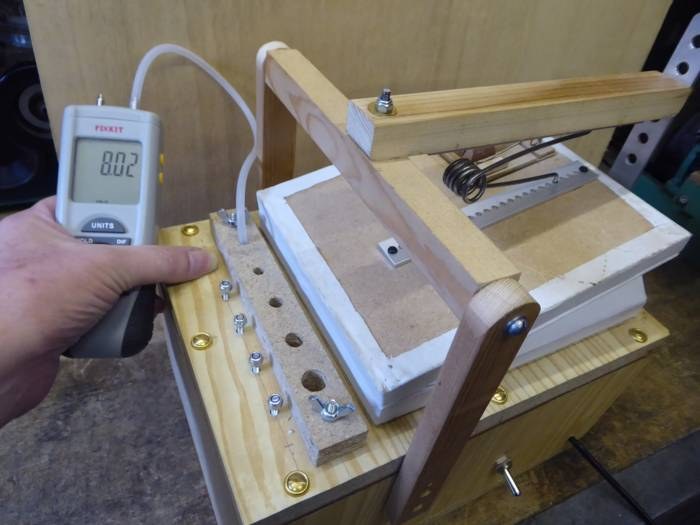
Balance is the second half of voicing: no pipe within a rank may dominate its neighbours, and no rank may swamp another when several are drawn — both trimmed with the foot holes and judged by ear across the compass (Vol 4 §6; Vol 6 §6.1; jsart19).
7.7 Free-reed tuning quick-card
The hobbyist’s practical reed route is the free-reed “melodica trumpet,” not the traditional beating reed. The numbers below are quoted exactly from Gisli Olsen’s recipe (jsart51) and match Vol 5 §3; keep them identical wherever they appear in the program.
Table 7 — 7. Free-reed tuning quick-card
| Step | Value / action | Source |
|---|---|---|
| Which reed | Use the air-out reed of each pair; tape off the air-in reed (spare) | jsart51 (Vol 5 §3.1) |
| Where they start | Factory A = 420 Hz → about 20 cents sharp at A = 440 Hz | jsart51 (Vol 5 §3.2) |
| Lower the pitch | Scratch the middle of the tongue, flat on a hard surface, over 3–4 mm, “little by little, very light” | jsart51 (Vol 5 §3.3) |
| Target | Bring it to about 4–5 cents above zero on the tuner | jsart51 (Vol 5 §3.3) |
| Raise the pitch | Scratch the tip (removes tip mass) | jsart51 (Vol 5 §3.4) |
| Resonator length | Low C ≈ 10 cm, high C ≈ 6 cm, others between (“length not critical”) | jsart51 (Vol 5 §3.5) |
| Tune the resonator | Slide a stopper to the resonance dip (pitch drops, then the tuner turns up again — the lowest point is resonance) | jsart51 (Vol 5 §3.5) |
| Mount the plate | Glue with beeswax, soldering iron moved fast — the plate must not be heated | jsart51 (Vol 5 §3.6) |
The reed-versus-flue temperature caution (Section 5, “Temperature note”) applies directly to this rank: tune it to the flues at playing temperature, and expect the two families to part if the temperature changes (Vol 5 §4).
7.8 Faults and fixes
A diagnostic table for the common complaints, each pointing to the volume with the full method. The order of the columns is the order of the bench thought: symptom, likely cause, the lever to reach for.
Table 8 — 8. Faults and fixes
| Symptom | Likely cause | Fix | Detail in |
|---|---|---|---|
| Organ was in tune, now sounds off after a move | Temperature change — flues sharp when warm, flat when cold (~3 c/°C, est.) | Let it settle to playing temperature and retune at that temperature; do not tune cold | Vol 3 §8; Vol 6 §8.1 |
| Reeds sound flat against the flues (warm room) | Flues went sharp; reeds barely move | Touch up the reeds to the flues at the playing temperature; the split returns if temperature changes | Vol 3 §8; Vol 5 §4 |
| A pipe overblows (jumps to the octave) | Too much wind / cut-up wrong / no frein on a string pipe | Reduce wind at the foot hole; adjust cut-up; on a string pipe fit/set the frein to pull it down an octave | Vol 4 §5; Vol 3 §4 |
| Slow or late speech | Cut-up too high / too much nicking / foot hole too small | Lower the cut-up, reduce nicking, or open the foot hole a little | Vol 4 §2–3, §5 |
| Explosive spit / harsh attack | Too little nicking / cut-up too low | Add light nicking or raise the cut-up slightly | Vol 4 §2–3 |
| A rank sounds uneven — one pipe punches through | Loudness not balanced within the rank | Balance with foot holes/flueway, judged up and down the scale | Vol 4 §6; Vol 6 §4.2 |
| One rank swamps another when drawn together | Ranks not balanced against each other | Trim the louder rank’s foot holes; balance by ear with ranks combined | Vol 4 §6; Vol 6 §6.1 |
| Doubled pair beats under a sustained note | Not zeroed to unison | Sound the pair together and adjust the mate to zero beat | Vol 2 §2.3; Vol 6 §5.2 |
| Celeste will not waver evenly across the rank | Fixed cents offset beats faster higher up | Set the offset, then even the heard waver speed pipe to pipe by ear | Vol 2 §2.5; Vol 6 §5.3 |
| A single pipe has drifted alone | A stopper has crept, or a frein/wire shifted | Reset that one pipe only; no full pass needed | Vol 3; Vol 6 §8.1 |
| Whole organ slightly off but internally consistent | Overall temperature/season drift | Touch-up to the organ’s existing reference; re-zero-beat the doubles | Vol 6 §8.2 |
The governing distinction (Vol 6 §8.2): if pipes are on the wrong pitch the organ needs tuning; if pipes sound wrong, it needs voicing — and voicing re-enters at Stage 1, voice-first, tune-last, exactly as the first time.
Glossary
Definitions and values as verified across the dive; spellings are the canonical ones for the program (see the spelling watch at the end).
Table 9 — 9. Glossary
| Term | Definition / value |
|---|---|
| Cent | One hundredth of an equal-tempered semitone; one 1200th of an octave; frequency ratio 2^(1/1200) ≈ 1.0005778 (Vol 2 §2.4; Wiki: Cent). |
| Octave | Frequency ratio 2 : 1 = 1200 cents (Wiki: Cent). |
| Equal-tempered semitone | 100 cents, ratio 2^(1/12) ≈ 1.059463; twelve make an octave (Wiki: Equal temperament). |
| Cents formula | n = 1200 · log₂(f₂ / f₁) — the cents between two frequencies (Wiki: Cent). |
| Harmonic series | The partials of a pitched pipe at integer multiples of the fundamental (f, 2f, 3f…); the basis of just intervals and of beats between near-coincident partials (Vol 2 §2.2; the acoustics of why belong to “How Organ Pipes Make Sound”). |
| Beat | The periodic loudness pulsation of two close tones; **rate = |
| Just intonation | Intervals as small whole-number ratios (major third 5/4 = 386.31 c; perfect fifth 3/2 = 701.955 c); pure but key-bound (Vol 2 §2.6). |
| Meantone | Historical temperament narrowing the fifths to purify the thirds; sweet in a few keys, “wolf” elsewhere — reference only (Vol 2 §2.6). |
| Well temperament | Unequal but all-keys-usable (Werckmeister 1707; Kirnberger); each key a distinct colour — reference only (Vol 2 §2.6). |
| Equal temperament (12-TET) | The octave in twelve identical 100-cent steps; every key alike, every major third ~+14 c wide, every fifth ~−2 c narrow; the fixed organ’s tuning (Vol 2 §2.6–2.7). |
| A440 / ISO 16 | A4 = 440 Hz reference standard; crank organs commonly built at A = 442/443/445 but internally consistent (Vol 2 §2.8; Wiki: A440; O’Rourke). |
| Voicing | Adjusting a pipe for tone, loudness and prompt, blended speech (cut-up, flue, nicking, lip, foot hole) — done first (Vol 1 §1.1; Vol 4). |
| Tuning | Adjusting a pipe’s pitch to the scale (stopper / slide / cone / wire / scratch) — done last (Vol 1 §1.2; Vol 3). |
| Chiff | The transient “spit” as speech begins; more nicking suppresses it (Vol 4 §3; C.B. Fisk). |
| Cut-up | Mouth height ÷ mouth width; kept ≤ 1/3 here; higher = flutier/louder/later, lower = brighter/chiffier (Vol 4 §2; jsart42; OHS). |
| Nicking | Notches across the languid/lower-lip flue edge that steady the jet and reduce chiff (Vol 4 §3; C.B. Fisk; Audsley). |
| Frein (Gavioli beard) | A 0.5–1 mm brass plate across a string-pipe mouth; pulls an over-blowing pipe down an octave and fine-tunes it (Vol 3 §4; en_vioolpijp). |
| Languid | The internal block/plate below the mouth that forms the windway and directs the jet at the upper lip (OHS works18; the acoustics dive). |
| Manometer | A U-tube water gauge on the voicing rig; pipes are voiced at a known gauge (~5 in H₂O), never by mouth (Vol 1 §3.2; jsart26). |
| Celeste / undulant | Two ranks deliberately detuned a few cents so they beat gently — beats used as the effect (Vol 6 §5.3; O’Rourke). |
| Gedeckt (gedackt) | A stopped flue pipe; sounds an octave lower than an open pipe of the same length and carries mainly odd partials (Vol 3 §2; the acoustics dive). |
Spelling watch: cent (not “sent”), temperament (not “temperment”), Werckmeister, Kirnberger, gedeckt/gedackt, frein, languid, chiff, celeste.
7.9 Cross-index
7.9.1 Within this dive (Vols 1–6)
Table 10 — 10.1 Within this dive (Vols 1–6)
| Topic | Volume |
|---|---|
| Voicing vs tuning; the golden rule; the toolkit; note-count ≠ pipe-count; reference pitch | Vol 1 |
| The cent, the harmonic series, beats, cents↔beats helper; just/meantone/well/equal; why ET for a fixed organ; A440 vs 442/443/445 | Vol 2 |
| Setting pitch per family (stopper, slide/cone/cut, frein, tuning wire, scratch); temperature dependence | Vol 3 |
| Voicing flue pipes — cut-up, nicking, upper lip, flueway/foot hole, balancing, the manometer rig | Vol 4 |
| Voicing and tuning reeds — beating reed and the free-reed “melodica trumpet”; reed-vs-flue drift | Vol 5 |
| The whole-organ session — order of operations, zero-beat doubles, detune the celeste, balance, keeping it in tune | Vol 6 |
| Reference tables, glossary, cross-index, bibliography | Vol 7 (this volume) |
7.9.2 To the sibling dives (Mechanical Organs program)
Table 11 — 10.2 To the sibling dives (Mechanical Organs program)
| Topic | Sibling dive |
|---|---|
| Edge tone, standing waves, open f≈c/2L vs stopped f≈c/4L, odd-vs-full harmonics, Töpfer h=17, end correction, reed excitation — the why behind cut-up, nicking and the frein | How Organ Pipes Make Sound |
| Wind pressure and bellows; the ~5 in H₂O (127 mm ≈ 1.245 kPa) voicing gauge in context | Wind Systems |
| Making the pipe (geometry: cut-up ≤ 1/3, frein 9°/0.5–1 mm, free-reed build numbers) — hands the finished rank to this dive to tune and voice; defers the cent, ET and the temperament comparison to here | Building Organ Pipes |
| The worked instrument — Raffin 20-note + Alderman 26-note, ~69 pipes, ~5 in H₂O | The John Smith Universal Organ |
| The 20-note Höffle build path + Jäger & Brommer benchmark; overlapping craft sources | The Hobby Crank Organ |
| Reading and arranging what the organ plays (rolls/books/MIDI) | Encoding the Music |
7.10 Bibliography
Temperament, cents and beats (theory this dive owns).
- Wikipedia, “Cent (music)” — cent definitions (1200/octave, 100/semitone), ratio 2^(1/1200), formula n = 1200·log₂(f₂/f₁).
- Wikipedia, “Equal temperament” — twelve equal 100-cent steps, ratio 2^(1/12) ≈ 1.059463, A4 = 440 Hz, the ET third (+13.69 c) and fifth (−1.96 c) deviations, Werckmeister’s 1707 advocacy of ET.
- Wikipedia, “Beat (acoustics)” — beat rate = |f₁ − f₂|; zero-beat tuning.
- Wikipedia, “A440 (pitch standard)” — A4 = 440 Hz, ISO 16.
- Wikipedia, “Musical temperament” / “Werckmeister temperament” / “Kirnberger temperament” — the just → meantone → well → equal history (reference/context).
Bench craft (tuning and voicing the crank organ).
- Hal O’Rourke, Raffin owner tuning guide,
melright.com/busker/tuning.htm— the primary bench-tuning source: wide-range chromatic tuner, per-family pitch methods, “pick one pitch and keep it consistent,” most new Raffins ≈ A = 445 Hz, the celeste set by beats. - Bruce Thompson,
melright.com/busker/jsart42.htm— cut-up ≤ 1/3 the mouth width; knife-cut equal to the cut-up; slight upper-lip rounding for a smoother tone. - Tony Goldsworthy,
melright.com/busker/jsart26.htm— the inflator-pump + U-tube water-manometer voicing rig; voice at a known gauge, never by mouth (moisture swells thin walls). - Gisli Olsen,
melright.com/busker/jsart51.htm— free-reed scratch-tuning: A = 420 → ~20 c sharp at A = 440; scratch the middle 3–4 mm to ~4–5 c; resonator low C ≈ 10 cm / high C ≈ 6 cm; beeswax mount, plate not heated. - John Pettifer,
melright.com/busker/jsart19.htm— a 26-note multi-rank build; balancing several ranks so none dominates; bass chest ≈ 6½″ water. - John Smith,
melright.com/busker/jsart09.htm— the piccolo (open, octave-above); final upper-lip adjustment made on the organ wind supply. - Walter Höffle,
hobbycrankorgan.com/subdir/en_vioolpijp.htm— frein (Gavioli “beard”) tuning of the string pipe; build over-length with a tuning slide; voice without the frein first, then fit it to pull the pipe down an octave. - Walter Höffle,
hobbycrankorgan.com/subdir/en_pijp.htm— stopped-pipe cap and stopper detail; trim stoppers to near-equal length after tuning.
Voicing terminology and traditional practice.
- Organ Historical Society, “Pipes and Timbres” (
works03.htm) and “Flue Pipe Construction” (works18.htm) — cut-up ↔ timbre, scale ↔ timbre, and pipe-anatomy definitions (languid, flue/windway, lips, cap/stopper). - C.B. Fisk, “Pipe Flueways” and “Articulateness and the Organ” — nicking and chiff, authoritatively: more nicking diminishes the chiff until it is inaudible.
- Colin Pykett, “The Physics of Voicing Organ Flue Pipes” — a physics-literate tie between flueway, cut-up, foot hole and nicking and their effect on loudness and speech.
- G. A. Audsley, The Art of Organ Building (1905, public domain) — classic treatise on voicing, nicking, cut-up ratios and languid setting.
Dutch originals of the hobbycrankorgan.com pages are at hobbydraaiorgel.nl on
the same subdir paths if an English page is unavailable.
End of Vol 07 and of the Tuning & Voicing dive. This volume gathered the numbers; Vols 1–6 carry the craft. For the physics beneath the levers, see “How Organ Pipes Make Sound”; for wind, “Wind Systems”; for making the pipes handed here to tune and voice, “Building Organ Pipes.”
Comments (0)