Tuning And Voicing · Volume 3
Tuning & Voicing — Vol 03: Setting Pitch, Pipe by Pipe
Vol 01 drew the line between the two crafts — voicing shapes tone, loudness and prompt speech; tuning sets pitch — and fixed the working order: voice first, tune last, in a stable temperature, on the manometer bench rig rather than by mouth. Vol 02 supplied the measuring stick for tuning: the cent (1200 to the octave, 100 to the equal-tempered semitone), the beat (rate = |f₁ − f₂| Hz, zero beat = in tune), and the working decision that a fixed mechanical organ is tuned in equal temperament at one internally consistent reference pitch — A = 440 Hz as the ISO 16 standard, but crank organs commonly built sharp of it at A = 442, 443, even 445 Hz (O’Rourke/tuning.htm).
This volume is the hands-on middle of the dive: once a rank is voiced and speaking well, how does the pitch of each pipe actually get moved? The answer is different for every pipe family, because each family holds its pitch by a different physical mechanism. A stopped flute is tuned by sliding its stopper; an open flue by its speaking length; a string pipe by a slide and its frein; a beating reed by a tuning wire; a free reed by removing metal from the tongue. Get the direction wrong on any of these and the pipe goes the opposite way from where it is wanted, so this volume states each direction explicitly and repeats the ones that are easy to invert.
The volume closes on the one environmental fact that undoes a good tuning if it is ignored: temperature. Flue pipes sharpen when the room warms and flatten when it cools; reeds barely move. A rank tuned in a cold workshop and played in a warm hall will be sharp, and — worse for an organ that mixes flue and free-reed ranks — the two families will have drifted apart. The direction of that drift is derived here so it is not guessed at.
Scope and sourcing. This volume covers how pitch is moved and how temperature shifts it — the mechanics, not the acoustics. Why a stopped pipe sounds an octave low, why a narrow string pipe over-blows, why a reed tongue sets the pitch of a reed pipe — all belong to the program’s “How Organ Pipes Make Sound” dive and are cross-referenced, not re-derived. Cents are defined in Vol 02; flue voicing (cut-up, nicking, lips) is Vol 04; the full free-reed voicing recipe with its exact numbers is Vol 05. Craft facts drawn from a source are cited inline —
(O'Rourke/tuning.htm),(en_pijp),(en_vioolpijp),(jsart09); a value the sources do not pin down is marked (est.) and never invented. Pitch errors are in cents (100 cents = one equal-tempered semitone); lengths in millimetres; temperature in °C with the physics done in kelvin.
3.1 One principle, five mechanisms
Every pitch-setting method in this volume is a way of changing one of two things: the length of the vibrating air column (the flue and stopped families) or the vibrating length or mass of a metal tongue (the reed families). A pipe’s pitch is not a free parameter to be dialled in from anywhere — it is fixed by geometry, and tuning is the act of nudging that geometry by a controlled, usually small, amount after voicing has already set the tone.
Two consequences follow and run through the whole volume:
- Voice first, tune last. Voicing adjustments — cut-up, flue width, the upper lip, nicking (Vol 04), or a reed’s curvature (Vol 05) — all shift pitch as a side effect. Tuning done before voicing is thrown out by the voicing that follows. Pitch is therefore the last thing set on any pipe, once its tone is settled.
- Small moves. A tuning correction is a few cents to a few tens of cents, not a semitone. A pipe that needs a semitone of correction is the wrong length and should be re-made, not forced with the tuning control. The stopper, slide, cone, wire and scratch are trim controls, not gross ones.
The five families and their controls are collected in the chart below and then worked one at a time.
Figure 1 — The pitch-setting control for each of the five pipe families, with the direction each control moves pitch. Green arrows raise pitch; red arrows lower it. Stopped: push the stopper in to sharpen. Open flue: lengthen or shorten the speaking length (cutting only ever shortens, so leave over-length and tune down). String: the slide sets coarse pitch, the frein the octave and fine trim. Beating reed: shorten the free tongue with the wire to sharpen. Free reed: no wire — remove metal from the tongue tip to sharpen, from the middle to flatten.
3.2 Stopped (gedeckt) pipes — slide the stopper
A stopped pipe is a wooden box closed at the top by a movable stopper — a snug, usually leathered or felted, plug that slides up and down inside the top of the tube. Because the top is closed, the vibrating air column is the distance from the mouth up to the underside of the stopper, and that distance is the tuning control. The stopped pipe is the workhorse rank of a small busker organ precisely because its tuning control is so direct and so forgiving: no metalwork, no cutting, just a plug that slides.
3.2.1 The direction — push in to sharpen
The rule is short and must be memorised in the right direction:
- Push the stopper IN / DOWN → the air column shortens → pitch RISES (sharp).
- Pull the stopper OUT / UP → the air column lengthens → pitch FALLS (flat).
The physics is deferred to “How Organ Pipes Make Sound,” but the intuition is sound: a shorter closed column resonates at a higher frequency, so shortening it by driving the stopper down raises the pitch. O’Rourke’s tuning guide records exactly this behaviour in describing how a celeste (undulating) rank is set: the secondary pipe’s stopper is tapped down to bring it sharp of its primary until the beat “gets faster… until out of tune” (O’Rourke/tuning.htm). Tapping the stopper down sharpens — that is the anchor for the whole direction.
In practice the stopper is moved with the fingers or a soft mallet to push it in, and long-nose pliers to pull it out, gripping the stopper’s handle or shaft sideways so it is not twisted in the bore (O’Rourke/tuning.htm). Small taps, re-blow, re-read the tuner; a stopped pipe responds a good many cents to a millimetre or two of travel, so the moves are genuinely small.
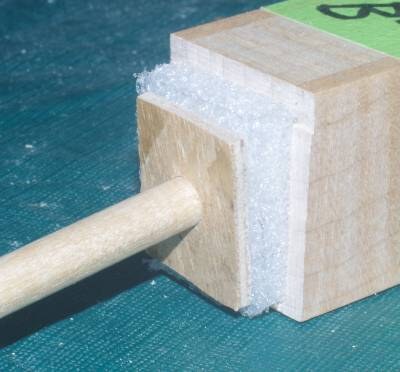
3.2.2 Trim the stoppers to equal length — after tuning
Once the whole rank is tuned, the stoppers will be sitting at a variety of depths — some driven well in, some barely home. The finishing step is cosmetic and practical at once: trim the protruding stopper shafts so that, across the rank, the stoppers finish at roughly equal length (en_pijp). This is done after tuning, never before, and it does not change the tuning — only the exposed length of shaft above the pipe is cut. A rank of stopped pipes whose stoppers all stand a uniform height above the tops looks finished and is easier to re-seat if a stopper is ever pulled for service.
3.2.3 The flush cap is voicing, not tuning
One detail from the same source is easy to misfile as a tuning move: the thinner cap of a stopped pipe is set flush with the core, or up to +0.5 mm above it, “to correct the wind flow” (en_pijp). This is a voicing adjustment — it shapes how the wind sheet leaves the flue and strikes the upper lip, which is Vol 04’s subject — and it is set during voicing, before pitch is touched. It is mentioned here only so it is not mistaken for a pitch control: the pitch of a stopped pipe is set by the stopper, not by the cap.
3.3 Open flue pipes — set the speaking length
An open flue pipe is open at the top, so its vibrating air column is the full speaking length from the mouth to the open end. Setting the pitch means setting that length, and there are three ways to do it, in descending order of reversibility.
3.3.1 The three length controls
- Tuning slide. A sleeve or collar at the top of the pipe that can be slid up to lengthen the speaking length (flatten) or pushed down to shorten it (sharpen). This is the reversible, preferred control on wooden busker pipes, and it works exactly like the stopper in direction: shorter = sharper, longer = flatter.
- Tuning cone / tuning knife. On metal flue pipes the open end is reshaped with a cone or knife: flaring the end outward effectively shortens the speaking end and sharpens, curling it inward lengthens it and flattens. This is the classic metal-pipe method, but busker organs are overwhelmingly wooden, and wooden pipes are tuned by a slide or stopper rather than a cone — so the cone-on-metal method is marked (est.) for this class of instrument and noted for completeness rather than as the expected bench practice.
- Cutting to length. The pipe body is physically cut shorter, which raises the pitch. This is irreversible — a pipe cut too short is scrap — so the standing rule is: build over-length and tune DOWN. A pipe left a little long can always be brought to pitch by a slide or by trimming; a pipe cut short cannot be made longer. Cutting is the coarse control of last resort, reserved for getting a wildly long pipe into the range where the slide can finish it.
3.3.2 The piccolo without a stopper — bend the tab
Early open pipes at the top of the compass — piccolos built without any stopper or slide — have no sliding control at all. These are tuned by bending the metal tab that stands over the top of the pipe: bending it partly across the open end shortens the effective opening and raises the pitch, opening it lowers the pitch (O’Rourke/tuning.htm). It is a delicate move on a small pipe and is done in tiny increments.
The piccolo also illustrates the voice-first rule from the other direction: the final upper-lip adjustment on a piccolo is made on the organ’s own wind supply, not on a separate test blower, because the lip that speaks cleanly at the organ’s working pressure is the one that matters (jsart09). Pitch is only settled once that lip is right — voicing first, tuning last, on the real wind.
3.4 String / violin pipes — slide plus frein
The string (violin) pipe is the hardest of the flue family to bring to pitch, because it is deliberately built to want the wrong octave. It is a tall, narrow-scale open pipe, and a narrow open pipe over-blows: left to itself it speaks an octave high — “too much air in the pipe” — until a small brass plate across the mouth pulls it back down (en_vioolpijp). That plate is the frein (the Gavioli “beard”), and tuning a string pipe is a two-stage affair: a slide for coarse pitch, and the frein for the octave and the fine trim.
3.4.1 Build over-length, coarse-tune with the slide
The string pipe is built over-length with a tuning slide at the top (en_vioolpijp). The slide is the coarse control and behaves like any open pipe: slide up to flatten, down to sharpen. Because the pipe is over-length by design, the slide has room to bring it down onto pitch. O’Rourke records the same control in owner-facing terms: “violins tuned by sliding the brass tab in/out” (O’Rourke/tuning.htm) — and if a violin will not come down to pitch even with the tab (frein) at its limit, the chosen reference pitch is simply too low for that pipe’s length (O’Rourke/tuning.htm).
3.4.2 Voice without the frein, then fit it to pull down an octave
The sequence matters and is spelled out on the Höffle violin page (en_vioolpijp):
- Voice the pipe with the frein removed. In this state it over-blows and sounds an octave high — that is expected and correct at this stage.
- Fit the frein. The brass (or aluminium) plate, 0.5–1 mm thick, is mounted across the mouth with two holes — the lower one fastens it, the upper one adjusts it by bowing the plate toward or away from the mouth. Fitting the frein “sucks air out” of the over-blown pipe and pulls it down an octave to its proper pitch.
- Fine-tune by the plate-to-mouth gap. The final pitch and speech are trimmed by the gap between the frein plate and the mouth, bowing the plate in or out via the upper hole.
The geometry that makes this work — the labium and core both cut at 9°, their surfaces in line, with an air-regulation screw in the foot — is a build detail from “Building Organ Pipes” and is stated here only so the frein’s job is clear (en_vioolpijp). The tuning takeaway is that the string pipe carries two pitch controls, and they do different jobs: the slide sets the coarse pitch, the frein sets the octave and the fine trim.
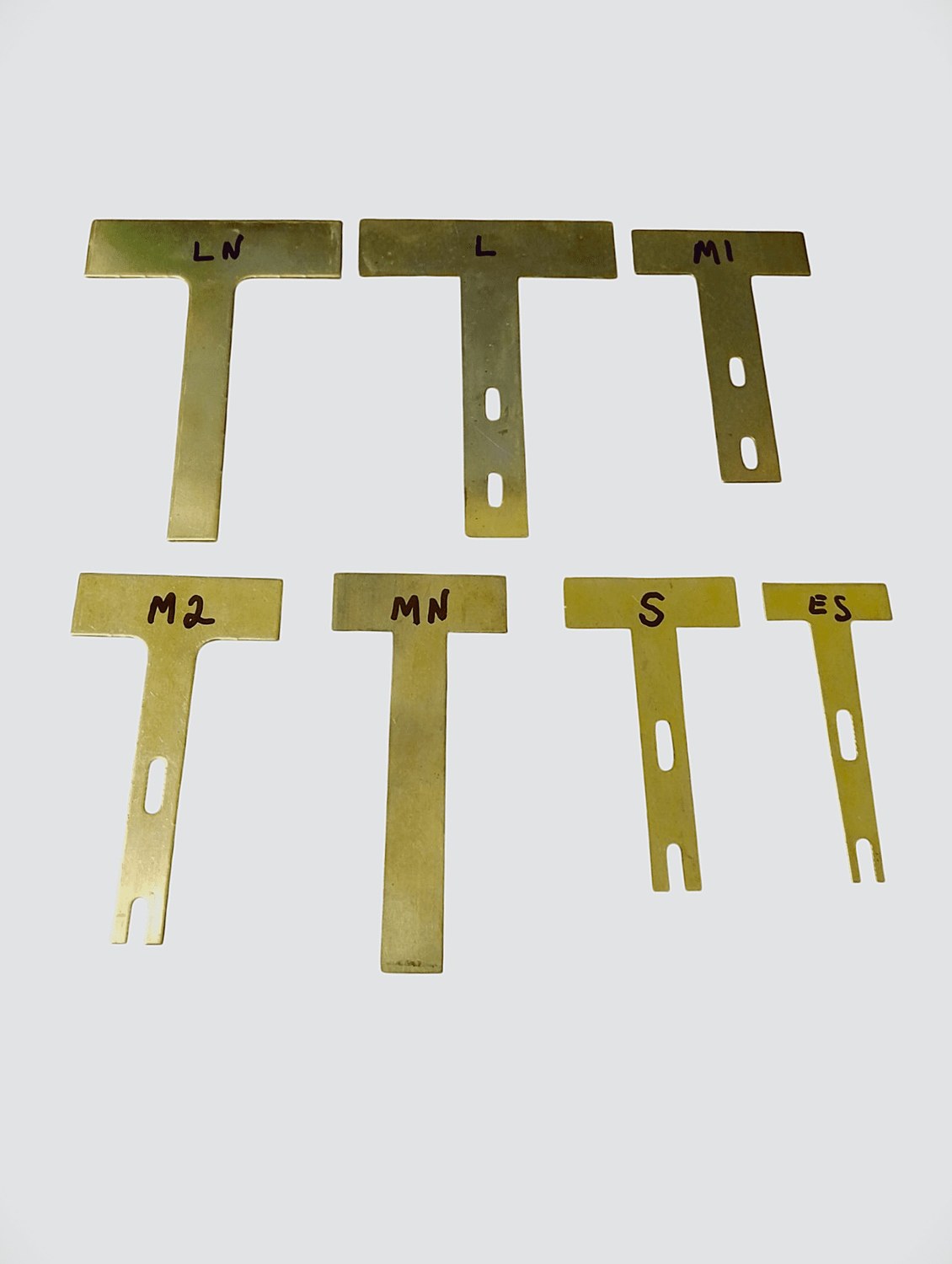
3.5 Beating reed pipes — move the tuning wire
A reed pipe makes its sound not from the air column but from a thin metal tongue beating against a shallot; the pipe body (the resonator) reinforces and colours the tone but does not set the fundamental pitch. The pitch of a beating reed is therefore set by the free vibrating length of the tongue, and that length is set by a tuning wire (or tuning spring) that presses against the tongue and defines where its free portion begins.
- Move the wire toward the tip → the free tongue is SHORTER → pitch RISES.
- Move the wire toward the root → the free tongue is LONGER → pitch FALLS.
O’Rourke’s guide records the mechanism in the trumpet (reed) section: the reeds are “tuned by moving the wire sliders” (O’Rourke/tuning.htm). A shorter vibrating tongue beats faster, so sliding the wire up toward the tip raises the pitch, exactly as a shorter string on a fretted instrument sounds higher. The move is made with a tuning knife or a light tap on the wire, a small amount at a time, re-reading the tuner between moves.
The voicing of a beating reed — the curvature set into the tongue, which governs how promptly and strongly it speaks — is Vol 05’s subject and, like all voicing, is done before the wire sets the final pitch.
3.6 Free reeds (melodica / accordion tongues) — scratch the tongue
The hobbyist’s shortcut to a reed voice on a small organ is the free reed — the accordion- or melodica-type tongue riveted to an aluminium plate. It differs from the beating reed in one crucial way for tuning: there is no tuning wire. The tongue’s pitch is set entirely by its own mass and stiffness distribution, so the only way to retune it is to change that distribution by removing metal — filing or scratching the tongue.
The direction follows from where metal is removed:
- Scratch / file the TIP (the free end) → less mass at the tip → pitch RISES (sharp). Removing mass from the fastest-moving part of the tongue lets it vibrate faster.
- Scratch / file the MIDDLE or BASE → the tongue is made more flexible near the root → pitch FALLS (flat). Thinning nearer the fixed end lowers the effective stiffness and drops the pitch.
This is a one-way, irreversible operation — metal cannot be put back — so the scratching is done “little by little, very light,” re-reading the tuner constantly. Free reeds are almost always retuned downward in this hobby context, because the melodica reed stock is factory-tuned sharp of A = 440 Hz, so the middle-of-the- tongue (flattening) scratch is the usual move.
The full free-reed voicing recipe with its exact numbers — the factory A = 420 Hz stock reading ~20 cents sharp at A = 440 Hz, the middle scratch over 3–4 mm to ~4–5 cents above zero, the cardboard resonator sizing, the beeswax mount (plate not heated) — belongs to Vol 05 and is not repeated here. This volume states only the method and direction: no wire, scratch the tongue, tip up / middle-base down, and cross-references Vol 05 for the numbers.
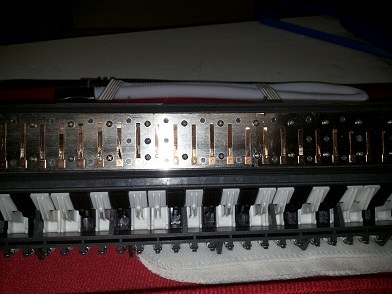
3.7 The per-family method table
The five families and their controls, collected for reference. The direction column is the load-bearing part — it is the thing most easily inverted at the bench.
Table 1 — 7. The per-family method table
| Pipe family | What holds the pitch | Tuning control | Sharpen (raise pitch) | Flatten (lower pitch) | Reversible? | Source |
|---|---|---|---|---|---|---|
| Stopped (gedeckt) | Closed air column, mouth to stopper | Slide the stopper | Push stopper in / down | Pull stopper out / up | Yes | O’Rourke/tuning.htm; en_pijp |
| Open flue | Full speaking-length air column | Tuning slide (wooden); tuning cone/knife on metal (est.); cut to length | Slide/cone shortens; cut shorter | Slide lengthens; (cannot un-cut) | Slide yes; cutting no | O’Rourke/tuning.htm |
| Open flue, piccolo (no stopper) | Speaking length + tab | Bend the metal tab over the top | Bend tab across the opening | Open the tab away | Yes (careful) | O’Rourke/tuning.htm; jsart09 |
| String / violin | Over-length column + frein | Slide (coarse) + frein (octave/fine) | Slide down; adjust frein | Slide up; adjust frein | Yes | en_vioolpijp; O’Rourke/tuning.htm |
| Beating reed | Free vibrating length of tongue | Move the tuning wire/spring | Wire toward tip (shorter tongue) | Wire toward root (longer tongue) | Yes | O’Rourke/tuning.htm |
| Free reed (melodica) | Mass/stiffness of the tongue | Scratch/file the tongue | Scratch the tip (less tip mass) | Scratch the middle/base | No (metal removed) | jsart51 (see Vol 05) |
Two patterns are worth naming. First, the air-column families (stopped, open, string) are tuned by changing a length, and — apart from irreversible cutting — their controls run both ways, so they are the easy families to bring exactly onto pitch. Second, the reed families are tuned by changing the tongue: the beating reed reversibly, by moving a wire, and the free reed irreversibly, by removing metal. The free reed is the one family where a tuning move cannot be undone, which is why it is scratched in the smallest possible increments.
3.8 Temperature — the tuning that moves on its own
A rank can be tuned perfectly and still be out of tune an hour later, because pitch depends on temperature and the two pipe families respond to it very differently. This is not a fault to be fixed at the bench — it is a physical fact to be planned around — and getting its direction right is the whole point of this section.
3.8.1 Flue pipes go sharp when warm, flat when cold
A flue (or stopped) pipe’s pitch is f = c / λ, where λ (the resonant wavelength)
is fixed by the pipe’s geometry and c is the speed of sound in air. The speed
of sound rises with absolute temperature as c ∝ √T, with T in kelvin. The
pipe length does not change appreciably, so as the air warms, c rises, and f
rises with it:
Flue and stopped pipes go SHARP when the room WARMS, and FLAT when it COOLS.
The magnitude is worth having as a number. Taking a common room-temperature example, warming from 20 °C to 30 °C takes T from 293 K to 303 K, so:
c₃₀ / c₂₀ = √(303 / 293) = √1.03413 = 1.01692That is a +1.69 % rise in frequency for +10 °C. Converting to cents with the
Vol 02 formula n = 1200 · log₂(f₂/f₁):
n = 1200 · log₂(1.01692) = 1200 · 0.024216 = +29.06 cents (for +10 °C)So roughly +29 cents per 10 °C, or about +3 cents per °C as a rule of thumb (est.) — the commonly quoted figure is ~30 cents / 10 °C, and the exact value drifts slightly with the starting temperature because the relationship is in kelvin, not degrees. Either way the practical scale is clear: a 10 °C swing is worth almost a third of a semitone, which is grossly audible. A rank tuned in a 15 °C workshop and played in a 25 °C hall will be very nearly 30 cents sharp across the board.
Because the shift is nearly the same fraction on every flue pipe, a purely flue organ stays internally in tune as it warms — every pipe sharpens together, and the intervals between them hold. The organ is sharp of the absolute reference pitch, but it is still in tune with itself. That is the saving grace of the flue-only instrument, and it is why the practical rule is simply: tune at the temperature the organ will be played, and let a cold organ reach room temperature before tuning.
3.8.2 Reeds barely move — so the families drift apart
The reed families are the complication. A reed’s pitch is set by the mechanical vibration of its metal tongue, not by an air column, and a metal tongue’s frequency is almost independent of air temperature. The reed’s temperature coefficient is very small (est.) — for the purposes of this volume, a reed rank holds its pitch while the flues around it move.
Combine the two facts and the consequence is specific and must be stated in the right direction:
In a warming room, the flues sharpen while the reeds stay put — so the reeds sound FLAT relative to the flues. In a cooling room, the flues flatten while the reeds hold — so the reeds sound SHARP relative to the flues.
For a busker organ that mixes a flue rank with a melodica-type free-reed rank — the common hobby configuration — this is the drift that actually spoils the sound, because the two families come apart even though each is behaving normally. The organ does not just go sharp or flat; its two voices disagree.
Figure 2 — Reed-vs-flue temperature drift. A rank tuned together at 15 °C comes apart as the room warms: the flue rank rises about +3 cents/°C (est.) — roughly +45 cents by 30 °C — while the reed rank holds its pitch. The absolute sharpening of the flues matters less than the fact that the two families no longer agree. Cool the room and the flue line drops below the reed line instead, making the reeds sound sharp of the flues.
3.8.3 Practical upshot
Three working rules fall out of the temperature physics:
- Tune at the playing temperature. Let a cold organ warm to the temperature of the room or hall it will actually play in before tuning. Tuning a cold organ guarantees it will be sharp when it warms up.
- Tune the reed rank to the flues at that temperature. Because the reeds will not follow the flues when the temperature changes, the one moment they can be matched is at the temperature the organ will be played — so match them there and accept that a temperature change will pull them apart.
- Expect flue-vs-reed drift, and re-check the reed rank after a temperature swing. A flue-only organ stays internally in tune as it warms (every pipe sharpens together); a mixed flue-and-reed organ does not, and its reed rank is the one to spot-check when the venue is much warmer or cooler than where it was tuned.
3.9 Summary — the direction table in one breath
The whole volume reduces to a handful of directions that must not be inverted:
- Stopped: stopper in/down = sharp, out/up = flat. Trim stoppers to equal length after tuning; the flush cap is voicing, not tuning.
- Open flue: shorter = sharp; build over-length and tune down, because cutting is one-way. Piccolo without a stopper: bend the tab.
- String: slide for coarse pitch, frein for the octave and fine trim; voice without the frein (it sounds an octave high), then fit the frein to pull it down an octave.
- Beating reed: wire toward the tip = shorter tongue = sharp.
- Free reed: no wire — scratch the tip to sharpen, the middle/base to flatten (numbers in Vol 05); the one irreversible tuning move on the organ.
- Temperature: flues go sharp when warm, flat when cold (~3 c/°C, est.); reeds barely move, so a warm room makes the reeds sound flat relative to the flues. Tune at playing temperature.
With every pipe at its correct pitch, the rank is in tune — but not yet necessarily speaking well or evenly. Shaping the tone and speech of each flue pipe — cut-up, flue width, the upper lip, and nicking — is the work of Vol 04; the voicing and tuning of reeds in full, free-reed numbers and all, is Vol 05; and assembling all of it into a single ordered tuning-and-voicing session for a whole organ is Vol 06.
Comments (0)