Tuning And Voicing · Volume 2
Tuning & Voicing — Vol 02: Temperament, Cents & Beats
This volume is the theory core of the dive. Everything the later volumes do at the bench — sliding a stopper, moving a frein, scratching a free reed, detuning a celeste rank — is an attempt to place a pipe on a numerical target and to read, by ear or by tuner, how far it still misses. That target is defined by a temperament; the distances are measured in cents; and the ear’s most sensitive error signal is the beat. This dive owns that material: the sibling dive “Building Organ Pipes” deliberately builds the pipe and hands it here without deriving the cent, equal temperament, or the temperament comparison, so this volume delivers all three in full and with every number recomputed.
The deeper acoustics — why a jet at an edge speaks at all, how the standing wave in the bore sets the fundamental, why an open pipe carries the full harmonic series and a stopped pipe only the odd partials — are deferred by name to “How Organ Pipes Make Sound.” Wind pressure is deferred to “Wind Systems.” Here the harmonic series is used only as far as it takes to explain where just intervals and beats come from.
2.1 The problem a fixed organ sets
A hand-cranked busker organ is a fixed-pitch instrument. Each note is a physical pipe (or a doubled pair, or a rank of several), cut and voiced once and then left alone. Unlike a violinist or a singer, who nudges every interval into tune as the music moves from key to key, the organ cannot retune itself between one bar and the next. Whatever pitches its pipes hold, they hold for every tune on every roll or book that is ever fed through it.
That single fact drives the whole of this volume’s conclusion. A music roll punched in one key may be played, or a later roll arranged, so that the same physical pipes serve as the tonic of one piece and the mediant or dominant of another. Every one of those roles must sound acceptable, because none of the pipes can be moved to favour a particular key. As Section 2.7 shows, that requirement has exactly one sensible answer — equal temperament — and the reason is worth understanding rather than merely asserting.
The working order at the bench (established in Vol 1) is voice first, tune last, in a stable temperature. This volume concerns the tune half: the numbers a pitch is tuned to. It says nothing yet about how the pitch is physically moved — that is Vol 3, “Setting Pitch, Pipe by Pipe.”
2.2 The harmonic series, only as far as needed
A pipe does not sound a single pure frequency. It sounds a fundamental f
together with a series of partials (overtones) at whole-number multiples of
that fundamental: f, 2f, 3f, 4f, and so on. Why a real pipe produces this
particular ladder — and why a stopped pipe emphasises only the odd rungs — is the
business of “How Organ Pipes Make Sound.” For tuning, two consequences of the
ladder are all that matter.
First, just intervals are small whole-number ratios. Because the partials sit
at integer multiples, the intervals between partials are ratios of small
integers. The second partial is 2f: exactly double the fundamental, the pure
octave, ratio 2/1. The third partial 3f against the second partial 2f
gives 3/2, the pure perfect fifth. The fifth partial 5f against the fourth
4f gives 5/4, the pure major third. These “just” intervals are the pitches
at which the partials of two notes line up exactly, and the ear hears that
alignment as maximal consonance.
Second, beats arise between near-coincident partials. When two notes are a near-unison or a near-just interval apart, a partial of one note lands very close in frequency to a partial of the other. Two frequencies that are close but not identical interfere, and the interference is heard as a slow throb — a beat (Section 2.3). The beat is the ear’s error meter: it goes to zero exactly when the two partials coincide, i.e. when the interval is pure.
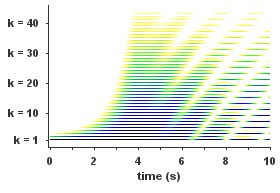
The table below lists the first eight partials and the just intervals they define
above the fundamental. The cents column (defined in Section 2.4) is recomputed
from n = 1200·log2(ratio).
Table 1 — 2.2 The harmonic series, only as far as needed
| Partial | Frequency | Ratio to f | Interval above fundamental | Cents (recomputed) |
|---|---|---|---|---|
| 1 | f | 1/1 | unison (fundamental) | 0 |
| 2 | 2f | 2/1 | octave | 1200 |
| 3 | 3f | 3/1 | octave + perfect fifth | 1902 |
| 4 | 4f | 4/1 | two octaves | 2400 |
| 5 | 5f | 5/1 | two octaves + major third | 2786 |
| 6 | 6f | 6/1 | two octaves + perfect fifth | 3102 |
| 7 | 7f | 7/1 | two octaves + (flat) subminor seventh | 3369 |
| 8 | 8f | 8/1 | three octaves | 3600 |
The single fundamental physical acoustics fact carried forward is only this: a pitched pipe is a stack of harmonics, and where the harmonics of two pipes nearly coincide, they beat.
Figure 2.1 — Top: a pipe’s tone is a stack of partials at f, 2f, 3f… (bar heights schematic). Bottom: two tones a few hertz apart sum to a wave whose amplitude swells and pinches; the loudness maxima recur at the beat rate |f1 − f2|, and the throb vanishes — zero beat — only when the two tones are identical.
2.3 Beats: the ear’s error meter
When two tones of frequencies f1 and f2 sound together and lie close in
frequency, the summed pressure wave rises and falls in amplitude at a steady
rate. This is a beat: interference “perceived as a periodic variation in
volume whose rate is the difference of the two frequencies” (Wiki: Beat
(acoustics)). The rule is exact and simple:
Beat rate (Hz) = |f1 − f2|.
Two tones at 442 Hz and 440 Hz beat at 2 Hz — two swells per second. Tones at 440.5 and 440.0 beat once every two seconds. When the two frequencies become equal the difference is zero, the amplitude stops pulsing, and the tone sits steady: zero beat is the definition of in tune at the unison (Wiki: Beat (acoustics)). Tuners have used this for centuries because the ear detects a slow beat far more precisely than it judges an absolute pitch: a wavering once every few seconds is unmistakable even when the interval sounds, to casual listening, already correct.
Beats are not confined to the unison. Because each pipe carries a stack of partials (Section 2.2), a near-just fifth or octave produces a beat between the coincident partials of the two notes — the ear can zero-beat a fifth by listening to the throb between the third partial of the lower pipe and the second partial of the upper. At the busker-organ bench, though, the electronic tuner carries most of that load, and beats are used directly for two jobs: setting doubled pipes (each bass note and many melody notes are voiced as a pair) to zero beat so the pair reads as one reinforced voice, and then, on a celeste or undulating rank, deliberately detuning the mate a few cents so the pair beats on purpose for a gentle shimmer (Vol 6; O’Rourke, tuning.htm). Beats are thus both the error signal and, on the celeste, the effect itself.
2.4 The cent
Frequency ratios are the honest currency of pitch, but ratios are clumsy to add: stacking two intervals means multiplying their ratios, and comparing a 3/2 against a 1.4983 by eye is hopeless. The cent converts ratios to a linear, additive scale on which intervals simply add up and small errors read directly.
The definitions are exact and are taken as given (Wiki: Cent):
-
One octave = 1200 cents.
-
One equal-tempered semitone = 100 cents, by definition.
-
Therefore one cent is the frequency ratio that, stacked 1200 times, makes an octave: 1 cent = 2^(1/1200) ≈ 1.0005778 (a rise of about 0.058%).
-
The number of cents between any two frequencies is
n = 1200 · log2(f2 / f1).
Two worked checks confirm the definitions close on themselves:
- The octave.
f2/f1 = 2, son = 1200 · log2(2) = 1200 · 1 = 1200 cents.✓ - The equal-tempered semitone. Its ratio is 2^(1/12) ≈ 1.059463 (Section
2.6). Then
n = 1200 · log2(1.059463) = 100.0 cents.✓ (Computed: 99.9998, the rounding of 1.059463; the exact ratio gives exactly 100.)
The cent’s practical virtue is that human pitch discrimination sits at roughly the same size across the audible range — a few cents — so a cents figure means the same thing at the bottom of a busker organ’s compass as at the top, whereas a “1 Hz error” means something very different at 65 Hz than at 1000 Hz. A trained ear resolves on the order of 5 cents; the equal-temperament compromises examined below run to a few cents on fifths and around 14 cents on thirds, so cents are exactly the resolution at which tuning decisions are made.
2.5 From cents to beats: the engineer’s helper
The tuner reads cents; the ear hears hertz of beat. It is worth being able to convert between them so a cents error can be checked against the throb it should produce. Consider the reference A4 = 440 Hz. A pipe one cent sharp sounds at
440 × 2^(1/1200) = 440 × 1.0005778 = 440.254 Hz,
so it lies 440·(2^(1/1200) − 1) = 0.254 Hz above the reference. Sounded against a true 440, a one-cent error therefore beats at about 0.254 Hz — one swell every ~3.9 seconds (est. helper; recomputed from the cent ratio). That is a useful yardstick: near A440, roughly one cent per quarter-hertz of beat, or one beat every four seconds per cent of error. The relation scales with frequency (the same cents error higher up beats faster in hertz), but for setting unisons in the melody register it is a good working number.
Table 2 — 2.5 From cents to beats: the engineer's helper
| Error (cents) | Ratio 2^(c/1200) | Δf at A = 440 (Hz) | Beat period |
|---|---|---|---|
| 1 | 1.000578 | 0.254 | ≈ 3.9 s |
| 2 | 1.001156 | 0.509 | ≈ 2.0 s |
| 5 | 1.002892 | 1.273 | ≈ 0.8 s |
| 10 | 1.005793 | 2.549 | ≈ 0.4 s |
The table recomputes Δf = 440·(2^(c/1200) − 1) and the period 1/Δf. Its main
use is at the celeste: a “few cents” of intentional detune (roughly 2 cents)
gives a waver of about one swell every two seconds, which is the slow, pleasant
undulation a celeste rank is voiced for (Vol 6). It also sanity-checks a
suspicious tuner reading — if the tuner says a pipe is 5 cents off but the ear
hears no beat against its neighbour, one of the two is wrong.
Figure 2.2 — A doubled pair tuned to zero beat sums to a steady tone (left). A celeste mate detuned by about 2 cents beats at roughly half a hertz, giving the undulating rank its shimmer (right). Beats are the tuning error signal on the first and the intended effect on the second.
2.6 Temperaments: just, meantone, well, and equal
A temperament is a scheme for spacing the twelve semitones of the octave. The history runs from purity in one key toward flexibility in all keys.
2.6.1 Just intonation
Just intonation tunes every interval as a small whole-number ratio (Section
2.2): the major third as 5/4, the perfect fifth as 3/2, and so on. Recomputed
from n = 1200·log2(ratio), the pure major third is 386.31 cents and the
pure perfect fifth is 701.955 cents. In its home key just intonation is
flawless — the partials line up, the beats vanish, the chords lock. The trouble
is that it is key-bound: the fixed pitches that make one key pure leave other
keys badly out, because the pure intervals do not tile the octave evenly. Twelve
pure fifths overshoot seven octaves (the Pythagorean comma), and stacking pure
thirds and fifths produces two subtly different sizes for what the keyboard calls
the same note. On a fixed instrument, just intonation can serve exactly one key.
2.6.2 Meantone
Meantone temperament, dominant in European keyboards from the sixteenth into the eighteenth century, deliberately narrows the fifths so as to purify the thirds — quarter-comma meantone makes the major third a pure 5/4 and pays for it with fifths noticeably flat of 3/2. The result is very sweet in the handful of keys near C major and progressively worse as the music moves away, until one fifth becomes the howling “wolf” and the remote keys are unusable. Meantone is named here as history and context only; it is not a live option for a fixed crank organ meant to play rolls in any key.
2.6.3 Well temperament
Well temperament — the family that includes Werckmeister (whose 1707 treatise advocated moving all the way to equal temperament) and Kirnberger — spreads the compromises unevenly but so that every key is usable. No wolf remains, but each key keeps a distinct “colour”: near keys purer, remote keys brighter and more tense. This is the tuning behind much early-eighteenth-century keyboard music. For a fixed mechanical organ it is again reference and context only: a well temperament would make the same roll sound different depending on which key it happened to be arranged in, which is precisely the property a transposing roll library cannot tolerate (Section 2.7). Werckmeister and Kirnberger are named here as the history that equal temperament replaced; their per-key schemes are not derived, because a fixed crank organ is not tuned to them.
2.6.4 Equal temperament (12-TET)
Equal temperament divides the octave into twelve identical steps of 100 cents each. The single ratio between adjacent semitones is
2^(1/12) ≈ 1.059463,
and twelve of them multiply back to exactly 2 (the octave). Every semitone, every whole tone, every third and fifth is now the same size in every key — which is exactly what lets music modulate freely and lets a fixed instrument play in all keys alike.
The price is paid on the pure intervals, and it must be stated precisely — not as “all intervals are pure” (they are not) and not as “only the octave is pure and everything else is badly out” (it is not that either). Recomputed against just intonation:
- The major third. ET puts it at 400 cents; just is 386.31 cents (5/4). ET is therefore +13.69 cents wide of just — a distinctly bright, faintly restless third that beats audibly.
- The perfect fifth. ET puts it at 700 cents; just is 701.955 cents (3/2). ET is therefore −1.96 cents narrow of just — flat by about two cents, close enough that the fifth still sounds solid and beats only slowly.
Only the octave is left pure. The tradeoff, stated exactly, is: every key equally usable and free modulation between them, in exchange for every major third about 13.69 cents wide of just and every perfect fifth about 1.96 cents narrow of just (Wiki: Equal temperament). The fifths are so nearly pure that most listeners never notice; the thirds are the audible cost of the compromise.
The table gives the full comparison, recomputed for the principal intervals.
Table 3 — Equal temperament (12-TET)
| Interval | Just ratio | Just (cents) | Equal (cents) | ET − just (cents) |
|---|---|---|---|---|
| Unison | 1/1 | 0 | 0 | 0 |
| Major second | 9/8 | 203.910 | 200 | −3.91 |
| Minor third | 6/5 | 315.641 | 300 | −15.64 |
| Major third | 5/4 | 386.314 | 400 | +13.69 |
| Perfect fourth | 4/3 | 498.045 | 500 | +1.96 |
| Perfect fifth | 3/2 | 701.955 | 700 | −1.96 |
| Major sixth | 5/3 | 884.359 | 900 | +15.64 |
| Octave | 2/1 | 1200 | 1200 | 0 |
Note the symmetry that falls out of the arithmetic: the fourth (the fifth’s inversion) is as wide as the fifth is narrow, and the minor third and major sixth are the mirror of the major third and minor sixth. The thirds and sixths carry the largest errors; the fifths and fourths are nearly clean.
Figure 2.3 — Top: the octave drawn as a 1200-cent ruler with twelve equal 100-cent steps; the just major third (386.31 c) sits 13.69 cents below the equal 400, and the just fifth (701.955 c) sits 1.96 cents above the equal 700. Bottom: just intonation serves one key, meantone a handful, well temperament all keys but each a different colour, and equal temperament all twelve keys identically — which is why it is the fixed organ’s tuning.
2.7 Why equal temperament is the right choice for a fixed organ
The general argument for equal temperament is freedom of modulation. For a fixed mechanical organ the argument is stronger than that — it is closer to a necessity, and it rests on the two facts established at the start of this volume.
The pipes cannot be retuned per key. A keyboard player using a well temperament accepts that some keys sound sweeter than others and chooses repertoire accordingly; a harpsichordist can even re-tune between pieces. The crank organ can do neither. Its pipes hold one set of pitches for every tune it will ever play. Any temperament that makes some keys better than others (just, meantone, well) therefore makes some tunes better than others, arbitrarily, according to the key each arranger happened to pick.
Every transposition a roll or book calls for must sound equally acceptable. The same physical pipe serves as tonic here and as third or fifth there. A library of rolls will, taken together, exercise every key and every interval relationship on the instrument. The only temperament under which a given chord shape sounds the same wherever it falls — under which no key is a trap — is the one in which every semitone is the same size. That is equal temperament, and no other scheme has the property.
So the ~14-cent-wide thirds are not a defect to be apologised for; they are the deliberate, evenly distributed price of an instrument that must play anything in any key with no human at the pitch controls. Equal temperament is not merely a defensible choice for the fixed crank organ — it is effectively the only sensible one. Every pipe in the instrument is tuned to the same equal-tempered grid, and Vols 3 through 6 are entirely about placing each pipe accurately onto it.
2.8 Reference pitch: A440, and why crank organs run sharp
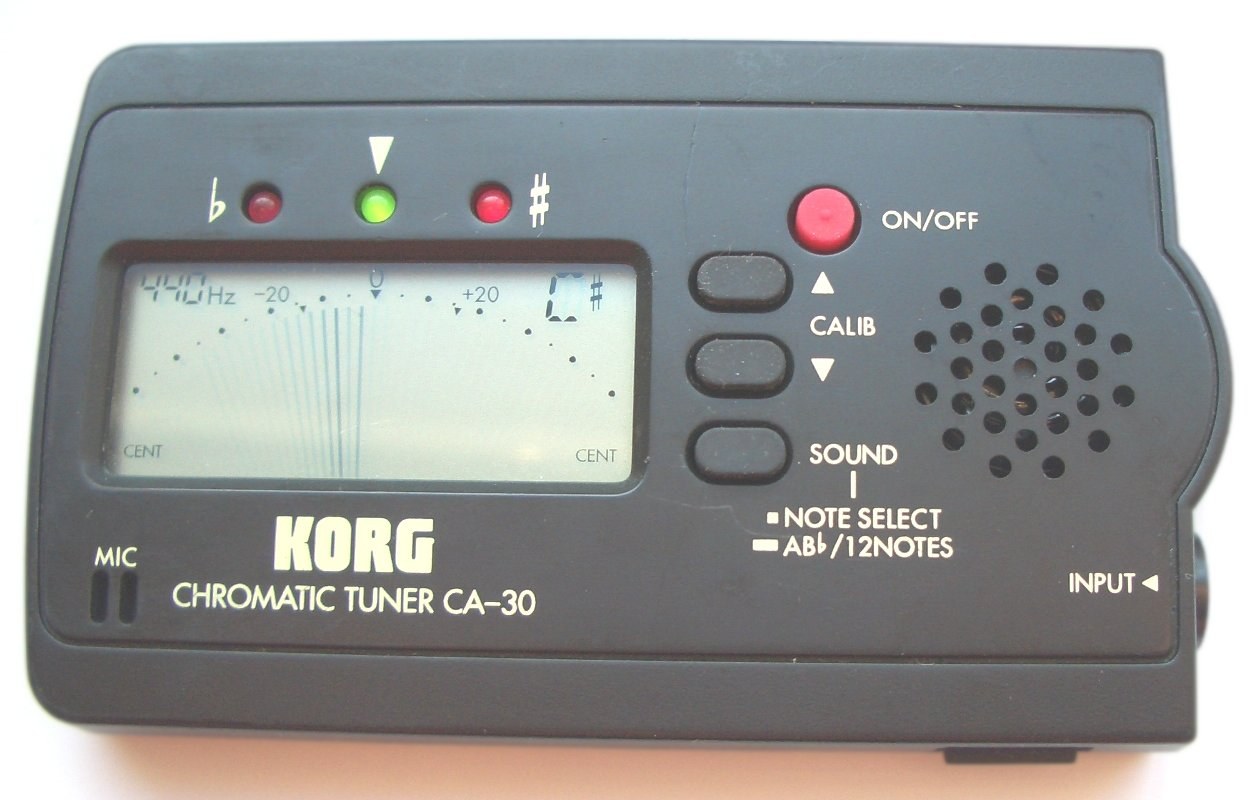
Equal temperament fixes the ratios between the notes but not the absolute frequency of any one of them. That anchor is the reference pitch. The international standard is A4 = 440 Hz, standardised as ISO 16 (Wiki: A440). It is the pitch a chromatic tuner defaults to and the natural first choice for an organ that may some day play alongside other instruments.
Crank organs, however, are commonly built and tuned sharp of A440. Across much of continental Europe — Germany, Austria, the Netherlands — A = 442 Hz and A = 443 Hz are ordinary, and some instruments run higher still. Hal O’Rourke, long the US agent for Josef Raffin, reports that Raffin crank organs are “very rarely tuned to concert pitch” and that most new ones he measured came in at about A = 445 Hz (O’Rourke, tuning.htm). A slightly sharp instrument sounds a touch brighter and more brilliant outdoors, which suits a street organ; and historically many organs were simply built to whatever pitch their maker favoured.
The engineering point is that the absolute pitch is arbitrary within reason; what matters is that it is identical across the whole organ (O’Rourke, tuning.htm). Whether an instrument settles on 440, 442, 443, or 445 Hz, every pipe — every rank, every doubled pair, the flues and any reeds — must be tuned to the same A. An organ internally consistent at A = 443 is in tune with itself and will sound well; an organ with its flue ranks at 440 and its reed rank left at the factory’s pitch is out of tune with itself and will not, however “standard” either number is on its own. The practical procedure, therefore, is to choose one reference pitch at the start of a tuning session and keep it consistent throughout (O’Rourke, tuning.htm) — a decision revisited in Vol 3, because the pitch an organ holds also drifts with temperature, and in Vol 6, where the whole instrument is brought to one pitch in order.
2.9 Carry-forward
- A pipe’s tone is a harmonic stack (
f,2f,3f…); just intervals are the small whole-number ratios where partials coincide (octave 2/1, fifth 3/2, third 5/4), and beats arise where partials nearly coincide. - Beat rate = |f1 − f2| Hz; zero beat = in tune. Beats are the tuning error signal for doubled pairs and the intended effect on a celeste rank.
- The cent: 1200 per octave, 100 per equal semitone, ratio 2^(1/1200) ≈
1.0005778, and
n = 1200·log2(f2/f1). Near A440, 1 cent ≈ 0.254 Hz ≈ one beat every ~4 s (est. helper). - Equal temperament = twelve identical 100-cent steps, ratio 2^(1/12) ≈ 1.059463. Its exact tradeoff: every key equally usable and free modulation, in exchange for every major third +13.69 cents wide of just and every perfect fifth −1.96 cents narrow of just (only the octave stays pure). Just, meantone, and well temperaments are history and context; a fixed organ cannot use them, because it cannot retune per key and every transposed roll must sound alike.
- Reference pitch: A4 = 440 Hz is ISO 16, but crank organs commonly run A = 442/443/445 Hz (Raffin ≈ 445). The absolute pitch is arbitrary within reason; internal consistency across the whole organ is what matters.
The next volume, “Setting Pitch, Pipe by Pipe,” turns to how the pitch is physically moved onto this equal-tempered grid for each pipe family — stopper, slide, cone, frein, tuning wire, and the scratched free reed — and to how temperature shifts the whole grid. The deeper acoustics behind why a pipe carries its particular harmonics, and why beats and edge tones behave as they do, remain with “How Organ Pipes Make Sound.”
Sources
- Wikipedia, “Cent (music)” — cent definitions (1200/octave, 100/semitone), ratio 2^(1/1200), formula n = 1200·log2(f2/f1). (Wiki: Cent)
- Wikipedia, “Equal temperament” — 12 equal 100-cent steps, ratio 2^(1/12) ≈ 1.059463, A4 = 440 Hz, ET third and fifth deviations. (Wiki: Equal temperament)
- Wikipedia, “Beat (acoustics)” — beat rate = |f1 − f2|; zero-beat tuning. (Wiki: Beat (acoustics))
- Wikipedia, “A440 (pitch standard)” — A4 = 440 Hz, ISO 16. (Wiki: A440)
- Wikipedia, “Musical temperament” / “Werckmeister temperament” / “Kirnberger temperament” — just → meantone → well → equal history; Werckmeister’s 1707 advocacy of equal temperament (reference/context only).
- Hal O’Rourke, Raffin owner tuning guide,
melright.com/busker/tuning.htm— crank organs rarely at concert pitch, most new Raffins ≈ A = 445 Hz, “pick a pitch and keep it consistent,” celeste set by beats. (O’Rourke, tuning.htm)
Comments (0)