Tuning And Voicing · Volume 4
Tuning & Voicing — Vol 04: Voicing Flue Pipes
Vol 03 answered how the pitch of a finished pipe is moved — the stopper, the slide, the frein, the wire, the scratch. This volume steps back one place in the working order to the craft that comes before pitch is ever set: voicing. Where tuning fixes a pipe’s frequency, voicing fixes its voice — its tone colour, its loudness, and above all the way it speaks: how promptly and how cleanly it starts, and how well it blends with its neighbours in the rank.
The distinction matters because the reader arriving at the bench with a rank of newly built flue pipes will find that most of them do not yet sound like an organ. Straight off the tools a flue pipe is as likely to over-blow to the octave, hiss instead of speak, spit a rude transient at the start of every note, or simply be too loud or too soft for the pipe next to it. None of those are tuning faults. They are voicing faults, and every one of them is corrected by a small, deliberate adjustment to the geometry of the pipe’s mouth — the cut-up, the nicking, the upper lip, the flue slit, and the foot hole — made while the pipe is blown at the pressure the organ will actually run.
Scope and sourcing. This volume is about adjustment, not acoustics. Why a higher cut-up gives a flutier tone, why nicking suppresses chiff, why a thin air-sheet crossing the mouth breaks into edge-tone at all — the jet physics, edge tone, standing waves and the harmonic content behind every lever here — all belong to the program’s “How Organ Pipes Make Sound” dive and are cross-referenced, not re-derived. Wind pressure and how it is generated and stabilised belong to “Wind Systems”; this volume uses only the single working gauge (~5 in H₂O = 127 mm ≈ 1.245 kPa) as the pressure at which voicing is done. Pitch-setting is Vol 03; reed voicing is Vol 05; the ordered whole-organ session is Vol 06. Craft facts are cited inline —
(jsart42),(jsart26),(jsart19),(en_pijp),(OHS works03),(C.B. Fisk),(Pykett)— and a value the sources do not pin down is marked (est.), never invented. Dimensions are in millimetres, pressures in inches and millimetres of water, pitch shifts in cents (100 cents = one equal-tempered semitone, Vol 02).
4.1 What voicing controls, and the one rule that governs all of it
A flue pipe makes sound by directing a thin ribbon of air — the air-sheet or jet — across the open mouth, where it strikes the upper lip and sets the pipe’s air column vibrating. Everything the voicer does is a modification of that mouth: how tall it is, how the jet is shaped before it gets there, how sharp the edge it strikes is, and how much wind is behind it. Four levers cover the whole craft:
- Cut-up — the height of the mouth. The master control for tone colour and, as a side effect, for loudness and speech. (§2)
- Nicking — small notches across the flue that steady the jet and control the attack transient known as chiff. (§3)
- The upper lip — the edge the jet strikes; its exact profile trims the brightness of the tone. (§4)
- The flue slit and the foot (toe) hole — the two controls over how much wind reaches the mouth and how thick the jet is: the regulators of loudness and promptness. (§5)
Across all four sits a single governing rule that the reader must internalise before touching a file: voicing is done at the organ’s own working pressure, on a bench rig, never by mouth. A crank organ’s flue pipes speak at roughly 5 in H₂O = 127 mm ≈ 1.245 kPa (John Smith 20-note scale; the 26-note bass chest runs a little higher, ~6½ in — see “Wind Systems”). A pipe voiced at some other pressure is voiced wrong: the cut-up, jet velocity and foot-hole balance that give prompt, blended speech at 127 mm do not hold at 90 mm or 160 mm. And a pipe blown by mouth is voiced wrong twice over — the voicer cannot hold a steady pressure with the lungs, and exhaled moisture soaks into the 2–3 mm wooden walls of these small pipes, swelling and warping them (jsart26). The bench rig that solves both problems is the subject of §7, but it is named here because every adjustment described below assumes it.
The second half of the rule is order, carried over from Vol 01: voice first, tune last. Every voicing move in this volume shifts pitch as a side effect — raising the cut-up flattens the pipe slightly, opening the foot hole sharpens it, and so on. Pitch set before voicing is finished is thrown away by the voicing that follows. So the pipe is brought to good speech first, and only then is it tuned to the scale by the Vol 03 method for its family.
4.2 Cut-up: the master tone lever
Cut-up is the height of the mouth — the vertical distance from the top of the flue (where the jet emerges) to the upper lip (where it strikes). It is expressed as a ratio to the mouth’s width, and for these small busker pipes the hard number from the craft literature is that the cut-up should not exceed one-third of the mouth width (jsart42). A mouth 18 mm wide, then, is cut up no more than about 6 mm.
Cut-up is called the master lever because moving it changes tone, loudness and speech all at once, and moves them together in a fixed, predictable direction:
- Higher cut-up → louder, rounder, flutier tone; later, slower speech; fewer upper partials. Raising the upper lip lets the pipe accept more wind and swing a fatter jet, so it plays louder and with a broader, hollower, more flute-like voice dominated by the fundamental. The price is speech: a tall mouth takes perceptibly longer to lock onto its note, so the attack is slower and less crisp (OHS works03; Britannica; Pykett).
- Lower cut-up → brighter, stringier, thinner tone; prompter attack; more chiff. A shallow mouth throws a thin jet a short distance onto the lip, which starts fast and keenly, rich in upper partials, with a pronounced transient at the onset (OHS works03; Pykett).
The reason the mouth height should do this — how the ratio of cut-up to jet travel selects which mode the air column locks onto and how much energy goes into the higher partials — is the acoustics dive’s territory (“How Organ Pipes Make Sound”). At the bench it is enough to know the direction and treat cut-up as the first and largest tone control.
Two practical cautions follow from how cut-up is physically made. First, cut-up is set at build time by where the upper lip is cut, and it is easy to raise but very hard to lower — filing the mouth taller is a minute’s work, but bringing it back down means letting a new upper lip into the pipe. The bench discipline is therefore to approach the target from slightly low: build or receive the pipe with the mouth a touch shallow, then file the upper lip up in small increments, listening at working pressure, and stop at the point where tone and speech are both acceptable. Overshoot and the pipe is spoiled. Second, because cut-up flattens the pitch as it rises, the pipe is left over-length and tuned down to pitch after voicing (Vol 03) — never cut to final length before the mouth is finished.
4.2.1 Cut-up and pipe scale together
Cut-up does not act alone; it works with the pipe’s scale — the ratio of its width to its length. The two combine into the tonal families the organ builder names (OHS works03):
Table 1 — names (OHS works03)
| Pipe scale (width : length) | Cut-up | Resulting family | Character |
|---|---|---|---|
| Wide | Higher | Flute | Round, hollow, fundamental-heavy, gentle attack |
| Medium | Medium | Diapason / principal | The “organ” tone; balanced partials |
| Narrow | Lower | String | Thin, bright, partial-rich, keen attack |
For a small busker organ most of the flue work is stopped bourdons and open flutes and principals, with a narrow-scale violin/string rank if the organ has one (voiced with the frein — Vol 03 §string, and the acoustics dive for why a narrow pipe over-blows). The table is the map: a rank that is meant to be a mellow flute is cut up toward the one-third ceiling; a rank meant to cut through as a principal is left lower; a string rank is narrow and low. The voicer chooses the target from the rank’s intended role, then works to it from slightly low.
4.3 Nicking: the control over chiff
When a flue pipe begins to speak, the jet does not lock instantly onto its steady note — for a few tens of milliseconds it flails, and that initial turbulence is heard as a transient at the front of the note. That transient is chiff (also called the pipe’s “attack” or, when strong, its “spit”). A little chiff makes a pipe sound alive and articulate, as if each note were gently tongued; too much makes it splutter; none at all makes it start with a bland, seamless swell. The control over how much chiff a pipe has is nicking.
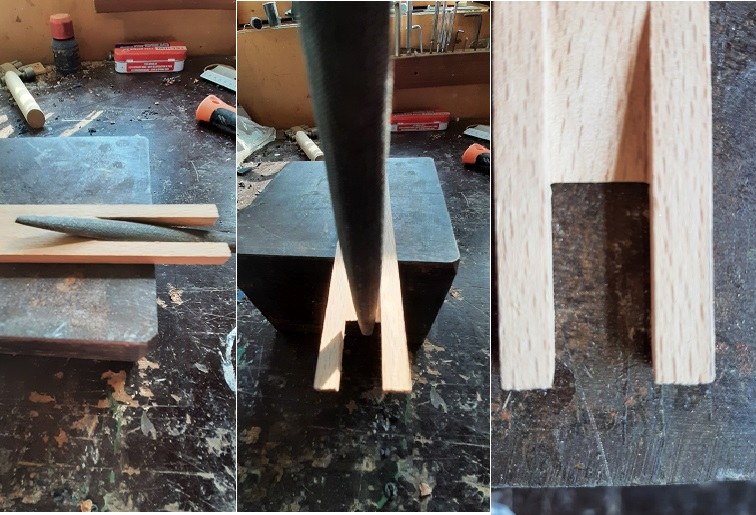
Nicking is a row of small notches filed perpendicular to the flue, on the edge of the languid (block) and often on the lower lip as well — that is, across the path the jet takes as it leaves the windway (C.B. Fisk). Each nick disturbs the sheet slightly, so that instead of the whole ribbon arriving at the upper lip as one clean front and starting with an abrupt slap, the sheet arrives already broken up and settles onto its note more gently. The effect direction is the citable fact, and it is stated authoritatively by C.B. Fisk: a principal pipe “chiffs if its windway is lightly nicked or not nicked at all, and more and more nicking diminishes the chiff until finally it becomes inaudible.” In one line:
- More/heavier nicking → less chiff. Smoother, immediate, seamless speech; the note swells in without a transient. Taken to its limit the attack becomes inaudible (C.B. Fisk).
- Light or no nicking → pronounced chiff. A vigorous, “tongued” attack; the note starts with an audible transient before settling (C.B. Fisk; Audsley).
Because nicking only ever removes chiff and cannot add it, and because a nick filed is a nick that cannot be un-filed, the same discipline applies as for cut-up: start with light or no nicking and add nicks a few at a time, blowing the pipe at working pressure after each pass, until the chiff is where it is wanted. It is far easier to add three more nicks than to fill one in.
For these small busker flue pipes the working norm is light nicking, or none at all, giving each note a lively chiff that suits the bright, articulate, out-of-doors voice a street organ wants — a bland, chiff-less swell would be lost in the open air and against the percussion of the mechanism (est.). That norm is marked as an estimate because the hobby sources do not state it as a rule; the effect direction (more nicking = less chiff) is the sourced fact, and the voicer should set the amount by ear on the actual rank, not by a number.
4.4 The upper lip
The upper lip is the edge the jet strikes, and after cut-up and nicking it is the fine control on the tone’s brightness. Two things about it are adjusted: its profile (the sharpness of the edge) and its alignment with the jet.
Profile. A clean, straight edge is the starting point; a common way to get one is a shallow knife-cut on the inside face of the pipe, made equal to the cut-up, which lets the lip come to a definite edge rather than a ragged one (jsart42). From that clean edge the voicer trims character:
- A slightly rounded upper lip → smoother, rounder tone. Blunting the edge a touch softens the high partials the jet generates as it splits on the lip (jsart42; Audsley).
- A sharp upper lip → keener, brighter, stringier tone. A crisp edge splits the jet cleanly and preserves the upper partials (jsart42; Audsley).
So a flute rank is finished with a slightly rounded lip and a string rank with a sharp one, the lip profile pushing the tone the last small distance in the same direction the cut-up and scale already chose.
Alignment. None of the lip work matters if the jet does not arrive at the lip correctly. The languid (block) and the lower lip together form the windway, and their setting aims the air-sheet at the upper lip — ideally so the sheet meets the lip square, splitting evenly inside and outside the mouth. If the languid is set too high or too low, or the lower lip is out of line, the jet strikes the upper lip at the wrong angle: the pipe then speaks weakly, over-blows to the octave, or refuses to start cleanly no matter how the cut-up and nicking are set. Getting the languid-to-lower-lip-to-upper-lip line right is therefore the precondition for the other adjustments, checked first at working pressure; the pipe-anatomy and the geometry of that setting are laid out in “Building Organ Pipes” and the acoustics dive.
4.4.1 The three mouth adjustments at a glance
The figure below draws one flue-pipe mouth three ways — high, medium and low cut-up — and beside each the two edge treatments (nicked vs un-nicked flue; sharp vs rounded upper lip), with the tonal-effect arrow each move sends the voice along.
Figure 4.1 — The three mouth adjustments and their tonal directions. Cut-up is the master lever (higher = flutier, louder, later-speaking; lower = brighter, stringier, prompter, chiffier); nicking sets how much chiff survives (more nicking = less chiff); the upper-lip profile trims brightness (sharp = keener, rounded = smoother). All are approached from the “safe” side — cut-up from slightly low, nicking from none — because each is easy to add and hard to undo.
4.5 Wind delivery: the flue slit and the foot hole
Cut-up, nicking and the lip shape the quality of the voice; the flue slit and the foot (toe) hole govern its quantity — loudness and the promptness of speech — by controlling how much wind reaches the mouth and how thick the jet is.
The foot hole (toe). At the bottom of the pipe’s foot is a small hole through which all the pipe’s wind must pass on its way from the chest to the mouth. It is the pipe’s throttle:
- A larger foot hole passes more wind → the pipe plays louder and, up to a point, speaks more promptly and more securely.
- A smaller / lower foot hole passes less wind → the pipe plays quieter and, if taken too far, starts to speak slowly or unreliably.
Enlarging a foot hole is done with a tapered reamer a little at a time; closing one is done by driving in a plug or leathering it down, so once again the voicer opens from small toward large, listening at working pressure, and stops at the loudness wanted. The foot hole is the primary loudness control when a whole rank is being balanced (§6), precisely because it changes volume with only a small effect on tone.
The flue slit. The flue (windway) is the narrow slit between the languid and the lower lip through which the sheet emerges. Its width sets the thickness of the jet — a wider slit throws a fatter, more powerful sheet; a narrower slit a thin, keen one. Jet thickness interacts with cut-up (a fat jet wants a taller mouth to lock onto; a thin jet a shallow one), so the flue width is trimmed together with the cut-up to get secure speech, not adjusted in isolation. On the stopped-pipe cap this is where the hobby literature’s one hard number lives: the cap is set flush with, or up to +0.5 mm above, the core “to correct the wind flow” (en_pijp) — a half-millimetre adjustment of the windway that can be the difference between a pipe that speaks and one that hisses.
The physics of all of this — why jet velocity and thickness set the transient and the harmonic balance, how the foot hole and mouth together fix the jet’s Reynolds regime — is the acoustics dive’s job, and wind pressure (the other half of “how much wind”) is the “Wind Systems” dive’s. At the bench the reader treats the foot hole and flue slit as the two throttle controls: foot hole for loudness, flue width for jet thickness, both trimmed at the organ’s own 127 mm gauge.
Figure 5.1 — Wind delivery. All the pipe’s wind enters through the foot (toe) hole and emerges as a jet through the flue slit before crossing the mouth to the upper lip. The foot hole is the loudness throttle (larger = more wind = louder, and prompter up to a point); the flue-slit width sets jet thickness and is trimmed together with the cut-up. On a stopped-pipe cap the windway is corrected within ±0.5 mm (en_pijp).
4.6 Balancing a rank
A pipe that speaks beautifully on its own is only half the job; in the organ it has to sit in a rank — a full set of pipes of one voice across the compass — and in a multi-rank organ, beside other ranks. The voicer’s last flue task is regulation: adjusting the pipes pipe-to-pipe so that no single pipe dominates and the rank plays evenly from bass to treble and blends with its neighbours.
The primary tool for regulation is the foot hole (§5), because it changes loudness with the least disturbance to tone. Working along the rank at the organ’s own pressure, the voicer compares each pipe to its neighbours and to the rank as a whole: a pipe that jumps out is quietened by closing its foot hole a little; a pipe that hides is brought forward by opening its foot hole. Cut-up and flue-slit trims are held in reserve for pipes whose tone, not just their loudness, is out of family. The aim is a rank with a smooth loudness curve across the compass — often deliberately shaped, with the bass a little stronger to carry the harmony and the treble eased back so the melody sings without shrillness — and no pipe that the ear picks out as an individual.
The scale of the balancing problem grows with the number of ranks. John Pettifer’s 26-note “Universal” organ, which plays both 20- and 26-note rolls, carries several flue ranks together — doubled bourdons, stopped flutes, an octave open rank and open flutes — on a bass chest running about 6½ in H₂O (jsart19). Balancing that organ is not just evening each rank within itself but setting the ranks against each other: the bourdons must underpin without booming, the stopped flutes must fill without muddying, the open flutes must sing on top without stridency, and when the music calls all of them at once the result must be one blended organ tone rather than four ranks competing. Each rank is regulated on its own first, then the ranks are balanced against one another, all by the same foot-hole-first method, all at working pressure on the chest.
4.7 The manometer bench rig
Every adjustment in this volume has been qualified by the same phrase — at the organ’s own working pressure — and this section builds the rig that supplies it. The rig exists because the two obvious ways to blow a pipe on the bench are both wrong. Blowing by mouth cannot hold a steady pressure and loads the thin wooden walls with exhaled moisture, swelling and warping them; blowing from the organ itself ties up the whole instrument and gives no reading of the pressure the pipe is seeing. The bench rig fixes both by delivering a controlled, measured wind to one pipe at a time (jsart26).
The canonical crank-organ voicing rig is simple and cheap (jsart26):
- An inflator pump — a foot pump or air-mattress inflator — as the wind source, giving a steady low-pressure supply the voicer can hold with the foot while both hands work the pipe.
- A length of PVC wind pipe carrying that wind toward the pipe under test.
- A tee (an aquarium or washing-machine tee) in the wind pipe, one branch feeding the pipe and the other feeding —
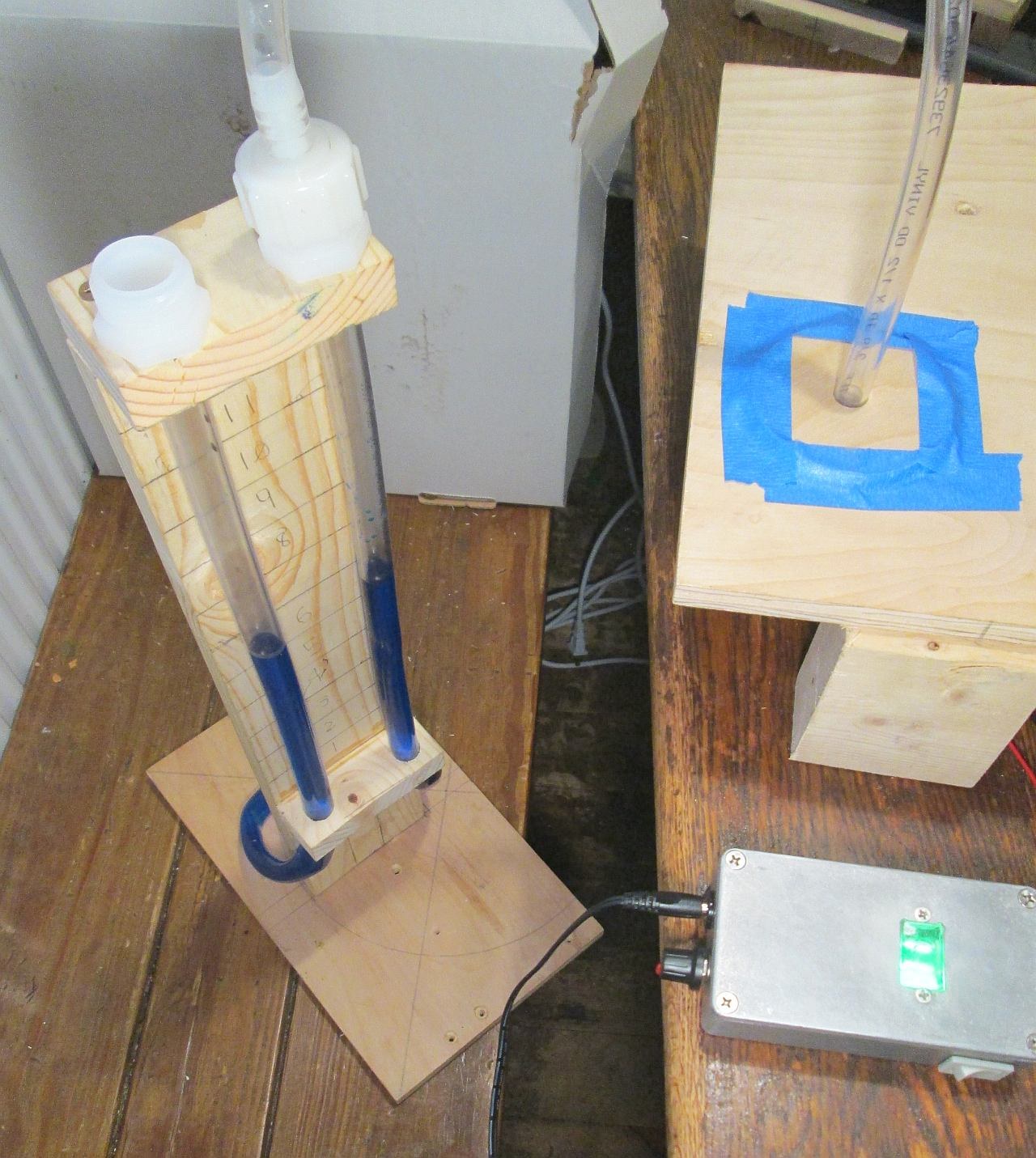
- A U-tube water manometer: a clear U of tubing part-filled with water, whose two columns separate by an amount that reads the pressure directly in inches or millimetres of water.
- The pipe under test on the outlet, blown at whatever gauge the pump is set to.
The manometer is the point of the whole rig. Because the difference in the two water columns is the wind pressure in the units the organ world uses, the voicer sets the pump so the U-tube reads the organ’s own working figure — ~5 in H₂O = 127 mm ≈ 1.245 kPa for a 20-note flue rank — and voices every pipe at exactly that gauge. As Goldsworthy puts it, with the rig “you can see what you’re doing and the wood doesn’t load with exhaled moisture and swell” (jsart26). Voice at the pressure the organ actually runs, read off the water, and the pipe that speaks well on the rig speaks well on the organ.
Figure 7.1 — The manometer voicing rig (jsart26). The inflator pump feeds a tee; one branch blows the pipe, the other drives a U-tube water manometer read against the organ’s own working gauge (~5 in H₂O = 127 mm ≈ 1.245 kPa). Voicing on this rig lets the voicer see the pressure and keeps exhaled moisture out of the thin wooden pipe walls — voice by pump, never by mouth.
4.8 Working order and the voicing-effects table
Assembling the whole flue-voicing craft into a bench sequence, and holding to the “approach from the safe side” discipline throughout:
- Set the rig. Pump, tee, U-tube; set the pressure to the organ’s own gauge (~5 in H₂O = 127 mm). Every step below is done at this reading.
- Check the languid/lip alignment first (§4). The jet must aim square at the upper lip; a mis-set languid defeats every later adjustment.
- Bring the pipe to speech. Trim the flue slit and foot hole (§5) until the pipe speaks securely without over-blowing or hissing — foot hole opened from small, cap/windway within ±0.5 mm (en_pijp).
- Set the tone with cut-up (§2). File the upper lip up from slightly low toward the target voice (flute high, principal medium, string low), never past one-third of the mouth width (jsart42), stopping the moment tone and speech are both good.
- Trim brightness with the upper-lip profile (§4): round it a touch for a smoother voice, leave it sharp for a keener one.
- Set the chiff with nicking (§3). Add nicks from none upward until the attack is where it is wanted; for busker pipes usually light or no nicking (est.).
- Balance the rank (§6) with the foot hole, pipe against pipe and rank against rank, so nothing dominates.
- Only now, tune (Vol 03) — pitch is set last, after the voice is settled, then the doubled and celeste pipes are set by beat (Vol 06).
The whole of it collapses into one reference table of levers and their directions:
Table 2 — The whole of it collapses into one reference table of levers and their directions
| Adjustment | Move | Effect on tone | Effect on loudness | Effect on speech / attack |
|---|---|---|---|---|
| Cut-up (≤ 1/3 mouth width, jsart42) | Higher | Rounder, flutier, fewer partials | Louder | Later / slower |
| Lower | Brighter, stringier, more partials | Softer | Prompter | |
| Nicking (C.B. Fisk) | More / heavier | (little change) | (little change) | Less chiff — smooth, immediate |
| Light / none | (little change) | (little change) | More chiff — lively, “tongued” | |
| Upper lip (jsart42; Audsley) | Rounded | Smoother, rounder | — | — |
| Sharp | Keener, stringier | — | — | |
| Foot (toe) hole (Pykett) | Larger | (little change) | Louder | Prompter (to a point) |
| Smaller / lower | (little change) | Quieter | Slower if overdone | |
| Flue slit width (en_pijp) | Wider | Fuller (fatter jet) | Louder | Set with cut-up |
| Narrower | Keener (thin jet) | Softer | Set with cut-up |
The table is the whole volume in one view, and it doubles as the safety check: every row’s “safe” direction — the one that can be walked back — is the lower cut-up, the lighter nicking, the smaller foot hole. The voicer always starts on that side and adds, because tone can be brightened, chiff added by leaving nicks off, and loudness raised, but none of them can easily be taken back once overshot.
4.9 Summary and hand-off
Voicing a flue pipe is the craft of setting its tone, loudness and speech — every part of its voice except its pitch — by shaping the mouth. Cut-up is the master tone lever: within the ≤ 1/3-mouth-width ceiling (jsart42), higher gives a louder, rounder, flutier voice with later speech and fewer partials, lower a brighter, stringier, prompter, chiffier one (OHS works03; Pykett) — and because it is easy to raise and hard to lower, it is always approached from slightly low. Nicking sets the attack transient: more nicking suppresses chiff toward inaudibility, light or no nicking leaves a lively chiff (C.B. Fisk), the busker norm being light or none (est.). The upper lip trims brightness — rounded smoother, sharp keener (jsart42; Audsley) — once its alignment with the jet is right. The foot hole and flue slit meter the wind: foot hole for loudness (and the tool for balancing a rank so no pipe dominates, jsart19), flue width for jet thickness. And all of it is done on the manometer bench rig — inflator pump, tee, U-tube — at the organ’s own working pressure of ~5 in H₂O = 127 mm ≈ 1.245 kPa, never by mouth (jsart26).
The why behind each lever — the jet physics, edge tone and harmonic content — is in “How Organ Pipes Make Sound”; the wind that drives the rig is in “Wind Systems”. With the flue rank voiced and speaking well, Vol 05 turns to the other voice family, the reed — the beating reed and the practical free-reed “melodica trumpet” — and Vol 06 puts voicing and tuning together into the ordered session for a whole organ, where these voiced pipes are finally brought to pitch, set to zero beat in their doubled pairs, and detuned a few cents where a celeste waver is wanted.
Comments (0)