Tuning And Voicing · Volume 1
Tuning & Voicing — Vol 01: Tuning vs Voicing
The rest of the Mechanical Organs program builds a crank organ from the ground up: what such an instrument is and where it came from (History of Mechanical Organs), how a single pipe turns a stream of wind into a musical note (How Organ Pipes Make Sound), how that wind is raised and held steady (Wind Systems), and how the music is written onto a book, roll, or MIDI file (Encoding the Music). The build dives — The John Smith Universal Organ, The Hobby Crank Organ, and their sibling Building Organ Pipes — take that theory to the bench and produce a physical rank of pipes. This dive picks the rank up at that point. It assumes the pipes are made, mounted on a chest, and blown by the organ’s own wind, and it asks the last two questions before the instrument can be played in the street: does each pipe speak the way it should, and is each pipe in tune.
Those are two different questions, answered by two different crafts, done in a fixed order. Getting them straight is the whole subject of this dive, and this first volume draws the boundary. It defines voicing and tuning, states the single rule that governs the entire exercise, lays out the toolkit an engineer-grade hobbyist actually needs, situates this dive among its siblings (including the temperament theory it owns on their behalf), clears up the common confusion between note-count and pipe-count, and closes with a roadmap of the six volumes that follow. The deep acoustics of why an adjustment works, and the physics of wind pressure, are deferred to the dives that own them — this dive stays on the bench.
The golden rule (stated once, returned to throughout). Voice first, tune last, in a stable temperature, by pump-and-manometer — never by mouth. Every later volume is an elaboration of that sentence. Voicing changes tone and speech and drags pitch with it, so tuning done before voicing is thrown away; pitch drifts with temperature, so a rank tuned cold is out of tune warm; and blowing a thin wooden pipe by mouth loads the walls with exhaled moisture (they swell and warp) while giving no steady pressure to judge against. The bench answer to all three is an inflator pump feeding a U-tube water manometer, so every pipe is voiced and tuned at a known, held gauge (jsart26).
1.1 Two crafts, one goal
The goal of the whole exercise is a rank that is in tune with itself, speaks promptly and cleanly, and blends — so that when the tracker bar calls a chord, the pipes arrive together, sound like members of one family rather than a row of strangers, and land on the pitches the arrangement expects. Reaching that goal takes two separable skills.
1.1.1 Voicing — adjusting the pipe for tone and speech
Voicing is the craft of adjusting a pipe so that it produces the sound wanted: the right tone quality (flutey, stringy, or somewhere between), the right loudness relative to its neighbours, and a prompt, clean start to the note — what organ builders call good speech. A pipe can be dead on pitch and still voice badly: it may be too loud and swamp the rest of the rank, too quiet to be heard, slow to start so it lags the chord, or it may begin with an ugly explosive spit instead of settling straight onto its note. Voicing fixes all of that. On a flue pipe the levers are the cut-up (the height of the mouth relative to its width), the nicking of the flue edge, the shape of the upper lip, the width of the flueway, and the size of the foot hole that meters wind into the pipe (jsart42; OHS works03). On a reed pipe the lever is the curvature of the tongue, and on the hobbyist’s free-reed “melodica trumpet” it is a light scratch of the reed tongue (jsart51). Voicing volumes 4 and 5 cover those in detail; the why behind each lever — edge tone, the jet, why cut-up trades brightness for body — belongs to How Organ Pipes Make Sound, and this dive points there rather than re-deriving it.
The key fact for this volume is that voicing moves pitch as a side effect. Raising the cut-up, changing the wind, moving the languid, trimming a stopper for a better tone — all of them shift the note the pipe sounds. That is the single reason voicing must come before tuning, not after.
1.1.2 Tuning — adjusting the pipe’s pitch to the scale
Tuning is the craft of adjusting a pipe’s pitch so that it sits exactly on its assigned note in the scale, in the chosen temperament, at the chosen reference pitch. Tuning does not (or should not) change the tone; it changes only how high or low the pipe sounds. The mechanism differs by pipe family — a stopped pipe is tuned by sliding its stopper, an open flue by its speaking length (a tuning slide, a tuning cone, or cutting to length), a string/violin pipe by a slide plus its frein, a beating reed by its tuning wire, and a free reed by scratching the tongue — and Vol 3 walks through each. Because a well-voiced pipe’s pitch is already close, tuning is the finishing pass: small, reversible moves that bring a pipe already sounding well onto its exact frequency and leave it there.
1.1.3 Why the order is fixed
Put the two facts together. Voicing changes pitch; tuning (done properly) does not change tone. Therefore:
- Voice first. Get every pipe speaking and balanced. Accept that its pitch is wandering while you do this — you are not tuning yet.
- Tune last. Only once a pipe’s tone and speech are settled do you set its exact pitch, knowing the pitch will now stay put because the voicing is done.
Reverse the order and every voicing adjustment de-tunes a pipe you had already tuned, so the whole tuning pass is wasted. This is not a stylistic preference; it is the direct consequence of the two crafts acting on the same pipe.
Figure 1. The golden rule drawn as a workflow. Three preconditions — a stable temperature, a pumped and manometer-metered wind supply, and one chosen reference pitch — gate the session; within it, voicing (tone and speech) always precedes tuning (pitch). The dashed reverse path is the trap the rule exists to prevent.
1.2 The golden rule, part by part
The rule packs four separate instructions into one sentence. Each earns its place.
1.2.1 Voice first, tune last
Covered in §1.3 above, and returned to as the backbone of Vols 4–6. It is stated first because getting the order wrong quietly wastes hours of work: the pipes end up in tune on the bench and out of tune the moment the voicing is finished.
1.2.2 In a stable temperature
Flue pipes go sharp when warm and flat when cold. The reason belongs to the acoustics dive, but the direction must never be written backwards: the speed of sound in air rises with temperature (it goes as the square root of absolute temperature), while the pipe’s resonating length is essentially fixed, so the frequency it sounds rises as the room warms. As a rough working figure, a 10 °C rise sharpens a flue rank by very roughly 30 cents — about 3 cents per °C (est.) — which is large enough to hear and far larger than the tolerance a careful tuning aims for. The consequences are practical and non-negotiable:
- Let the organ reach room temperature before tuning; tuning a cold instrument that will be played warm guarantees it plays sharp.
- Tune in a room whose temperature is not drifting during the session, or the later pipes will be set against a different pitch than the earlier ones.
- Reeds barely move with temperature (their pitch is set by a metal tongue’s mechanical vibration, not by an air column), so in a warm room the flues run sharp while the reeds stay put, and the reeds sound flat relative to the flues. For an organ that mixes a flue rank with a free-reed rank, tune the reeds to the flues at the temperature the organ will be played, and expect the two families to drift apart if that temperature changes (Vol 5 develops this).
1.2.3 By pump-and-manometer, not by mouth
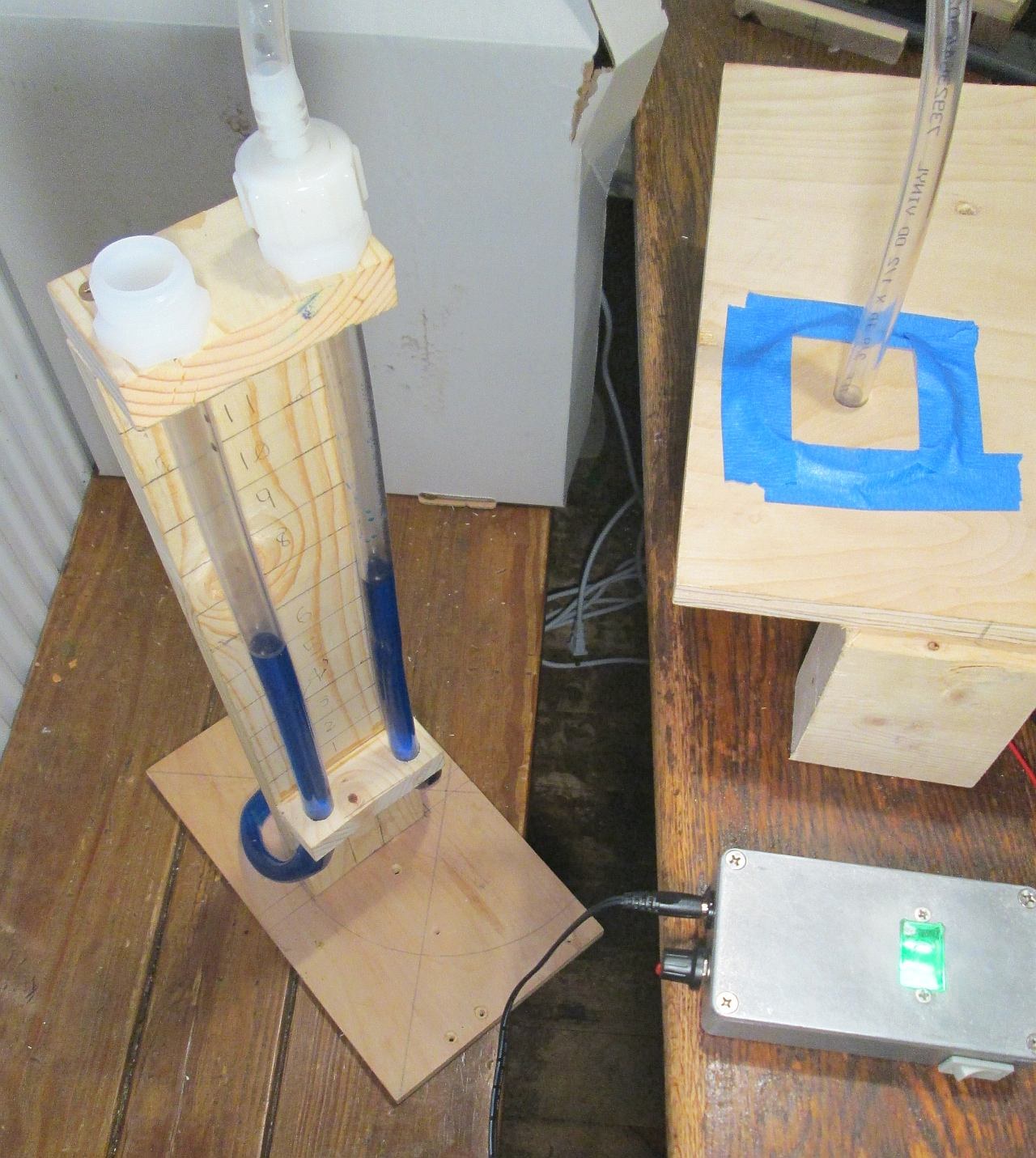
A pipe must be voiced and tuned at the same wind pressure it will actually play at — roughly 5 in H₂O (127 mm ≈ 1.245 kPa) for a small 20-note organ — because both tone and pitch depend on wind. The hobby-standard bench answer, and the canonical method for this whole dive, is Tony Goldsworthy’s manometer rig (jsart26): an air-mattress or foot inflator pump feeds a length of PVC wind pipe, which is teed into a U-tube water manometer so the operator can read the gauge and hold it while working the pipe. Two failures are avoided at once:
- Moisture. Blowing a thin (2–3 mm) wooden pipe by mouth loads the walls with exhaled water vapour; the wood swells, the voicing shifts under the hand, and over time the walls can warp (jsart26). A dry pump never does this.
- Unsteady pressure. No one can hold a constant pressure by lung, and both tone and pitch ride on the wind, so a mouth-blown judgement is being made against a moving target. The manometer turns the pressure into a number you can hold.
Wind pressure itself — where the 5 in H₂O comes from, how the bellows and reservoir hold it flat — is owned by Wind Systems; this dive uses the one gauge figure and the instruction “voice at your organ’s own pressure,” and points there for the rest.
1.2.4 The rule in one line, to keep
Warm the organ, hold the wind on a manometer, get every pipe speaking and balanced, and only then set its pitch — once, at a reference you keep identical across the whole instrument.
1.3 The toolkit
The bench kit for tuning and voicing a small crank organ is short and mostly cheap. The one item that must be chosen with care is the tuner.
1.3.1 The tuner — range is the specification that matters
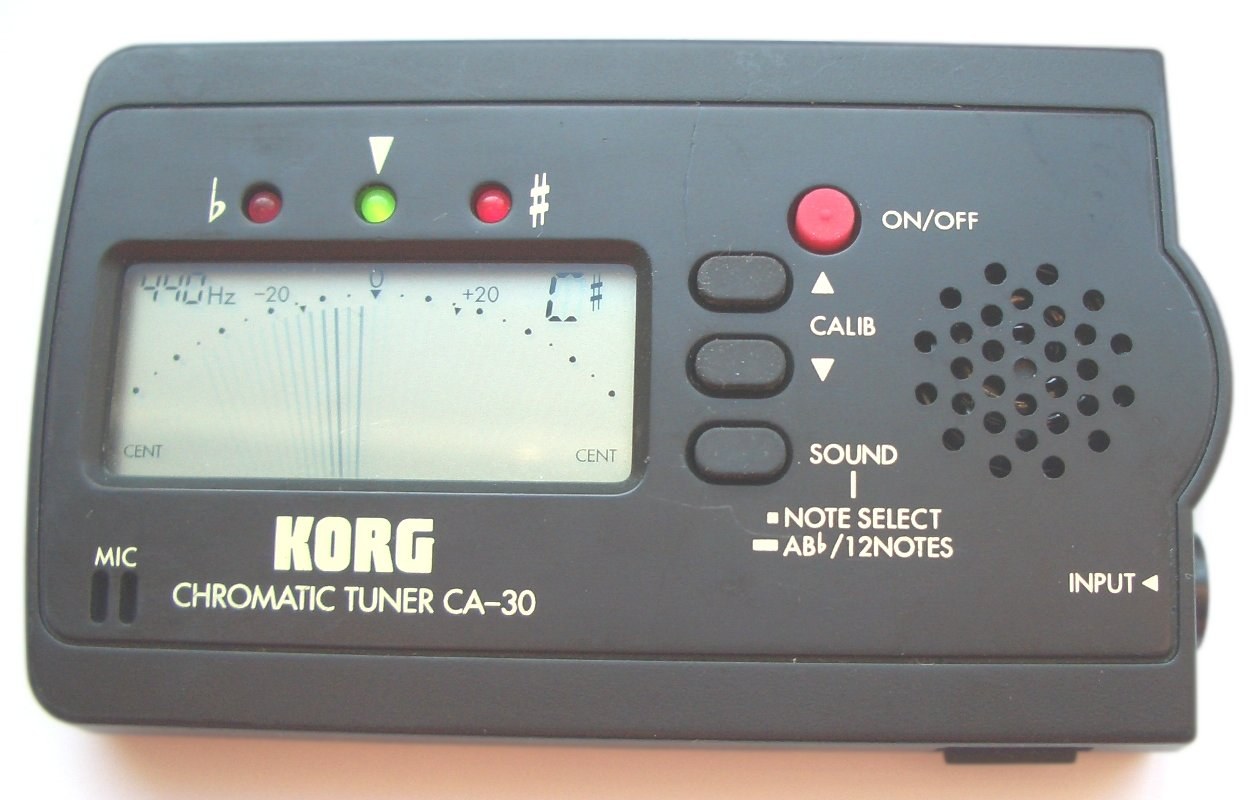
Tuning is done against a chromatic electronic tuner, ideally a strobe type for resolution. The specification that matters is range: the tuner must read every note the organ can sound, from the lowest bass pipe to the highest piccolo, and a crank organ spans several octaves. Guitar tuners are the classic mistake — they lack the range and simply will not register the extremes of the compass (O’Rourke, tuning.htm). A general-purpose chromatic instrument tuner or a strobe tuner (hardware or a well-reviewed software/phone strobe) with a stated wide range is the correct tool. A tuner that can be offset to a chosen reference (A=442, 443, 445, and so on) is strongly preferred, because these organs are rarely at concert A=440 — see §5.
1.3.2 The wind rig — pump and manometer
The voicing bench is the manometer rig of §2.3: an inflator pump (air-mattress or foot type) and a U-tube water manometer teed into the wind line, so pipes are worked at a held gauge near 5 in H₂O (127 mm) (jsart26). This is not optional equipment for a serious job — it is the difference between voicing against a number and guessing.
1.3.3 The hand tools
Everything else is small hand tools. Long-nose pliers pull a wooden stopper (grip it sideways so as not to crush it; push it back in with the fingers or a soft hammer) (O’Rourke). Small needle files cut and adjust nicks, dress a languid, or scratch a free reed. A soft mallet or soft hammer taps a stopper home without denting it. To these add the usual bench consumables — a fine-tip marker or pencil (the hobby sources darken a lower lip with pencil to change airflow), thin PVA for sealing pipe interiors, and beeswax for mounting a free-reed plate — which the voicing volumes call out where they are used.
Table 1 — 3.3 The hand tools
| Tool | Job in this dive | Note |
|---|---|---|
| Chromatic / strobe tuner, wide range | Setting and checking pitch (tuning pass) | Must cover the whole organ’s compass; guitar tuners lack the range (O’Rourke). Prefer one offset-able to A=442/443/445. |
| Inflator pump (air-mattress / foot) | Supplies steady, dry wind for voicing and tuning | Half of the “not by mouth” rule (jsart26). |
| U-tube water manometer | Reads and holds the working pressure (~5 in H₂O / 127 mm) | Teed into the wind line; the number you voice against (jsart26). |
| Long-nose pliers | Pulling/adjusting wooden stoppers | Grip sideways; push back with fingers or soft hammer (O’Rourke). |
| Small needle files | Nicking, dressing lips/languid, scratching free reeds | Light, repeated cuts; reversible only in one direction (metal removed stays removed). |
| Soft mallet / soft hammer | Seating a stopper without denting | Wood-on-wood or faced; never a steel face on a wooden stopper. |
| Marker/pencil, thin PVA, beeswax | Airflow tweak, sealing pipe walls, mounting a reed plate | Called out per-task in Vols 4–5. |
Figure 2. The manometer bench rig and the hand kit. The inflator pump feeds a wind line teed into a U-tube water manometer, so the pipe under test is voiced and tuned at a read, held gauge of about 5 in H₂O (127 mm) rather than by an unsteady, moisture-laden mouth (jsart26). The tuner, chosen for its range, does the pitch pass.
1.4 How this dive relates to its siblings
This dive does not stand alone. It sits in a program of interlocking dives and is deliberately scoped so that each body of knowledge lives in exactly one place.
1.4.1 What this dive takes in
It picks up the finished pipe rank produced by the build dives — Building Organ Pipes, The John Smith Universal Organ, and The Hobby Crank Organ — and brings it to pitch and speech. Building Organ Pipes makes the pipes and hands them over; the shared geometry numbers (cut-up no more than one third of the mouth width; the frein plate 0.5–1 mm thick at a 9° cut; the free-reed build figures) are stated identically in both dives because they come from the same sources (jsart42, jsart51, the Höffle violin-pipe page). Where Building Organ Pipes covers making the pipe, this dive covers bringing the made pipe to pitch and speech.
1.4.2 What this dive owns for the others
This dive owns temperament theory for the whole program. Building Organ Pipes deliberately does not derive the cent, equal temperament, or the temperament comparison — it defers all of that to here, so Vol 2 of this dive delivers it in full: the cent (1200 to the octave, 100 to the equal-tempered semitone), the beat rate as the difference of two frequencies, and why equal temperament is the right choice for a fixed mechanical organ whose pipes cannot be retuned per key and every one of whose transposed rolls must sound alike. If a sibling dive needs the temperament argument, it points here.
1.4.3 What this dive defers to the others
Symmetrically, this dive refuses to re-derive what it does not own:
- How Organ Pipes Make Sound owns the physics — edge tone and the air jet, standing waves, why an open pipe sounds near c/2L and a stopped pipe near c/4L (an octave lower on odd harmonics at roughly half the length), why raising the cut-up trades brightness for body, why nicking calms the attack, the Töpfer halving number h = 17, end correction, and how a reed is excited. Every “why does this adjustment do that” in the voicing volumes cross-refers there.
- Wind Systems owns wind pressure and the bellows/reservoir. This dive uses only the single gauge figure (~5 in H₂O = 127 mm ≈ 1.245 kPa) and the instruction to voice at the organ’s own pressure, and points there for how that pressure is made and held.
Kept this way, the reader who wants the derivation knows exactly which dive to open, and this dive stays a bench manual rather than a textbook it does not need to rewrite.
1.5 Reference pitch: standard vs. actual
A word on the target the tuning pass aims at, because it surprises newcomers. The standard reference is A4 = 440 Hz, defined internationally as ISO 16. But crank organs are very rarely tuned to concert A=440. Much of continental Europe builds sharp of it — A=442 and A=443 are ordinary in Germany, Austria, and the Netherlands — and Raffin crank organs run higher still, with most new ones measured at about A=445 (O’Rourke, tuning.htm). The practical rule is therefore not “tune to 440”; it is:
- The absolute pitch is arbitrary within reason — pick one that suits the organ and the pipes as built.
- But it must be identical across the entire instrument. Every pipe is tuned to the same reference; an organ that is internally consistent at A=443 is in tune with itself, while one that mixes references is not, however close any single pipe is to 440 (O’Rourke). This is why a tuner that can be offset to the chosen reference (§3.1) matters: set it once, and tune the whole organ against that one number.
Vol 2 gives the theory behind the reference-pitch standard and the equal-temperament scale it anchors.
1.6 Note-count is not pipe-count
One counting distinction must be fixed before the later volumes, because it changes how many pipes there actually are to voice and tune. A crank organ is rated in notes — the number of distinct tonal steps the tracker bar can call, which is also the number of scale positions. But the number of pipes is larger, often much larger, than the note count, for two reasons:
- Doubled pipes. On the Carl Frei / Raffin 20-note scale, each bass note is doubled (two pipes sound it together for weight), and there are nine paired melody pipes — so even a single-rank 20-note organ has well more than 20 pipes (O’Rourke).
- Multiple ranks. An organ with several registers — say stopped flutes, an open flute, a violin (string) rank, and a piccolo — sounds each note on every rank that is drawn, multiplying the pipe count by the number of ranks. The John Smith Universal build, for instance, carries several ranks across a 20-note (Carl Frei / Raffin) and 26-note (Alderman) compass, so its pipe count runs to dozens beyond its note count.
The scale names are fixed across the whole program and used exactly: the 20-note scale is the Carl Frei / Raffin scale; the 26-note scale is the Alderman scale. Never “20 pipes” for a 20-note organ. When Vols 3–6 say “tune the rank” or “balance the rank,” the rank in question may hold two or three times as many pipes as the organ has notes — and every one of them is voiced and tuned individually, with the doubled pipes tuned to zero beat against each other and any celeste/undulant rank deliberately detuned a few cents for a gentle waver (Vol 6).
1.7 Roadmap — Vols 2 to 7
This volume drew the boundary between the two crafts and stated the rule that orders them. The remaining six volumes work through the theory, the tools, and the bench procedures in the order a job is actually done.
-
Vol 2 — Temperament, Cents & Beats. The theory this dive owns: the harmonic series and how beats arise; the cent (1200 to the octave, 100 to the equal-tempered semitone, the ratio and the cents formula, all recomputed on the page); just versus meantone versus well versus equal temperament, and why equal temperament is right for a fixed mechanical organ — stated precisely, with every major third slightly wide and every fifth slightly narrow as the price of using every key alike; the beat rate = the frequency difference and zero-beat tuning; and A=440 as ISO 16 against the A=442/443/445 these organs actually use.
-
Vol 3 — Setting Pitch, Pipe by Pipe. How the pitch is actually moved in each family: stopped (slide the stopper — in shortens the column and raises pitch, out lowers it; trim stoppers to near-equal length afterward), open flue (tuning slide, tuning cone, or cut-to-length; a piccolo without a stopper is tuned by bending the metal tab), string/violin (coarse by the slide, octave-and-fine by the frein), beating reed (move the tuning wire), and free reed (scratch the tongue — tip to raise, middle/base to lower). Plus the temperature dependence in full: flues sharp when warm, reeds barely moving, and how to keep the families together.
-
Vol 4 — Voicing Flue Pipes. The bench levers of tone and speech on the manometer rig: cut-up (no more than one third of the mouth width; higher is flutier, louder, and slower to speak, lower is brighter, stringier, and chiffier), nicking the flue edge (more nicking calms the chiff, light or none leaves a lively attack), the upper lip (rounded is smoother, sharp is keener), flueway width and foot hole for loudness and jet velocity, and balancing the rank so no pipe dominates.
-
Vol 5 — Voicing & Tuning Reeds. The beating reed (tongue, shallot, boot, tuning wire) and the hobbyist’s practical free-reed “melodica trumpet”: use the air-out reed; a factory A=420 reed sits about 20 cents sharp at A=440 and is scratched down at the middle of the tongue over 3–4 mm to a few cents above zero; the cardboard resonator is then tuned to the reed with a sliding stopper. Reed-versus-flue temperature drift and how to hold the two families together.
-
Vol 6 — The Tuning & Voicing Session. The whole thing in order for a complete organ: warm to room temperature, choose one reference pitch, voice each rank on the manometer, tune each rank against the tuner, set the doubled pipes to zero beat, detune the celeste/undulant rank a few cents for a matched, pleasant waver, balance the ranks against one another, and keep the finished organ in tune against seasonal and temperature drift. A worked walkthrough on a 20-note (Carl Frei / Raffin) organ.
-
Vol 7 — Reference & Cheatsheet. The cents table and the cents-to-beats helper at A=440; the equal-temperament interval table; the temperament comparison (reference only); the pitch-method-by-family table; a voicing-effects table; a faults-and-fixes table; a glossary; a cross-index to Vols 1–6 and the sibling dives; and the bibliography.
Read in order, the six volumes take a freshly built, silent rank of pipes and leave a crank organ that is in tune with itself, speaks promptly, and blends — which was the goal set out at the top of this volume, and the reason the two crafts exist.
Comments (0)