Tuning And Voicing · Volume 6
Tuning & Voicing — Vol 06: The Tuning & Voicing Session
The five volumes before this one took the two crafts apart. Vol 1 drew the line between voicing (tone, loudness, prompt speech) and tuning (pitch) and stated the rule that orders them; Vol 2 delivered the temperament theory this dive owns — the cent, the beat, equal temperament, and the cents-to-beats helper at A=440; Vol 3 walked through how pitch is actually moved in each pipe family; and Vols 4 and 5 covered voicing the flue pipes and the reeds respectively. Each of those volumes looked at one lever, one pipe, or one idea in isolation. This volume puts them back together and asks the question a hobbyist standing in front of a finished but untuned instrument actually needs answered: in what order, and by what steps, does one take a complete organ from silent-on-the-bench to in-tune-and-speaking?
The answer is presented here as a single worked session — a numbered, start-to-finish walkthrough — carried out on one specific instrument so that the sequence is concrete rather than abstract. The specimen is a 20-note Carl Frei / Raffin organ, the small busker/street organ this whole program is built around. The volume does not re-teach the detail of the earlier volumes; it references them by number at each step and concentrates on sequencing, decisions, and the things that only become visible when the whole organ is treated as one job — choosing and committing to a reference pitch, ordering voicing before tuning across every rank, zero-beating the doubled pipes, deliberately detuning a celeste rank, balancing rank against rank, and then keeping the finished instrument in tune through the seasons.
The golden rule, one more time, because it is the skeleton of the session. Voice first, tune last, in a stable temperature, by pump-and-manometer — never by mouth (Vol 1; jsart26). Everything below is that sentence expanded into a procedure.
6.1 The specimen on the bench
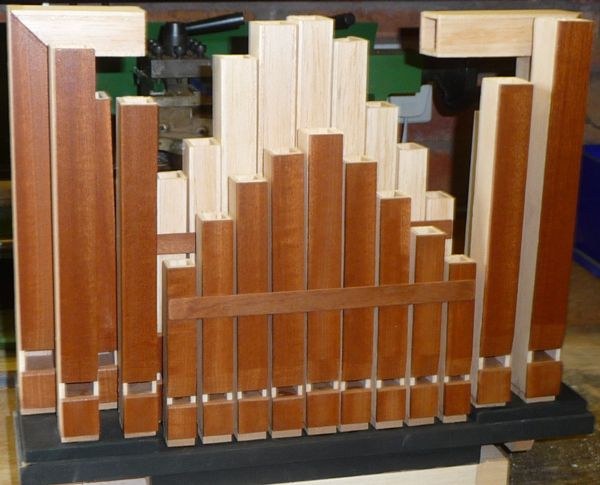
The worked example is a single-manual 20-note Carl Frei / Raffin organ with a modest register scheme typical of the class: a stopped (gedeckt) flute rank as the foundation, an open flute or violin/string rank drawn against it, and — for this walkthrough — a lightly celeste (undulant) treatment on part of the melody so the session exercises every decision the craft contains. The exact registers matter less than the counting discipline they force.
Note-count is not pipe-count (Vol 1 §6). The organ is rated at 20 notes — 20 tonal steps the tracker bar can call — but it holds far more than 20 pipes. On the Carl Frei / Raffin scale each bass note is doubled (two pipes voiced and tuned to sound one note together, for weight), and there are nine paired melody pipes as well (O’Rourke, tuning.htm). Add a second drawn rank and the pipe count runs to two or three times the note count. The practical consequence for the session is that “tune the rank” never means “tune 20 pipes”: it means voice and tune every physical pipe individually, then tune each doubled pair to zero beat with its mate, and — where a celeste is wanted — deliberately detune the secondary pipe of a pair a few cents so it wavers (§6). The session is planned around pipes, not notes.
6.2 Stage 0 — Preparation
Nothing is adjusted in this stage. Its entire purpose is to remove the variables that would otherwise corrupt every later judgement: an unstable temperature, an unsteady or moisture-laden wind supply, an inadequate tuner, and — the one decision that governs the whole day — an uncommitted reference pitch.
6.2.1 Bring the organ to a stable room temperature and let it settle
Flue pipes go sharp when warm and flat when cold (Vol 3). The reason belongs to the acoustics dive — the speed of sound rises with the square root of absolute temperature while the pipe’s resonating length is essentially fixed — but the direction and the size of the effect are the session’s concern. As a working figure, a 10 °C change shifts a flue rank by very roughly 30 cents, about 3 cents per °C (est.), which is far larger than the fraction of a cent a careful tuning aims for. A rank tuned in a cold garage and then played in a warm hall will be audibly sharp; a rank tuned while the room is still warming will have its early pipes set against a different pitch than its late ones.
The preparation, therefore, is simple and non-negotiable:
- Move the organ into the room it will be tuned in and leave it to reach that
room’s temperature before touching a pipe. A large wooden instrument brought in
from a different temperature needs time — allow it to settle, not merely to be
carried in (an hour or more for a substantial change is a reasonable rule of thumb
(est.)). - Tune in a room whose temperature is not drifting across the hours the session takes. Sun moving onto the bench, a heater cycling on and off, or an evening chill arriving mid-session all reintroduce the very variable this stage exists to remove.
- Tune at the temperature the organ will be played at where that is known. This matters most for an instrument that mixes a flue rank with a free-reed rank (Vol 5): reeds barely move with temperature, so if the room is warm the flues run sharp while the reeds stay put and the two families separate. The two are brought together only at the temperature they will both be heard at.
Never tune a cold organ, and never begin the tuning pass while the room is still changing.
6.2.2 Ready the wind rig and the tuner
Set up the bench exactly as Vol 1 §3 specifies, because the whole session depends on its three instruments.
- The manometer rig. An inflator pump (air-mattress or foot type) feeds the wind line, teed into a U-tube water manometer so each pipe is worked at a read, held gauge near the organ’s own pressure — about 5 in H₂O (127 mm ≈ 1.245 kPa) for a small 20-note organ (jsart26; the pressure itself is owned by Wind Systems). This is what keeps the “not by mouth” half of the rule: a dry pump loads no moisture into the thin wooden walls, and the manometer turns the pressure into a number that can be held rather than a lungful that cannot.
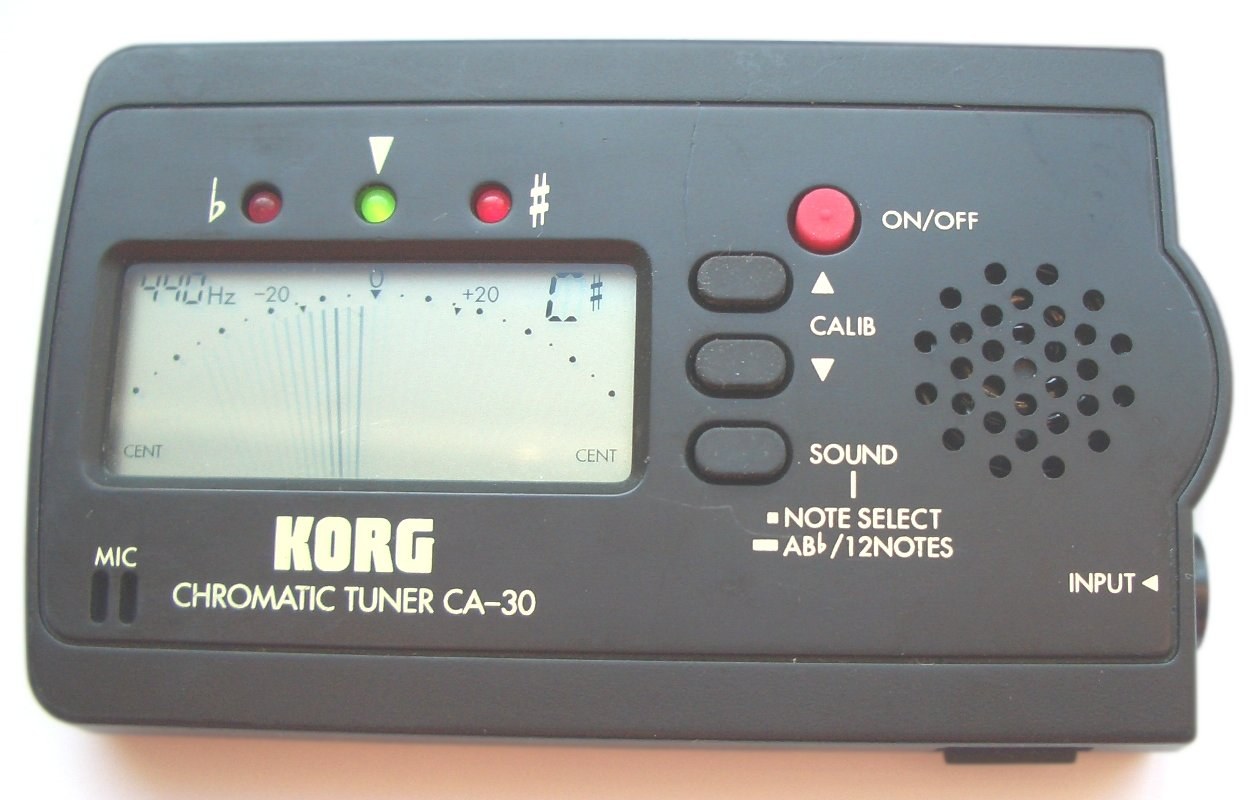
- The tuner. A chromatic electronic tuner, preferably a strobe for resolution, chosen for the one specification that matters — range. It must read every note from the lowest bass pipe to the highest melody pipe or piccolo, a span of several octaves. Guitar tuners are the classic mistake; they lack the range and will not register the extremes of the compass (O’Rourke, tuning.htm). The tuner must also be offset-able to the chosen reference (A=442, 443, 445, and so on), because these organs are rarely at concert A=440 — which is the next decision.
- The hand kit. Long-nose pliers for the stoppers, small needle files for nicks and reeds, a soft mallet, a pencil or marker, thin PVA and beeswax — all as Vol 1 §3.3 lists, called out per task in the voicing volumes.
6.2.3 Choose one reference pitch and commit to it
This is the single most consequential decision of the session, and it is made once, before any pipe is tuned, and never revisited during the job.
The standard reference is A4 = 440 Hz (ISO 16), but crank organs are very rarely at concert pitch. Continental European practice runs sharp of 440 — A=442 and A=443 are ordinary — and Raffin organs run higher still, most new ones measured at about A=445 (O’Rourke, tuning.htm). The governing principle, stated in Vol 1 §5 and repeated here because the whole session hangs on it, is:
The absolute pitch is arbitrary within reason, but it must be identical across the entire organ (O’Rourke).
An organ internally consistent at A=443 is perfectly in tune with itself; an organ whose bass was set to 440 and whose melody drifted to 444 is out of tune with itself, however close any single pipe sits to a “correct” number. The practical procedure:
- Measure where the organ already is. Sound a few well-behaved pipes on the manometer at the organ’s own pressure and read the tuner. New Raffin-scale organs commonly land near A=445; a given instrument may be anywhere in the 442–445 band.
- Pick a reference that the pipes as built can actually reach without fighting them. Vol 3 gives the tell: if a violin/string pipe will not come down to pitch even with its frein (brass tab) flush, the chosen reference is too low for that pipe as built — choose a pitch the whole rank can meet.
- Set the tuner’s offset to that reference and leave it there for the rest of the session. Every pipe, every rank, every doubled pair is tuned against that one number. Writing the chosen reference on a piece of tape stuck to the bench is a cheap insurance against setting it back to 440 by reflex halfway through.
6.3 The order of operations
With the preparation done, the session runs the golden rule as a sequence. The whole of it is drawn in Figure 6.1; the numbered stages that follow expand each box.
Figure 6.1. The session as a flowchart. Stage 0 removes the variables and, crucially, commits to one reference pitch. Stage 1 voices every rank (pitch is allowed to wander). Stage 2 tunes — working up the scale, zero-beating the doubled pipes, and detuning any celeste pair for a matched waver. Stage 3 balances rank against rank, proves the work on a full roll, and finishes the stoppers. The heavy boxes are the decisions unique to treating the organ as one whole instrument.
6.4 Stage 1 — Voice every rank
Voicing comes first and is finished before a single note is tuned, because voicing drags pitch with it (Vol 1 §1.3): raising a cut-up, changing a foot hole, moving a languid, or scratching a reed all shift the pitch the pipe sounds, so any tuning done before voicing is thrown away the moment the voicing changes. The detail of the levers lives in Vols 4 and 5; this stage is about doing them across the whole organ, in order, on the manometer.
6.4.1 Get every pipe speaking promptly
Working rank by rank on the manometer rig at the organ’s own pressure, bring every pipe to prompt, clean speech (Vol 4). On the flue pipes the levers are the cut-up (no more than one third of the mouth width — jsart42), the nicking of the flue edge (more nicking calms the chiff, light or none leaves a lively attack — C.B. Fisk), the upper lip, the flueway width and the foot hole. On the reeds it is the tongue curvature and, on the hobbyist’s free-reed “melodica trumpet,” a light scratch of the tongue (Vol 5). The target at this point is not pitch — it is that each pipe starts the moment wind arrives, without lag and without an ugly explosive spit, and settles straight onto a note.
6.4.2 Balance loudness within each rank
The second half of voicing is balance: no pipe within a rank may dominate its neighbours (Vol 4). A rank in which one pipe is markedly louder than the rest sounds like a row of strangers rather than one voice, and the loud pipe will punch through every chord it appears in. Loudness is trimmed with the foot hole and flueway (Vol 4) until, played up and down the scale, the rank reads as an even whole. This is done within each rank now; balancing one rank against another comes later, in Stage 3, once every rank is individually even and in tune.
A note on discipline: it is tempting, when a pipe sounds close to pitch, to nudge it onto the tuner during voicing. Resist it. Pitch set now is provisional and will be disturbed by the very next voicing move. Voicing judges speech and loudness; tuning is a separate, later pass. Keeping them separate is the entire reason the session has stages.
6.5 Stage 2 — Tune the rank against the tuner
Only when every pipe in every rank speaks promptly and the ranks are internally balanced does the tuning pass begin — the organ warm and settled, the wind held on the manometer, the tuner set to the one chosen reference (§2.3). The mechanism for moving each pipe’s pitch is the business of Vol 3 and is only named here: a stopped pipe by sliding its stopper (in shortens the column and raises pitch, out lowers it), an open flue by its speaking length (a tuning slide, a tuning cone, or cut-to-length; a piccolo without a stopper by bending the metal tab), a string/violin pipe by its slide for coarse pitch and its frein for the octave and fine control, a beating reed by its tuning wire, and a free reed by scratching the tongue (tip to raise, middle/base to lower). This stage concerns the order in which those adjustments are applied across the organ.
6.5.1 Work up the scale, pipe by pipe
Tune systematically up the scale, one pipe at a time, sounding each against the tuner on the manometer and moving it onto the chosen reference. Working in scale order — lowest to highest — rather than hopping about makes drift and mistakes easy to catch: a run of pipes reading consistently sharp says the reference or the temperature has shifted, not that one pipe is wrong. On the Carl Frei / Raffin scale the note sequence itself is fixed (Vol 3), but the pipe sequence includes the doubled bass and the paired melody pipes, so “up the scale” means visiting each physical pipe, its double included.
6.5.2 Tune the doubled pipes to zero beat
The doubled bass pipes and the nine paired melody pipes present a tuning target the tuner alone cannot resolve finely enough — and here the ear beats the meter. Two pipes sounding the same note interfere, and the interference is heard as a beat whose rate is the difference of their two frequencies, |f₁ − f₂| (Vol 2). As the two are brought together the beat slows; when they are identical the beat vanishes. Zero beat is the definition of a unison in tune (Vol 2; Wiki: Beat). So a doubled pair is tuned by first setting each pipe roughly onto the reference with the tuner, then sounding the two together and adjusting the mate until the throb slows to nothing. The pair then reads as one reinforced voice rather than two pipes — which is the whole reason bass and melody notes are doubled.
The ear resolves a slow beat far more precisely than it resolves an absolute pitch: a wavering once every four seconds is a one-cent error at A=440 (Vol 2), well below what a tuner needle shows cleanly, yet plainly audible as a slow pulse. Zero beat is therefore not just a tuner reading confirmed — it is a finer criterion than the tuner can give.
6.5.3 Detune the celeste rank for a matched waver
A celeste (undulant) rank inverts the previous step: instead of tuning a pair to zero beat, its secondary pipe is deliberately detuned a few cents sharp of its primary so that the pair beats on purpose, producing a gentle, shimmering waver (O’Rourke, tuning.htm). This is not an error — it is the effect the rank exists to produce, and beats are used here as the tuning tool, not the error signal.
Two things make a celeste sound well:
- The detune is small and consistent. A “few cents” — roughly 2 cents — of sharpening gives a waver of about one swell every two seconds at A=440 (Vol 2), the slow, pleasant undulation a celeste is voiced for. More than that and the shimmer coarsens into an audible out-of-tune-ness.
- The beat speed is matched across the rank. The aim is the same waver rate from bottom to top of the celeste (O’Rourke). Because a fixed cent-offset gives a larger frequency difference — and so a faster beat — at higher pitches, matching the heard waver across the compass means the tuner offset in cents is a starting point that the ear then evens out pipe to pipe. O’Rourke’s method is direct: tap the celeste pipe’s stopper to sharpen it until the waver appears, then adjust until its speed matches the neighbouring celeste pairs; too far and it “gets faster … until out of tune.”
Figure 6.2 draws the two cases side by side — the zero-beat double and the detuned celeste — with the cents-to-beats numbers at A=440 that set the target waver.
Figure 6.2. The beat as error signal and as effect. Left: a doubled pair tuned to zero beat sums to a steady tone and reads as one reinforced voice. Right: a celeste mate detuned by about 2 cents beats at roughly half a hertz — one swell every two seconds at A=440 — a shimmer produced on purpose and matched in speed across the rank (O’Rourke, tuning.htm). The table recomputes Δf = 440·(2^(c/1200) − 1) and its period 1/Δf; near A=440, one cent of error is about 0.254 Hz, one beat every four seconds (Vol 2).
6.6 Stage 3 — Balance, prove, and finish
The pipes now speak well and sit on their pitches, each rank internally even and in tune. Three finishing tasks remain, and they are the ones that only make sense with the whole organ in front of the operator.
6.6.1 Balance rank against rank
Each rank was balanced within itself during voicing (§4.2); now the ranks are balanced against one another so that, when several are drawn together, none swamps the rest (Vol 4; jsart19 describes the same task on a multi-rank 26-note build). A stopped-flute foundation should support rather than be buried by an open or string rank drawn over it; a bright rank added for colour should add colour, not take over. Loudness is trimmed with the foot holes as in Vol 4, judged by ear with the ranks played together up and down the compass. This is deliberately left to the end: a rank cannot be balanced against another until both are individually even and in tune, or the operator is chasing a moving target.
6.6.2 Play the whole roll
The proof of the session is not the tuner reading on isolated pipes — it is the organ playing its music. Run a complete roll (or book, or MIDI file) through the instrument at its normal wind and listen to the whole thing. This is where the faults that a pipe-by-pipe pass hides reveal themselves: a chord in which one pipe arrives late or too loud, a doubled pair that beats faintly under a sustained note, a celeste whose waver is uneven across a run, a note that speaks cleanly alone but not in a fast passage. Each such fault is traced back to the relevant stage — speech and balance to Stage 1, pitch and zero-beat to Stage 2 — and corrected, then the roll is played again. The organ is finished when a full roll plays cleanly, not when the last pipe passed the tuner.
6.6.3 Trim the stoppers to near-equal length
A cosmetic-sounding step with a practical point. After tuning, the movable stoppers of a stopped rank will sit at different heights — each was slid to whatever position put its pipe on pitch. Once tuning is complete and confirmed, the stopper lengths are trimmed so that all the stoppers in a rank end up at roughly equal length (en_pijp). This is done after tuning, never before, because trimming a stopper before the pitch is settled would simply mean cutting it twice. It tidies the rank, makes a future touch-up easier to read at a glance, and is the conventional finishing mark of a properly tuned stopped rank.
6.7 The session checklist
The whole session, condensed to a bench card. Each row names the stage, the action, and the earlier volume that carries the detail.
Table 1 — 7. The session checklist
| # | Stage | Action | Detail in |
|---|---|---|---|
| 0.1 | Prep | Settle the organ to a stable room temperature; do not tune cold or while the room is drifting | Vol 3 |
| 0.2 | Prep | Rig the inflator pump + U-tube manometer; hold the organ’s own pressure (~5 in H₂O / 127 mm) | Vol 1 §3; jsart26 |
| 0.3 | Prep | Ready a wide-range chromatic/strobe tuner (not a guitar tuner) | Vol 1 §3; O’Rourke |
| 0.4 | Prep | Choose ONE reference pitch (A=442/443/445 as the organ was built); set the tuner offset; keep it all session | Vol 1 §5; O’Rourke |
| 1.1 | Voice | Bring every pipe in every rank to prompt, clean speech (cut-up, nicking, lip, foot hole; tongue/scratch for reeds) | Vols 4–5 |
| 1.2 | Voice | Balance loudness within each rank so no pipe dominates | Vol 4 |
| 2.1 | Tune | Work up the scale, pipe by pipe, onto the chosen reference on the manometer | Vol 3 |
| 2.2 | Tune | Tune each doubled bass/melody pipe to zero beat with its mate | Vol 2; O’Rourke |
| 2.3 | Tune | Detune each celeste secondary pipe a few cents (~2 c) for a matched waver | Vol 2; O’Rourke |
| 3.1 | Finish | Balance rank against rank so none swamps the others when drawn together | Vol 4; jsart19 |
| 3.2 | Finish | Play a whole roll; trace and fix any fault; replay until clean | — |
| 3.3 | Finish | Trim the stoppers of each rank to near-equal length (after tuning only) | en_pijp |
6.8 Keeping an organ in tune
A finished organ does not stay finished by itself. Wood, wind, and weather all move it, and the maintenance craft is knowing which movements are ignorable, which want a quick touch-up, and which mean the organ is telling the operator it needs real work again.
6.8.1 Seasonal and temperature drift
The dominant, unavoidable movement is temperature drift, and it is the same mechanism the preparation stage guarded against (§2.1; Vol 3). Flue pipes go sharp when warm and flat when cold, at very roughly 3 cents per °C (est.); reeds barely move. The important consequence for a mixed-family organ is not that the whole instrument drifts — a flue-only organ that drifts uniformly is still in tune with itself, just at a slightly different overall pitch — but that the families separate. In a warm hall the flues run sharp while the reeds stay put, so the reeds sound flat against the flues; in a cold one, the reverse. There is no tuning that removes this; there is only tuning the families together at the temperature the organ will be played and accepting that a large temperature change will part them again until it is corrected (Vol 5).
Table 2 — 8.1 Seasonal and temperature drift
| Cause | What moves | Fix |
|---|---|---|
| Warm room / hot day | Flues go sharp; reeds barely move → reeds sound flat vs. flues | Let it settle to playing temperature; if the split remains, touch-up the reeds to the flues at that temperature |
| Cold room / cold day | Flues go flat; reeds barely move → reeds sound sharp vs. flues | As above, at the actual playing temperature |
| Season change (months) | Slow humidity + temperature swing; wood moves; overall pitch and balance wander | Periodic touch-up tuning; re-zero-beat the doubles; re-check the celeste waver |
| A single pipe drifts alone | Usually a stopper that has crept, or a frein/wire that has shifted | Reset that one pipe (Vol 3); no full pass needed |
| Rough handling / transport | Stoppers knocked, freins bent, a pipe unseated | Reseat and touch-up the affected pipes; check the doubles beat clean again |
6.8.2 Touch-up tuning versus a full re-voice
Most maintenance is a touch-up: the organ has drifted a little or a few pipes have crept, and the fix is to warm it to playing temperature, set the tuner to the organ’s existing reference (not a new one), and correct the pipes that have moved — re-zero-beating any doubled pairs and re-checking that the celeste waver is still even. A touch-up changes pitch only; it does not touch voicing, and it follows the same “warm, on the manometer, one reference” discipline as the original tuning pass in miniature.
A full re-voice — going back to Stage 1 — is warranted only when the speech or balance has degraded, not merely the pitch: pipes that have become slow or breathy, a rank that no longer balances, walls that have swelled or a languid that has shifted so a pipe no longer speaks as it did. That is a change in tone, and tone is voicing, so it re-enters the session at Stage 1 and runs through to Stage 3 again — voice first, tune last, exactly as the first time. The tell is simple: if pipes are on the wrong pitch the organ needs tuning; if pipes sound wrong, it needs voicing.
6.8.3 Storage and humidity
Between outings, the organ is best kept where the earlier work is least disturbed: a stable, moderate temperature and humidity, out of direct sun and away from heat sources that cycle. The pipes are thin wood; large humidity swings swell and shrink the walls and eventually move both voicing and tuning (jsart26 makes the same point about moisture and thin walls in the context of not mouth-blowing). An organ stored somewhere stable and brought to playing temperature before use will need only occasional touch-ups; one stored in a damp shed or a baking loft and played straight from storage will drift, split its families, and in time need real re-voicing. Good storage is, in effect, the cheapest tuning maintenance there is.
6.9 Closing
The session, seen whole, is the golden rule carried out at the scale of an entire instrument. Preparation removes the variables and commits — once — to a single reference pitch. Voicing brings every pipe to prompt, balanced speech, pitch allowed to wander. Tuning then sets pitch: up the scale against the tuner, the doubled pipes to zero beat, the celeste pair detuned a few cents for a matched waver. Balancing, proving on a full roll, and trimming the stoppers finish it. And the keeping of it in tune is the same craft in miniature, run whenever temperature and season have moved the pipes — a touch-up for pitch, a return to Stage 1 for tone.
Read against Vols 1 through 5, this volume adds no new lever; every adjustment it calls for was taught earlier. What it adds is order — the sequence and the whole-organ judgements that turn a box of individually correct pipes into a crank organ that is in tune with itself, speaks promptly, and blends, which was the goal set out in Vol 1. Vol 7 gathers the numbers, tables, and glossary the session leans on into a reference to keep on the bench.
Comments (0)