The Case Facade And Figures · Volume 7
The Case, Façade & Figures — Vol 07: Reference & Cheatsheet
This is the reference apparatus for the dive: the tables, the glossary, the cross-index and the bibliography that the preceding six volumes draw on. It is meant to be read at the bench or printed and carried. Nothing new is argued here; every figure is consolidated from Vols 1 to 6 and cited back to the same sources. Where a value is inferred rather than read off a page it is marked (est.), and where the deep survey belongs to another dive that is stated rather than reproduced.
Three things live in one small wooden box and are kept distinct throughout: the case (the structural, mildly acoustic box that carries the chest, wind and music medium and protects the pipes), the façade (the decorative front — display pipes, fretwork, name board, crest), and the figures (moving automata driven off the crank or by a dedicated mechanism). The melright.com “busker” articles are a contributor anthology, so each is cited by article plus author (for example “jsart11, Ken Rawlings”); hobbycrankorgan.com is cited by page (for example “en_31toets”). All dimensions carry both imperial and metric.
7.1 Case, façade and figures at a glance
The one-page summary below is the whole dive compressed to a card. Each panel names the job, the governing material or mechanism, and the volume that treats it in full.
7.2 Case materials and wall thickness
The box is sheet stock — plywood for the structure, MDF for anything carved, solid wood for anything seen. The governing wall gauge is about ¼″ (6 mm) in plywood, the John Smith Universal case figure (JS Universal): thick enough that a screwed-and-glued box does not drum when the crank turns and the bellows pulse, thin enough to stay portable. Front and decorative boards run thinner because their framing and glued-on scrollwork stiffen them. Pipe-wall gauge (1/8″ and less) is a pipe-making decision and belongs to the Building Organ Pipes dive, not here.
Table 1 — 2. Case materials and wall thickness
| Material | Thickness | Where it is used | Source token |
|---|---|---|---|
| Baltic birch plywood | ¼″ (≈6 mm) | The structural box — walls, floor, lids | JS Universal |
| Baltic birch plywood | 1/8″ (≈3 mm) | Pipe walls (Building Organ Pipes dive, not the case) | JS Universal |
| ”Concrete” (film-faced) plywood | ≈ box gauge (est.) | Smooth-faced case, South-German / Black-Forest look | en_31toets |
| Plywood backboard | 6 mm (≈¼″) | Decorative front board | jsart11, Ken Rawlings |
| Plywood, layered relief front | 3/32″ (≈2.4 mm) | Scroll-sawn front, layered up for relief | jsart38, “Daniel” |
| MDF | 10, 12, 15 mm (≈3/8, 1/2, 5/8″) | Bandsawn/carved scrollwork; carved bandmaster | jsart11, Ken Rawlings |
| Pine (solid) | — | Fretsawn front scrolls | jsart11, Ken Rawlings |
| Mahogany (solid) | ¼″ (≈6 mm) | Corner spandrels | jsart11, Ken Rawlings |
| Walnut (solid) | — | Display-pipe fronts (the real speaking rank) | JS Universal |
Notes on reading the table. “Concrete plywood” is a film-faced ply prized for its very smooth face; its gauge is not stated on the source page and is taken as box gauge (est.). The two plywood thicknesses that matter for the case are the ¼″ (6 mm) structural wall and the 6 mm front backboard; the 3/32″ (2.4 mm) figure is a front-relief ply, not a structural gauge. Solid woods appear only as show parts. Full treatment is in Vol 2 §1 (materials) and §1.5 (wall thickness).
7.3 Cart and trolley options
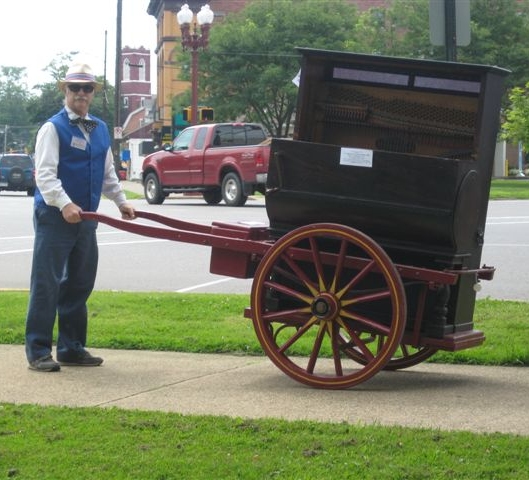
A small crank organ is built to be carried, and on the street it rides a cart. The size band for “small crank organs” is ~12 × 8 × 10 in to ~24 × 8 × 10 in (30 × 20 × 15 cm to 60 × 40 × 30 cm) (jsart98, Wallace Venable). The all-up weight of a 20-note pipe busker organ is ~10–15 kg (est.): the source gives ~150 lb (60–70 kg) only for a barrel piano, a much heavier instrument, so that figure must not be carried over to a small pipe organ.
Table 2 — 3. Cart and trolley options
| Cart type | Wheels | Folds? | Notes | Source token |
|---|---|---|---|---|
| Two-wheel hand-truck | 2, large | Tips back | The traditional street rig; big wheels for rough ground / tram rails; long handles | jsart98, Venable |
| Four-wheel German cart | 4 | No | Free-standing; needs a parking brake; skids on tight corners; ≈ US $1000 delivered from a builder | jsart98, Venable |
| Folding cart | 2–4 | Yes | Packs small for transport | jsart98 |
| Box-cart | 2–4 | Converts | A carrying case that converts into a cart | jsart98, jsart67 |
| Golf-trolley conversion | 2 | Yes | Cheapest amateur route; a light folding frame plus a platform | jsart112 |
| 13.5″ (≈343 mm) lawn-mower wheels | — | — | Big, cheap, tough wheels for a home-built frame | jsart98 |
The 31-note “concrete plywood” build bolts to its cart with two screws (en_31toets), which is a good template: the cart is a separate sub-assembly the case sits on, not part of the case. Full treatment is in Vol 2 §4.
7.4 Façade motif and proportion guide
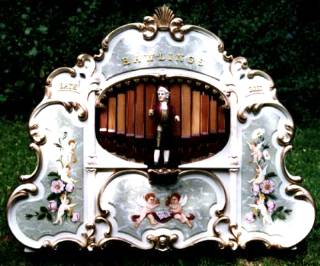
The hobby fair-organ front of record is modelled on the 46-key Chiappa organs and measures 30″ × 24″ (≈760 × 610 mm) (jsart11, Ken Rawlings). The classical vocabulary below is documented on that hobby front; the deep proportion canon is fairground tradition (est.) and its full survey is deferred to Dive 14 (Fairground & Dutch Street Organs, forthcoming). The one hard acoustic point: on a small busker or street organ the display pipes are usually the real speaking pipes — the pan-flute / piccolo rank on the front with wooden bass beneath (Wikipedia, “Street organ”; JS Universal walnut fronts). Dummy (mute) pipes are chiefly a grand-front space-filler (OrganTutor; Organ Forum) and are rare on a busker front.
Table 3 — 4. Façade motif and proportion guide
| Façade element | What it is | Speaking or decorative? | Source token |
|---|---|---|---|
| Display-pipe field | The central rank shown on the front | Speaking (busker norm) | Wikipedia Street organ; JS Universal |
| Bass pipes (below/behind) | The large low pipes | Speaking | Wikipedia, “Street organ” |
| Fretwork / grille / pipe-shade | Pierced panel framing/crowning the mouths | Decorative — kept acoustically open (est.) | jsart11; OHS works09 |
| Central name board | Lettered board naming the organ / builder | Decorative | jsart11; jsart60 |
| Columns / pilasters | Vertical framing members | Decorative (framing) | jsart11 (est.) |
| Arch(es) | Arched head over field or name board | Decorative | jsart11 (est.) |
| Corner spandrels | Carved corner triangles beside an arch/scroll | Decorative | jsart11, Ken Rawlings |
| Floral scrolls / cherubs | Foliate ornament and figurework | Decorative | jsart11, Ken Rawlings |
| Carved crest / cresting | The top ornament crowning the front | Decorative | jsart11 (est.); Dive 14 |
| Gilded lettering | The organ’s name in gold | Decorative | jsart11 (24-ct leaf) |
| Dummy (mute) pipe | A non-speaking decorative pipe | Decorative — a grand-front device (Dive 14) | OrganTutor; Organ Forum |
Speaking versus dummy, stated plainly. A façade pipe “may be either a sounding pipe or a dummy pipe solely for decoration” (OrganTutor; Organ Forum); dummies fill space in a mostly-speaking front on a large organ. A busker front is small enough that its front rank is the speaking melody rank, so the norm runs the other way — the front shows the pipes that actually sound. A grille or pipe-shade over the mouths must stay acoustically open: sound projects “through the opening in the front of the case” (OHS works09), so the front is dressed but not boxed in — the “don’t choke the pipe mouths” guidance is an (est.) inference cross-referenced to the acoustics and wind dives. Full treatment is in Vol 4.
7.5 Decoration routes
Four documented routes take a bare front to a finished one, sorted by the skill they demand. They are not exclusive — a builder can carve the scrollwork and decoupage the panels — but each stands on its own.
Table 4 — 5. Decoration routes
| Route | Skill demanded | Tools / materials | Finish & durability | Source token |
|---|---|---|---|---|
| Carve & gild | High — carving, painting, gilding | Bandsaw / fretsaw; MDF, pine, mahogany; enamels & household paint; 24-ct gold leaf | Most original and convincing; sealed with Danish oil / varnish; durable | jsart11, Ken Rawlings; jsart38 |
| Bauernmalerei (laser-print transfer) | Medium — colouring, not drawing | Laser print + thinner to transfer the outline; then hand-colour | Folk-painted look without freehand drawing; varnish over | en_31toets |
| Decoupage (Mod-Podge) | Low — no carving or drawing | Colour-laser-printed art (better water resistance than ink-jet); Mod-Podge (PVA); varnish; gold-painted end frames | Printed art under glue and varnish; a printed name badge & builder’s plate; weather-resistant if sealed | jsart60, Wallace Venable |
| Resin-cast | Low–medium — casting, not carving | Silicone moulds; casting kit; primer, paint, gilding | A reproducible figure or ornament for the non-carver; paint & gild to match the front | jsart109, John Smith |
A short skill key: a confident carver-painter takes the carve-and-gild route; a builder who can colour but not draw takes Bauernmalerei; a builder who neither carves nor draws takes decoupage; a builder who wants a figure but cannot carve one buys the resin-cast conductor and drives it per Vol 6. Danish oil, varnish, acrylic craft paint and gold leaf are the common finishes throughout (jsart11, jsart38, jsart60). Full treatment is in Vol 5.
7.6 Figure-drive mechanisms
A figure is driven one of two ways: off the crank or driveshaft (so it moves in time with the music) or by a dedicated mechanism (so it performs on demand, independent of playing — usually coin-triggered). The four documented drives sort cleanly, and none is a variant of another; the comparison keeps each attributed to its own source so the mechanisms are never cross-attributed.
Table 5 — 6. Figure-drive mechanisms
| Figure drive | How it works | Crank-driven or dedicated | Source token |
|---|---|---|---|
| Crankshaft linkage | Brass link over the crankshaft end (cotter pin) → vertical pivot arm / bell-crank on a pivot block → long horizontal connecting rod that reciprocates → an actuator flaps a wing; a “C”-shaped cam on the wing dowel drives a lever to open the beak; a frog’s throat is a see-saw off the front bellows frame | Crank-driven | jsart38, “Daniel” |
| Driving-wheel drive rod | A 1/8″ (≈3.2 mm) brazing-rod drive rod off a driving wheel rocks a detachable figure held in a cradle through one lever; throw set by mocking up in wood and panel pins; the figure stands on the fixed lid | Crank-driven | jsart14, Bernard Pilgrim |
| Motor + eccentric + coin | A gear-driven eccentric self-aligning bearing rocks the figure continuously; a Bowden cable raises the hat; floppy-drive motors on a 12 V battery with gearing and limit switches; a coin micro-switch feeds a capacitor-slugged relay; the ply box slots into side brackets | Dedicated (coin-triggered) | jsart55 |
| Resin control-arms | The figure is sculpted then resin-cast from silicone moulds with built-in control arms that beat time and move the head | Dedicated figure (crank or motor drive by choice) | jsart109/122, John Smith |
7.6.1 The mechanism vocabulary
The terms below are the working parts named across the four drives. They are the same words a machinist or clockmaker would use, and using them correctly keeps a build description unambiguous.
- Crank / eccentric — a rotary-to-reciprocating drive. A crank is an offset pin on a shaft; an eccentric is an offset disc in a bearing. Both turn steady rotation into back-and-forth (or rocking) motion (jsart38; jsart55).
- Cam — a shaped profile on a shaft (or dowel) that programs a follower’s motion: the “C”-shaped piece that opens the beak is a cam (jsart38).
- Connecting rod / pushrod — a rod that carries motion from one point to another, reciprocating along its length (jsart38, jsart14).
- Pivot arm / bell-crank / lever — a pivoted arm that changes the direction or leverage of a motion; a bell-crank turns motion around a corner (jsart38, jsart14).
- Linkage — the whole chain of rods and levers taken together (jsart38).
- Bowden cable — a sheathed pull-cable for remote actuation, such as raising the monkey’s hat from the drive box (jsart55).
The monkey — the organ-grinder’s monkey — is the archetypal figure this vocabulary serves, and it recurs across the whole busker corpus (jsart55; and jsart02/46/74 for further monkey builds). Full treatment is in Vol 6.
7.6.2 Figure-drive family tree
7.7 The professional benchmark — the Jäger & Brommer Karakuri organ
The professional benchmark for a small figure-carrying crank organ is the Jäger & Brommer Karakuri organ (Waldkircher Orgelbau Jäger & Brommer, Waldkirch; the firm founded 1988 by Wolfgang Brommer and Heinz Jäger). The figures below are verified from the maker’s page and are kept identical to the Hobby Crank Organ dive.
Table 6 — 7. The professional benchmark — the Jäger & Brommer Karakuri organ
| Attribute | Value | Status |
|---|---|---|
| Scale | 31 notes (hand-crank) | Verified (waldkircher-orgelbau.de) |
| Registers | 5 | Verified |
| Additional controls | 10 | Verified |
| Automaton | An automatic bird | Verified |
| Occasion | World Karakuri Contest, Sunday 18 September 2005, EXPO grounds, Nagoya, Japan | Verified |
| Selection | From 600+ worldwide applications, alongside 11 other international makers (~12 total) | Verified |
| Pipe count | ”111 pipes” | (est.) — unverified; the maker’s page states no pipe count |
The one figure to flag every time it is quoted is the pipe count: the maker’s page gives no pipe count, so “111 pipes” is an estimate and unverified. The firm is a professional builder, never a hobby-site author. Full treatment is in Vol 6 §6 (and in the Hobby Crank Organ dive).
Glossary
Definitions are the verified terms used across Vols 1–6, each cited to its source. Spellings to keep exact: façade, Bauernmalerei, decoupage, spandrel, automaton / automata, Chiappa, Karakuri, Jäger & Brommer, Waldkirch.
Table 7 — 8. Glossary
| Term | Definition | Source token |
|---|---|---|
| Case (cabinet) | The structural box carrying the chest, bellows and roll/book frame and protecting the pipes; historically a sculptural, architectural object; mildly acoustic (blends ranks, projects forward through the front opening) | OHS works09 |
| Façade (front) | The decorative front of the case — display pipes, fretwork, scrollwork, name board, crest; on a fair organ “designed to attract attention” | Wikipedia, Fairground organ |
| Display pipe | A pipe shown on the front; on a busker/street organ usually the real speaking front rank (pan-flute/piccolo, wooden bass beneath) | Wikipedia, Street organ; JS Universal |
| Dummy (mute) pipe | A non-speaking façade pipe “solely for decoration,” filling space in a mostly-speaking front — chiefly a grand-organ device | OrganTutor; Organ Forum |
| Fretwork / grille / pipe-shade | A pierced or carved panel over the pipe mouths — decorative but kept acoustically open so the front can speak | OHS works09; jsart11 |
| Name board | The lettered board naming the organ/builder; hobby version fretsawn ply gilded in 24-ct leaf, or a printed name badge / builder’s plate | jsart11; jsart60 |
| Crest / cresting | The carved top ornament crowning the front (fairground tradition, est.; Dive 14) | jsart11 (est.) |
| Spandrel | The carved corner triangle beside an arch or scroll; hobby version fretsawn from ¼″ mahogany | jsart11 |
| Bauernmalerei | South-German / Black-Forest folk (farmer) painting used to decorate a case | en_31toets |
| Decoupage | Non-carver decoration — printed art glued down and varnish-coated (Mod-Podge / PVA) | jsart60 |
| Automaton / figure | A moving figure on the organ — monkey, bandmaster/conductor, bird, dancer | Wikipedia; jsart11/14/38/55/109 |
| Cam | A shaped profile on a shaft converting rotation into a programmed motion (e.g. the “C”-piece opening a beak) | jsart38 |
| Crank / eccentric | A rotary-to-reciprocating drive; the eccentric bearing that rocks the monkey | jsart38; jsart55 |
| Connecting rod / linkage / bell-crank | Rods and pivoted levers transmitting the drive to the figure | jsart38; jsart14 |
| Bowden cable | A sheathed pull-cable for remote actuation (raising the monkey’s hat) | jsart55 |
| Cart / trolley | The wheeled carrier — 2-wheel hand-truck, 4-wheel German cart, folding / box-cart, golf-trolley conversion | jsart98; jsart112 |
7.8 Cross-index
7.8.1 Topics within this dive (Vols 1–6)
Table 8 — 9.1 Topics within this dive (Vols 1–6)
| Topic | Volume(s) |
|---|---|
| The three jobs; case vs façade vs figures; design tradition in brief | Vol 1 |
| Hobby craft vs the professional benchmark; scale / pipe-count consistency | Vol 1 |
| Case materials and wall thickness | Vol 2 §1 |
| The two lids; groundplate and wind path | Vol 2 §2 |
| Weight, size band and portability | Vol 2 §3 |
| Cart / trolley options and mounting | Vol 2 §4 |
| The case’s acoustic role (stated carefully) | Vol 2 §5 |
| Internal layout and packaging; the vertical stack | Vol 3 |
| Keeping the front pipes speaking; mitring bass pipes to clear moving parts | Vol 3 §5–§6 |
| Speaking vs dummy display pipes | Vol 4 §1 |
| Fretwork / grille / pipe-shade kept acoustically open | Vol 4 §2 |
| Proportion and motif; the 30″×24″ Chiappa front | Vol 4 §3 |
| Carving, gilding, painting; the maker’s route | Vol 5 §2–§4 |
| Bauernmalerei, decoupage, resin-cast (non-carver routes); finishes | Vol 5 §5–§8 |
| Mechanism vocabulary; the two drive families; the four drives | Vol 6 §1–§4 |
| The “monkey” archetype; the Karakuri benchmark | Vol 6 §5–§6 |
7.8.2 To the sibling dives (Mechanical Organs program)
Table 9 — 9.2 To the sibling dives (Mechanical Organs program)
| For… | See dive |
|---|---|
| Pipe-wall gauge, pipe construction, pipe materials | Building Organ Pipes |
| Tuning and voicing the pipework | Tuning & Voicing |
| Bellows, reservoir, wind pressure (~5 in H₂O = 127 mm ≈ 1.245 kPa) | Wind Systems |
| The roll/book music medium and how the notes are encoded | Encoding the Music |
| Why and how an organ pipe speaks (pipe acoustics) | How Organ Pipes Make Sound |
| The worked example whose case is ¼″ Baltic birch ply with walnut speaking fronts | The John Smith Universal Organ |
| Walter Höffle’s 20-note build path; the Karakuri benchmark (identical numbers) | The Hobby Crank Organ |
| The grand fairground / Dutch-street proscenium, maker survey and proportion canon | Fairground & Dutch Street Organs (Dive 14, forthcoming) |
7.9 Bibliography
7.9.1 melright.com / busker (contributor anthology; cite by article + author)
Fetch with curl -sk http://www.melright.com/busker/PAGE.htm (self-signed TLS
cert). Article index: jsmenu.htm.
- jsart11 — Ken Rawlings, Decoration tips & a “Fair Organ” front (the 46-key
Chiappa 30″×24″ front; scrollwork, spandrels, gilded lettering, carved
bandmaster).
http://www.melright.com/busker/jsart11.htm - jsart14 — Bernard Pilgrim, Detailed plans for animated figures
(driving-wheel drive rod; cradle and lever; the two lids).
http://www.melright.com/busker/jsart14.htm - jsart38 — “Daniel”, Animated ‘Storybook’ organ front (the crankshaft
linkage; cuckoo, nightingale and frog; the beak cam).
http://www.melright.com/busker/jsart38.htm - jsart55 — Anthony Ashe, Mechanical Monkey (motor + eccentric + coin trigger;
Bowden-cable hat).
http://www.melright.com/busker/jsart55.htm - jsart60 — Wallace Venable, Decoupage Organ Decoration (Mod-Podge over
laser-printed circus-poster art; name badge and builder’s plate).
http://www.melright.com/busker/jsart60.htm - jsart98 — Wallace Venable, Carts for Small Organs (hand-truck vs German
cart; size band; lawn-mower wheels).
http://www.melright.com/busker/jsart98.htm - jsart109 / jsart122 — John Smith Conductor Project (resin-cast conductor
with control arms; installation).
http://www.melright.com/busker/jsart109.htm - Further cart and figure builds — jsart67 / jsart95 / jsart112 (box-cart /
organ cart / golf-trolley conversion); jsart02 / jsart46 / jsart74 (animated
monkey / figure ideas).
http://www.melright.com/busker/jsmenu.htm
7.9.2 hobbycrankorgan.com (cite by page)
- en_31toets — the author’s 31-note build: “concrete plywood” case, layered
leak-tested groundplate, cart mounting with two screws, and Bauernmalerei by
laser-print transfer.
http://www.hobbycrankorgan.com/subdir/en_31toets.htm
7.9.3 Definitions and context
- OHS works09 — Organ Historical Society, “Organ Cases and Chambers” (the
case’s acoustic role for cased organs).
https://organhistoricalsociety.org/OrganHistory/works/works09.htm - OrganTutor — speaking vs dummy façade pipes.
https://organ.byu.edu/(organ_types). - Organ Forum — speaking vs dummy façade pipes.
https://organforum.com/ - Wikipedia, “Street organ” (front pan-flute rank, wooden bass, automata);
“Fairground organ” (front designed to attract attention; automata; makers —
context, deferred to Dive 14).
https://en.wikipedia.org/wiki/Street_organ·https://en.wikipedia.org/wiki/Fairground_organ
7.9.4 The professional benchmark
- Jäger & Brommer Karakuri organ — Waldkircher Orgelbau Jäger & Brommer (31
notes / 5 registers / 10 controls / automatic bird; World Karakuri Contest, 18
September 2005, Nagoya EXPO; “111 pipes” est., unverified).
https://www.waldkircher-orgelbau.de/sonderinstrumente/karakuri.html·https://www.jaegerbrommer.de
7.9.5 Sibling dives (cross-ref, not re-derived)
Building Organ Pipes · Tuning & Voicing · Wind Systems · Encoding the Music · How Organ Pipes Make Sound · The John Smith Universal Organ · The Hobby Crank Organ · Fairground & Dutch Street Organs (Dive 14, forthcoming).
This volume closes the dive. The case is the structural box (Vols 2–3), the façade is the decorative front (Vols 4–5), and the figures are the moving automata (Vol 6); the three stay distinct, the busker front is usually speaking, the four figure drives are never cross-attributed, the Karakuri numbers match the Hobby Crank Organ dive with “111 pipes” flagged (est.), and the grand fairground and Dutch-street survey is left to Dive 14.
Comments (0)