The Case Facade And Figures · Volume 2
The Case, Façade & Figures — Vol 02: The Case as a Box
The case of a small hand-cranked busker organ is, before it is anything decorative, a box — a structural enclosure that has to carry the wind chest, the bellows and reservoir, the roll or book frame and the pipework, protect all of it, stay light enough for one person to move, and ride on a cart. This volume treats the case strictly as that box: what it is built from, how thick its walls are, how the working parts hang inside it, what it weighs, how it travels, and what (modest) acoustic job it does. The decorative front — display pipes, fretwork, name board, crest — is deferred to Vol 4, and the interior packaging of pipes and wind is developed in Vol 3. Pipe acoustics and wind pressure belong to the sibling dives “How Organ Pipes Make Sound” and “Wind Systems” and are only pointed to here, never re-derived.
The through-line is that the case is a spatial-engineering problem dressed up as a piece of furniture. A person has to be able to lift and wheel it; the wind system has to fit and stay airtight; the pipes have to sit where they can speak out of the front; the music medium (roll or book) has to load and run; and a figure may need a flat platform to stand on. All of that is negotiated inside a box roughly the size of a large suitcase.
2.1 What the box is made of
2.1.1 Plywood dominates
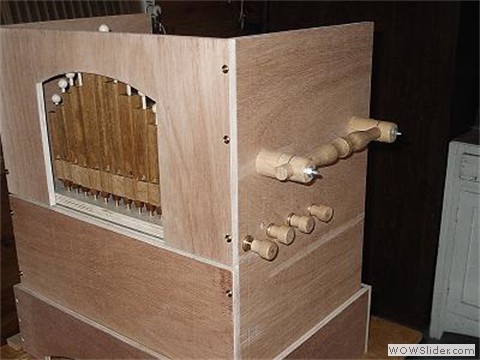
For the structural box, thin plywood is the default across the whole hobby corpus, and Baltic birch plywood is the reference material. The John Smith Universal organ — the worked example this program keeps returning to — has its case built from ¼″ (≈6 mm) Baltic birch plywood, with the pipe walls in thinner 1/8″ (≈3 mm) Baltic ply and the displayed front pipes fronted in walnut (JS Universal). Baltic birch is favoured because it is dimensionally stable, void-free through its many thin plies, takes glue and screws in its edges without splitting, and finishes cleanly — all useful properties in a thin-walled box that must not warp, rack or leak.
The Dutch-tradition 31-note build documented on hobbycrankorgan.com uses what its author calls “concrete plywood” — a very smooth-faced plywood (the phrase refers to the film-faced shuttering ply sold for concrete formwork, prized here for its flat, hard, paint-ready surface), giving the case a “south German design (Black Forest)” look (en_31toets). The point of interest for a builder is the smooth face: a good painted or folk-painted finish (Vol 5) wants a substrate that does not telegraph grain or voids, and a film-faced ply delivers that without filling.
For the decorative front board — strictly a Vol 4 subject, but worth noting here because it is still sheet stock — the hobby fair-organ front is built on a 6 mm plywood backboard (jsart11, Ken Rawlings), while the animated ‘Storybook’ front is worked in 3/32″ (≈2.4 mm) plywood, scroll-sawn and layered up for relief (jsart38). These thin plies are chosen for cutting and layering, not for structure.
2.1.2 MDF for carved and moulded work
Where the work is carved, shaped or moulded rather than structural, the corpus turns to medium-density fibreboard (MDF). Ken Rawlings bandsaws his front scrollwork from 10, 12 and 15 mm MDF, then carves it to shape and section and glues it to the plywood backboard; his bandmaster figure is carved from MDF and other woods (jsart11). MDF has no grain, so it carves and sands to a smooth relief in any direction and holds crisp moulded detail — exactly what scrollwork and a carved figure want, and exactly what one would not build a load-bearing, weight-critical box from, since MDF is heavy and weak in thin sections. The division of labour is clean: ply for the box, MDF for the carving.
2.1.3 Solid wood for show parts
Solid timber appears in the show parts — the pieces that are seen and that benefit from real grain or a hardwood edge. Rawlings fretsaws the big front scrolls from pine and cuts the corner spandrels from ¼″ (≈6 mm) mahogany (jsart11). The John Smith Universal fronts its speaking melody pipes in walnut (JS Universal). John Smith’s published pipe plans famously use balsa for the pipe bodies, and many builders substitute basswood — but those are pipe materials, covered in the Building Organ Pipes dive, not case materials. For the case proper, solid wood is a facing and detailing material: pine and mahogany for scrolls and spandrels, walnut for pipe fronts, chosen for looks and workability rather than for carrying load.
2.1.4 Materials at a glance
Table 1 — 1.4 Materials at a glance
| Material | Typical thickness | Where it is used | Source |
|---|---|---|---|
| Baltic birch plywood | ¼″ (≈6 mm) | The structural box (walls, floor, lids) | JS Universal |
| Baltic birch plywood | 1/8″ (≈3 mm) | Pipe walls (Building Organ Pipes dive, not the case) | JS Universal |
| ”Concrete” (film-faced) plywood | ≈ box gauge | Smooth-faced case, Black-Forest look | en_31toets |
| Plywood backboard | 6 mm | Decorative front board (Vol 4) | jsart11, Ken Rawlings |
| Plywood, layered | 3/32″ (≈2.4 mm) | Scroll-sawn relief front, layered up (Vol 4) | jsart38 |
| MDF | 10, 12, 15 mm | Bandsawn/carved scrollwork; carved bandmaster | jsart11, Ken Rawlings |
| Pine (solid) | — | Fretsawn front scrolls | jsart11, Ken Rawlings |
| Mahogany (solid) | ¼″ (≈6 mm) | Corner spandrels | jsart11, Ken Rawlings |
| Walnut (solid) | — | Display pipe fronts | JS Universal |
2.1.5 Wall thickness
The governing figure for the box is a wall thickness of about ¼″ (6 mm) in plywood — the John Smith Universal case gauge (JS Universal). It is a deliberate compromise: thick enough that a screwed-and-glued ply box is rigid and does not drum or flex when the crank is turned and the bellows pulse, thin enough that the whole instrument stays light. Front and decorative boards run thinner — 6 mm for a front backboard, down to 3/32″ (≈2.4 mm) for a layered relief front (jsart11, jsart38) — because those panels are stiffened by their framing and by the scrollwork glued to them, and because thin ply is what you want to scroll-saw and layer. Pipe walls are thinner still (1/8″ and less), but pipe-wall gauge is a pipe-making decision, not a case decision, and is left to the Building Organ Pipes dive.
Figure 2.1 — Materials and wall thickness. The structural box is roughly ¼″ (6 mm) Baltic-birch plywood; carved scrollwork is bandsawn MDF; show parts are solid pine, mahogany and walnut. Sources: jsart11 (Ken Rawlings), JS Universal, en_31toets.
2.2 How the innards mount
The case is not a shell wrapped around a finished mechanism; it is the chassis the mechanism is built onto. Four subsystems hang inside it — the wind chest, the bellows and reservoir, the roll or book frame, and the pipework — and the box’s job is to locate them, brace them and keep the wind path airtight. The detailed geometry (where each subsystem sits, the wind path, centre of gravity, loading access) is the subject of Vol 3; this section covers only the structural principle: how the box carries the innards and how its lids work.
2.2.1 The two lids
A recurring feature of these small organs is that the top of the case is made of two different lids doing two different jobs (jsart14, Bernard Pilgrim):
- A fixed lid closes over the pipes. It is a permanent part of the box, not meant to be opened in normal use, and — this is the elegant part — it doubles as the platform on which a moving figure stands (jsart14). The automaton (monkey, bandmaster, bird) needs a flat, rigid stage and a place to route its drive linkage down into the mechanism; the fixed pipe lid provides both. Bernard Pilgrim’s plans specifically note setting the automaton’s travel before slotting the lid, because the figure’s drive comes up through it — the figure and the lid are designed together (jsart14). The figure-drive mechanics themselves are Vol 6’s subject.
- A lifting lid gives access to the crank, driveshaft and driving wheels (jsart14). This is the lid you open to service the drive, adjust the figure linkage, or reach the driving wheels. Pilgrim’s catches for it are made from off-centre-drilled coins turned as cam catches — a characteristic amateur touch (jsart14).
The split is functional: the part of the top that carries the show (and must stay put) is fixed, and the part that must be opened for maintenance is hinged. Exactly how the lids are hinged, caught and sealed varies by design; specific hinge and catch hardware here is builder’s choice (est.).
2.2.2 The groundplate and the wind path
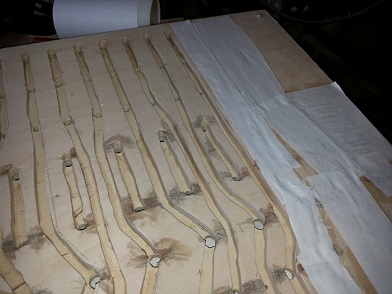
The most instructive account of how the box carries the wind path is the 31-note build (en_31toets). It is built on a layered groundplate: the base is made up in layers, and the air channels are jigsawn into the layers, then the whole thing is glued to the walls and papered over so the channels become sealed ducts running through the base. The papered-over channels are then tested for leaks before the build goes further (en_31toets). This is worth dwelling on because it shows the case doing structural and pneumatic duty at once: the floor of the box is not just a floor, it is a manifold, and the walls it glues to both brace the box and close the ducts. The principle generalises — a small organ’s base and lower case commonly carry wind between the reservoir, the chest and the pipe feet — but the exact channel layout is specific to each design and each note count.
Two things follow for the builder. First, airtightness is a case property, not just a bellows property: a leaking glued seam in the groundplate wastes wind exactly as a leaking bellows would, which is why the 31-note build leak-tests the papered channels before trusting them. (The wind budget itself — how much air the pipes draw and how the reservoir stabilises pressure — is the Wind Systems dive’s territory, at the program’s standard ~5 in H₂O ≈ 127 mm ≈ 1.245 kPa; it is not re-derived here.) Second, the specific internal fixings — how the chest is screwed down, how the reservoir is anchored, how the roll frame is bracketed — vary from plan to plan and are marked (est.) wherever a general statement is made; the reliable, sourced principle is only that the case carries all four subsystems and that its floor and walls may themselves form the wind path.
2.2.3 Cross-section of the box
Figure 2.2 — The case in cross-section. One box carries the wind chest and pipework, the bellows/reservoir and the roll/book frame, all standing on a layered groundplate whose jigsawn channels form part of the wind path. The fixed lid over the pipes doubles as the figure’s platform; a separate lifting lid gives access to the crank and driveshaft. Sources: jsart14 (Bernard Pilgrim), en_31toets. Interior packaging is developed in Vol 3.
2.3 Weight and portability
A busker organ is defined by the fact that it travels — it is carried to a pitch, played standing, and wheeled home. That makes size and weight first-order design constraints, not afterthoughts.
2.3.1 Size band
Wallace Venable’s survey of carts gives the working size band for “small crank organs” as roughly 12 × 8 × 10 in to 24 × 8 × 10 in — about 30 × 20 × 15 cm to 60 × 40 × 30 cm (jsart98, Wallace Venable). In plain terms: from something the size of a large lunch box up to something the size of a small suitcase or a milk-crate. The depth and height stay fairly constant (roughly a hand-span deep and shin-to-knee tall) while the width grows with the note count — a 20-note organ is narrower than a 31-note one because there are simply more pipes and more chest to fit across the front. This is the box a person must be able to lift onto a cart and steady while cranking.
2.3.2 Weight — and a caution about the 150 lb figure
A realistic weight for a small pipe busker organ of this size is on the order of 10–15 kg (≈ 22–33 lb) (est.) — light enough for one person to lift onto a cart, which is the whole point of the two-wheel-hand-truck tradition below. Wallace Venable’s cart survey does put a weight band on “small crank organs” — from about 7 lb (≈ 3 kg) to possibly over 100 lb (≈ 45 kg) (jsart98, Wallace Venable) — but that band is deliberately broad, spanning everything from a tiny 20-note box to a heavily built instrument. The 10–15 kg figure narrows it to a typical small pipe busker organ; because the source does not isolate that case, it is marked (est.) accordingly.
It is worth being explicit about a trap. The often-quoted ~150 lb (≈ 68 kg) weight belongs to a barrel piano, not to a pipe busker organ. A barrel piano carries a full iron-framed, strung piano action, which is enormously heavier than a handful of small wooden and thin-ply organ pipes on a small chest. Conflating the two would overstate a pipe busker organ’s weight by roughly a factor of five and misrepresent how it is carried. The small pipe organ is a one-person lift; the barrel piano is not. Anyone sizing a cart or a lifting handle should use the 10–15 kg (est.) order of magnitude, not the barrel-piano number.
2.3.3 Portability features
Portability shows up in the case itself, not only in the cart. Lifting handles are fitted — Rawlings uses “Magnet” kitchen-cupboard handles as lifting handles (jsart11) — and the box is kept to the size band above precisely so that a fitted handle and a person’s two hands are enough. The operating (crank) handle is itself made portable and stowable; Rawlings saws his from 1/8″ brass sheet to a swan-neck profile (jsart11). None of these is structurally deep, but together they are what makes the box a thing one person actually moves.
2.4 The cart or trolley
Below a certain distance a small organ is carried; beyond it, it is wheeled. The cart is therefore part of the instrument’s design, and the hobby corpus documents a clear range of options (jsart98, Wallace Venable, and the related cart articles jsart67/jsart95/jsart112).
2.4.1 The two-wheel hand-truck tradition
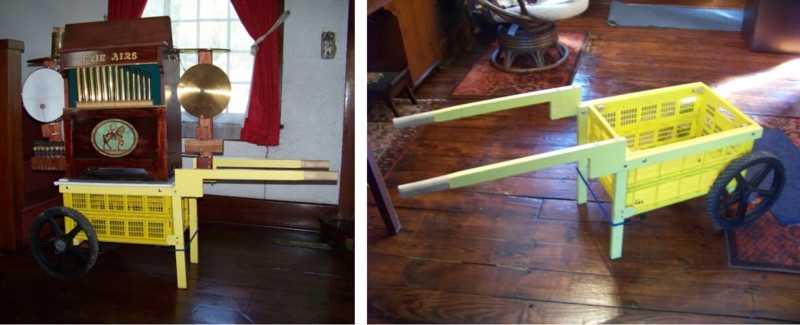
The traditional street instrument rides a two-wheel hand-truck — essentially a sack-barrow purpose-shaped for the organ, with large-diameter wheels and long handles (jsart98). The large wheels are not cosmetic: they roll over rough ground and across tram rails and cobbles without jamming, which a small caster cannot do, and the long handles give the leverage to tip the balanced load back and walk it. This is the classic organ-grinder’s rig, and for a light box (Section 3.2) it is entirely sufficient — the organ is tipped back onto the two wheels and wheeled like a hand-truck, then stood up and played.
2.4.2 The modern four-wheel German cart
The late-twentieth-century German crank-organ cart is a four-wheel, non-folding design (jsart98). Four wheels make the organ free-standing and stable to play from, but the trade-offs are real: because it does not fold it is bulky to transport and store, it needs a parking brake to stop it rolling while played, and it skids or scrubs its wheels on tight corners (a four-wheel cart with fixed axles does not turn as cleanly as a two-wheeler pivots). Bought complete from a major builder it runs to about US $1000 delivered (jsart98) — which is a large fraction of a hobby organ’s cost and a big reason builders make their own.
2.4.3 Folding and box-cart designs
Because the four-wheel cart’s bulk is its weakness, folding versions exist, and a particularly neat idea is the box-cart: a carrying case that converts into a cart (jsart98, and the box-cart build jsart67). The organ travels inside its carrying case; at the pitch, the case unfolds or reconfigures into the wheeled stand the organ plays from. One object does two jobs — transport container and playing cart — which is exactly the kind of packaging economy that suits a one-person instrument.
2.4.4 Amateur conversions
The cheapest routes are conversions of existing wheeled goods. A golf trolley adapted as an organ cart is documented (jsart112) — a golf trolley is already a light, folding, two-wheel frame with a handle, so it needs only a platform to carry the organ. Builders also fit 13.5″ (≈343 mm) lawn-mower wheels (jsart98) — large, cheap, tough pneumatic-or-solid wheels that bring the two-wheel tradition’s rough-ground advantage to a home-built frame.
2.4.5 Mounting the organ to the cart
How the box attaches to the cart can be as simple as it sounds: the 31-note build bolts its case to the cart with just two screws (en_31toets). Two fixings are enough because the organ’s weight sits it down onto the cart platform and the screws only have to stop it sliding or lifting; more elaborate mounts are a matter of preference (est.).
Figure 2.3 — Four cart traditions. The two-wheel hand-truck (large wheels, long handles) for rough ground; the four-wheel German cart (stable but non-folding, needs a brake, ≈ US $1000); the folding box-cart that converts from carrying case to cart; and the cheap golf-trolley conversion (often on 13.5″ lawn-mower wheels). Sources: jsart98 (Wallace Venable), jsart67, jsart112.
2.4.6 Cart options at a glance
Table 2 — 4.6 Cart options at a glance
| Cart type | Wheels | Folds? | Notes | Source |
|---|---|---|---|---|
| Two-wheel hand-truck | 2, large | Tips back | Rough ground / tram rails; long handles; the traditional street rig | jsart98 |
| Four-wheel German cart | 4 | No | Free-standing; needs a parking brake; skids on tight corners; ≈ US $1000 delivered | jsart98 |
| Folding / box-cart | 2–4 | Yes | Carrying case converts to cart; packs small for transport | jsart98, jsart67 |
| Golf-trolley conversion | 2 | Yes | Cheapest; a light folding frame + a platform | jsart112 |
| 13.5″ lawn-mower wheels | — | — | Big cheap tough wheels for a home-built frame | jsart98 |
2.5 The case’s acoustic role — stated carefully
It is tempting to credit the case with shaping the sound. That claim has to be made carefully, because what is authoritatively documented is about large cased pipe organs, and its application to a small busker box is much more limited.
2.5.1 What is established (for large cased organs)
The Organ Historical Society’s account of organ cases and chambers describes the case, for a full cased organ, as “a resonating chamber in which the sounds produced by different ranks of pipes are blended,” and as “a means for projection of the sound of the pipes forward into the room through the opening in the front of the case”; the interior surfaces should be reflective, and taller pipes are placed toward the front (OHS works09). For a room-sized organ with many ranks in a built architectural case, that is a genuine acoustic function: the case blends the ranks and throws the combined sound forward through the front opening.
2.5.2 What that means for a small busker box (modest, and marked)
For a small hand-cranked busker organ, this role is modest. The box has only a handful of pipes and a shallow interior; it is not a room-scale resonating chamber. Its dependable jobs are the structural ones this volume has described — it houses and protects the pipework and gives the front rank an opening to speak through. The one design guideline that carries over cleanly from the OHS principle is directional and defensive rather than tonal: keep the front acoustically open and do not box the pipe mouths in — because projection is “through the opening in the front of the case,” anything that seals or muffles the pipe mouths (a solid front, a choked grille) will dull and quieten the organ. Even that guideline is an (est.) inference applied to the small box; a fretwork grille over the mouths is fine so long as it stays open (the grille and its acoustics are Vol 4).
Any stronger claim — that the small case acts as a swell box, tunes or colours the tone, or deliberately shapes the sound beyond keeping the front open — is not supported for a busker organ and is marked (est.) wherever it might be inferred. The pipes make the sound (see “How Organ Pipes Make Sound”); the wind system feeds and steadies them (see “Wind Systems”); the case, on this scale, mainly gets out of the way and points the sound forward. Those two sibling dives own pipe acoustics and wind respectively and are not re-derived here.
Figure 2.4 — The case’s acoustic role. For a large cased organ the enclosure is a resonating chamber that blends the ranks and projects the sound forward through the front opening, with reflective interior surfaces (OHS works09). For a small busker box the role is modest: house and protect the pipes and keep the front acoustically open (est.). Pipe acoustics and wind are covered in the sibling dives, not here.
2.6 Summary
The case is the chassis of the instrument. It is built as a light, rigid box — about ¼″ (6 mm) Baltic-birch plywood for the structure (JS Universal), a smooth film-faced “concrete” ply where a paint-ready face is wanted (en_31toets), MDF for carved scrollwork and solid pine, mahogany and walnut for show parts (jsart11; JS Universal). It carries the wind chest, the bellows and reservoir, the roll or book frame and the pipework, standing on a layered groundplate whose jigsawn, papered, leak-tested channels may themselves form the wind path (en_31toets); its top is split into a fixed lid over the pipes that doubles as the figure’s platform and a lifting lid over the crank and drive (jsart14). It stays inside a size band of roughly 12 × 8 × 10 in to 24 × 8 × 10 in and weighs on the order of 10–15 kg (est.) — a one-person lift, and emphatically not the ~150 lb of a barrel piano — so it can ride a two-wheel hand-truck, a four-wheel German cart (≈ US $1000), a folding box-cart or a golf-trolley conversion (jsart98, jsart112), bolting to the cart with as little as two screws (en_31toets). Acoustically, on this small scale the box does a modest job: it houses and protects the pipes and keeps the front open to speak forward — the resonating-chamber-and-projection role documented by OHS is a large-cased-organ property, and any stronger tone-shaping claim for the busker box is marked (est.).
The interior packaging of all this — where each subsystem sits, the wind path, the roll-frame access, the centre of gravity and handling — is the subject of Vol 3 (Layout & Packaging), and the decorative front that closes over this box — the display pipes, fretwork, name board and crest — is the subject of Vol 4 (The Façade & Display Pipes).
Comments (0)