The Case Facade And Figures · Volume 6
The Case, Façade & Figures — Vol 06: Moving Figures & Automata
A crank organ that only makes sound is a musical instrument. A crank organ whose front comes alive while it plays — a monkey doffing its hat, a bandmaster beating time, a bird flicking its wings and opening its beak — is a piece of street theatre, and the difference is almost entirely in the figures. This volume is the headline of the dive: how a figure is actually made to move on a small hand-cranked busker/street organ, at the level of the rods, pivots and cams that do the work.
Two design philosophies dominate the hobby corpus, and the whole volume turns on keeping them distinct:
- (A) Driven off the crank / driveshaft. The organ’s own rotating handle is tapped for motion. The figure moves only while the operator cranks, in exact lockstep with the music. No motor, no battery, no coin — just linkages. This is the usual hobby route (jsart38; jsart14, Bernard Pilgrim).
- (B) A dedicated mechanism. The figure has its own drive — a small electric motor, its own gearing and, very often, a coin trigger so the automaton “comes to life” when a passer-by pays. It runs independently of the crank (jsart55), and it is the route taken by high-quality reproducible figures such as the John Smith resin-cast conductor with its own control arms (jsart109/122).
The mechanism vocabulary — crank/eccentric, cam, connecting rod/pushrod, pivot arm/bell-crank/lever, linkage, Bowden cable — is the same vocabulary an engineer would use for any reciprocating machine, and this volume teaches it against real hobby examples. The archetypal figure throughout is the “monkey” organ-grinder, the animal that has ridden the front of a street organ for two centuries. The volume closes on the professional benchmark: the Jäger & Brommer Karakuri organ and its automatic bird, kept numerically identical to its treatment in The Hobby Crank Organ dive.
6.1 The mechanism vocabulary
Before the worked examples, the parts. Every moving figure on a crank organ is a small mechanism that converts the one motion the organ can supply — the steady rotation of the crank handle or a driving wheel — into whatever the figure needs to do: a bird’s wing must flap (oscillate), a monkey must rock, a hat must lift (a linear pull), a bandmaster’s arm must beat (a swing about a pivot). The named parts below are the standard converters.
- Crank / eccentric. A crank is a rotating arm offset from the shaft axis; an eccentric is a disc mounted off-centre on a shaft — mechanically the same trick. Both convert rotary motion into reciprocating (back-and-forth) motion. The organ’s crankshaft is a crank; the “self-aligning eccentric bearing” that rocks the mechanical monkey (jsart55) is an eccentric. This is the primary conversion every figure depends on.
- Cam. A shaped profile on a shaft or dowel that, as it turns or moves, pushes a follower through a programmed motion determined by the profile’s shape rather than by a simple circle. The canonical hobby example is the “C”-shaped piece on a bird’s wing dowel that, at the right point in the wing stroke, drives a lever and opens the beak (jsart38). Change the profile and you change the timing and the throw — that is the whole point of a cam.
- Connecting rod / pushrod. A rigid rod that carries motion from one place to another — from a crank to a lever, from a lever to a figure. On the Storybook front it is a long horizontal rod that reciprocates side-to-side across the width of the organ (jsart38); on Bernard Pilgrim’s figures it is a length of 1/8″ (3.2 mm) brazing rod (jsart14).
- Pivot arm / bell-crank / lever. A rigid arm turning about a fixed pivot. A plain lever changes the size or direction of a motion (a short input swing becomes a long output swing, or vice versa). A bell-crank is a lever with two arms meeting at the pivot at an angle — typically about 90° — so it turns motion around a corner, for example converting the crankshaft’s up-and-down throw into a horizontal push. The Storybook front’s vertical pivot arm on a pivot block is exactly this (jsart38).
- Linkage. The assembly of rods and pivoted levers taken together — the chain that carries the drive from the crank to the figure. “The crankshaft linkage” means the whole run: link, pivot arm, connecting rod, actuators.
- Bowden cable. A steel inner wire sliding inside a flexible outer sheath, so a pull applied at one end appears at the other regardless of the route between — the same cable that works a bicycle brake. It is the tool for remote actuation where a rigid rod cannot reach: raising the mechanical monkey’s hat is done with a Bowden-cable crank (jsart55).
Figure 6.1 — The six converters. Everything that follows is these parts arranged in different chains. Vocabulary after jsart38 (crank, cam, connecting rod, bell-crank, linkage) and jsart55 (eccentric, Bowden cable).
6.2 Philosophy A — driven off the crank / driveshaft
The elegance of a crank-driven figure is that it needs no power of its own. The operator is already turning the handle to work the bellows and the music medium; tapping a little of that rotation for a figure costs almost nothing and guarantees the figure moves in time with the music, because both come from the same shaft. The figure stops the instant cranking stops — which is honest street-organ behaviour and, for a hobby build, a large simplification: no batteries, no switches, nothing to go flat mid-performance.
6.2.1 The crankshaft linkage (jsart38, “Daniel”)
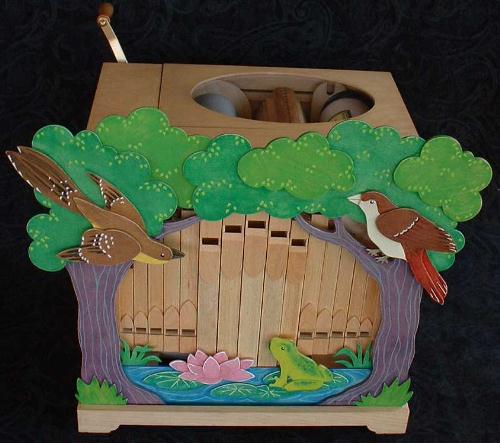
The most completely documented figure drive in the hobby corpus is the animated “Storybook” front described by the builder “Daniel” (jsart38). The front itself is 3/32″ (2.4 mm) plywood, scroll-sawn and layered for relief, and it carries three animated characters: a cuckoo, a nightingale and a frog. The birds’ wings and beaks, and the frog’s throat, are all driven off the organ’s own crankshaft.
The drive chain, from the shaft outward, runs as follows:
- A brass connecting link fits over the end of the crankshaft, retained by a cotter pin. As the crankshaft turns, the far end of this link describes a circle — the classic crank action, rotation offset from the axis.
- That link swings a vertical pivot arm mounted on a pivot block — a bell-crank. The circular motion of the link is turned into a rocking swing of the arm.
- The top of the pivot arm drives a long horizontal connecting rod that runs across the width of the organ and reciprocates side-to-side. This single rod is the “spine” of the whole animation: one rod, one motion, feeding everything.
- At each end of the rod an actuator taps off the reciprocation to work a figure — flapping a bird’s wings via a wing dowel.
- The beak is a separate, cleverer motion. A “C”-shaped piece — a cam — fixed on the wing dowel drives a lever as the wing moves, and that lever opens the beak at the right point in the stroke. The wing and beak are thus coordinated automatically: the profile of the “C” sets when the beak opens relative to the wing lift.
- The frog’s throat is driven differently again: it is a see-saw (a simple two-arm lever pivoted in the middle) run from a link on the front bellows frame — so as the bellows work, the frog’s throat pulses. This is still crank-derived motion, but tapped from the bellows rather than the crankshaft.
A construction detail ties this volume straight back to Vol 3 (internal layout and mitring): because the reciprocating rod and the wing dowels sweep through the space just behind the front, the D and E♭ pipes are mitred at the bottom — their feet bent to clear the wing dowels (jsart38). This is exactly the kind of collision the layout volume warns about: moving figures and pipework compete for the same shallow depth behind the façade, and the pipes give way by mitring. See Vol 3 §on mitring pipes to clear linkages.
Figure 6.2 — The jsart38 chain in full: crankshaft → brass link (cotter pin) → vertical pivot arm / bell-crank on a pivot block → long horizontal connecting rod (reciprocating side-to-side) → actuator → wing dowel, with a “C”-shaped cam on the dowel driving a lever that opens the beak. The frog’s throat (not shown) is a see-saw off the front bellows frame.
6.2.2 The drive-rod-off-the-driving-wheel (jsart14, Bernard Pilgrim)
Bernard Pilgrim’s plans (jsart14) describe a simpler, more modular crank-derived drive that suits builders who want their figures detachable. Instead of tapping the crankshaft directly, the drive comes off one of the organ’s driving wheels via a drive rod of 1/8″ (3.2 mm) brazing rod. The rod rocks a figure that sits in a cradle, worked by a simple lever — a single pivoted arm rather than the multi-stage bell-crank-and-connecting-rod chain of the Storybook front. The figures Pilgrim animates are toy animals — a monkey, a cat playing a concertina — the familiar organ-grinder cast.
Two pieces of practical method from jsart14 are worth carrying into any figure build:
- Mock up the linkage in wood and panel pins first. Before committing to metal, build the lever and its pivots from scrap wood pinned together with panel pins, so the geometry can be adjusted by trial. The critical thing to get right is the throw — how far the figure travels — because a lever that swings too far looks frantic and one that swings too little looks dead. Setting the throw is a geometry problem (pivot position and arm lengths), and it is far cheaper to solve it in pinned wood than in soldered brass.
- Use the lids as structure. In Pilgrim’s arrangement the case’s fixed lid closes over the pipes and doubles as the platform the automaton stands on, while a separate lifting lid gives access underneath to the drive rod and the driving wheels. The automaton’s travel is set before the fixed lid is slotted into place. (This is the same fixed-lid-as-platform idea developed in Vol 2’s treatment of the case as a box.) Catches to hold the lids can be made from coins drilled off-centre so they turn to lock — a period-appropriate touch.
A word on throw and timing, since both govern whether a figure reads as alive or as a twitching mechanism. Throw is the distance the figure’s business end travels; it is set by the ratio of the lever arms and by how far off-axis the crank or eccentric sits. A crank whose pin sits 6 mm off the shaft axis delivers a 12 mm peak-to-peak reciprocation at the connecting rod; a lever that then trades a short input arm for a long output arm multiplies that throw at the figure. Timing — when in the crank rotation the figure reaches each extreme — is fixed by the phase of the crank pin and, for the beak, by the angular position of the “C”-cam on the wing dowel (jsart38). Because everything downstream is rigidly linked, a builder tunes the look by adjusting geometry at exactly two places: the crank/eccentric offset (how much motion), and the lever ratios and cam phase (how that motion is distributed and timed). Pilgrim’s advice to mock the whole run up in wood and panel pins (jsart14) is precisely so these two adjustments can be found by eye before anything is soldered.
The trade-off between the two crank-driven routes is clear. The Storybook linkage (jsart38) is a fixed, integrated animation — several figures driven from one reciprocating spine, permanently built into the front, capable of coordinated motions (wing and beak) via cams. Pilgrim’s driving-wheel rod (jsart14) is a modular, detachable animation — one figure at a time in a cradle, easy to swap, easy to mock up, worked by a single lever. A first-time builder is usually better served by Pilgrim’s approach; the Storybook front is where to go once the mechanism vocabulary is fluent.
6.3 Philosophy B — a dedicated mechanism
The second philosophy cuts the figure loose from the crank entirely. The figure gets its own drive — most often a small electric motor with its own gearing — and therefore moves on its own schedule rather than in lockstep with the music. The motive to go this way is almost always the coin: a dedicated mechanism can be made to wake up when a passer-by drops a coin, run through a routine, and stop — the classic “put money in and the monkey performs” trick that a crank-locked figure cannot do. It also lets a figure move without the operator having to crank, and lets it perform motions (continuous rocking, a timed hat-raise, a foot wiggle) that would be awkward to derive from the crankshaft.
6.3.1 Motor + eccentric + coin trigger (jsart55)
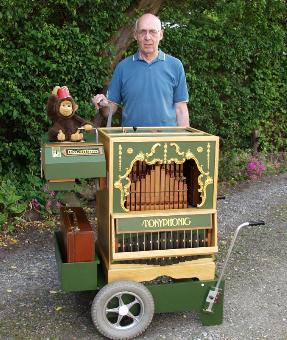
The “Mechanical Monkey” build (jsart55, Anthony Ashe) is the fullest hobby example of a dedicated figure drive, and it is worth reading closely because it demonstrates every element of the philosophy at once. The starting point is a £15 toy monkey — bought, not carved — reworked into an animated street figure.
- Continuous rocking via an eccentric. The monkey sits on a circular plywood board carried on a bar that runs in a gear-driven eccentric self-aligning bearing. As the bearing’s eccentric turns, the bar — and the board, and the monkey — is driven through a continuous circular rocking motion. This is the eccentric doing exactly what §1 described: converting steady rotation into a rich reciprocating sway. The self-aligning bearing matters because the bar is being rocked, not spun cleanly, and a rigid bearing would bind.
- The hat lift via a Bowden cable. The monkey raises its hat, and this is done with a Bowden-cable crank — a remote pull run through a flexible sheath from the mechanism up to the hat, so the lifting force reaches the hat without a rigid rod cluttering the figure. This is the textbook use of a Bowden cable: actuation at a distance, around a bend.
- The power train. The drive is three motors salvaged from old floppy-disk drives, run from a 12 V rechargeable battery, with added gearing to get the speed and torque down to figure-appropriate levels, and limit switches to govern the ends of travel.
- The coin trigger. A coin mechanism provides a micro-switch that a dropped coin closes; the switch feeds a capacitor-slugged relay — a relay with a capacitor across it so that it stays energised for a set time after the momentary switch closure, running the routine for a few seconds before dropping out. This is a simple, robust way to turn a one-instant coin drop into a timed performance.
- Packaging. The whole mechanism lives in a plywood box that slots into two brackets on the side of the organ — a self-contained module that can be lifted off, serviced on the bench and slid back. This modular housing is characteristic of dedicated drives: because they do not share the organ’s shaft, they can be built and maintained as separate units.
Figure 6.3 — The dedicated-drive monkey (jsart55): a gear-driven eccentric self-aligning bearing rocks the monkey continuously; a Bowden cable raises the hat; floppy-drive motors on a 12 V battery run through gearing and limit switches; a coin closes a micro-switch feeding a capacitor-slugged relay that runs the routine for a timed few seconds. The whole thing is a ply box that slots into brackets on the organ’s side.
6.3.2 Resin-cast conductor with control arms (jsart109/122, John Smith)
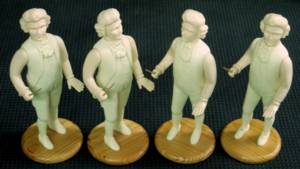
The other dedicated-figure route in the corpus is the John Smith Conductor Project (jsart109, with installation in jsart122). Its premise is reproducibility for the non-carver: a figure is sculpted once and then resin-cast from silicone moulds (the casting kit and moulds are covered in Vol 5’s treatment of resin-cast figures — see Vol 5), so a builder who “is not a wood carver” can still put a high-quality bandmaster on the front. The animation is provided by “control arms for movement” built into the figure, driven so that the conductor beats time and moves its head, baton in hand.
This is the direct descendant of Ken Rawlings’ earlier hand-made bandmaster (jsart11, Ken Rawlings), which was carved from MDF and other woods, painted and gilded, and — in Rawlings’ own words — “beats time and moves his head.” The same two motions, the same conducting archetype; the difference is that Rawlings carved a one-off while the John Smith project casts a repeatable figure and supplies the control-arm mechanism to move it. Whether the control arms are ultimately worked off the crank or off a dedicated drive is a builder’s choice; the figure itself, and its arm-and-head control geometry, is what the project standardises.
6.4 Choosing a drive — a comparison
The four documented drives sort cleanly by where the motion comes from and how complex the figure’s repertoire is. The table keeps each mechanism attributed to its own source; none of the four is a variant of another.
Table 1 — 4. Choosing a drive — a comparison
| Figure drive | How it works | Source | Crank-driven or dedicated |
|---|---|---|---|
| Crankshaft linkage | Brass link over the crankshaft end (cotter pin) → vertical pivot arm / bell-crank on a pivot block → long horizontal connecting rod (reciprocates) → actuator flaps a wing; a “C”-shaped cam on the wing dowel drives a lever to open the beak; a frog’s throat is a see-saw off the front bellows frame | jsart38 (“Daniel”) | Crank-driven (off the crankshaft + bellows frame) |
| Driving-wheel drive rod | 1/8″ (3.2 mm) brazing-rod drive rod off a driving wheel rocks a detachable figure held in a cradle via a single lever; throw set by mocking up in wood + panel pins; figure stands on the fixed lid | jsart14 (Bernard Pilgrim) | Crank-driven (off a driving wheel) |
| Motor + eccentric + coin | Gear-driven eccentric self-aligning bearing rocks the figure continuously; Bowden cable raises the hat; floppy-drive motors on a 12 V battery with gearing + limit switches; coin micro-switch → capacitor-slugged relay; ply box slots into side brackets | jsart55 | Dedicated (independent of the crank; coin-triggered) |
| Resin conductor + control arms | Figure sculpted then resin-cast from silicone moulds; built-in control arms drive it to beat time and move its head (cf. Rawlings’ carved bandmaster, jsart11) | jsart109/122 (John Smith) | Dedicated figure (control-arm mechanism; crank or motor drive by choice) |
Two rules of thumb fall out of the table. First, let the music medium decide whether to lock the figure to the crank. If the whole appeal is a figure that dances in time with the tune — birds flapping on the beat — a crank drive is correct and simple (jsart38/14). If the appeal is a figure that performs on demand for a coin, independent of whether the operator is playing, a dedicated drive is required (jsart55). Second, match the mechanism to the motion’s complexity. A single rocking or beating motion is a one-lever job; coordinated motions (wing and beak, arm and head) want cams or multiple control arms, and are where the build effort concentrates.
6.5 The “monkey” — the archetype, and why it endures
Across every one of these sources the same character keeps appearing: the monkey. Bernard Pilgrim’s cradle holds a toy monkey (jsart14); the whole of jsart55 is a mechanical monkey; the broader hobby literature (“Ideas for animated figures,” “Animated Monkey,” “Monkey Business,” jsart02/46/74) returns to it again and again. The organ-grinder’s monkey is the archetypal street-organ automaton for a plain historical reason: the barrel-organ grinder really did travel with a live capuchin that collected coins in a cup, and the mechanical monkey is that living tradition frozen into brass and plywood. For a builder, the monkey is also the ideal first figure — small, light, tolerant of a rough throw, and instantly legible to an audience. It is the automaton equivalent of a first weld: forgiving, and a complete lesson in the whole mechanism in miniature.
6.6 The professional benchmark — the Jäger & Brommer Karakuri organ
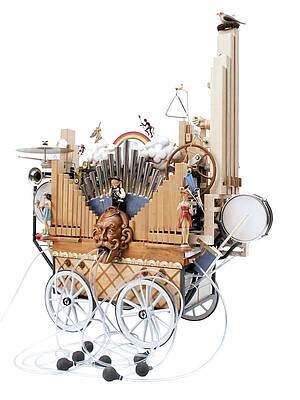
Where the hobby ceiling is a monkey rocking on an eccentric or a bird flapping off a crankshaft, the professional benchmark for a figure-carrying small organ is the Karakuri organ built by Waldkircher Orgelbau Jäger & Brommer (the Waldkirch firm founded in 1988 by Wolfgang Brommer and Heinz Jäger — the professional firm, never a hobby-site author). “Karakuri” is the Japanese tradition of mechanical automata, and the organ was built for the World Karakuri Contest 2005, held on Sunday 18 September 2005 on the EXPO grounds in Nagoya, Japan. From over 600 worldwide applications the firm was chosen as one of twelve makers — Jäger & Brommer alongside 11 other international artists (waldkircher-orgelbau.de).
By the firm’s own listing the instrument is a 31-note hand-crank street organ with 5 registers (31er Handdrehorgel mit 5 Registern), carrying 10 additional controls beyond the ordinary playing controls, and — the Karakuri feature proper — an automatic “bird” figure that animates with the music (waldkircher-orgelbau.de). It is, in effect, the professional sibling of the hobby birds on the Storybook front: the same idea — a bird animated in time with the music — executed on a 31-note concert-scale instrument with five registers and ten controls under the operator’s hands. The oft-quoted figure of “111 pipes” does not appear on the firm’s own Karakuri page and is unverified — treat it as an estimate (est.); note that note count is not pipe count (a five-register 31-note organ carries several pipes per note step across its ranks). These numbers are kept identical to their treatment in The Hobby Crank Organ dive, which profiles the same instrument.
The point of the benchmark, for a hobby builder, is not to copy it but to see the same attitude scaled up: an automaton is not a bolt-on novelty but part of the instrument, designed in from the start, animated in time with the music, and executed to the standard of the rest of the build. A monkey on an eccentric and the Karakuri’s automatic bird are the same craft at two scales.
6.7 Takeaways
- Two philosophies, kept distinct. A figure is either driven off the crank / driveshaft — moving only while the operator cranks, in time with the music, with no power of its own (jsart38; jsart14) — or given a dedicated mechanism — its own motor, gearing and usually a coin trigger, running independently (jsart55; jsart109).
- The crankshaft linkage (jsart38) is the fully-integrated crank drive: brass link (cotter pin) → bell-crank → long reciprocating connecting rod → actuators, with a “C”-shaped cam coordinating the beak and a see-saw off the bellows frame working the frog. Its rod and dowels force the D and E♭ pipes to be mitred to clear them (Vol 3).
- The driving-wheel drive rod (jsart14) is the modular crank drive: a 1/8″ brazing rod off a driving wheel rocks a detachable figure in a cradle via one lever; mock up in wood and panel pins to set the throw; the fixed lid is the figure platform.
- The motor + eccentric + coin drive (jsart55) is the full dedicated build: an eccentric self-aligning bearing rocks the monkey, a Bowden cable raises the hat, floppy-drive motors on 12 V run through gearing and limit switches, and a coin micro-switch feeds a capacitor-slugged relay — all in a ply box that slots into side brackets.
- The resin conductor (jsart109/122) casts a repeatable figure with control arms that beat time and move the head — the reproducible descendant of Rawlings’ carved bandmaster (jsart11) — with the casting itself covered in Vol 5.
- The vocabulary is universal: crank/eccentric (rotary → reciprocating), cam (shape → programmed motion), connecting rod, bell-crank/lever, linkage, Bowden cable (remote pull). The monkey is the archetype to start with.
- The benchmark is the Jäger & Brommer Karakuri organ — a 31-note, 5-register hand-crank street organ with 10 additional controls and an automatic bird, built for the World Karakuri Contest (18 September 2005, Nagoya EXPO); the widely-cited “111 pipes” is unverified (est.) — kept identical to The Hobby Crank Organ dive.
Comments (0)