The Case Facade And Figures · Volume 1
The Case, Façade & Figures — Vol 01: Case, Façade & Figures
A small hand-cranked busker organ looks, from the pavement, like one object: a painted wooden box on a cart, a rank of shining pipes across the front, and perhaps a little monkey nodding on the lid. It is, in fact, three quite different engineering problems wearing one coat of paint. This dive is the hobby builder’s how-to for all three, and this first volume draws the boundaries between them so that the six volumes that follow can each go deep without stepping on one another.
The three jobs are the case, the façade, and the figures. The case is a structural — and mildly acoustic — box: it carries the wind chest, the bellows and reservoir, and the roll or book frame; it protects the pipework; it must be light enough for one person to move; and it usually rides on a cart. The façade is the decorative front: display pipes, a fretwork grille over the mouth of the case, scrollwork, a name board, a carved crest. The figures are the moving automata — the monkey, the conducting bandmaster, the birds — driven off the crank or by a dedicated mechanism. A builder who confuses the three ends up with a box too weak to carry its own wind, a front too solid to let the pipes speak, or a figure that stalls the crank. Kept distinct, each becomes a solvable job.
This dive is deliberately scoped to the small hand-cranked busker and street organ of roughly 20 to 31 notes. The grand tradition — the ornate Dutch draaiorgel front and the fairground proscenium — appears here only as context. That survey belongs to the forthcoming Fairground & Dutch Street Organs dive (Dive 14), which owns the Gavioli, Bruder, Ruth, Wellershaus and Dutch-street lineage; this volume points there rather than reproducing it. Likewise, the physics of how a pipe makes a note and how the bellows deliver wind are the business of the How Organ Pipes Make Sound and Wind Systems dives, and are deferred to them by name throughout.
1.1 Three jobs in one box
The single most useful idea in this dive is that the case, the façade and the figures are separable concerns. They share a bill of materials and a footprint, but they answer to different masters: structure and portability for the case, appearance and acoustic transparency for the façade, and motion for the figures.
1.1.1 The case — a structural, mildly acoustic box
The case is the cabinet: the box that everything else lives in and on. Its first duty is structural. It carries the wind chest (the pressurised box the pipes stand on), the bellows and reservoir that feed the chest, the roll or book frame that reads the music, and the pipework itself — all while staying light enough to carry and rigid enough not to rack, twist, or spring a wind leak when lifted onto a cart. A typical hobby case is built from sheet stock: the John Smith Universal organ (a sibling dive, The John Smith Universal Organ) uses a case of 1/4-inch (about 6 mm) Baltic birch plywood, with the pipe walls in 1/8-inch ply and the display pipe fronts in walnut. One Dutch builder’s 31-note instrument uses a smooth-faced “concrete plywood” and sits on a layered groundplate whose air channels were jigsawn, glued to the walls, papered over and leak-tested before assembly (en_31toets). Volume 2 (The Case as a Box) and Volume 3 (Layout & Packaging) own this material in full.
The case is also, in a modest way, an acoustic object. For large cased pipe organs this is well established: the case forms “a resonating chamber in which the sounds produced by different ranks of pipes are blended” and provides “a means for projection of the sound of the pipes forward into the room through the opening in the front of the case,” with reflective interior surfaces (organhistoricalsociety.org, “Organ Cases and Chambers”). For a small busker box that role is genuine but far more limited — the box chiefly houses and protects the pipes and gives them a front opening to speak through. Any claim beyond “keep the front acoustically open and do not box the pipe mouths in” is an inference and is marked (est.); the pipe acoustics themselves are deferred to How Organ Pipes Make Sound and the wind to Wind Systems.
Finally, the case is a portability problem. The hobby literature bands “small crank organs” at roughly 12 × 8 × 10 in to 24 × 8 × 10 in (about 30 × 20 × 15 cm to 60 × 40 × 30 cm) (jsart98, Wallace Venable). A pipe busker organ in that band weighs on the order of 10–15 kg (est.) — the site quotes ~150 lb (60–70 kg) only for a barrel piano, a much heavier instrument, so the light figure is an estimate for a small pipe organ, not a quoted value. Because even 15 kg is awkward to play standing, the instrument rides a cart: traditionally a two-wheel hand-truck with large wheels for rough ground and tram rails, or the modern German four-wheel crank-organ cart (non-folding, roughly $1000 delivered from a builder), with folding, “box-cart” (a carrying case that converts to a cart), and golf-trolley conversions as amateur options (jsart98, Wallace Venable). The 31-note case above simply bolts to its cart with two screws (en_31toets).
1.1.2 The façade — the decorative front
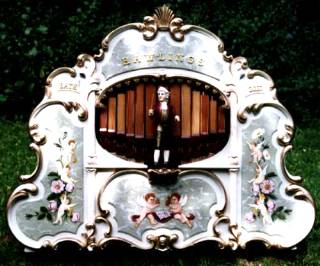
The façade is the front of the case: the face the audience sees and the surface the sound projects through. It is the part builders most enjoy and most easily overdo. Its elements, in the hobby tradition, are a field of display pipes, a fretwork or grille over the mouth of the case, scrollwork and corner spandrels, a central name board, and sometimes a carved crest. The canonical hobby example is Ken Rawlings’ “fair organ” front, modelled on the 46-key Chiappa organs and built at 30 in wide × 24 in high (about 760 × 610 mm) on a 6 mm plywood backboard, with scrollwork bandsawn from 10, 12 and 15 mm MDF, floral designs and cherubs hand-painted, and lettering fretsawn from 1/16-inch ply and gilded in 24-carat gold leaf (jsart11, Ken Rawlings). Volume 4 (The Façade & Display Pipes) and Volume 5 (Decoration & Finish) own this in full.
Two points of discipline belong here, because they are where façade work most often goes wrong. First, display pipes are usually speaking pipes on a small organ. Façade pipes in general “may be either sounding pipes or dummy pipes solely for decoration,” and dummies fill space in a mostly-speaking front (organ.byu.edu OrganTutor; organforum.com). But on a busker or street organ the front rank is normally the real speaking rank — the pan-flute or piccolo pipes across the front with the wooden bass pipes beneath (Wikipedia: Street organ) — just as the John Smith Universal displays its walnut-fronted speaking melody pipes. Dummy (mute) pipes are chiefly a grand-fair-organ device for filling a large proscenium, which is Dive 14 territory. A builder who fills a small front with dummies has thrown away the most natural place to put working pipes.
Second, the fretwork must stay acoustically open. The front opening is where sound projects (organhistoricalsociety.org); a grille or pipe-shade dresses the pipe mouths but must not choke them. That “don’t box the mouths in” guidance is an inference (est.) for the small case and is cross-referenced to the acoustics and wind dives rather than derived here.
1.1.3 The figures — moving automata
The figures are the moving ornaments: the organ-grinder’s monkey, a bandmaster or conductor who beats time, birds that flap and sing, dancers. They are what turns a music box into a small piece of theatre, and they are the headline craft of this dive — Volume 6 (Moving Figures & Automata) is devoted to them.
The essential division among figures is how they are driven. Most hobby figures are driven off the crank or driveshaft: a linkage taps the rotating crank and converts that rotation into the reciprocating or nodding motion the figure needs. The ‘Storybook’ animated front is the clearest worked example — a brass connecting link fits over the crankshaft end (held by a cotter pin), swings a vertical pivot arm on a pivot block, drives a long horizontal connecting rod side to side, and an actuator at each end works a bird; a “C”-shaped cam piece on the wing dowel opens the beak, and the D and E-flat pipes are mitred at the bottom to clear the moving wing dowels (jsart38, Daniel Wright). Bernard Pilgrim’s plans drive detachable figures from a 1/8-inch brazing-rod drive rod off the driving wheel, rocking a toy animal in a cradle through a simple lever (jsart14, Bernard Pilgrim).
The alternative is a dedicated mechanism independent of the crank. The mechanical monkey of jsart55 is a reworked £15 toy monkey sitting on a circular ply board driven by a gear-driven eccentric self-aligning bearing for a continuous circular rocking motion, with three floppy-drive motors on a 12 V battery, added gearing, limit switches, a Bowden-cable hat-raise and a coin mechanism — the whole thing in a plywood box that slots into brackets on the side of the organ (jsart55). The John Smith Conductor is a resin-cast figure with control arms that beat time and move the head, the route for builders who “are not a wood carver” (jsart109/122). These mechanisms — crank, eccentric, cam, connecting rod, bell-crank, linkage, Bowden cable — are taught in Volume 6.
1.1.4 Why they are treated separately
The three jobs pull in different directions, and that is exactly why they are worth separating. The case wants to be light and stiff; the façade wants to be handsome and acoustically transparent; the figures want to move without loading the crank or fouling a pipe. Optimise one in ignorance of the others and the conflicts surface late: a heavy carved front that unbalances the cart, a grille that mutes the melody, a figure linkage that adds drag the player feels in every turn of the handle, or — as jsart38 shows — pipes that must be mitred after the fact to clear a wing dowel nobody planned for. The table below is the map the rest of the dive follows.
Table 1 — 1.4 Why they are treated separately
| Job | What it is | Chief function | Typical materials | Covered in |
|---|---|---|---|---|
| Case | The structural cabinet | Carry the chest, wind and roll/book frame; protect the pipes; be portable; project sound through the front | 1/4-in (6 mm) Baltic birch or “concrete” plywood box; solid corners; rides on a cart (organhistoricalsociety.org; en_31toets; JS Universal) | Vols 2–3 |
| Façade | The decorative front | Attract attention; show pipes; stay acoustically open at the mouth | 6 mm ply backboard; bandsawn/fretsawn MDF, pine and mahogany scrollwork; gilded ply lettering; display pipes (usually speaking) (jsart11; Wikipedia: Street organ) | Vols 4–5 |
| Figures | The moving automata | Motion and theatre — nodding, beating time, flapping, singing | MDF/mixed-wood carvings or resin castings; brass/steel linkage; motors, eccentrics, cams, Bowden cables (jsart11; jsart38; jsart55; jsart109) | Vol 6 |
The following SVG makes the same point spatially: three jobs, one box.
Figure 1 — The three jobs, exploded. The figure sits on top (driven off the crank or a dedicated mechanism), the case is the structural box carrying pipes, wind and roll frame, and the façade is the decorative front the sound projects through. The whole rides on a cart.
1.2 The design tradition, in brief
The busker organ did not appear from nowhere; it is the small, portable end of a long family of mechanical organs. This section sketches that family only far enough to place the hobby instrument in it. The deep survey — makers, dates, regional schools, proportion canons — is the job of the Fairground & Dutch Street Organs dive (Dive 14), and is cross-referenced here rather than reproduced.
1.2.1 Three fronts, three purposes
Three broad front types bracket the tradition, and they differ mostly in how much front there is.
The portable busker case is the subject of this dive: a modest box a person can carry, with a small front that shows the melody pipes and just enough decoration to draw a crowd. Its whole design is disciplined by weight and size — everything is packaged into the band of roughly 30 × 20 × 15 cm to 60 × 40 × 30 cm noted above (jsart98).
The Dutch street organ (draaiorgel) is larger and far more ornate: its front carried “a set of pan-flutes or piccolo pipes” with “wooden bass pipes placed underneath,” and “mechanical figures, or automata, mounted on top of or in the front of the case” (Wikipedia: Street organ). The elaborated draaiorgel façade — the deep carved and gilded architectural front — is Dive 14’s to survey.
The fairground proscenium is the grandest: a front “designed to attract attention,” often with automata such as “a conductor whose arm moved in time to the music, or women whose arms struck bells,” plus glockenspiel and drums for visual entertainment (Wikipedia: Fairground organ). The makers who built these — Gavioli, Limonaire Frères and Charles Marenghi in Paris; Gebrüder Bruder, Andreas Ruth & Sohn and Gebrüder Wellershaus in and around Waldkirch and Mülheim — are Dive 14’s roll-call, listed here only to show where the hobby vocabulary of columns, arches, cresting and spandrels comes from.
The point for the hobby builder is that the classical façade vocabulary is inherited from these grand fronts, but a busker organ uses a fraction of it, sized to a box one can lift. Rawlings’ 30 × 24 in front borrows the Chiappa fair-organ look at a carryable scale (jsart11, Ken Rawlings); it is a quotation, not a reproduction.
1.2.2 Scale names and the note-versus-pipe distinction
Two numbers cause endless confusion and must be kept straight from the outset: the note count and the pipe count. They are not the same thing, and this dive never treats them as interchangeable.
The note count is the number of distinct musical notes the instrument’s key frame can read and play — it is a property of the music medium and the scale, and it names the instrument. In this program the scale names are held identical across dives: 20-note is the Carl Frei / Raffin (and Stüber) scale, and 26-note is the Alderman scale; the John Smith Universal is built to play both 20-note Raffin and 26-note Alderman music. The professional benchmark below is a 31-note instrument.
The pipe count is the number of physical pipes, which is almost always larger than the note count. Bass and melody notes are frequently doubled, and multiple ranks (registers) each add a pipe per note, so a 20-note organ has many more than 20 pipes. The rule for this dive is simple: note count ≠ pipe count, and the phrase “20 pipes” is never used for a 20-note organ. The registers and ranks behind that multiplication belong to Building Organ Pipes and are cross-referenced there.
1.3 Hobby craft versus the professional benchmark
This dive documents the amateur builds — the melright.com/busker contributor articles and hobbycrankorgan.com — but it measures them against one professional instrument so the reader has a ceiling to aim at. Keeping those two clearly apart, and both apart from the grand tradition of Dive 14, is a standing rule of the dive.
1.3.1 The amateur corpus
The hobby corpus is a contributor anthology, not the work of one author, and this dive cites it by article and author accordingly — “(jsart11, Ken Rawlings)”, “(jsart38)”, “(en_31toets)”. It documents all three jobs at amateur scale: cases in Baltic birch or “concrete” plywood; fronts modelled on fair organs with bandsawn scrollwork, gilded lettering and hand-painted cherubs; and figures driven off the crank or by scavenged floppy-drive motors and coin mechanisms. Its great virtue is that it shows how a person with a bandsaw and a soldering iron actually does this — the swan-neck operating handle sawn from 1/8-inch brass sheet (jsart11), the £15 toy monkey reworked into an automaton (jsart55), the laser-print image transferred through the wood with thinner because freehand folk-painting failed (en_31toets). Volumes 2 through 7 are built almost entirely on this corpus.
1.3.2 The Jäger & Brommer Karakuri organ
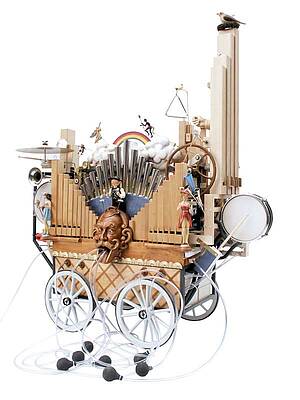
The professional benchmark for a small, figure-carrying organ is the Jäger & Brommer Karakuri organ. Jäger & Brommer is Waldkircher Orgelbau Jäger & Brommer, a professional firm founded in 1988 by Wolfgang Brommer and Heinz Jäger in Waldkirch — it is a company, never a hobby-site author, and this dive is careful never to conflate the two. (Note that hobbycrankorgan.com is an amateur-builder site and is not Brommer’s; the professional firm is Jäger & Brommer. The Hobby Crank Organ dive makes the same distinction.)
The Karakuri organ itself is a 31-note hand-crank organ with 5 registers, 10 additional controls, and an automatic bird (waldkircher-orgelbau.de). It was built for the World Karakuri Contest held on Sunday, 18 September 2005, on the EXPO grounds in Nagoya, Japan, where the firm was selected from over 600 worldwide applications alongside 11 other international makers (about a dozen makers in all). The often-quoted figure of “111 pipes” is unverified (est.) — the maker’s page states no pipe count, so that number is flagged here and must not be presented as fact. These figures are held identical to the Hobby Crank Organ dive, which profiles the same instrument.
The Karakuri organ is the benchmark precisely because it packages all three of this dive’s jobs at a professional standard: a 31-note case, a finished professional front, and a working automatic bird driven as part of the instrument. The hobby builds in the volumes that follow are honest attempts at the same three jobs with a bandsaw, MDF and scavenged motors.
Figure 2 — The framing map. This dive documents the hobby craft (left) and holds it up against one professional benchmark (right); the grand fairground and Dutch-street tradition (centre) is context only and is surveyed in Dive 14. The three lanes are never blurred together.
1.4 Roadmap — Volumes 2 to 7
The remaining six volumes take the three jobs in the order a builder meets them: first the box, then how everything packs into it, then the front and its finish, then the figures, and finally a reference volume.
1.4.1 Vol 2 — The Case as a Box
The structural and mildly acoustic box in full: materials (1/4-inch Baltic birch ply as on the John Smith Universal; the smooth-faced “concrete plywood” of en_31toets; MDF for carved scroll; solid pine, mahogany and walnut for show parts), wall thicknesses, how the box carries the chest, bellows, reservoir and roll frame, the fixed lid that doubles as the figure platform and the lifting lid over the crank (jsart14), the leak-tested layered groundplate (en_31toets), weight and portability, and the cart and trolley options (jsart98). The case’s acoustic role is stated carefully — the organhistoricalsociety.org resonating-chamber claim holds for large cased organs but is modest for a small box — and the pipe acoustics and wind are cross-referenced to How Organ Pipes Make Sound and Wind Systems, not re-derived.
1.4.2 Vol 3 — Layout & Packaging
The spatial-engineering problem: fitting the pipework, wind system and roll or book mechanism into a carryable box. Chest placement, the wind path, roll-frame access, keeping the front pipes speaking, mitring pipes to clear moving parts (jsart38), centre of gravity and handling. This is where the case stops being a box and becomes a solved packaging exercise, and it cross-references Wind Systems and Encoding the Music for those subsystems.
1.4.3 Vol 4 — The Façade & Display Pipes
The decorative front proper: the speaking-versus-dummy display-pipe distinction (small fronts are usually the real speaking pan-flute or piccolo rank with wooden bass beneath; dummy pipes are a grand-organ space-filler); the fretwork, grille or pipe-shade kept acoustically open; and proportion and motif — columns, arches, the central name board, the crest, the corner spandrels, and the 46-key-Chiappa- modelled 30 × 24 in hobby front (jsart11). The deep proportion canon is deferred to Dive 14.
1.4.4 Vol 5 — Decoration & Finish
Making the front look the part: carving and scrollwork (bandsawn and fretsawn MDF, pine, mahogany), gilded lettering in 24-carat leaf, painting (enamels and household paint, cherubs and florals), and the non-carver routes — Bauernmalerei via laser-print transfer and hand-colour (en_31toets), decoupage with Mod-Podge over laser-printed circus-poster art (jsart60, Wallace Venable), and resin-cast parts (jsart109). Name boards, the builder’s plate, and finishes (enamel, Danish oil, varnish, acrylic, gilding).
1.4.5 Vol 6 — Moving Figures & Automata
The headline craft: driving a figure off the crank or driveshaft — the crankshaft linkage (brass link to pivot arm and bell-crank to connecting rod to actuator, with a “C”-piece cam opening a beak, jsart38) and the drive-rod-off-the-driving- wheel with cradle and lever (jsart14) — and the dedicated-mechanism route (motor, eccentric and coin trigger, jsart55; the resin conductor with control arms that beats time and moves its head, jsart109). The mechanism vocabulary (crank/eccentric, cam, connecting rod, bell-crank, linkage, Bowden cable), the “monkey” tradition, and the Jäger & Brommer Karakuri automatic bird as the benchmark.
1.4.6 Vol 7 — Reference & Cheatsheet
A case-materials and wall-thickness table; the cart and trolley options; a façade motif and proportion guide; a figure-drive mechanism comparison (crank-linkage / driving-wheel-rod / motor-plus-coin / resin control-arms); a decoration-route table (carve / Bauernmalerei / decoupage / resin); a glossary; a cross-index to Volumes 1 through 6 and the sibling dives; and a bibliography.
Throughout, the discipline set here holds: the case, the façade and the figures stay three distinct jobs; the hobby craft, the grand tradition (Dive 14) and the professional benchmark (Jäger & Brommer) stay three distinct frames; pipe acoustics go to How Organ Pipes Make Sound, wind goes to Wind Systems, music encoding goes to Encoding the Music, and pipe-making goes to Building Organ Pipes; every non-obvious value carries its source; and the numbers that are guesses — the ~10–15 kg busker weight and the “111 pipes” of the Karakuri organ chief among them — are marked (est.) so the reader always knows what is measured and what is merely likely.
Comments (0)