The Case Facade And Figures · Volume 4
The Case, Façade & Figures — Vol 04: The Façade & Display Pipes
The façade is the face the instrument turns to the street: the flat, decorated front board carrying the display pipes, the fretwork over their mouths, a name board, and — on the ambitious builds — columns, arches, corner spandrels and a carved crest. It is the part a passer-by sees first and the part that, on a well-made busker organ, is doing acoustic work at the same time as it is doing decorative work. That double duty is the theme of this volume: the front is not a picture frame bolted over a working machine, it is (usually) the working machine’s mouth, dressed up.
This volume covers the front board and the pipes shown on it. It deliberately stops short of two neighbours. The structural box that the front bolts onto — its plywood, its lid arrangement, its cart — is Vol 2 (The Case as a Box). The decoration and finish applied to the front — the carving, gilding, painting, Bauernmalerei, decoupage — is Vol 5. The moving figures that stand above the front are Vol 6. And the deep survey of the grand fairground and Dutch-street tradition — the Gavioli/Bruder/Ruth proscenium, the ornate draaiorgel — belongs to the forthcoming “Fairground & Dutch Street Organs” dive (Dive 14), which this volume treats as context and cross-refs rather than reproduces.
Pipe voicing, cut-up, scaling and the physics of how a flue pipe speaks are the territory of “How Organ Pipes Make Sound”; how much wind reaches the front rank and at what pressure is “Wind Systems.” This volume points to those dives by name for anything acoustic and does not re-derive it here.
4.1 Speaking pipes versus dummy pipes
The single most important distinction on any organ front is whether the pipes you see are actually making the sound, or are there only to be looked at.
4.1.1 The definition
In the pipe-organ world at large, façade pipes “may be either sounding pipes or dummy pipes solely for decoration” (OrganTutor). The distinction is standard: on a large instrument the visible front rank is a small fraction of the pipework, most of which stands behind the façade out of sight, and the front may mix genuinely speaking pipes with dummy (also called mute or blank) pipes that carry no wind and make no sound — they exist to fill out the visual line of a proscenium (OrganTutor; Organ Forum). A dummy pipe is a hollow decorative shell: it has the profile of a pipe, often the polished tin or gilt appearance of a pipe, but no languid, no windway that matters, and no connection to a live toe-hole on the chest.
4.1.2 The small-organ norm: speaking fronts
On a small hand-cranked busker or street organ the situation is usually the opposite of the grand instrument, and it is worth stating plainly because it is easy to get backwards: the pipes on the front of a busker organ are usually the real, speaking pipes. There simply is not room in a 20-to-31-note box to hide most of the pipework behind a decorative screen, and there is no reason to — the melody rank is the showpiece and it is put where it can be seen and heard at once.
The historical street-organ front carried “a set of pan-flutes or piccolo pipes” with “wooden bass pipes placed underneath” (Wikipedia: Street organ). That is a description of a speaking front: the small, bright melody pipes (the pan-flute or piccolo rank) are ranged across the top of the front where they show, and the large wooden bass pipes — which are too big and too plain to be decorative — sit below or behind. The worked hobby example in this program follows the same logic: the John Smith Universal organ “displays its walnut-fronted speaking melody pipes” — the pipes you see through the front are the genuine melody rank, faced in walnut so they look the part (JS Universal).
So the rule of thumb for the hobby builder is:
- Busker / street organ: front pipes = real speaking pipes (the melody / pan-flute rank), dressed to be seen. Bass pipes below, usually wood.
- Grand fair organ: a large proscenium may carry dummy (mute) pipes to fill space around and above the speaking ranks — a space-filling device for a big front, and Dive 14’s territory, not a busker feature.
Dummy pipes are therefore not a thing a small-organ builder needs, and a builder who reads “façade pipes are often decorative” and concludes a busker front should be mute pipes has drawn exactly the wrong lesson. If anything, the busker builder’s job is the reverse: to make the real speaking pipes attractive enough to serve as the decoration, so that no dummies are needed.
4.1.3 When a small organ might still use a dummy
There are narrow cases where even a small front carries a token dummy. If a builder wants a symmetrical front but the melody rank is asymmetrical (say, an odd number of pipes, or a rank that steps in height in one direction), a blank shell or two at the ends can balance the composition. If the tallest bass pipes would foul the front opening, a builder may show short decorative pipe-tops on the front while the real long pipes are mitred and hidden behind — the visible top is then effectively a dummy even though it belongs to a speaking pipe. These are exceptions; the norm is a speaking front, and any purely decorative pipe on a busker organ should be a deliberate, noted choice rather than a default.
4.1.4 Dressing the speaking rank to be seen
If the display pipes are the real speaking pipes, then making the front handsome means making the working pipes handsome — the busker builder’s version of the fairground builder’s polished-tin front. The corpus shows the two routes a hobbyist takes.
The first is to face the melody pipes in a show wood. The John Smith Universal builds the melody pipes with 1/8-inch (≈3 mm) Baltic-birch ply walls but gives them walnut fronts, so that the surface presented to the street is close-grained, dark walnut rather than the plainer body wood (JS Universal). The walnut face is purely cosmetic — it is the pipe’s own front wall, not an added panel — but it turns a functional wooden flue pipe into a display object without changing how it speaks. A builder can extend the same idea with any presentable facing: a hardwood front board, a stained or oiled face, a chamfered mouth. The constraint is that whatever dresses the pipe must not alter the mouth geometry or the pipe’s speaking length, which is voicing territory (“How Organ Pipes Make Sound”).
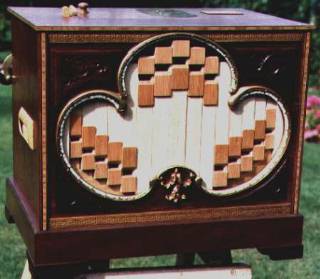
The second route is arrangement. The historical street-organ front sets a bright pan-flute or piccolo rank across the top, where the small pipes catch the eye and the light, with the large wooden bass pipes placed underneath where their bulk does not spoil the line (Wikipedia: Street organ). This is a compositional trick as much as an acoustic layout: the eye is drawn to the ordered rank of small pipes stepping up and down in pitch, and the plain bass is kept out of the primary sightline. Figure 4.2 shows the field laid out this way — a symmetric rise-and-fall of small melody pipes across the centre of the front, which reads as ornament in its own right before a single carved scroll is added. A well-arranged speaking rank is, in this sense, the busker front’s most important piece of decoration.
4.2 The fretwork, grille and pipe-shade
Over and around the display pipes sits the pierced decorative panel variously called the fretwork, the grille, or (in the traditional organ-case vocabulary) the pipe-shade — the carved or scroll-sawn panel that frames the pipe mouths and crowns the pipe field. On the hobby fronts it is the scrollwork itself: big front scrolls fretsawn from pine, floral panels bandsawn from MDF, the whole assembly glued to the backboard (jsart11, Ken Rawlings). Vol 5 covers how that panel is cut, carved and finished; this section is about one constraint on its geometry.
4.2.1 Keep it acoustically open
Because the busker front is (per §1) usually a speaking front, the fretwork sits directly in front of live pipe mouths. That is fine — decorative pipe-shades have framed speaking façade pipes for centuries — but it sets a rule: the fretwork must stay open where the pipes speak.
The authoritative statement of what the front opening does comes from the general organ-case literature: the case provides “a means for projection of the sound of the pipes forward into the room through the opening in the front of the case” (OHS works09). The sound leaves the instrument through the front opening; anything solid placed across that opening obstructs the projection. A pipe-shade works precisely because it is pierced — it is mostly holes — so it decorates the opening without closing it.
For a small busker organ the practical inference is: do not choke the pipe mouths. (est.) Keep an unobstructed air path immediately in front of and above the mouth line of the speaking pipes; let the fretwork be a frame around and above the mouths rather than a fine mesh across them; and avoid backing the fretwork with cloth or a solid panel over the speaking field. This is marked (est.) because it is an inference from the projection principle (OHS works09) applied to a small box — the OHS statement concerns large cased organs, not busker instruments, and this volume does not attempt to quantify how much a tiny front actually shades or shapes the tone. The magnitude of any tonal effect, and the case’s resonating-chamber role, are treated carefully in Vol 2 and belong properly to “How Organ Pipes Make Sound” and “Wind Systems”; the guidance here is limited to the geometric one — leave the mouths free to speak.
A useful builder’s check: with the front off, note the height of the mouth line of the melody rank across the pipe field. With the front on, that mouth line should sit behind open fretwork or below the bottom edge of a solid name board, never behind solid material. If a decorative element must cross the pipe field, pierce it.
4.2.2 What the fretwork is doing, and what it is not
It is worth being precise about the claim, because the general organ-case literature credits the case with more than a busker box can deliver. For a large cased organ the case is described as “a resonating chamber in which the sounds produced by different ranks of pipes are blended,” with reflective interior surfaces and forward projection “through the opening in the front of the case” (OHS works09). A busker organ is not that instrument. Its box is small, its rank count is low, and its front opening is a modest aperture rather than a room-scale mouth. The resonating-chamber and tone-blending role is therefore modest at busker scale (est.), and Vol 2 states it carefully; this volume claims only the geometric consequence, that the front must stay open where the pipes speak.
So the fretwork is doing two things and not a third. It frames and crowns the pipe mouths decoratively, and it must not obstruct the air path in front of them. It is not a tone control: a busker builder should not expect the pipe-shade to voice, swell, or shape the sound, and any such claim is (est.) inference well beyond what the sources support. Where genuine tone-shaping happens — cut-up, nicking, the wind supply — is the subject of “How Organ Pipes Make Sound” and “Wind Systems,” and this volume does not encroach on it. The fretwork’s job here is honest and narrow: look good, and keep out of the way of the mouths.

4.3 Proportion and motif: the classical vocabulary
Set the acoustics aside and the front is a composition. The tradition it draws on is the fairground and street-organ front, whose deep survey — the Waldkirch school, the Gavioli/Bruder/Ruth proscenia, the ornate Dutch draaiorgel — is Dive 14’s subject. This volume gives the vocabulary a busker builder actually uses and points to Dive 14 for the canon.
4.3.1 The hobby fair-organ front as the worked example
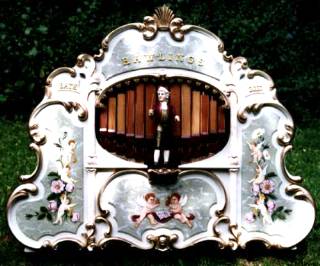
The best-documented amateur front in the corpus is Ken Rawlings’ “Fair Organ” front, built as a scaled decorative front modelled on the 46-key Chiappa organs and measuring 30 inches wide by 24 inches high (about 760 mm × 610 mm) (jsart11, Ken Rawlings). Its construction gives the material breakdown that Vol 5 details: a backboard of 6 mm ply; scrollwork bandsawn from 10, 12 and 15 mm MDF, carved to shape and section and glued to the backboard; lettering fretsawn from 1/16-inch (≈1.6 mm) ply and gilded with 24-carat gold leaf; corner spandrels fretsawn from 1/4-inch (≈6 mm) mahogany; and big front scrolls fretsawn from pine (jsart11, Ken Rawlings). It was shown at the 2000 Great Dorset Steam Fair (jsart11). Because it is a front modelled on a real organ rather than a working organ front, its proportions are a faithful hobby-scale sample of the tradition — useful as a template even though this particular piece is decoration on its own.
4.3.2 The elements
The classical front assembles a fairly fixed set of parts. Reading a front from the bottom up and the outside in:
- The plinth / base rail — the horizontal footing the composition stands on, usually where lifting handles and the crank aperture live.
- Columns (pilasters) — vertical members framing the sides, often flanking the central field. They read as architecture and give the front its “building” look.
- Arches — one or more arched heads over the pipe field or over the name board, the classic organ-case gesture that echoes the pipe tops.
- The display-pipe field — the central zone where the speaking pipes show (§1), framed by the columns and crowned by the arch or the fretwork.
- The central name board — the lettered board naming the organ or builder, set centrally where it reads at a glance. On the hobby front it is fretsawn ply gilded in 24-carat leaf (jsart11); the alternative non-carver route is a printed name badge (covered in Vol 5).
- Corner spandrels — the carved triangular fillers in the corners beside an arch or scroll; on the hobby front, fretsawn from 1/4-inch mahogany (jsart11).
- Floral scrolls, and cherubs — the carved and painted foliate ornament and figurework running over the front; Rawlings’ front carries hand-painted floral designs and cherubs (jsart11).
- The carved crest (cresting) — the top ornament crowning the whole front, the silhouette a passer-by sees against the sky.
The proportion canon that governs how these parts relate — the ratio of pipe field to name board, the rhythm of the columns, the pitch of the arch, the mass of the crest — is the fairground tradition, and the deep, sourced survey of it is Dive 14’s job. Treat the specific classical proportion rules as tradition (est.) in this volume: the elements above are documented on the hobby front (jsart11) and named in the general front tradition (Wikipedia: Fairground organ; Street organ), but the canonical ratios themselves are not derived here and should not be presented as sourced numbers. Build the busker front by eye and by the Chiappa-scaled sample, and consult Dive 14 for the survey.
4.3.3 Motif table
The table below maps the front’s elements to what each one is, the hobby material of record, and whether it is doing acoustic (speaking) work or is purely decorative.
Table 1 — 3.3 Motif table
| Façade element | What it is | Typical hobby material | Speaking or decorative? |
|---|---|---|---|
| Display-pipe field | The central rank of pipes shown on the front | Melody pipes faced in walnut (JS Universal); pan-flute/piccolo rank | Speaking (busker norm) |
| Bass pipes (below/behind) | The large low pipes | Wood (Wikipedia: Street organ) | Speaking |
| Fretwork / grille / pipe-shade | Pierced panel framing/crowning the mouths | Scroll-sawn pine; bandsawn MDF florals (jsart11) | Decorative — but kept acoustically open (est.) |
| Central name board | Lettered board naming the organ/builder | Fretsawn 1/16″ ply, gilded 24-ct (jsart11); or printed badge | Decorative |
| Columns / pilasters | Vertical framing members | Solid wood / MDF | Decorative (structural framing) |
| Arch(es) | Arched head over field or name board | Cut ply / MDF | Decorative |
| Corner spandrels | Carved corner triangles beside arch/scroll | 1/4″ mahogany, fretsawn (jsart11) | Decorative |
| Floral scrolls / cherubs | Foliate ornament and figurework | Bandsawn 10/12/15 mm MDF; pine scrolls; hand-painted (jsart11) | Decorative |
| Carved crest / cresting | Top ornament crowning the front | Carved MDF + solid wood | Decorative |
| Gilded lettering | The organ’s name in gold | 1/16″ ply, 24-ct gold leaf (jsart11) | Decorative |
| Dummy (mute) pipe | Non-speaking decorative pipe | Hollow shell | Decorative — a grand-front device (Dive 14), rare on busker fronts |
4.4 Practical layout of a busker front
The design intent above has to resolve into a real board that bolts onto the case, frames the live pipes, and comes off again when the instrument needs service. This section is the build layout.
4.4.1 The front as a removable panel
The front is, structurally, a decorated panel fixed to the front face of the case (Vol 2). Two things must both be true of that fixing: it holds the front rigidly in normal use, and it releases the front for access. A crank organ is serviced often — tuning the melody rank, adjusting the wind, clearing a stuck note, getting at the book or roll frame — and much of that access is from the front. A front that has to be pried, or that was glued on, is a mistake.
The standard arrangement is to make the decorated front a removable panel held by a small number of screws or turn-buttons into the case front frame, so it lifts away as a unit and carries all its ornament, pipes-shade and name board with it. The speaking display pipes themselves generally stand on the chest inside the case rather than on the front panel, so removing the front exposes the pipe field without disturbing the pipes — the front is a frame in front of them, not their support. Where a pipe or its visible top is carried on the front, that pipe must be disconnected or clear the chest when the panel lifts; this is a detail that varies by design and is best mocked up before it is committed (est.).
4.4.2 The display-pipe field
Lay the pipe field out from the chest, not from the front board. The melody rank sits on the chest at fixed spacing (set by the chest and the pipe scaling — “How Organ Pipes Make Sound”), and the front’s pipe apertures or fretwork openings must line up to that spacing. Establish the mouth line (§2) and the top line of the rank with the pipes in place, then cut the front’s opening and fretwork to frame them, allowing the open path in front of the mouths. If the tallest pipes would rise above the front board or foul the crest, the usual remedy is to mitre those pipes so their tops fold back inside the case while their mouths stay on the front line — the same mitring trick used to clear moving parts on animated organs (see Vol 6). Mitring is a pipe question; its acoustic effect is “How Organ Pipes Make Sound,” and here it is only a packaging move to fit the rank behind the front.
4.4.3 The name board
The name board is the front’s focal line and the cheapest big-impact element. Set it centrally, below the pipe field, at reading height for someone standing at the instrument. On the carved route it is fretsawn ply lettering gilded in 24-carat leaf (jsart11); on the non-carver route it is a printed name badge or an oval name plate (Vol 5). Either way, size it to the front and keep it clear of the speaking mouth line — a solid name board is exactly the kind of solid panel that must not sit across live pipe mouths (§2). Placed below the field, as in Figure 4.2, it decorates without shading anything.
4.4.4 Mounting and access — a checklist
A workable busker front satisfies all of the following. Specific fixings vary by design and are marked (est.) where the corpus does not prescribe them:
- Removable as a unit. A few screws or turn-buttons into the case front frame; no glue to the case, no captive fasteners you cannot reach (est.).
- Pipes independent of the front. The speaking rank stands on the chest; the front frames it and lifts away without disturbing it (JS Universal displays the speaking rank behind a walnut front).
- Mouths kept clear. No solid material — fretwork backing, cloth, or name board — across the speaking mouth line; fretwork over the mouths is pierced and open (est.; OHS works09 for the projection principle).
- Tall pipes accommodated. Any pipe that would foul the front board or crest is mitred to fit behind the front line (packaging move; acoustics deferred to “How Organ Pipes Make Sound”).
- Name board central and clear. Below the field, at reading height, not across the mouths.
- Ornament carried on the panel. Crest, columns, spandrels, scrolls and name board are all fixed to the removable front so it lifts as one decorated unit (jsart11 construction: scrollwork glued to the backboard).
4.5 Where this sits in the tradition — and where it stops
A busker front is a small, honest version of the fairground front. It uses the same vocabulary — crest, columns, arches, spandrels, a name board, gilded lettering — and the same instinct to make the instrument “designed to attract attention” (Wikipedia: Fairground organ). But it differs from the grand front in the one respect that matters most acoustically: on the busker organ the front pipes are almost always the real speaking pipes, dressed to show, whereas the grand proscenium can afford ranks of dummy pipes as pure space-fillers (OrganTutor; Organ Forum). The busker builder’s craft is to make the working parts beautiful; the fairground builder’s craft includes making beautiful parts that do no work.
The deep survey — the Waldkirch makers, the Gavioli/Bruder/Ruth proscenia, the Limonaire and Marenghi fronts, the ornate Dutch draaiorgel, and the proportion canon that governs them — is the “Fairground & Dutch Street Organs” dive (Dive 14). This volume has given the busker builder the working subset: speaking-versus-dummy correctly stated, the fretwork kept acoustically open, the classical elements named and tabled, and a practical, removable front laid out around a live speaking pipe field.
For the neighbouring craft, see Vol 2 (the structural case and its cart) for the box the front bolts to, Vol 5 (decoration and finish) for how the carving, gilding, painting, Bauernmalerei and decoupage are actually done, and Vol 6 (moving figures and automata) for the conductor, monkey and birds that stand above the front. For anything the front does to sound, see “How Organ Pipes Make Sound” and “Wind Systems”; for the grand tradition this front descends from, see Dive 14.
Comments (0)