Steam Organs And Calliopes · Volume 7
Steam Organs & Calliopes — Vol 07: Reference & Cheatsheet
Series orientation. This is the final volume of a seven-volume deep dive on the steam calliope. Volumes 1–6 built the argument: what a calliope is and where it came from (Vol 1), the steam whistle as sound source (Vol 2), the boiler and steam supply (Vol 3), the action (Vol 4), the steam-versus-air distinction the whole dive guards (Vol 5), and the great instruments (Vol 6). This volume is the reference apparatus — the tables, the glossary, the safety note, the cross-index, and the bibliography — collected so the numbers can be checked at a glance without re-reading the prose. Every figure here is drawn from the earlier volumes and their sources; nothing new is asserted. Where a value is an estimate rather than a documented fact, it is marked (est.), exactly as in the volumes it comes from.
7.1 How to use this volume
A steam calliope is an instrument that lives at the intersection of music and steam engineering, and its reference data splits along that seam. On the musical side sit the note counts, the makers, and the pitch-drift behaviour; on the engineering side sit the pressures, the steam-table temperatures, and the boiler-safety points. This volume keeps both, tabulated, in one place.
Three conventions carry through every table below, unchanged from the earlier volumes:
- STEAM ≠ AIR ≠ WIND. Three instruments share the calliope’s graded-whistle mechanism and are constantly confused, but they occupy three distinct pressure regimes and traditions: the low-pressure wind organ (a few inches of water), the air calliope or Calliaphone (about a pound), and the true steam calliope (~100–180 psi, est.). No table here blurs the three.
- Pitch rises with pressure and temperature. Hotter, drier, or higher-pressure steam makes every whistle sharper; cooler, wetter, lower-pressure steam makes it flatter. The direction is easy to write backwards and is stated correctly everywhere below.
- Mark the estimates. Only two steam-pressure figures are documented — Stoddard’s original reportedly ran at ~180 psi, and industrial steam whistles run at 100–300 psig (Wikipedia: Steam whistle). The generic ~100–180 psi working band and the saturated-steam temperatures are estimates, marked (est.).
7.2 The pressure ladder — the dive’s signature table
The spine of the whole dive is the pressure ladder: the three mechanical-organ regimes ranked by the pressure at which their sound source is blown. It is the single most important table in the reference, because reading it correctly is what keeps steam, air, and wind distinct.
Table 1 — 2. The pressure ladder — the dive's signature table
| Regime | Working pressure | Ratio to wind organ | Fluid | Source | Loudness / reach | Tuning stability |
|---|---|---|---|---|---|---|
| Low-pressure WIND organ | ~5 in H₂O ≈ 0.18 psi | ×1 (baseline) | Air (wind) | Bellows + reservoir | Room to hall | Stable |
| AIR calliope (Calliaphone) | ~½–1 psi (≈14–27 in H₂O) | ≈ 5× | Compressed air | Blower / compressor + tank, driven by an electric motor or gas engine | Carries a midway / fairground | Stable — near-constant-temperature air |
| STEAM calliope | ~100–180 psi (est.) | ≈ 500–1000× | Steam | Fired boiler (main or auxiliary) | Extreme — reportedly heard ~5 miles (8 km) | Drifts — pitch tracks steam temperature |
Read across the ratio column, the ladder’s whole lesson is there: the air calliope sits roughly 5× above the wind organ (a real step up, but still under one pound), while the steam calliope sits roughly 500–1000× above the wind organ and roughly 100–180× above the air calliope it is so often confused with. The steam calliope and the air calliope are not neighbours on the ladder — they are separated by about two full decades of pressure. That gap is why an air calliope is safe to build in a garage and a steam calliope is a licensed pressure vessel (Vol 5).
Because a linear scale cannot show a 0.18 psi wind organ and a 180 psi steam calliope on the same axis, the ladder is drawn on a base-10 logarithmic scale.
7.3 Whistle and note counts — steam vs air kept distinct
Note counts are the quickest single tell for whether an instrument is steam or air, so the two families are tabulated separately and must never be blurred: a 43-note instrument is almost certainly an air calliope, a 32-note riverboat instrument a steam calliope.
7.3.1 Steam calliopes
Table 2 — 3.1 Steam calliopes
| Instrument | Notes / whistles | Note |
|---|---|---|
| Traditional steam calliope | 32 (traditional); range 25–67 | The canonical count; the historical range spans 25 to 67 whistles (Wikipedia: Calliope) |
| Stoddard’s first instrument (1855) | 15 graded whistles | Boiler + valves + fifteen whistles played from a pinned cylinder; keyboard added later (Wikipedia: Joshua C. Stoddard) |
| Delta Queen | 32 | 1960 remote keyboard; whistles salvaged from the showboat Water Queen (Steamboats.org) |
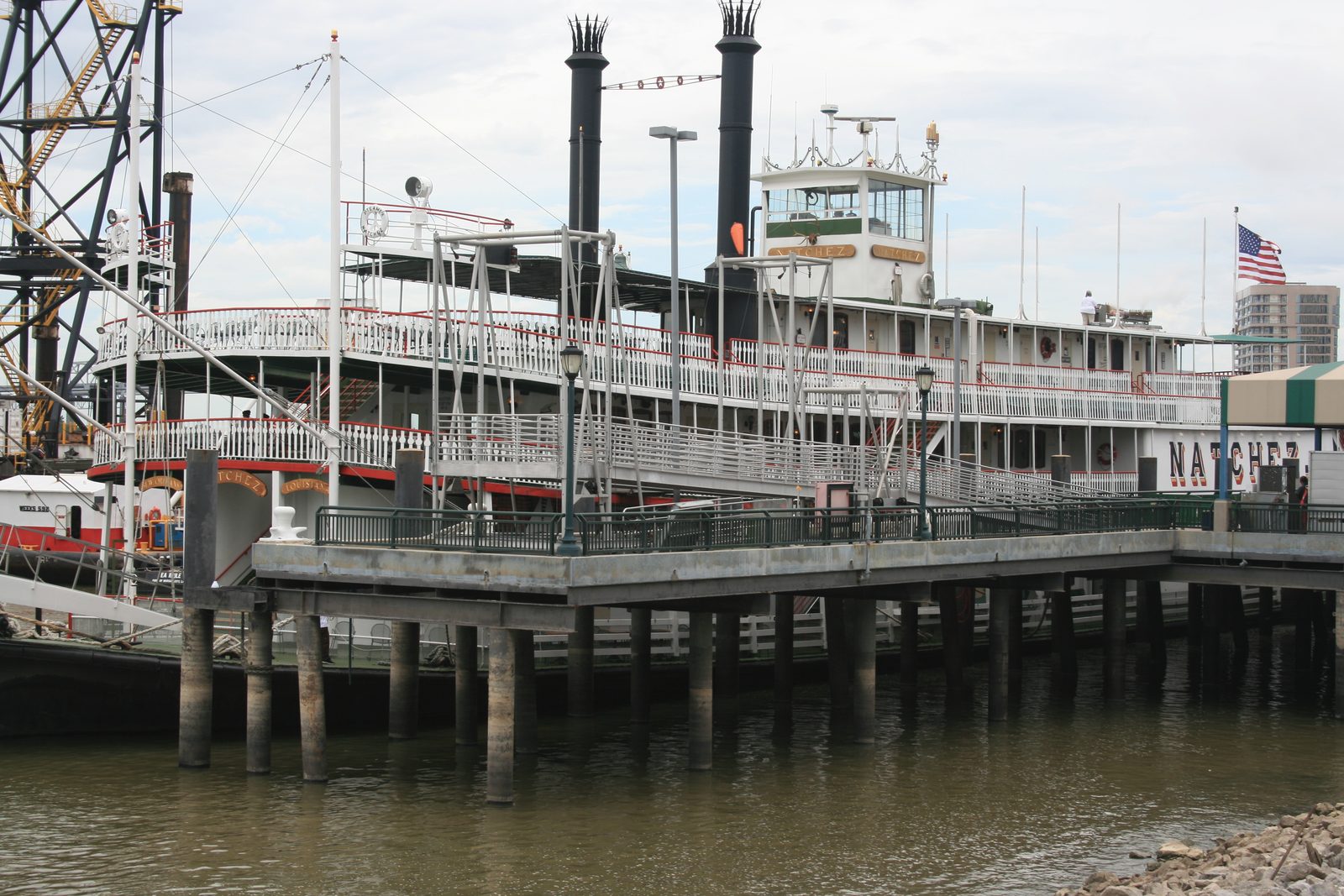
| Str. Natchez | 32 | Christened 1975; replicates Thomas J. Nichol originals; per-whistle colored lights (“aurora effect”) (Steamboat Natchez) |
7.3.2 Air calliopes (calliaphones)
Table 3 — 3.2 Air calliopes (calliaphones)
| Instrument | Notes / whistles | Note |
|---|---|---|
| Tangley Calliaphone (flagship / CA-43) | 43 notes | Tangley Co., Muscatine, Iowa; “Calliaphone” trademark (Mechanical Music Press) |
| National Calliope Corp. Model B | 53 whistles | Kansas City, Missouri; H. R. Brandt, 1927 (Mechanical Music Press) |
| Automatic roll standard | 65-note “A” roll | The roll standard both Tangley and National instruments read; wider than either instrument’s compass, so each reads the subset that maps to its whistles (Mechanical Music Press) |
Guardrail — do not collapse the counts. Steam: 25–67, 32 traditional. Air: Tangley 43-note, National 53-whistle, playing 65-note “A” rolls. Note that for calliopes the note count and whistle count are usually 1:1 — one whistle per note, with no unison ranks — unlike a pipe organ, where notes and pipes diverge across ranks and couplers (cross-ref “How Organ Pipes Make Sound” and “Wind Systems”). The 65-note “A” roll is the sole figure above that is a roll-format count, not an instrument compass.
7.4 Pressure, temperature, and pitch — the tuning tables
The calliope’s defining engineering fact is that its pitch tracks the temperature of its steam, and its temperature is bound to its pressure. This section collects the three tables that quantify that: the direction of drift, the saturated-steam pressure↔temperature relation, and the resulting pitch shifts in cents.
7.4.1 Direction of drift
With the bell length L fixed by construction, a whistle sounds at f ≈ c/(4L) for a closed (stopped) bell, where c is the speed of sound in the steam filling the bell. Because the speed of sound in a gas rises with absolute temperature as c ∝ √T, it follows that f ∝ √T — the pitch tracks the square root of the absolute steam temperature (Vol 3; the acoustic derivation is deferred to “How Organ Pipes Make Sound”). Every entry in the direction table is a consequence of that one proportionality.
Table 4 — 4.1 Direction of drift
| Change in the steam | Speed of sound c | Effect on pitch |
|---|---|---|
| Hotter (warmer boiler / superheated) | rises (c ∝ √T) | sharper ↑ |
| Cooler (cold boiler / wet exhaust) | falls | flatter ↓ |
| Higher blowing pressure | rises (hotter saturated steam + faster jet) | sharper ↑ |
| Lower blowing pressure | falls | flatter ↓ |
| Drier / more superheated | rises (hotter at same pressure) | sharper ↑ |
| Wetter (more entrained droplets) | falls (cooler, denser) | flatter ↓ |
The documented case: raising the blowing pressure drove one steam whistle “from E to D-flat” — a large upward shift (Wikipedia: Steam whistle). There is no operating regime in which raising the pressure or temperature of the steam flattens the pitch.
7.4.2 Saturated-steam pressure ↔ temperature (est.)
For saturated steam, temperature is fixed by pressure: at a given pressure there is exactly one temperature at which water boils and steam coexists with water. This mini-table sets the working temperatures behind the pressure ladder. All temperatures are estimates read from a standard steam table and rounded; verify against a steam table for precise work.
Table 5 — 4.2 Saturated-steam pressure ↔ temperature (est.)
| Gauge pressure (psig) | Absolute (psia) | Saturation temp (°C) | Saturation temp (°F) |
|---|---|---|---|
| 0 (1 atm) | ~14.7 | ≈100 (est.) | ≈212 (est.) |
| 15 | ~30 | ≈121 (est.) | ≈250 (est.) |
| 50 | ~65 | ≈150 (est.) | ≈300 (est.) |
| 100 | ~115 | ≈170 (est.) | ≈338 (est.) |
| 150 | ~165 | ≈186 (est.) | ≈366 (est.) |
| 180 | ~195 | ≈190 (est.) | ≈379 (est.) |
The calliope’s working band of ~100–180 psig therefore corresponds to saturated-steam temperatures of roughly 170–190 °C (est.). Note how the curve flattens: the first 15 psig buys about 21 °C, but the step from 150 to 180 psig buys only a few degrees. Superheated (dry) steam is hotter than the saturation value at the same pressure — and hotter steam is sharper steam.
The flattening has a practical consequence worth stating for the tuner. Because saturation temperature is a strong function of pressure at low pressure and a weak one at the calliope’s working pressures, a boiler held anywhere in the ~100–180 psig band delivers steam within a ~20 °C window on the saturation curve alone — so the large, unpredictable pitch excursions come not from the modest saturated-temperature spread but from superheat: steam sitting in a sun-warmed or throttled header can arrive tens of degrees above saturation at the same gauge pressure, and it is that superheat, not the boiler pressure reading, that sends a whistle a semitone sharp. The gauge tells the operator the loudness and the saturation floor; it does not tell the whole tuning story, because it cannot see how much the steam has dried and superheated on the way to the bell.
7.4.3 Pitch drift in cents
Because f ∝ √T, the interval between two steam temperatures is cents ≈ 600 × log₂(T₂ / T₁), with T₁ and T₂ in kelvin (the 600 rather than 1200 is the square root — doubling the pitch would need a quadrupling of absolute temperature). Worked across a calliope’s plausible steam range:
Table 6 — temperature). Worked across a calliope's plausible steam range
| Tuned at (saturated) | Drifts to | ΔT | Pitch shift |
|---|---|---|---|
| 150 °C (423 K) | 170 °C (443 K) | +20 °C | ≈ +40 cents (sharp) |
| 170 °C (443 K) | 200 °C (473 K) | +30 °C | ≈ +57 cents (sharp) |
| 170 °C (443 K), saturated | 250 °C (523 K), superheated | +80 °C | ≈ +144 cents (sharp, ~1½ semitones) |
| 170 °C (443 K) | 140 °C (413 K) | −30 °C | ≈ −60 cents (flat) |
(Temperatures est.; cents computed from f ∝ √T.)
The takeaway is stark: a quarter-tone of drift (~50 cents) needs only a ~25–30 °C swing in steam temperature — well within the difference between a boiler just brought up and one that has held pressure for an hour, or between wet saturated steam and mildly superheated steam. This is why Wikipedia observes that, for the calliope, “the pitch of each note is largely affected by the temperature of the steam, [so] accurate tuning is nearly impossible” (Wikipedia: Calliope). The mercy is that all bells see the same steam and drift together, so the instrument stays roughly in tune with itself even as it wanders from concert pitch.
7.5 The calliope at a glance
The one-page cheat card below collapses the dive to a single reference figure: what the instrument is, the pressure regime, the tuning rule, and the steam-versus-air tell. It is the figure to carry away if only one is kept: the four panels answer the four questions an enthusiast standing in front of an unfamiliar instrument actually asks — what is it, how hard is it blown, why won’t it stay in tune, and is it really steam? Each panel is a compression of a full volume — Vol 1 (what it is), Vols 3 and 5 (pressure), Vols 2 and 3 (tuning), and Vol 5 (the steam-versus-air tell) — so the card doubles as a table of contents for the dive.
7.6 Steam / calliope glossary
Definitions reused verbatim from the earlier volumes, so the terms carry one meaning across the dive.
Table 7 — 6. Steam / calliope glossary
| Term | Definition |
|---|---|
| Calliope | A musical instrument sounding tuned steam whistles, one per note, admitted by valves from a keyboard or a pinned cylinder / paper roll; named for the muse Calliope. Loosely applied to air versions too — see calliaphone. |
| Calliaphone | Trademark (Tangley Co., Muscatine, Iowa) for a compressed-air calliope; the generic “air calliope.” No boiler; blown at ~½–1 psi. |
| Steam whistle | The sound source: a valve, a steam orifice / steam-way, and a resonant bell; a steam jet directed across the bell’s lip drives a standing wave — a flue-pipe cousin. |
| Bell | The cylindrical resonator of a whistle; its length sets the pitch (f ≈ c/4L for a closed bell). A graded bank / rank of bells is the instrument’s compass. |
| Steam-way / orifice | The narrow (usually annular) gap the steam is forced through and directed across the bell mouth; the jet source. |
| Boiler | The fired pressure vessel that raises steam; on riverboats often the main or an auxiliary (“doctor”) boiler; sets the working pressure and hence loudness and (via temperature) tuning. |
| Working pressure | The steam gauge pressure feeding the whistles: ~100–180 psi (est.) for a steam calliope, contrast ~½–1 psi (air), ~0.18 psi (wind organ). Quoted as gauge pressure (psig): 0 psig ≈ 14.7 psia. |
| Saturated (wet) steam | Steam at the boiling point for its pressure, in equilibrium with water; may carry entrained droplets. Its temperature is fixed by pressure (≈170 °C at ~100 psig, est.). |
| Superheated (dry) steam | Steam heated above the saturation temperature for its pressure; higher speed of sound → sharper whistle. Dry steam is invisible; the visible white plume is condensing droplets (wet exhaust), not the dry steam. |
| Manifold (header) | The steam header / gallery that distributes boiler steam to each whistle’s valve; holds pressure so the whole rank drifts together. |
| Showboat | A riverboat theatre; the calliope was its advertising “loud-hailer,” played on approach to summon a town to the levee. |
7.7 Safety
A steam calliope is not a stage prop; it is a small live-steam installation, and the hazards are real and simultaneous. The reference note below is a summary — the full treatment is in Vol 3 §6 (boiler) and Vol 4 §6 (player hazards).
- Live-steam boiler at ~100–180 psi (est.). The boiler stores a large amount of energy. The safety (relief) valve is the primary protection and is never to be defeated, gagged, or overloaded to raise pressure “for a louder note” — the historical temptation, and a dangerous one, since more pressure raises both loudness and pitch (Vol 3 §3.3). A pressure gauge and a water gauge glass are mandatory; low water is the classic boiler hazard. Operation belongs to a competent, and where required certified/licensed, boiler attendant. Steam plant is inspected pressure equipment, not a garage project (contrast the boiler-free air calliope, Vol 5).
- Scalding steam and hot surfaces. Steam at ~170–190 °C (est.), and the header and whistles carrying it, cause severe burns on contact. Lagging (insulation) protects crew as well as conserving heat. The visible plume is condensing water — hot, wet, and also a burn hazard. Keep clear of the whistle bank while it is charged.
- Deafening volume — hearing protection. A calliope is engineered to be heard for miles; at the instrument the sound pressure is punishing. Hearing protection is required near a sounding whistle bank. The 1960 Delta Queen remote keyboard “at a safe distance from the whistles” (Vol 4 §5) was, in part, a response to exactly this — it moves the player away from the heat, steam, and noise of the bank.
7.8 Cross-index
Where each topic is treated, in this dive’s Volumes 1–6 and in the sibling dives of the Mechanical Organs program.
7.8.1 Topics → Volumes 1–6
Table 8 — 8.1 Topics → Volumes 1–6
| Topic | Volume(s) |
|---|---|
| What a calliope is; the name; one-whistle-per-note | Vol 1 §1 |
| Stoddard patent, American Steam Music Co., first 15-whistle instrument | Vol 1 §2 |
| ”Not a wind organ” thesis; the pressure ladder | Vol 1 §3; Vol 3 §1.2; Vol 5 §3 |
| Whistle anatomy (valve, steam-way/orifice, bell) | Vol 2 §1 |
| How the whistle makes a tone (jet across the lip, standing wave) | Vol 2 §2 |
| Pitch set by bell length; f ≈ c/(4L) closed bell; c/(2L) open variant | Vol 2 §3 |
| Why calliopes are enormously loud (near-choked jet) | Vol 2 §4; Vol 6 §1.1 |
| Boiler as pressure vessel; working pressure ~100–180 psi (est.) | Vol 3 §1 |
| Saturated vs superheated steam; pressure↔temperature | Vol 3 §2 |
| The plume is condensation | Vol 3 §2.3 |
| Tuning drift; f ∝ √T; direction and cents | Vol 3 §3 |
| Manifold / header; distribution; condensate; pressure sag | Vol 3 §5 |
| Boiler safety | Vol 3 §6 |
| The action — mechanical / pneumatic / electric valves | Vol 4 §2–3 |
| Roll-operated (automatic) calliope | Vol 4 §4 |
| Remote keyboard “at a safe distance” (Delta Queen 1960) | Vol 4 §5 |
| Steam vs air — the Calliaphone; the guardrail | Vol 5 (whole) |
| Tangley / National / Miner; 43 / 53 / 65-note “A” roll | Vol 5 §2 |
| Named boats (Delta Queen, Natchez, Belle of Louisville) | Vol 6 §3 |
| Thomas J. Nichol, maker of record | Vol 6 §4 |
| The circus parade calliope | Vol 6 §5 |
| Reference tables, glossary, safety, cross-index (this volume) | Vol 7 |
7.8.2 Topics → sibling dives (Mechanical Organs program)
Table 9 — 8.2 Topics → sibling dives (Mechanical Organs program)
| Topic | Sibling dive |
|---|---|
| Jet / edge-tone mechanism; standing-wave theory; closed vs open pipe; end-correction | How Organ Pipes Make Sound |
| Low-pressure wind supply (~5 in H₂O ≈ 0.18 psi); bellows and reservoir — the contrast case | Wind Systems |
| Paper-roll and pinned-barrel encoding; the 65-note “A” roll; tracker bar | Encoding the Music |
| The wind-blown fairground / street organ — the calliope’s wind-branch sibling | Fairground & Dutch Street Organs (Dive 14) |
The family relationship, in one line: the calliope is the steam branch of the mechanical-organ family tree; the fairground / Dutch street organ is the wind branch; the calliaphone is the air branch. All three sound tuned pipes or whistles admitted by valves from a keyboard or roll — they differ in working fluid and pressure, which is the whole of the pressure ladder.
7.9 Bibliography
Cited by the short forms used throughout Vols 1–7.
- Wikipedia: Calliope (instrument) — https://en.wikipedia.org/wiki/Calliope_(instrument). Stoddard patent; whistle count “25–67, 32 traditional”; steam or compressed air; “typically very loud… audible for miles”; pitch set by steam temperature so “accurate tuning is nearly impossible”; riverboat and circus use; keyboard vs roll operation; American Steam Music Co.
- Wikipedia: Joshua C. Stoddard — https://en.wikipedia.org/wiki/Joshua_C._Stoddard. Stoddard (1814 Pawlet VT – 1902); U.S. Patent 13,668, October 9, 1855; first instrument = boiler + valves + fifteen graded whistles played from a pinned cylinder; heard ~5 miles (8 km); banned within Worcester city limits; keyboard added later (Arthur S. Denny); original fed at ~180 psi.
- Wikipedia: Steam whistle — https://en.wikipedia.org/wiki/Steam_whistle. Mechanism (steam through the orifice; compress/rarefy in the bell; “similar to how organ pipes function”); pitch set by bell length (“doubling the effective length… halves the frequency”); pitch rises with blowing pressure (“E to D-flat”) and varies with steam temperature; industrial whistles 100–300 psig (some to 600).
- Steamboats.org — Steam Whistles & Calliopes — https://www.steamboats.org/whistle-calliope.html and the Delta Queen page https://www.steamboats.org/whistle-calliope/ecaliope.html. Steamboat calliope tradition since ~1865; Thomas J. Nichol of Cincinnati built most surviving boat calliopes; Delta Queen (1960 remote keyboard; whistles from the Water Queen); 32-note.
- Steamboat Natchez — steam calliope pages — https://www.steamboatnatchez.com/steam-calliope.html and guide PDF https://www.steamboatnatchez.com/uploads/files/SteamboatNatchezGuide.pdf. Str. Natchez (christened 1975) plays 32 notes, replicating Nichol originals; synchronized colored lights per whistle (“aurora effect”).
- Mechanical Music Press — Air Calliopes registry — https://mechanicalmusicpress.com/registry/calliope/calliope.htm (and the Tangley catalogue excerpt https://mechanicalmusicpress.com/registry/calliope/calliope_p04_tcat.htm). Tangley Co., Muscatine, Iowa; “Calliaphone” trademark; 43-note flagship; Norman Baker (first sale June 1915, $500); National Calliope Corp., Kansas City (H. R. Brandt, 1927; 53-whistle Model B; last unit 1950, Hadacol); 65-note “A” rolls; air pressure ~½–1 psi.
- Miner Company LLC — https://minercompany.com/tangley-calliope/ (and the Missouri Life profile https://missourilife.com/meet-one-of-the-worlds-last-calliope-builders-2/). One of the last living builders; modern Tangley-style air calliope replicas.
- Encyclopædia Britannica — Calliope (musical instrument) — https://www.britannica.com/art/calliope-musical-instrument. Concise definition (boiler → whistle pipes; keyboard or pinned cylinder); overview and cross-check.
- American Heritage — “Strike Up the Boiler” — https://www.americanheritage.com/strike-boiler. Narrative history of the calliope (Stoddard, circus/showboat era, loudness lore) — colour and corroboration.
- Steam-property / steam-table reference — a standard saturated-steam table (e.g. Engineering ToolBox saturated-steam properties, https://www.engineeringtoolbox.com/saturated-steam-properties-d_101.html). For the saturated-steam pressure↔temperature relation (≈100 °C at 0 psig, ≈170 °C at ~100 psig, ≈190 °C at ~180 psig — est., verify against the table).
Estimate marks. The saturated-steam temperatures (§4.2, §5, §7) are read from a standard steam table and rounded — verify there. Calliope working pressures other than Stoddard’s documented ~180 psi and the 100–300 psig industrial-whistle band are marked (est.) throughout. Pitch-drift figures in cents (§4.3) are computed from f ∝ √T at the (estimated) temperatures shown.
Comments (0)