Steam Organs And Calliopes · Volume 2
Steam Organs & Calliopes — Vol 02: The Steam Whistle
The calliope has exactly one voice, repeated in a graded bank: the steam whistle. Every note a calliope sounds is a single whistle, tuned to a single pitch, admitted from the boiler by a single valve. Understand the whistle and the rest of the instrument follows — the boiler (Vol 3) is a means of feeding it, the action (Vol 4) a means of switching it, the compass a means of stacking a scale of them. This volume treats the whistle as an acoustic object: what its parts do, how it makes a tone, what sets that tone’s pitch, why it is one of the loudest sustained sound sources ever built by hand, and why — uniquely among keyboard instruments — it will not hold its tuning.
The steam whistle is a close acoustic cousin of the flue organ pipe. It works by the same principle: a thin jet of fluid is thrown across a sharp edge, the resulting instability locks to a resonant air (here, steam) column, and the column radiates a musical tone. The jet/edge-tone mechanism and the standing-wave theory that governs it are derived in full in “How Organ Pipes Make Sound”; this volume names those results and applies them, but does not re-derive them. The low-pressure wind-organ case — the flue pipe blown at a few inches of water — is the explicit contrast case, covered in “Wind Systems”. The steam whistle is the same mechanism run in a wildly different regime: the working fluid is hot steam rather than air, and the driving pressure is on the order of 100 psi and up, not a fraction of a psi. That single change of regime accounts for everything distinctive about the calliope — its volume, and its refusal to stay in tune.
2.1 Anatomy of a steam whistle
A steam whistle is a deceptively simple casting. Five functional parts do all the work, from the bottom (where steam enters) to the top (where the tone is set):
Table 1 — work, from the bottom (where steam enters) to the top (where the tone is set)
| Part | Also called | Function |
|---|---|---|
| Valve | pull valve, lever valve | Admits boiler steam to the whistle on demand; on a calliope, one per note, operated by key, roll or lever. Closed, the whistle is silent; open, steam flows. |
| Orifice / steam-way | annular slit, nozzle | The narrow (usually annular, i.e. ring-shaped) gap the steam is forced through, which shapes it into a thin, fast jet and aims it upward across the mouth. |
| Bowl / mouth | cup, whistle mouth | The chamber above the orifice where the jet is thrown across a sharp lip; the sounding edge and the base of the resonator. This is the whistle’s analogue of the flue pipe’s mouth. |
| Bell | resonator, cup (variant) | The cylindrical resonator whose length sets the pitch. Steam alternately compresses and rarefies within it (Wikipedia: Steam whistle). The acoustically active part of the instrument. |
| Cap | top, cup, dome | Closes the top of the bell (in the common stopped design) or, in the adjustable variant, forms a sliding cup that tunes the effective length. |
Steam enters through the valve, is squeezed through the annular orifice into a high-speed sheet, and is directed across the lip of the bowl. Above the bowl stands the bell — a plain cylindrical tube of fixed diameter. In the most common locomotive- and calliope-type whistle the bell is closed at the top by the cap and open only at the bottom, at the mouth, where the jet enters. The steam sheet, striking the lip, sets up an oscillation that the bell’s resonance seizes and holds; the bell “rings” at its natural frequency, and steam radiates that tone out of the mouth. Wikipedia describes exactly this: steam passing through the orifice “is used to alternately compress and rarefy the [steam] in the bell, thus causing sound” (Wikipedia: Steam whistle).
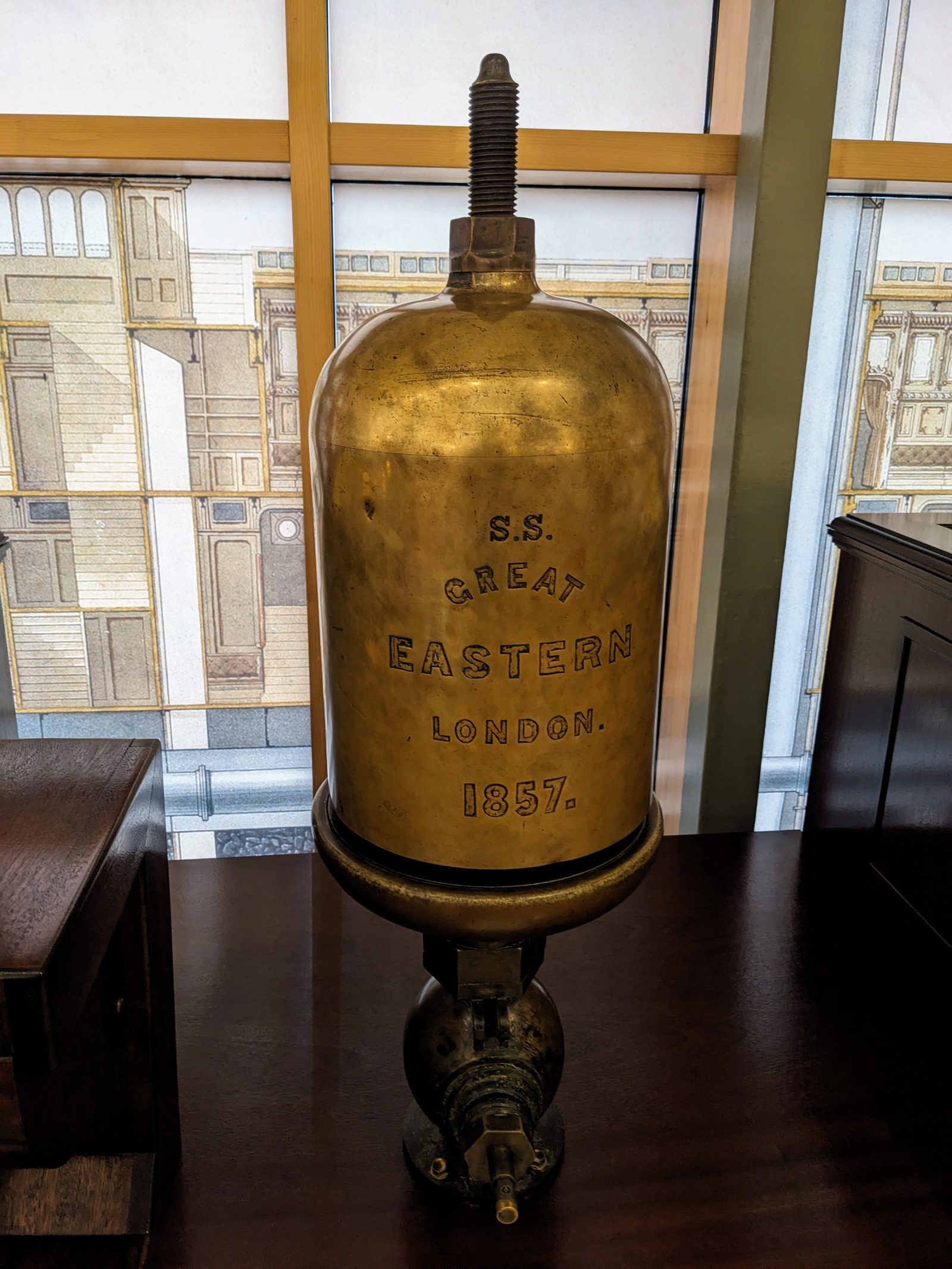
The calliope stacks a bank of these whistles — 25 to 67 of them, with 32 traditional for a steam calliope (Wikipedia: Calliope) — on a common steam manifold, graded in length from the longest (lowest note) to the shortest (highest). Each whistle is essentially independent: it has its own valve, its own orifice, and its own fixed-length bell tuned once to one note. There is no unison-rank doubling as in a pipe organ, so on a calliope the whistle count and the note count are normally the same, one whistle per note. (That one-to-one relationship is peculiar to the calliope; in a pipe organ notes and pipes diverge sharply — see “How Organ Pipes Make Sound” and “Wind Systems.”)
2.2 How the whistle makes a tone
The mechanism is the flue pipe’s, transposed into steam. The orifice performs the office of the pipe’s windway (flue): it forms the fluid into a thin, coherent sheet and aims it at an edge. The lip of the bowl performs the office of the pipe’s upper lip / labium: it is the sharp edge the sheet is thrown across. The sheet is aerodynamically unstable, and as it crosses the edge it flaps from one side of the lip to the other, alternately spilling into and out of the bell — an edge-tone. The bell is a resonator with a strong natural frequency, and it selects and reinforces whichever component of that flapping matches its own resonance, feeding energy back to the jet and locking the oscillation to the bell’s pitch. The bell then radiates a sustained, near-pure musical tone.
That is the same jet-drive-plus-resonator loop that sounds every flue pipe in “Wind Systems,” and the physics of why an unstable jet at an edge locks to a resonant column — the edge-tone, the feedback, the standing wave and its modes — is derived once, carefully, in “How Organ Pipes Make Sound.” It is not repeated here. What matters for the calliope is that the loop is the same and only the regime differs:
- Working fluid. A flue organ pipe is blown with air; a steam whistle is blown with hot steam. The speed of sound in the resonating column — the quantity that, with the length, fixes the pitch — is therefore a property of steam at its working temperature, not of room air. This is the root of the tuning problem (§5, and fully in Vol 3).
- Driving pressure. A low-pressure wind organ blows at roughly 5 inches of water, about 0.18 psi (“Wind Systems”). A steam calliope blows at boiler pressure — on the order of 100 to 180 psi (est.), three orders of magnitude higher (Stoddard’s original is reported fed at about 180 psi; industrial steam whistles typically run 100–300 psig and some to 600 psig — Wikipedia: Steam whistle). The jet is correspondingly fast and energetic (§4).
Same mechanism; a different universe of pressure and a different fluid. The diagram below sets the two sound sources side by side.
Figure 2-1. The steam whistle (left) and the flue organ pipe (right) are the same sound source in two regimes. In both, a fluid jet from a narrow way is thrown across a sharp lip and drives a standing wave in a resonant column. The whistle’s bell is normally closed at the top (a stopped resonator), so f ≈ c/(4L); the open-top flue pipe is a half-wave resonator, f ≈ c/(2L). The regimes differ utterly: the whistle runs hot steam at roughly 100–180 psi (est.), the flue pipe runs air at roughly 0.18 psi. See “How Organ Pipes Make Sound” for the physics of the jet/edge-tone loop.
2.3 Pitch is set by bell length
The bell is a cylindrical resonator, and — exactly as for an organ pipe — its length sets its pitch. Wikipedia states the rule directly: “the pitch of the sound is dependent on the length of the bell,” and “doubling the effective length of the bell will halve the resulting frequency” (Wikipedia: Steam whistle). A doubling of length dropping the pitch an octave is the signature of a resonant column: the resonant frequency is inversely proportional to length.
The proportionality constant depends on how the bell is terminated at its ends.
2.3.1 The stopped (closed) bell — the usual case: f ≈ c/(4L)
In the common calliope- and locomotive-type whistle the bell is closed at the top by the cap and effectively open at the bottom (the mouth, where the jet enters). Acoustically that is a stopped / closed pipe — closed at one end, open at the other. A stopped pipe resonates as a quarter-wave resonator: the fundamental fits one quarter of a wavelength into the tube, so
f ≈ c / (4L)
where f is frequency (Hz), c the speed of sound in the steam filling the bell (m/s), and L the effective bell length (m). The word “effective” carries a small end-correction at the open (mouth) end, which lengthens L slightly beyond the physical tube; the derivation of that correction lives in “How Organ Pipes Make Sound.” A stopped pipe of a given length sounds an octave lower than an open pipe of the same length, which is why calliope bells, for all their volume, are relatively compact.
2.3.2 The open / cupped-bell variant: f ≈ c/(2L)
Not every whistle is stopped. Some designs use an open or cupped bell — an adjustable cup or a bell open at the top — and an open-ended cylindrical resonator is a half-wave device:
f ≈ c / (2L)
An open bell of a given length therefore sounds an octave higher than a stopped bell of the same length. The adjustable cup is also a tuning device: sliding it changes the effective L and so trims the pitch, which is how many whistles are set to their note. Which termination a particular calliope uses is a design choice that is not always documented; unless a specific instrument’s whistles are known to be open/cupped, this dive treats them as stopped bells, f ≈ c/(4L) (est.), and flags the assumption rather than asserting a type without a source.
2.3.3 A worked bell-length ladder
Because f ≈ c/(4L), the required bell length is L ≈ c/(4f). The speed of sound in steam is higher than in room air — for saturated steam at roughly 170 °C (about 100 psig) c ≈ 520 m/s (est.), versus about 343 m/s for air at 20 °C; the steam value is derived with the boiler in Vol 3, where the temperature dependence is the whole story. Using c ≈ 520 m/s (est.), a stopped bell gives the following illustrative lengths:
Table 2 — illustrative lengths
| Note | Frequency (Hz) | Stopped-bell length L ≈ c/4f (est.) |
|---|---|---|
| C3 | 130.8 | ≈ 994 mm |
| C4 (middle C) | 261.6 | ≈ 497 mm |
| C5 | 523.3 | ≈ 248 mm |
| C6 | 1046.5 | ≈ 124 mm |
| C7 | 2093.0 | ≈ 62 mm |
(Illustrative only, marked (est.): the figures assume a stopped bell, c ≈ 520 m/s in ~170 °C steam, and ignore end-correction and bell-diameter effects. Real whistle bells are tuned empirically with the cup/cap. The pattern is the load- bearing point: each octave up halves the length — C3 to C4 to C5 each halving — just as “doubling the effective length halves the frequency” (Wikipedia: Steam whistle).)
The diagram below shows the graded bank that results: the longest bell at the bass end, each successive bell shorter, the highest note the stub at the treble end.
Figure 2-2. A calliope’s compass is a bank of graded bells on a common manifold: the longest bell sounds the lowest note, and each octave up halves the bell length (f ≈ c/(4L), so f ∝ 1/L). The right-hand curve is that inverse relation. Diameters are drawn roughly constant for clarity; in practice bell scaling (the length-to- diameter ratio) is also adjusted for tone across the compass.
2.4 Why calliopes are enormously loud
The calliope is famous for one thing above all: it is deafening. Stoddard’s very first instrument was reportedly heard about five miles (8 km) away and was banned within the Worcester, Massachusetts city limits for its loudness (Wikipedia: Joshua C. Stoddard). Wikipedia’s calliope article calls the instrument “typically very loud” and notes it “can sometimes be heard for miles” (Wikipedia: Calliope). That is not showmanship in the description; it is a direct consequence of the sound source.
The reason is the pressure regime. A sound source is, fundamentally, a device that converts flow energy into acoustic energy, and the acoustic power available scales steeply with the jet’s velocity and the driving pressure. A low-pressure flue organ pipe drives its jet with about 0.18 psi of wind (“Wind Systems”); the jet leaves the flue at a modest velocity, a few metres per second, and the pipe radiates a musically useful but physically small acoustic power. A steam whistle drives its jet with boiler pressure — on the order of 100 to 180 psi (est.), some five hundred to a thousand times higher.
At those pressures the flow through the orifice reaches the choked condition: once the pressure ratio across the orifice exceeds roughly 1.9, the steam leaves the steam-way at the local speed of sound (sonic velocity — several hundred metres per second) and cannot go faster no matter how much more pressure is applied. The jet crossing the bell’s lip is therefore a fast, near-choked steam jet carrying orders of magnitude more energy than a wind pipe’s low-velocity air jet, and the resonant bell converts a correspondingly larger acoustic power. The calliope is loud not because its resonator is special — the bell is an ordinary cylinder — but because it is driven by a pressure vessel rather than a bellows. The detailed jet aerodynamics belong to “How Organ Pipes Make Sound”; the takeaway here is the regime: choked steam jet at 100+ psi versus a gentle air jet at 0.18 psi, hence “audible for miles.”
Two further consequences of the loudness are worth stating, because they shape the rest of the instrument:
- The player cannot stand at the whistles. The noise, heat and steam make the whistle bank a hostile place. This is why the classic riverboat solution — the remote keyboard “at a safe distance from the whistles” (Delta Queen, 1960) — exists at all; the action that reaches across that gap is Vol 4’s subject.
- The calliope was an advertising instrument, not a concert one. Its social role — closing the circus parade, hailing a town from the levee — follows from a sound source engineered for reach rather than nuance. The colour and the named boats are Vol 6.

2.5 Why the whistle will not stay in tune (previewed)
A flue organ pipe, once voiced, holds its pitch: the speed of sound in the air filling it barely moves with the small temperature swings of a room, so a fixed length gives a fixed pitch. The steam whistle enjoys no such stability, and the reason is written into f ≈ c/(4L). The length L is fixed by the casting. But c — the speed of sound in the resonating steam — is not fixed: it depends on the steam’s temperature, rising as the steam gets hotter. To a good approximation c ∝ √T (with T the absolute temperature), so a hotter, drier steam gives a higher c, and with L fixed, a higher c means a higher f. The note goes sharp.
This is exactly what the sources report, and the direction matters:
- Raising the blowing pressure raises the pitch. Wikipedia notes that raising the steam pressure on one whistle drove it “from E to D-flat” — upward (Wikipedia: Steam whistle). Higher pressure means hotter saturated steam (Vol 3), hence higher c, hence a sharper note.
- At a fixed pressure the pitch still varies with the steam’s temperature — for instance whether the steam is merely saturated or is superheated above the saturation temperature (Wikipedia: Steam whistle).
- The calliope article draws the consequence explicitly: because “the pitch of each note is largely affected by the temperature of the steam,” on a steam calliope “accurate tuning is nearly impossible” (Wikipedia: Calliope).
So a calliope tuned in cool, wet, freshly-raised steam will play sharp once the boiler is hot and the steam dry and superheated, and will sag flat again as it cools or the steam turns wet. Every bell drifts the same way at once, so the instrument tends to stay roughly in tune with itself while wandering as a whole — but it is forever chasing a moving target, and it is “tuned for one temperature” rather than tuned once for good. This is the price of using a hot, variable working fluid as the resonating medium, and it is the single largest practical difference between a calliope and any wind instrument.
The full account — saturated versus superheated steam, the pressure-to-temperature relation from the steam tables, why the visible white plume is condensation rather than the dry working steam, and how players manage the drift — is the subject of Vol 3 (Boiler & Steam Supply). It is previewed here only to close the loop on the whistle: the same equation that sets the pitch, f ≈ c/(4L), also explains why that pitch will not sit still.
2.6 Summary
The steam whistle is the calliope’s entire voice, replicated in a graded bank of 25–67 (traditionally 32) tuned units (Wikipedia: Calliope), one whistle per note. Its anatomy runs valve → orifice/steam-way → bowl and lip → bell → cap. Its mechanism is the flue organ pipe’s: a jet from a narrow way thrown across a sharp lip, driving a standing wave in a resonant cylindrical column — the physics derived in “How Organ Pipes Make Sound,” not here. Its pitch is set by bell length, f ≈ c/(4L) for the usual stopped bell (quarter-wave), or f ≈ c/(2L) for the open/cupped variant (half-wave); doubling the length drops the note an octave (Wikipedia: Steam whistle). It is extraordinarily loud — heard for miles, banned in Worcester (Wikipedia: Joshua C. Stoddard; Wikipedia: Calliope) — because it is driven by a near-choked steam jet at roughly 100–180 psi (est.) rather than a wind pipe’s gentle 0.18 psi air jet (“Wind Systems”). And it will not hold its tuning, because c in f ≈ c/(4L) rides on steam temperature: hotter/drier steam sharpens every note at once (Wikipedia: Steam whistle, Calliope). Same mechanism as the organ pipe; a different fluid, three orders of magnitude more pressure, and a resonating medium whose speed of sound is set by a boiler — which is where Vol 3 takes up the story.
2.6.1 Cross-references
- “How Organ Pipes Make Sound” — the jet/edge-tone mechanism, the standing- wave theory, closed- vs open-pipe modes, and the end-correction; the physics this volume applies but does not re-derive.
- “Wind Systems” — the low-pressure wind organ (~5 in H₂O ≈ 0.18 psi), the explicit contrast case for the steam whistle’s pressure regime.
- Vol 3 — Boiler & Steam Supply — working pressure; saturated vs superheated steam and the pressure↔temperature relation; why the plume is condensation; the full account of the tuning drift previewed in §5.
- Vol 4 — The Action — how valves are opened from a keyboard or roll, and the remote keyboard “at a safe distance from the whistles.”
- “Fairground & Dutch Street Organs” (Dive 14) — the wind-blown sibling of the calliope; the two dives are the wind and steam branches of the same family.
Sources
- Wikipedia: Steam whistle — mechanism (orifice → bell), pitch set by bell length (“doubling the effective length… halves the frequency”), pressure/ temperature effect on pitch, industrial working-pressure band (100–300 psig).
- Wikipedia: Calliope (instrument) — whistle count (25–67, 32 traditional), “typically very loud… heard for miles,” pitch set by steam temperature so “accurate tuning is nearly impossible.”
- Wikipedia: Joshua C. Stoddard — first instrument heard ~5 miles; banned within Worcester city limits; original fed at ~180 psi.
Comments (0)