Steam Organs And Calliopes · Volume 4
Steam Organs & Calliopes — Vol 04: The Action
The action is the machinery that stands between a musician’s fingers (or a paper roll) and the steam. Vol 2 covered the whistle as a sound source; Vol 3 covered the boiler and the manifold that charges those whistles with steam. This volume covers the part in the middle: the valve that opens to let steam into one whistle when a note is called for, and closes to shut it off again — and the linkage, pneumatics, or wiring that tells that valve when to open. It is a harder engineering problem than the equivalent job on a wind organ, because the thing being controlled is not cool low-pressure air but hot, wet, erosive steam at boiler pressure. That single difference shaped every generation of calliope action, and ultimately drove the player off the manifold altogether and onto a remote keyboard at a safe distance.
4.1 The valve problem
Every keyed or roll-played organ, of whatever kind, reduces to the same task: for each note there must be a valve that is normally shut and that opens on demand to admit the working fluid to one sounding element, then reseals cleanly when the note ends. On a pipe organ that element is a flue or reed pipe and the valve is a pallet — a hinged, felted, leather-faced flap held shut against a slot by a spring, pulled open by the key action against a wind pressure of only a few inches of water column, on the order of 0.18 psi (see “Wind Systems”). The pallet is one of the gentlest control valves in all of mechanical engineering. It handles clean, cool, dry air at a pressure a child can hold back with a fingertip, so it can be made of wood and leather and last a century.
A steam calliope’s per-note valve does the same job in a completely different regime. What it must admit and shut off is saturated or superheated steam at a working pressure of roughly 100–180 psi (est.) — three orders of magnitude above the pipe organ’s wind — and at a temperature set by that pressure. For saturated steam the temperature is fixed by the pressure through the steam tables: about 170 °C at ~100 psig and about 190 °C at ~180 psig (est.) (Vol 3). Superheated (dry) steam is hotter still. The valve therefore operates red-hot to the touch, in a wet and mineral-laden flow that erodes seats and cuts wire-drawn grooves across any sealing face that is left cracked open under pressure.
Four requirements fall out of this, and they pull against one another:
- It must open fast and fully. A whistle needs a sharp, well-formed steam jet across its bell lip to speak promptly and cleanly (Vol 2). A valve that cracks open slowly gives a breathy, pitch-unstable attack and wastes steam.
- It must seal cleanly and completely when shut. Steam leaking past a shut valve keeps the whistle whispering (a false note or a “cipher,” in organ terms) and wire-draws the seat until it will no longer seal at all.
- It must survive heat, wetness, and erosion. Leather and felt are out; the seat and disc are metal — bronze, gunmetal, or hardened steel — often with a renewable seat so the erosion can be serviced rather than scrapping the valve.
- It must be operable. Steam pressure acts on the valve disc and tries to hold it shut (or, depending on which side the steam sits, tries to blow it open). Either way there is a real force to overcome on every note, and the whole later history of the calliope action is about who — or what — overcomes it.
The contrast with the pipe organ is the load-bearing point of this volume. A wind organ’s pallet is a light-touch valve on cool low-pressure air (cross-ref “Wind Systems”); a calliope’s note valve is an industrial steam valve dressed up as a musical one. Everything below follows from that.
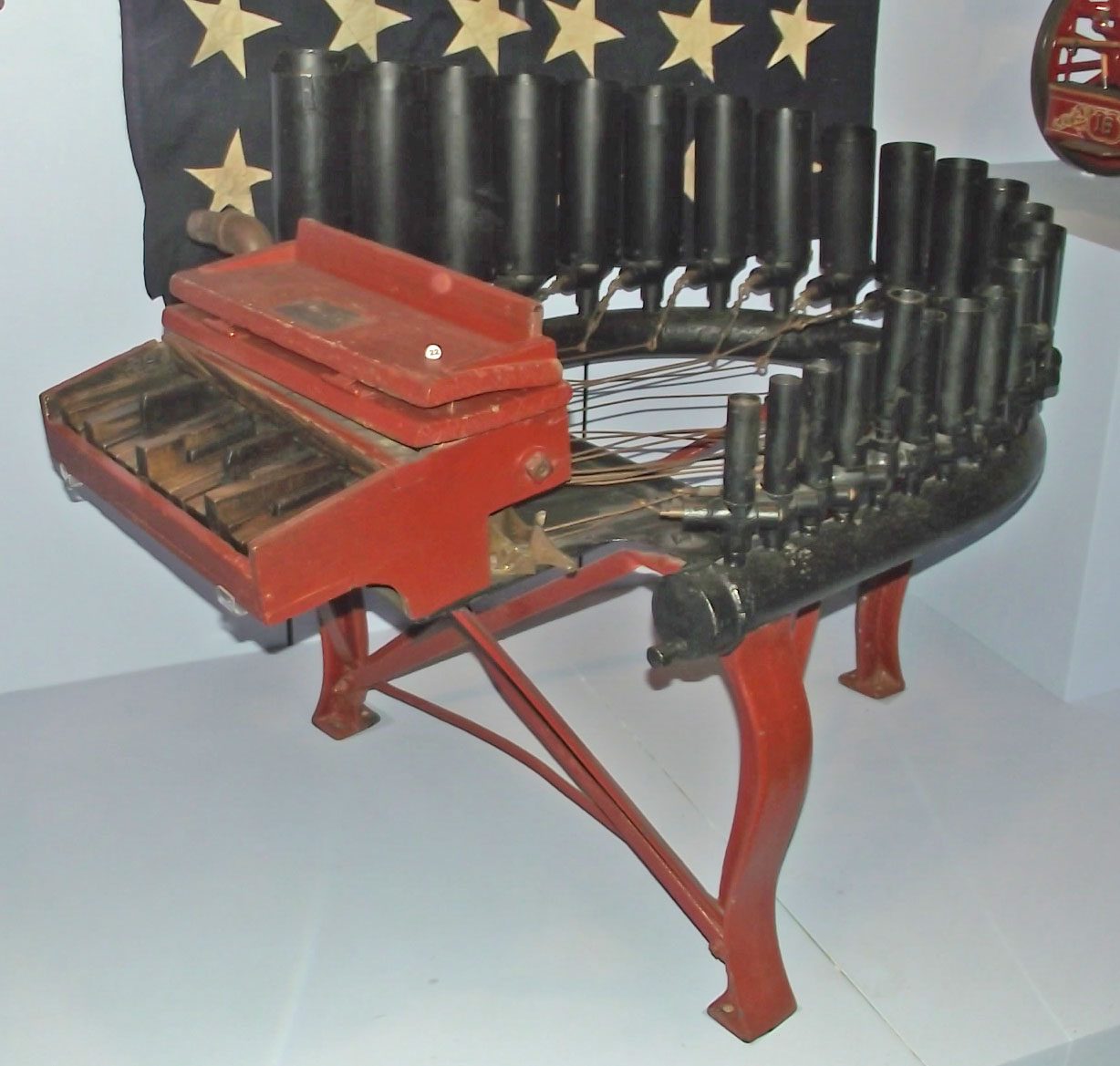
4.1.1 Why the whistle valve is not a pallet
It is worth being explicit about the substitutions. Table 1 sets the pipe-organ pallet beside the calliope note valve, feature for feature.
Table 1 — 1.1 Why the whistle valve is not a pallet
| Feature | Pipe-organ pallet | Steam calliope note valve |
|---|---|---|
| Working fluid | Air (cool, dry, clean) | Steam (hot, wet, erosive) |
| Pressure | ~0.18 psi (a few in H₂O) | ~100–180 psi (est.) |
| Temperature | Ambient | ~170–190 °C (est.), higher if superheated |
| Sealing face | Leather on wood, felt bushing | Metal seat (bronze/steel), lapped |
| Force to open | A few grams; a spring return | Substantial; steam pressure on the disc |
| Failure mode | Cipher from a warped pallet | Cipher plus wire-drawn/eroded seat |
| Service life | Decades on original leather | Seats re-lapped/renewed periodically |
The consequence for the player is immediate and physical. On a tracker pipe organ the resistance felt at the key is dominated by the pluck of the pallet against its wind — noticeable, but light. On a direct-action steam calliope the resistance felt at the key is the steam itself, and it is heavy. That is the first action type, and historically the original one.
4.2 Direct mechanical action: the player fights the steam
Stoddard’s first instrument (1855; U.S. Patent 13,668) had no keyboard at all. It was a boiler, a set of valves, and fifteen graded whistles played from a pinned cylinder — the keyboard was added later, by Arthur S. Denny (Wikipedia: Joshua C. Stoddard; see Vol 1). Both of those original control methods — the pinned cylinder and the keyboard that followed it — are direct mechanical actions: a physical member (a cylinder pin, or a key and its trackers) opens the steam valve itself, through a rigid linkage, with no intermediate amplification of force.
4.2.1 The keyboard direct action
In the keyed direct action, each key is coupled by a rod, lever, or tracker to the stem of one whistle’s steam valve. Pressing the key drives the valve off its seat against the steam; releasing it lets a spring (and the steam pressure itself) reseat the valve. The linkage is a straightforward class-1 or class-2 lever arrangement, sometimes with a roller board or backfall to spread the manifold’s valve spacing out to a playable key spacing, exactly as a tracker organ does — but where the tracker organ’s trackers pull a feather-light pallet, the calliope’s pull an industrial valve holding back 100+ psi.
The player therefore fights steam pressure at every key. The touch is heavy, uneven from note to note (valve size and the exact steam force vary across the compass), and utterly unlike a piano or an organ manual. Contemporary and modern accounts of playing a direct-action steam calliope agree on the character: it is hard physical work, the keys are hot because the manifold and its valves are at steam temperature and that heat conducts up the metal linkage to the key surface, and the instrument is deafening because the player is standing directly over a rank of whistles each drawing a choked steam jet at boiler pressure (Vol 2; Steamboats.org). The calliopist on a direct action is, quite literally, an operator of steam machinery who happens to be making music.
4.2.2 The pinned-cylinder direct action
The automatic form of the original instrument replaces the keyboard with a rotating pinned cylinder (a barrel), turned by hand or by a small steam engine. Pins set into the barrel’s surface, at positions corresponding to notes and beats, lift trackers or levers as the barrel rotates; each lifted lever opens its whistle’s steam valve for as long as the pin holds it up. This is the same barrel principle used across the whole mechanical-organ family (the barrel/pinned-cylinder mechanism itself is treated in “Encoding the Music” — it is not re-derived here). What matters for this volume is only the last link in the chain: the pin’s motion is still opening a steam valve directly, mechanically, against pressure. A barrel-driven calliope needs pins and a barrel spring stiff enough to overcome the steam force on the valve, just as the keyed version needs a heavy touch — the automation removes the player, not the force.
4.2.3 The limits of direct action
Direct mechanical action is simple, robust, and needs no auxiliary power beyond the muscle (or barrel spring) that already turns the mechanism. Its limits are exactly the four valve requirements of §1 turned into ergonomics:
- The touch is heavy because the operator supplies the full valve-opening force. This caps how fast and how expressively the instrument can be played.
- The keys are hot and the player is in the blast — heat, scalding-steam risk, and deafening volume all concentrate at the one place the direct action forces the operator to stand: right on top of the manifold.
- Valve size is constrained by playability: a bigger valve (more steam, a louder or larger whistle) means a heavier touch, so the direct action resists scaling up the low notes.
Every one of these limits is relieved by breaking the rigid link between the control surface and the steam valve — by letting a light control open a separate mechanism that supplies the heavy valve-opening force from the steam supply itself. That is the pneumatic and electric action.
4.3 Pneumatic and electric action: a light key, a heavy valve
The decisive idea, borrowed from the same era’s developments in large pipe organs, is power assistance: the key (or the roll, or the cylinder pin) no longer opens the note valve directly. Instead it opens a small, light pilot — a tiny valve or an electrical contact — and the pilot commands a separate power mechanism that does the heavy work of opening the steam valve. The control surface is thereby decoupled from the force, so the keyboard can be made as light as a piano’s and, crucially, can be located anywhere a tube or a wire can reach.
4.3.1 Pneumatic (or steam-pneumatic) action
In a pneumatic action the pilot admits a control fluid to a small motor — a pneumatic bellows or a piston — whose movement opens the main steam valve. There are two variants worth distinguishing:
- Tubular-pneumatic control on a separate air supply. The key opens a pilot that vents or charges a small air line; the air line works a pouch or bellows motor at the manifold, and the motor lifts the steam valve. This mirrors the tubular-pneumatic actions of turn-of-the-century pipe organs, where a light keyboard controls distant chests through lead tubing. The control air is low pressure and cool; only the final motor touches the hot region.
- Steam-pneumatic (pilot-operated) valves. The main valve is arranged so that steam pressure itself both holds it shut and, when a small pilot valve is opened, is bled to the other side of a piston to blow the main valve open — a pilot-operated or servo steam valve. Here the pilot is tiny (it passes only a trickle of steam or control fluid), so the force to work the pilot is small, while the main valve is opened by the full steam supply acting on a piston area. The player works the pilot; the steam works the valve.
In both cases the “amplification” is real: a few grams of force on a pilot commands a valve that would need many times that force to open directly. The touch at the keyboard becomes light and even, independent of the size of the note valve, so the low whistles can be made as large and loud as desired without punishing the player’s fingers.
4.3.2 Electric (solenoid) action
The electric action replaces the pilot valve with an electrical contact and the pneumatic motor with a solenoid — an electromagnet whose plunger opens the steam valve (directly for a small valve, or by working a pilot for a large one, in a electro-pneumatic hybrid). Closing the key’s contact energizes the solenoid; the plunger pulls the valve open; releasing the key de-energizes the coil and a spring (aided by steam pressure) reseats the valve.
Electric action brings advantages that matter especially for a steam instrument:
- The link between console and valve is a wire, which can run for tens of metres with no loss of touch or speed and around corners a tube or tracker cannot follow. This is what makes a genuinely remote keyboard practical (§5).
- The console is completely isolated from heat and steam — there is no steam, no hot linkage, and no pressure at the key; only a low-voltage contact.
- A roll or other automatic source is trivially interfaced: a switch under a tracker-bar port, or a contact closed by the roll reader, energizes the same solenoid the key would (see §4).
The trade is that the electric action needs a power source and wiring, and a coil and contacts sited near a hot, wet steam manifold must be built and insulated to survive it (a real design constraint; the coils are typically kept back from the hottest zone and the solenoid works the valve through a stem). But it removes the operator from the manifold entirely, and for a steam calliope that is worth a great deal.
4.3.3 The three actions compared
Figure 1 shows all three action types as a single signal chain — the same source (a key, a cylinder pin, or a roll) feeding, by three different routes, the one thing they all must accomplish: opening a steam valve so a whistle speaks.
Figure 1 — The three calliope actions as one signal chain. A light signal source (key, cylinder pin, or roll) reaches the note’s steam valve by one of three routes: (A) a rigid mechanical linkage that opens the valve directly, so the operator supplies the full force (heavy touch); (B) a pneumatic pilot that commands a bellows or piston motor to open the valve; or (C) an electrical contact that energizes a solenoid. In (B) and (C) the heavy valve-opening work is done by the mechanism, so the control surface can be light and remote. All three end at the same industrial steam valve feeding the whistle.
Table 2 summarizes the same three actions as an engineering comparison.
Table 2 — 3.3 The three actions compared
| Action type | How it works | Era | Touch / usability |
|---|---|---|---|
| Direct mechanical (keyboard) | Key opens the steam valve directly through a rigid linkage; operator supplies the full force | 1850s onward (Denny keyboard) | Heavy, uneven, hot keys; player in the blast |
| Direct mechanical (pinned cylinder) | Barrel pins lift levers that open the steam valves; automatic, no live player | 1855 (Stoddard’s first instrument) | No player touch; barrel/spring must overcome steam force |
| Pneumatic / steam-pneumatic | Key opens a light pilot; a pneumatic or piston motor opens the heavy steam valve | Late 19th–early 20th c. (est.) | Light, even touch independent of valve size |
| Electric / electro-pneumatic (solenoid) | Key or roll closes a contact; a solenoid (directly or via a pilot) opens the steam valve | 20th c.; classic on remote-keyboard boats (est.) | Light touch, wire link, console isolated from heat/steam |
Guardrail. The steam valve at the end of every row is the same industrial, hot, high-pressure valve. The action types differ only in how the command to open it is delivered and amplified — not in the nature of the valve or the steam. None of these is a low-pressure pipe-organ pallet (cross-ref “Wind Systems”).
4.4 The roll-operated (automatic) calliope
An automatic calliope plays from a paper roll drawn across a tracker bar, exactly as a player piano or a fairground organ does. The roll/tracker mechanism itself — the perforated paper, the tracker bar’s row of ports, how a hole in the paper is sensed as it passes a port, roll tempo and re-roll — belongs to “Encoding the Music” and is not re-derived here. What this volume adds is only the last link: how the roll’s sensed signal is turned into a steam valve opening.
The tracker bar presents one port per note. As the roll advances, a perforation uncovers a port for the duration of the note. In the mechanical-organ tradition that port is a small pneumatic signal: the uncovered port admits (or vents) control air to a pouch or bellows, and the pouch’s motion is the note command. On a calliope that note command must end at a steam valve, so the roll action is simply the pneumatic or electric action of §3 with the roll’s tracker-bar signal substituted for the key:
- Pneumatic roll action: the tracker-bar port’s pneumatic signal works a pouch or bellows motor that opens the whistle’s steam valve — the port takes the place of the pilot in §3.1. This is the direct descendant of the fairground/street organ’s pneumatic key action, retargeted from a wind pipe’s pallet to a steam valve.
- Electro-pneumatic roll action: the tracker-bar port (or an electrical reader over the roll) closes a contact that energizes the note’s solenoid, which opens the steam valve as in §3.2. This is the natural pairing with an electric keyboard: the same solenoids serve both a live console and the roll.
The air-calliope tradition (the Tangley “Calliaphone” and National units, covered in Vol 5) leaned heavily on roll operation — the Tangley plays from 65-note “A” rolls — and those are compressed-air instruments where the “steam valve” is instead an air valve, but the action topology is identical: tracker-bar port → pneumatic pouch or electric contact → note valve. On a true steam calliope the only change is that the note valve is the hot, high-pressure steam valve of §1, and the pneumatic control air (if used) is kept as a separate cool low-pressure supply so that the delicate paper roll and its pouches never see steam.
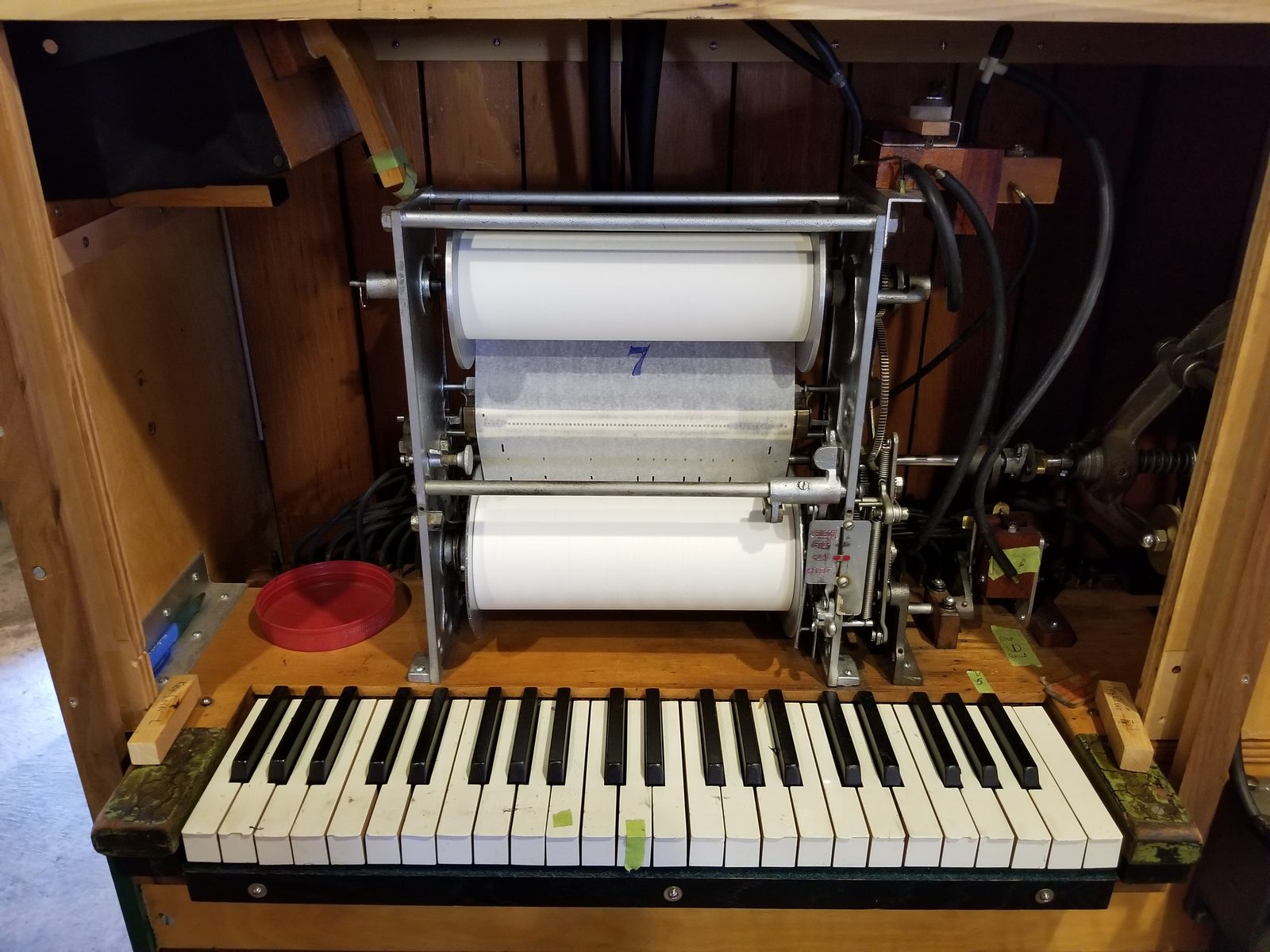
Cross-reference. For the roll medium itself — perforation coding, the tracker bar, roll tempo, and re-roll — see “Encoding the Music.” This volume covers only the conversion of the roll’s per-note signal into a steam (or air) valve opening.
4.5 The remote keyboard “at a safe distance from the whistles”
The pneumatic and electric actions decouple the control surface from the valve. Once that decoupling exists, the console no longer has to sit on the manifold — it can be put wherever the linkage (tube or wire) can reach. For a steam calliope that freedom is not a convenience; it is close to a necessity, because the region right at the whistle manifold is one of the most hostile places on the vessel to try to make music.
4.5.1 Why the manifold is nearly unplayable
Three hazards concentrate at the whistle bank, and all three bear directly on the player:
- Deafening volume. A steam calliope is designed to be heard for miles; its first instrument was reportedly audible ~5 miles (8 km) and was banned within Worcester city limits for loudness (Wikipedia: Calliope; Joshua C. Stoddard). The acoustic power comes from a near-choked steam jet at ~100+ psi (Vol 2), and the player of a manifold-mounted keyboard stands directly in that field. Hearing damage is a genuine occupational hazard, not an exaggeration.
- Scalding steam. The whistles exhaust wet steam; the manifold, valves, and any leaking joint are at steam temperature (~170–190 °C, est.). A slip, a blown gasket, or a wire-drawn valve puts scalding steam and hot metal within reach of the player’s hands and face. The visible plume (condensing droplets — Vol 3) is also hot and wets everything, including the keys and the player.
- Heat. Even without a leak, the manifold radiates and conducts heat. On a direct action the keys themselves get hot (§2.1); even on a decoupled action the ambient at the manifold is punishing to stand in for a performance.
A keyboard placed on the manifold, then, is barely playable: the operator is half-deafened, working hot keys, and standing in the path of scalding wet steam. Every one of these hazards is relieved by moving the operator away — and the decoupled action makes that possible.
4.5.2 The Delta Queen’s 1960 remote keyboard
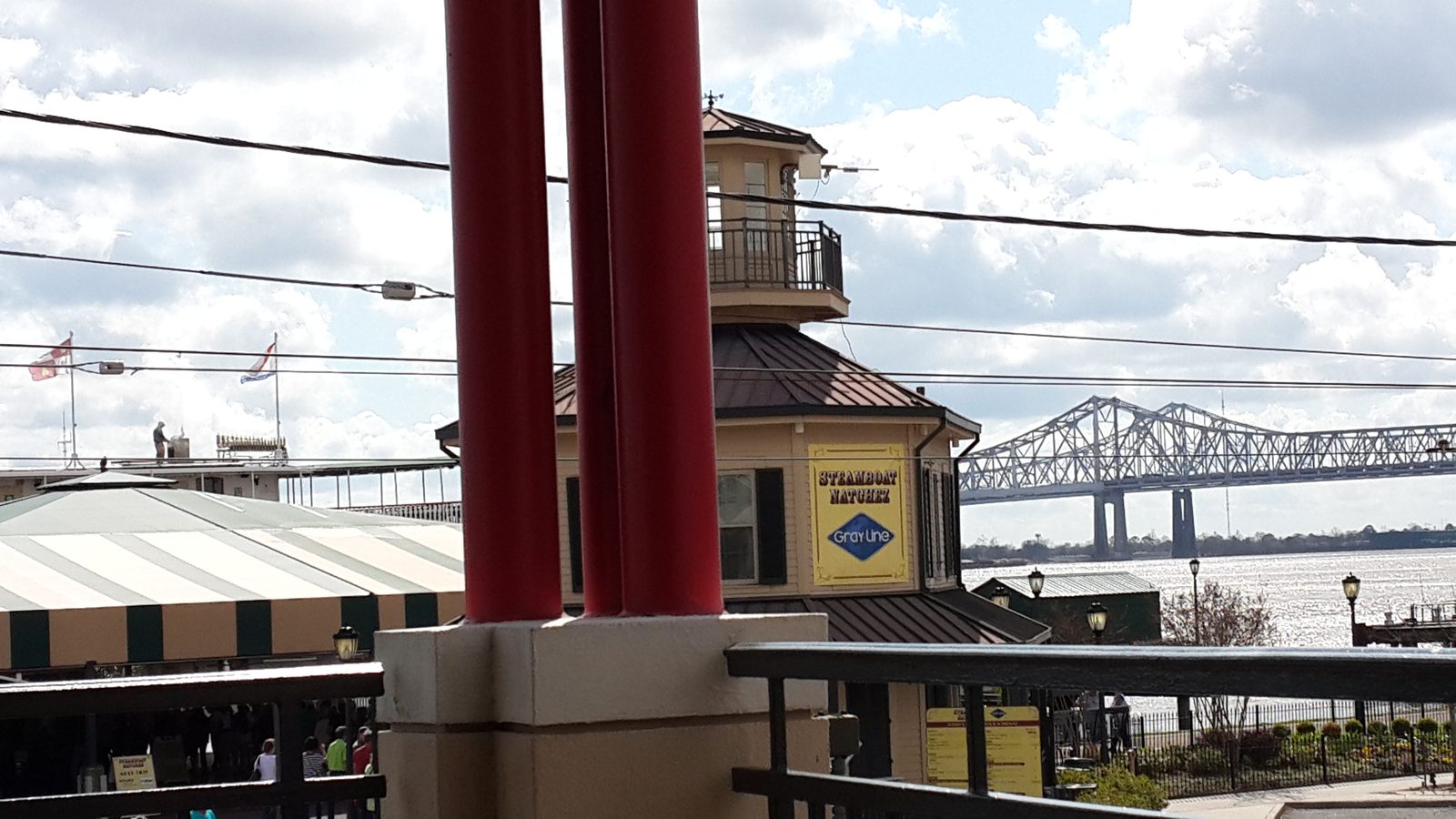
The definitive step was taken on the steamboat Delta Queen. In 1960, a remote keyboard placed at a safe distance from the whistles was fitted, the work of Commodore E. J. Quinby; the Delta Queen’s calliope is a 32-note instrument, and its whistles were salvaged from the showboat Water Queen (Steamboats.org). The remote console links to the whistle valves on deck through the decoupled action (pneumatic and/or electric linkage over the intervening distance), so the player commands the valves from a position out of the worst of the noise, heat, and steam, while the whistles remain up on deck where they sound.
The significance is exactly the engineering argument of §5.1: the Delta Queen arrangement is the point at which the calliope action’s decoupling is used not merely to lighten the touch but to relocate the player out of a hazardous environment. A 32-note manifold on a riverboat deck is a hostile place to stand for the length of a performance; a keyboard linked to it from a safe distance turns an ordeal into something a musician can actually play. The remote keyboard is the logical endpoint of the whole progression in this volume — from a direct action that chains the player to the manifold, through power-assisted actions that free the touch, to a remote console that frees the player’s whole body from the blast.
Guardrail — keep the Delta Queen fact accurate. The documented facts are: Delta Queen, 1960, first remote keyboard at a safe distance from the whistles, by Commodore E. J. Quinby; 32-note; whistles from the Water Queen (Steamboats.org). The exact linkage technology used in 1960 (pneumatic versus electric versus a hybrid) is not asserted here beyond “a decoupled pneumatic/electric linkage” and is marked (est.) where it goes past the sourced facts.
4.5.3 The remote-console layout
Figure 2 shows the arrangement in plan: the console at a safe distance, the linkage run (tubing and/or wiring) spanning the intervening space, and the whistle manifold up on deck where it can be heard for miles and where the player emphatically does not have to stand.
Figure 2 — Remote-keyboard layout. The console sits at a safe distance in a low-noise, steam-free zone; a run of tubing and/or wiring (the decoupled pneumatic or electric action) carries the note commands to the steam manifold on deck. The manifold, its per-note valves, and the graded whistle bank stay where they sound — in the deafening, scalding, steam-wet zone the player no longer has to occupy. This is the arrangement first fitted to the Delta Queen in 1960 (Commodore E. J. Quinby; 32-note; whistles from the Water Queen*; Steamboats.org).*
4.6 Player hazards as a design constraint
It is worth stating plainly, because it is the through-line of this whole volume: on a steam calliope the player’s safety and comfort are a first-order engineering constraint on the action, not an afterthought. The action is not merely a mechanism for making notes sound; it is also what determines how close to a set of scalding, deafening steam whistles a human being has to stand in order to play them.
- On a direct action, the constraint is met poorly. The player is chained to the manifold, fights the steam at every key, works hot keys, and stands in the full acoustic and thermal blast. The instrument is playable, but at real cost to the operator.
- On a pneumatic or electric action, the touch is relieved — the player no longer supplies the valve force — but if the console is still on the manifold the noise, heat, and steam hazards remain.
- On a remote keyboard, all four constraints are met at once: light touch (the power-assisted action), and low noise, no scalding steam, and no radiated heat (the safe distance). The Delta Queen’s 1960 console is the canonical example of the action being designed around the player’s survival as much as around the music.
The progression of calliope actions is therefore not just a story of increasing mechanical sophistication for its own sake. It is driven, at every step, by the same brute fact established in Vol 2 and Vol 3: the sound source is a rank of industrial steam whistles at boiler pressure, and standing next to it while it plays is genuinely dangerous. The action is the machinery that let musicians eventually stop doing so.
4.7 Summary
- The per-note valve problem is fundamentally harder on a steam calliope than on a wind organ: instead of a felted pallet on cool ~0.18 psi air (cross-ref “Wind Systems”), the calliope needs a metal-seated industrial valve that admits and seals off hot, wet, erosive steam at ~100–180 psi (est.) and ~170–190 °C (est.) — opening fast, sealing cleanly, and surviving erosion, all at once (§1; Vol 2, Vol 3).
- The direct mechanical action — Stoddard’s pinned cylinder (1855) and the later Denny keyboard — opens the steam valve directly through a rigid linkage. The operator (or the barrel spring) supplies the full valve force, giving a heavy touch, hot keys, and a player standing in the blast (§2).
- Pneumatic and electric (solenoid) actions insert a light pilot between the control surface and the valve: the key opens a pilot, and a pneumatic motor or a solenoid supplies the heavy valve-opening force from the steam (or a separate power) supply. The touch becomes light and even, and the console can be linked to the valves by tube or wire over a distance (§3).
- A roll-operated calliope plays from a paper roll over a tracker bar; the roll/tracker mechanism itself is “Encoding the Music,” and this volume covers only the last link — the tracker-bar signal driving a pneumatic pouch or an electric contact that opens the note’s steam valve (§4).
- The decoupled action makes a remote keyboard “at a safe distance from the whistles” possible — canonically the Delta Queen’s 1960 console (Commodore E. J. Quinby; 32-note; whistles from the Water Queen; Steamboats.org) — which removes the player from a deafening, scalding, steam-wet manifold (§5).
- Throughout, player hazard is a real design constraint that shaped the action. The evolution from direct to remote action is the story of getting the musician progressively further from the steam (§6).
Cross-references. Vol 2 (the whistle as sound source); Vol 3 (the boiler and manifold that charge the whistles); “Encoding the Music” (the roll and tracker-bar mechanism, not re-derived here); “Wind Systems” (the low-pressure pipe-organ pallet — the contrast case for §1); Vol 5 (air calliopes and the Tangley roll tradition). Cited: Wikipedia “Calliope (instrument)”, “Joshua C. Stoddard”; Steamboats.org.
Comments (0)