Steam Organs And Calliopes · Volume 1
Steam Organs & Calliopes — Vol 01: The Steam Branch
Series orientation. This is Volume 1 of a seven-volume deep dive on the steam calliope — the steam branch of the mechanical-organ family tree. This volume defines what a calliope is, tells the origin story (Joshua C. Stoddard, 1855), and plants the single load-bearing thesis of the whole dive: a calliope is not a low-pressure wind organ. The physics of the whistle itself is deferred to sibling dives and to Vol 2; here the job is orientation, the pressure ladder, and the roadmap.
1.1 What a calliope is
A calliope is a musical instrument that sounds a bank of tuned steam whistles — one whistle per note — admitted from a boiler by valves that are operated either from a keyboard or from an automatic mechanism (originally a pinned cylinder, later a perforated paper roll) (Wikipedia: Calliope). Strip away the steam and the showmanship and the architecture is disarmingly simple:
- a boiler that raises steam and holds it at working pressure;
- a manifold (steam header) that carries that steam to the instrument;
- a rank of graded whistles, each cut to a length that fixes its pitch;
- a valve in front of each whistle; and
- an action — a keyboard, a pinned cylinder, or a paper roll — that opens the right valves at the right time.
Press a key (or let a pin or a roll-perforation open a valve) and steam rushes through that whistle’s orifice, across the lip of its bell, and sets up a standing wave in the bell. The note sounds for exactly as long as the valve is open. The mechanism is, in outline, the same trick a flue organ pipe plays — a jet of fluid directed across a sharp edge, exciting a resonant column — which is precisely why Wikipedia describes the steam whistle as working “similar to how organ pipes function” (Wikipedia: Steam whistle). The acoustics of that jet-across-an-edge mechanism are the subject of the sibling dive “How Organ Pipes Make Sound” and of Vol 2, “The Steam Whistle” — this overview points there rather than re-deriving them.
What makes a calliope a calliope, and not just a large factory whistle with delusions of grandeur, is that the whistles are tuned — cut and voiced to a musical scale — and that a player interface selects them. A single steam whistle is a signal; a graded, valved, keyboard-played rank of them is an instrument.
1.1.1 The name
The instrument takes its name from Calliope (kə-LY-ə-pee), the Greek muse of epic poetry, eldest of the nine Muses (Wikipedia: Calliope). The literary name and the mechanical howl of the thing have never quite been reconciled; American showmen, unbothered, generally flattened the pronunciation to KAL-ee-ohp. Both survive. The instrument is also, in period sources, called a steam organ or steam piano — the latter a misnomer (there is nothing struck, and nothing about it is quiet), but a durable one.
1.1.2 One whistle per note
A pipe organ deliberately breaks the one-note-one-pipe correspondence: a single key can sound several ranks of pipes at once (that is what stops do), so a 61-note manual might command hundreds or thousands of pipes. That decoupling of note count from pipe count is a defining feature of the wind organ, and it is treated in the sibling dive “Wind Systems” and in “How Organ Pipes Make Sound.”
The calliope is the opposite extreme. It almost universally runs one whistle per note, no unison or mixture ranks — the whistle count is the note count, a clean 1:1. A “32-note calliope” has 32 whistles. This is worth stating plainly because the general principle still holds — note count is not, in the abstract, the same as pipe or whistle count — but for calliopes the two happen to coincide, and that simplicity is part of the instrument’s character. The traditional steam calliope carries 32 whistles/notes, though surviving and historical instruments range from about 25 to 67 (Wikipedia: Calliope).
1.2 Origin: Stoddard and the American Steam Music Company
The steam calliope has a clean point of invention, a named inventor, and a patent number — a rarity among folk-mechanical instruments.
Joshua C. Stoddard (1814–1902), born in Pawlet, Vermont, and working in Worcester, Massachusetts, patented the steam calliope on October 9, 1855, as U.S. Patent No. 13,668 (Wikipedia: Joshua C. Stoddard). He founded the American Steam Music Company in Worcester in 1856 to build and promote the instrument (Wikipedia: Calliope; Joshua C. Stoddard).
Stoddard’s first instrument establishes the archetype the rest of this dive elaborates. It consisted of a boiler, a set of valves, and fifteen (15) graded whistles, and — crucially — it was not played from a keyboard. The whistles were sounded from a pinned cylinder, exactly as a music box or a barrel organ is: pins on a rotating drum lifted the valves in programmed sequence. The keyboard came later, credited to Arthur S. Denny, who adapted the instrument to be played by hand (Wikipedia: Joshua C. Stoddard). So the calliope was born as an automatic instrument and only afterward became a played one — a lineage that connects it directly to the pinned-barrel and paper-roll traditions covered in “Encoding the Music.”
That fifteen-whistle first machine matters as a design datum: it is the ancestor of every later graded whistle bank, and it fixes the pinned cylinder as the original action. The later drift to 32-whistle boat calliopes, keyboard-played, is elaboration on Stoddard’s core idea, not a departure from it.
The sequence of that development is worth holding onto, because it inverts the usual assumption that a musical instrument is a played thing first and an automatic thing second. The calliope arrived automatic — a machine that ran a pre-programmed drum — and was later fitted with a keyboard so a human could drive it in real time. Both modes survived side by side for the instrument’s whole history: showboat calliopes were commonly built to be both hand-played from a keyboard and run automatically from a paper roll, so that the boat could advertise itself even when no player was on the bench. That dual heritage is why this dive treats the action (Vol 4) and the encoding of automatic music (cross-referenced to “Encoding the Music”) as first-class subjects rather than afterthoughts.

1.2.1 A note on Stoddard’s motive
Accounts hold that Stoddard, a beekeeper and inventor, wanted a machine that could play hymn tunes with more carrying power than church bells — and he got it, emphatically (American Heritage: “Strike Up the Boiler”). The carrying power is where the instrument’s whole engineering identity comes from, and it is the next subject.
1.3 The headline thesis: not a wind organ
Here is the claim the reader should carry through all seven volumes:
A steam calliope is not a low-pressure wind organ. It is a pressure vessel that happens to make music.
A church or fairground pipe organ is a bellows instrument: a blower or bellows fills a reservoir, and the pipes speak on wind — air at a pressure of a few inches of water column, typically around 5 in H₂O, which is only about 0.18 psi (the low-pressure regime treated in the sibling dive “Wind Systems”). That is barely above atmospheric — you could produce comparable pressure by blowing gently through a straw into a glass of water.
A steam calliope feeds its whistles from a boiler at ~100–180 psi (est.) — roughly the working pressure of a steam locomotive or a stationary mill engine (Wikipedia: Steam whistle, on the 100–300 psig industrial band; Stoddard’s original reportedly fed at ~180 psi). That is three orders of magnitude above the wind organ. The calliope does not have a bellows, a reservoir, or a wind-trunk in the organ-builder’s sense; it has a boiler, a manifold, and valves rated for steam. Its nearest engineering relatives are not other organs but the steam whistle on a locomotive or a factory — the same device, tuned and multiplied.
Between the two extremes sits a third regime — the air calliope — which runs on compressed air at about ½ to 1 psi (Mechanical Music Press: Air Calliopes). Air calliopes look and sound calliope-like and are, confusingly, the most common survivors, but they are a distinct family with no boiler. They get their own treatment in Vol 5, “Steam vs Air: the Calliaphone,” and are previewed in §5 below.
So there are three pressure regimes, and this dive keeps them rigorously apart throughout:
- WIND — the pipe/fairground/church organ, ~0.18 psi (a few in H₂O);
- AIR — the compressed-air calliope (“calliaphone”), ~½–1 psi;
- STEAM — the true, boiler-fed steam calliope, ~100–180 psi (est.).
1.3.1 The pressure ladder
The single most important image in this dive is the pressure ladder — the three regimes on a logarithmic pressure axis, because a linear axis cannot even display a range that spans three decades. The wind organ and the steam calliope differ by so much pressure that on any linear plot the wind organ simply vanishes into the baseline.
Rendered as numbers, the ladder looks like this:
Table 1 — Rendered as numbers, the ladder looks like this
| Instrument | Working fluid | Pressure | Source of pressure | Approx. loudness / reach |
|---|---|---|---|---|
| Wind (pipe/fairground) organ | Air (wind) | ~5 in H₂O ≈ 0.18 psi | Blower + reservoir/bellows | Room to hall; a fairground organ carries across a showground |
| Air calliope (calliaphone) | Compressed air | ~0.5–1 psi | Electric blower or gas engine + tank | Loud; carries across a fairground or midway |
| Steam calliope | Steam | ~100–180 psi (est.) | Boiler (main or auxiliary) | Extreme; reportedly heard ~5 miles |
The ratios are the point. The air calliope runs at roughly 5× the pressure of a wind organ (1 psi vs 0.18 psi). The steam calliope runs at roughly 500 to 1000× the wind organ (100–180 psi vs 0.18 psi), and roughly 100 to 180× the air calliope. A calliope is to a pipe organ, in pressure terms, as a fire hose is to a garden tap.
Guardrail — mark the estimates. Only two pressure figures in this dive are firmly documented: Stoddard’s original reportedly ran at ~180 psi, and industrial steam whistles run at 100–300 psig (some to 600) (Wikipedia: Steam whistle). Every “typical steam calliope runs at ~100–180 psi” is an estimate anchored on those two facts and is marked (est.) accordingly. Any specific boat’s working pressure should be treated as (est.) unless the boat’s own documentation states it.
1.4 Why it is so loud, and the circus/showboat tradition
The pressure ladder is not an abstraction — it is the reason a calliope sounds the way it does. Acoustic power scales with the energy in the exciting jet, and the calliope’s jet is a near-choked steam flow at 100+ psi. Compared with a wind pipe’s gentle, low-velocity air jet, the steam jet carries orders of magnitude more power, and it converts a lot of that into sound. The full jet physics belongs to “How Organ Pipes Make Sound” and to Vol 2 — but the one-line consequence belongs here: the calliope is possibly the loudest acoustic instrument ever put to musical use.
The loudness is not folklore. Stoddard’s very first instrument was reportedly heard about 5 miles (8 km) away, and the Worcester City Council banned it within the city limits for the disturbance (Wikipedia: Joshua C. Stoddard). Wikipedia describes the instrument as “typically very loud” and “audible for miles” (Wikipedia: Calliope). That reach is exactly what made the instrument commercially useful in the 19th century, in an era before amplification: it was a machine for summoning a crowd across a landscape.
Two traditions grew up around that capability:
- The circus. The steam calliope was the traditional finale of the circus street parade — “the boiler at the end of the parade” — its arrival announcing that the show had come to town and driving the crowd toward the big top (Wikipedia: Calliope; American Heritage). It was placed last precisely because nothing could follow it: it drowned out the bands ahead of it.
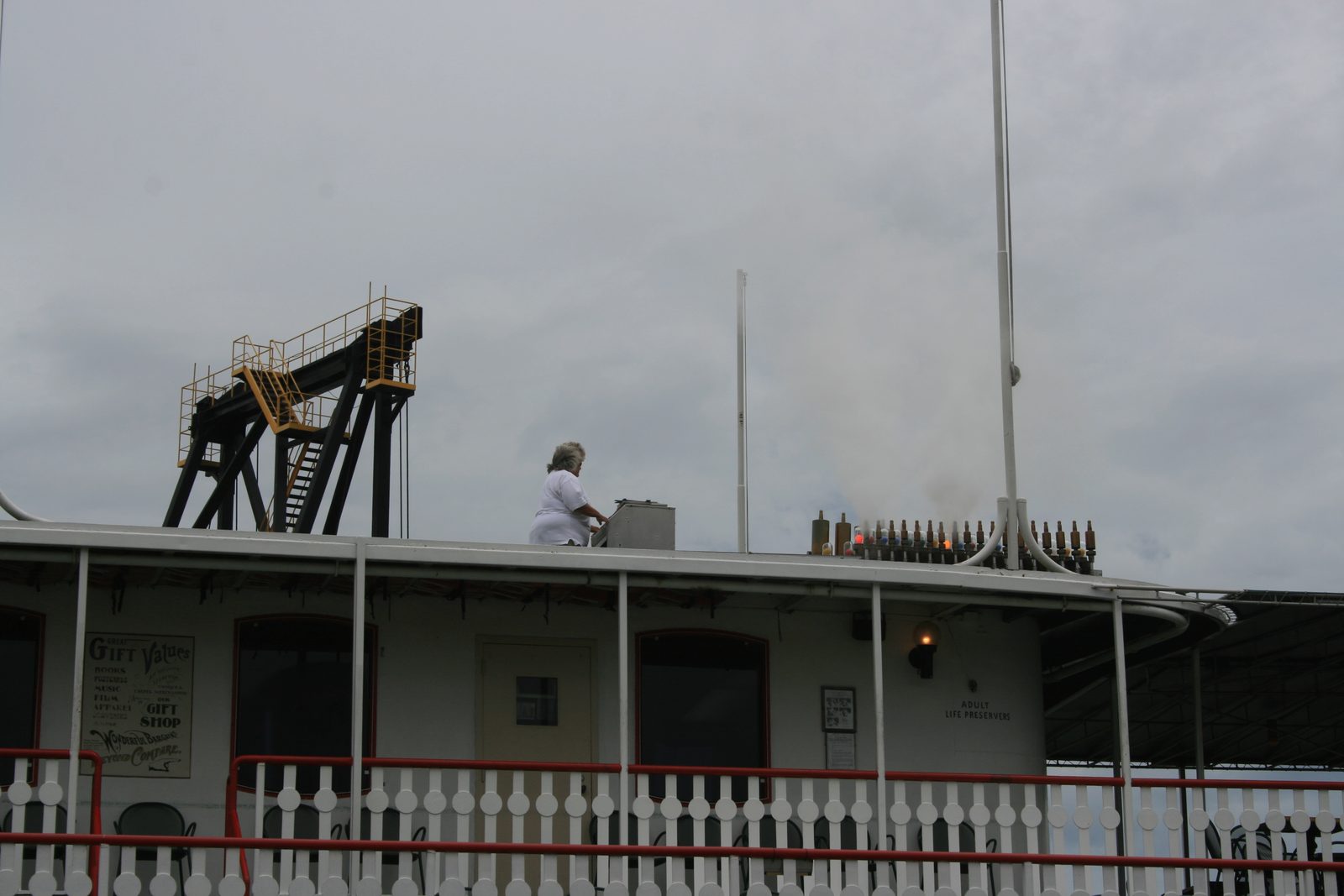
- The showboat and riverboat. On the Mississippi and Ohio rivers, the calliope became the advertising loud-hailer of the showboat — a floating theatre. Played on approach, it summoned a town to the levee from miles upriver, long before the boat was in sight. The steamboat calliope tradition runs from about 1865 onward (Steamboats.org), and its surviving exemplars — the Delta Queen, the Str. Natchez, the Belle of Louisville — are the reason anyone can still hear a true steam calliope today. Those instruments, their maker of record Thomas J. Nichol of Cincinnati, and the 1960 innovation of a remote keyboard placed at a safe distance from the scalding whistles, are the subject of Vol 6, “Great Instruments.”
The circus calliope and the riverboat calliope are two branches of the same loud, steam-powered idea — and both are the steam sibling of the wind-blown fairground and street organ covered in the sibling dive “Fairground & Dutch Street Organs.” That dive and this one are deliberately paired: same musical concept (a rank of tuned pipes, valved from an automatic action), opposite ends of the pressure ladder.
There is a practical dimension to the loudness that colors the whole instrument: a calliope is not something an operator plays near. At 100+ psi the whistles are scalding, deafening, and unforgiving; the plume of wet steam that boils off the bank is hot enough to burn, and the sound pressure at the keyboard — if the keyboard sits beside the whistles, as it originally did — is punishing. This is not incidental showmanship; it is the reason later builders moved the player away from the whistle bank (the 1960 Delta Queen remote keyboard, treated in Vol 4) and the reason a steam calliope demands boiler competence, not just musicianship, to run safely. Every design choice in the volumes that follow — the action, the manifold, the boiler plumbing — is shaped by the fact that the sound source is a bank of high-pressure steam whistles that a person cannot comfortably stand beside.
1.5 STEAM vs AIR: the coming distinction
Before the roadmap, one guardrail deserves an early flag, because it trips nearly everyone who meets these instruments.
Most instruments called “calliopes” that a person can actually see, buy, or hear on a fairground today are not steam calliopes at all — they are air calliopes. In 1914–15, the Tangley Company of Muscatine, Iowa commercialized a compressed-air version and trademarked it the “Calliaphone” (Mechanical Music Press: Air Calliopes). It has no boiler. A blower or a small engine supplies air at ~½–1 psi, and that air blows the whistles. The result is cheaper, safer, portable, and does not require a licensed boiler operator — and so the air calliope, not the steam calliope, is what filled circus wagons, skating rinks, and midways for most of the 20th century. Tangley’s flagship carried 43 notes; the later National Calliope Corporation of Kansas City built a 53-whistle Model B and played 65-note “A” rolls (Mechanical Music Press). Modern replicas are still built (the Miner Company of Missouri).
The distinction is not pedantry — it is the difference between a pressure vessel and a blower, between 100+ psi and 1 psi, between a boiler license and a wall outlet. This dive uses “calliope” for the true steam instrument and “calliaphone” / “air calliope” for the compressed-air family, and it never calls a Tangley or a National a “steam” instrument. The full story, including the family’s makers and why the air version won the market, is Vol 5.
1.5.1 The mechanical-organ family tree
It helps to see all three regimes as branches of one family — the mechanical/automatic organ — so that the calliope’s place is clear.
1.6 A first look at the tuning problem
One more property should be previewed here because it is a consequence of the steam regime and it colors everything about how the instrument is used: a steam calliope will not hold its tune.
Each whistle’s pitch is fixed by the length of its bell, but the frequency of the standing wave in that bell also depends on the speed of sound in the working fluid, and the speed of sound in steam rises with temperature. As the boiler warms, as pressure climbs, and as the steam dries and superheats, the speed of sound rises, and the whole instrument goes sharp. Wikipedia states the pitch of each note “is largely affected by the temperature of the steam,” so that “accurate tuning is nearly impossible” (Wikipedia: Calliope); raising the blowing pressure on one whistle drove it measurably upward in pitch — from E to D-flat — as pressure was raised (Wikipedia: Steam whistle).
The direction matters and is easy to get backwards: higher pressure / higher temperature → sharper (pitch rises). A calliope is tuned for one operating condition and drifts constantly around it — an intrinsic feature of a steam-driven instrument, not a defect of any particular one. The mechanism (f ≈ c/(4L) for a closed bell, with c ∝ √T) and the saturated-versus-superheated steam story are developed in Vol 2 and Vol 3. For now: expect a calliope to sound a little unhinged, and know that the steam, not the builder, is the reason.
1.7 Roadmap: Volumes 2–7
This dive proceeds from the sound source outward to the machine, then to the instruments and the reference apparatus.
- Vol 2 — The Steam Whistle. The sound source in detail: valve → steam-way / orifice → a steam jet directed across the bell’s lip → a standing wave in the cylindrical bell (the flue-pipe cousin, with the physics deferred to “How Organ Pipes Make Sound”). Pitch set by bell length, f ≈ c/(4L) for a closed/stopped bell (and the open/cupped-bell c/(2L) variant). Why the instrument is so loud, and the tuning problem, developed fully.
- Vol 3 — Boiler & Steam Supply. The boiler as a pressure vessel; working pressure ~100–180 psi (est.); saturated (wet) versus superheated (dry) steam and the pressure↔temperature relation; why the visible white plume is condensation, not the dry working steam; the manifold that distributes steam to each whistle valve; boiler safety.
- Vol 4 — The Action. How keys or a roll admit steam to each whistle — direct mechanical valves, then pneumatic and electric actions; the roll-operated automatic calliope (cross-ref “Encoding the Music”); and the 1960 remote keyboard placed “at a safe distance from the whistles” (Delta Queen), plus why heat, noise, and pressure make that a genuine engineering problem.
- Vol 5 — Steam vs Air: the Calliaphone. The full STEAM-versus-AIR story: Tangley’s Calliaphone (Muscatine, Iowa; Norman Baker; 43 notes), the National Calliope Corporation (Kansas City; 53-whistle Model B; 65-note “A” rolls), and modern replicas (Miner Company) — with the guardrail that only boiler-fed instruments are true steam calliopes.
- Vol 6 — Great Instruments. The showboat/riverboat calliopes (Delta Queen, 32-note, 1960 remote keyboard; Str. Natchez, 32-note, 1975, Nichol replica with its “aurora” lights; Belle of Louisville); the maker of record, Thomas J. Nichol of Cincinnati; and the circus parade calliope. What survives and where to hear one.
- Vol 7 — Reference & Cheatsheet. The pressure-ladder table; whistle/note-count tables (steam 25–67, 32 traditional; Tangley 43; National 53; “A” rolls 65); a pressure/temperature → pitch tuning table; a saturated-steam pressure↔temperature mini-table (est.); the steam/calliope glossary; a safety note; and a cross-index to Vols 1–6 and the sibling dives.
1.7.1 Sibling dives referenced throughout
- “How Organ Pipes Make Sound” — the jet/edge-tone and standing-wave physics the steam whistle shares with a flue pipe. This dive cross-references it rather than re-deriving the acoustics.
- “Wind Systems” — the low-pressure wind regime (~5 in H₂O ≈ 0.18 psi), the contrast case that makes the pressure ladder meaningful.
- “Encoding the Music” — pinned barrels and paper rolls, the automatic actions the calliope was born with and still uses.
- “Fairground & Dutch Street Organs” (Dive 14) — the wind branch of the family tree; the calliope is its steam sibling, and the two dives are paired.
1.8 Summary
A calliope is a rank of tuned steam whistles, one per note, valved from a keyboard or an automatic pinned-cylinder / paper-roll action. It was invented by Joshua C. Stoddard of Worcester, Massachusetts — U.S. Patent 13,668, October 9, 1855 — and first built by his American Steam Music Company (1856) as a boiler plus valves plus fifteen graded whistles on a pinned cylinder, with the keyboard added later by Arthur S. Denny. Its defining engineering fact is the pressure ladder: a wind organ speaks on ~0.18 psi, an air calliaphone on ~1 psi, and a true steam calliope on ~100–180 psi (est.) — three orders of magnitude, which is why the calliope is a pressure vessel that makes music, and why it is loud enough to be heard ~5 miles and banned in Worcester. It sits on the steam branch of the mechanical-organ family tree, the loud sibling of the wind-blown fairground organ — and it must never be confused with the boiler-less air calliope, its most common impostor. The volumes that follow build the instrument outward from that whistle.
Comments (0)