Steam Organs And Calliopes · Volume 5
Steam Organs & Calliopes — Vol 05: Steam vs Air — the Calliaphone
Series orientation. This is Volume 5 of a seven-volume deep dive on the steam calliope. It is the volume the whole dive exists to protect. The single load-bearing distinction of the mechanical-organ family tree — steam versus air versus low-pressure wind — is drawn here in full and defended: most instruments a person can see, buy, or hear today under the name “calliope” are not steam calliopes at all. They are air calliopes — the trademarked Calliaphone and its relatives — blown by a fan at roughly one pound of pressure, with no boiler anywhere in the machine. This volume names the makers, fixes the numbers, and gives the reader the one test that always settles the question: look for the boiler.
5.1 The distinction the dive guards
Every earlier volume has pointed here. Vol 1 planted the thesis that a calliope is a pressure vessel that makes music, not a bellows instrument; Vol 2 treated the steam whistle as the sound source; Vol 3 built the boiler and the steam supply behind it. This volume draws the line that those chapters have been circling: the line between a true steam calliope and the far more common air calliope, and it draws it hard, because in ordinary usage the two are hopelessly conflated.
The confusion is understandable. An air calliope and a steam calliope look alike, are played alike, use the same graded rank of tuned whistles, and make broadly the same brash, carrying, unmistakably-calliope sound. To an ear on a fairground, and to most of the written record, they are one instrument. But they are not one instrument, and the difference is not cosmetic. It is the difference between a machine that raises steam in a boiler at 100+ psi and a machine that blows air from a fan at about 1 psi — between a licensed pressure vessel and a wall outlet, between something audible five miles away and something merely very loud, between an instrument that drifts constantly out of tune and one that holds pitch all afternoon.
The guardrail, stated once and kept throughout. A steam calliope is boiler-fed: its whistles are blown by steam at ~100–180 psi (est.). An air calliope — the Calliaphone and its kin — is blown by compressed air at ~½–1 psi from a blower or a small engine, with no boiler. This dive never calls a Tangley or a National unit a “steam” calliope, and it never implies a steam calliope runs at air pressure. Only boiler-fed instruments are true steam calliopes. Everything else in this volume follows from that one rule.
The practical consequence for anyone who goes looking is blunt: the odds are overwhelming that a “calliope” advertised at a fairground, offered for sale, or mounted on a parade truck is an air calliope. Steam calliopes survive almost exclusively on a handful of riverboats and in a few museums (they are the subject of Vol 6). The instrument the general public actually encounters — the one on the skating-rink organ, the circus wagon, the pizza parlor, the collector’s trailer — is nearly always a Calliaphone or a National, and it has never seen a boiler in its life.
5.2 The air calliope and the Calliaphone
5.2.1 Tangley, Muscatine, and a trademark
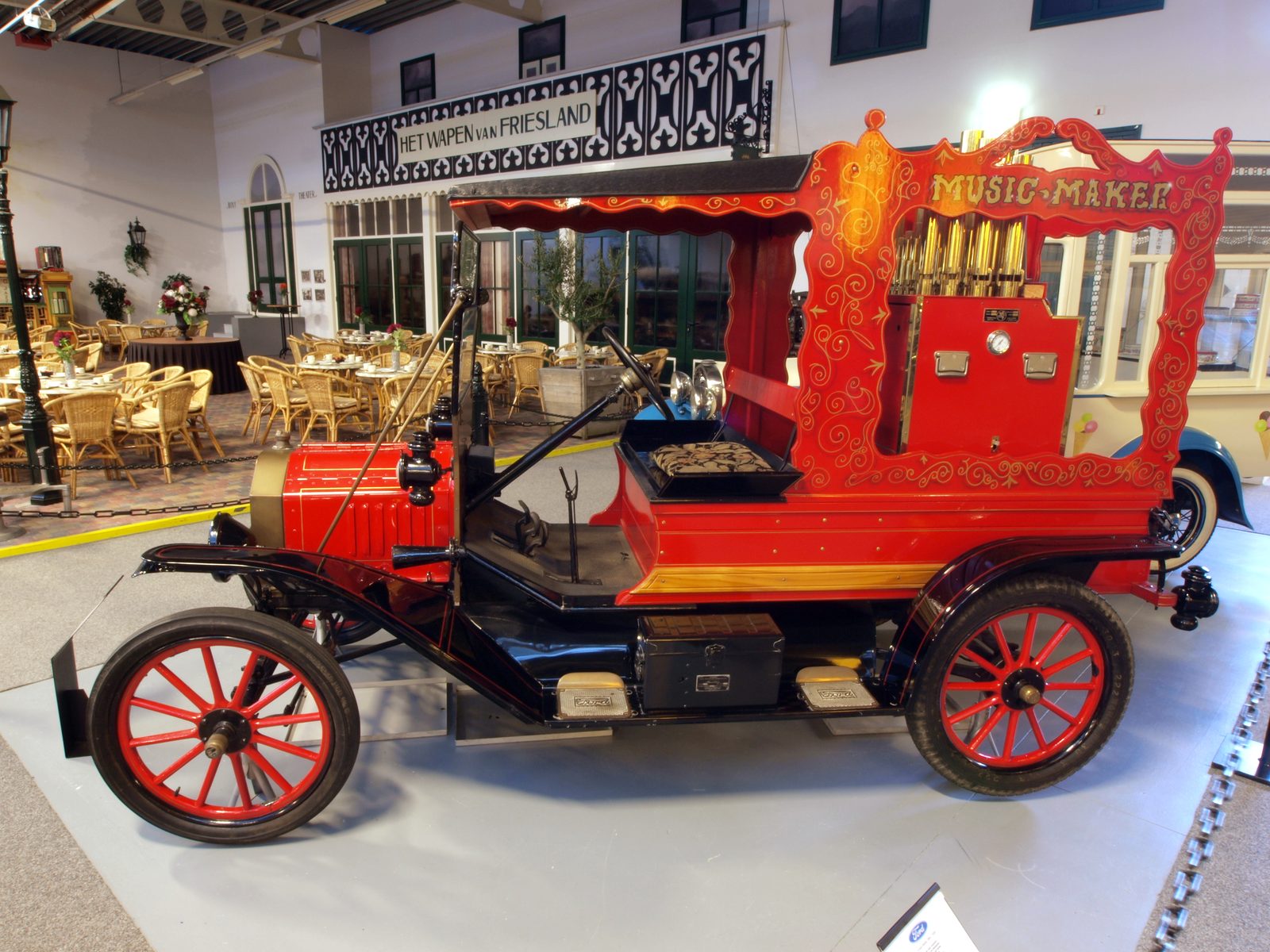
The air calliope was commercialized by the Tangley Company of Muscatine, Iowa, which built and sold a compressed-air calliope under the trademarked name “Calliaphone” (Mechanical Music Press: air-calliope registry). The word matters, and it is worth getting right: Calliaphone is a Tangley brand name, not a generic term for the instrument class and not another word for a steam calliope. It is to the air calliope roughly what a proprietary name is to a product category — a specific maker’s mark that came, through familiarity, to stand loosely for the whole compressed-air family. When this dive writes “Calliaphone” it means, strictly, a Tangley air calliope; when it means the category, it writes “air calliope.”
The commercial launch is datable. The first Calliaphones were sold about 1914–15, for $500 (Mechanical Music Press: air-calliope registry; the registry dates the design and first sales to about 1914, with Baker turning full-time manufacturer in 1915) — a price that, set against the cost, hazard, and licensing of a steam boiler, was much of the instrument’s appeal. The founding figure at Tangley was Norman Baker, a promoter whose later career took several colorful turns but who, at Muscatine in the 1910s, put a boiler-less calliope into volume production and made it a commercial product rather than a one-off curiosity.
The instrument that became the archetype was the 43-note flagship. Where a traditional steam calliope carries 32 whistles (with the historical range running about 25 to 67), the Tangley air calliope’s compass settled at 43 notes — a larger keyboard, made practical by the fact that a fan supplying low-pressure air is a far more tractable thing to scale up than a boiler raising high-pressure steam. Tangley’s model designations reflect that compass: the CA-43 names the 43-note (calliaphone) instrument directly.
5.2.2 What replaced the boiler
The engineering substitution at the heart of the air calliope is simple and it is the whole story: the boiler is gone. In its place is a source of compressed air at low pressure — a blower or compressor driven by an electric motor or a small gasoline engine — and a tank or reservoir that smooths the supply (Mechanical Music Press: air-calliope registry). Air at roughly ½ to 1 psi is fed to the same kind of manifold, the same per-note valves, and the same graded rank of whistles that a steam calliope uses. The whistles themselves are, acoustically, the same device treated in Vol 2, “The Steam Whistle” — a jet driven across a bell’s lip, exciting a standing wave in a resonant bell whose length sets its pitch. Nothing about the sound-generating mechanism changes. Only the working fluid and its pressure change.
That single substitution cascades into every advantage the air calliope enjoys:
- No boiler license, no fire, no water-gauge, no pressure-vessel inspection. An operator plugs it in (or pull-starts a small engine) and plays.
- Portable. A steam calliope drags a boiler, a fuel supply, and a water supply with it. An air calliope needs a motor and a fan, which ride on the same truck or wagon as the instrument. This is why air calliopes populated the circus wagon and the parade float — they could travel.
- Safe to stand beside. The whistles blow air near room temperature, not scalding steam. There is no hot plume, no burn hazard at the bank, and the player can sit at the keyboard among the whistles without the heat problem that forced steam builders to move the keyboard away (the 1960 Delta Queen remote keyboard, Vol 4).
- It stays in tune. This is the acoustically decisive advantage and it gets its own section (§4).
5.2.3 National Calliope Corporation and the Model B
The Calliaphone was the pioneer, but it was not the only air calliope on the market. The National Calliope Corporation of Kansas City, Missouri carried the air-calliope trade forward from the mid-1920s. National was established by H. R. Brandt in 1927, growing out of the assets of the earlier Harrington calliope enterprise (Mechanical Music Press: air-calliope registry). Where Tangley had made the air calliope a product, National scaled it up.
National’s signature instrument was the 53-whistle Model B — a larger compass than Tangley’s 43-note flagship, and a clear illustration of how far the boiler- less architecture could be pushed once high-pressure steam was out of the picture. A 53-whistle air rank is a substantial instrument; building the equivalent as a steam calliope would mean a correspondingly larger boiler and a much heavier, more hazardous, less portable machine. Low-pressure air made the extra whistles cheap.
National continued producing air calliopes into mid-century. The last new unit was built in 1950 for the Hadacol Caravan (the traveling medicine-show promotion of the patent tonic Hadacol) (Mechanical Music Press: air-calliope registry) — a fittingly showbiz send-off for a machine whose entire commercial logic was the advertising loud-hailer. After 1950 the era of new-build commercial air calliopes effectively closed, and the instrument passed into the hands of collectors, restorers, and a small number of modern builders.
Guardrail — keep the counts distinct. The whistle and note counts are not interchangeable between the two families and must not be blurred. Steam calliopes: 25–67 whistles, 32 traditional. Air calliopes: Tangley 43-note; National 53-whistle; both commonly play 65-note “A” rolls. A 43-note Tangley is an air instrument; a 32-note riverboat calliope is a steam instrument; the numbers are a quick tell.
5.2.4 The 65-note “A” roll and automatic play
Air calliopes were built, like their steam ancestors, to run automatically as well as to be hand-played — which for a self-advertising machine on a fairground was often the point, since the instrument could play to the crowd with nobody at the keyboard. The automatic medium of record for the air-calliope trade was the 65-note “A” roll — a perforated paper roll standard that both Tangley and National instruments were built to read (Mechanical Music Press: air-calliope registry). A tracker bar reads the perforations and opens the corresponding note valves, exactly as a player-piano roll drives a piano action.
Note the arithmetic and do not let it collapse: the “A” roll carries 65 note positions, while the flagship instruments have 43 (Tangley) or 53 (National) whistles. The roll standard is wider than either instrument’s compass, so a given calliope reads the subset of the 65 positions that map onto its own whistles. The roll format, its perforation coding, and the tracker-bar mechanism belong to the sibling dive “Encoding the Music,” which treats paper-roll encoding across the whole mechanical-instrument family; this volume notes only that the air calliope is a full member of that roll-driven tradition and that its roll of record is the 65-note “A” roll.
5.2.5 Modern replicas: the Miner Company
The air calliope did not die with the last National in 1950. It is still built. The Miner Company of Kirksville, Missouri constructs modern Tangley-style air calliopes today (Miner Company) — new instruments, in the Calliaphone tradition, blown by compressed air at low pressure with no boiler. For the enthusiast this matters twice over: it means the air calliope is a living instrument with a living maker rather than a purely historical object, and it means that a person who wants a calliope of their own will, in practice, be looking at an air calliope — a restored Tangley or National, or a new Miner — because that is what can be bought, built, and operated without a boiler license. The steam calliope, by contrast, is effectively un-buyable as a going concern; it survives as installed riverboat equipment and museum pieces (Vol 6). This is the concrete reason the guardrail matters so much: the instrument the reader is most likely to actually acquire is precisely the one that is most often mislabeled “steam.”
5.3 The full pressure ladder, revisited
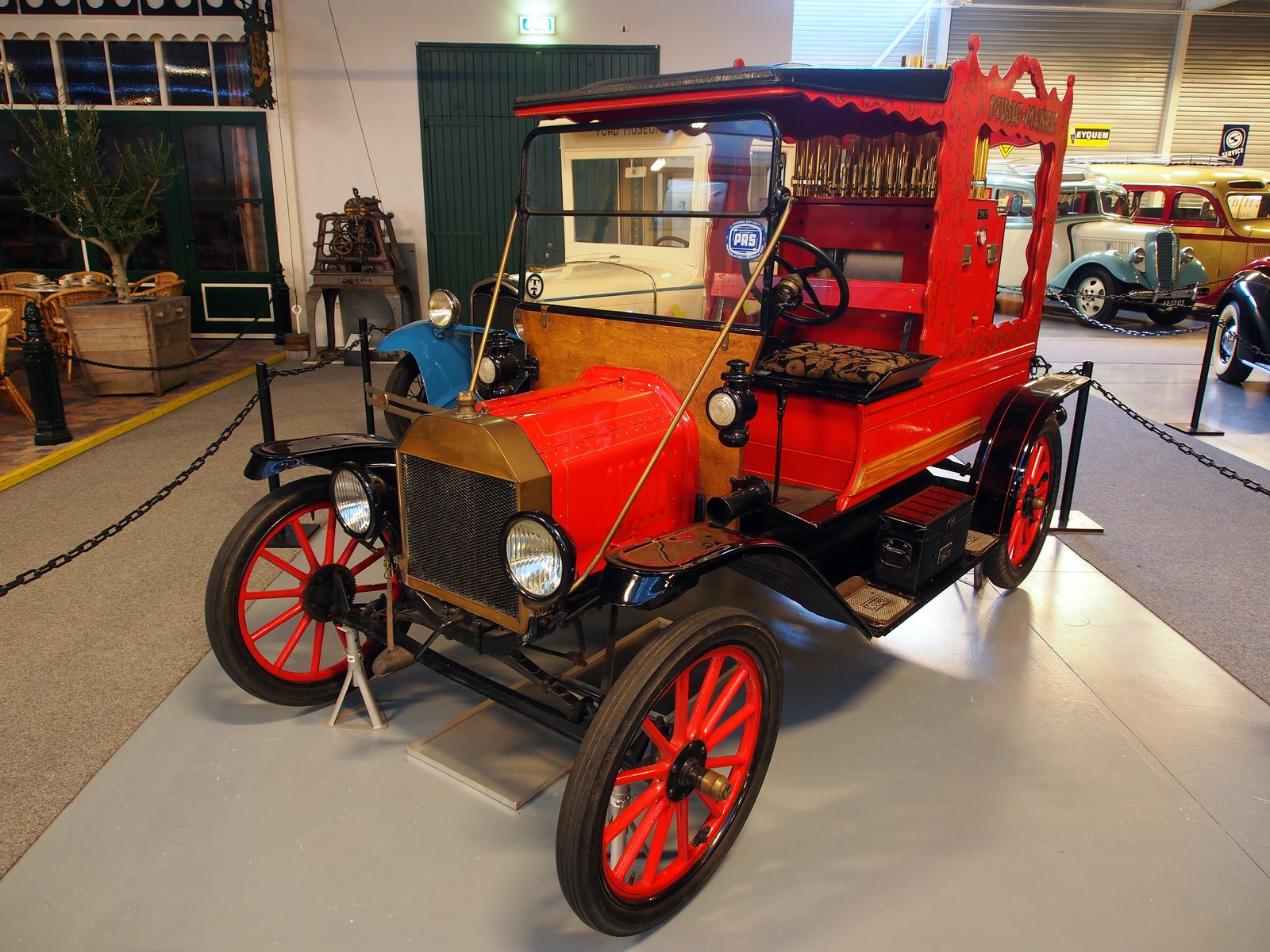
Vol 1 introduced the pressure ladder as the spine of the dive. This volume is where it does its decisive work, because the ladder is what makes the steam- versus-air distinction quantitative rather than merely nominal. The three regimes, on a base-10 logarithmic pressure axis (a linear axis cannot show them together — the wind organ vanishes into the baseline against the steam calliope), are these:
- Low-pressure WIND organ — the church, barrel, and fairground pipe organ — speaks on wind at ~5 in H₂O ≈ 0.18 psi, the baseline of the ladder (the regime treated in the sibling dive “Wind Systems”).
- AIR calliope (Calliaphone) — compressed air at ~½–1 psi, roughly 5× the wind organ.
- STEAM calliope — steam at ~100–180 psi (est.), roughly 500–1000× the wind organ and roughly 100–180× the air calliope.
The ratios are the substance of the whole dive. The air calliope stands at roughly five times the pressure of a low-pressure wind organ — a real step up, and enough to make the instrument carry across a midway, but still under one pound. The steam calliope stands at roughly 500 to 1000 times the wind organ and 100 to 180 times the air calliope. That last ratio is the one to hold: a steam calliope runs at more than a hundred times the pressure of the air calliope it is so often confused with. The two instruments are not neighbors on the ladder; they are separated by two full decades. Reading the ladder tells the reader, at a glance, why an air calliope is safe to build in a garage and a steam calliope is a licensed pressure vessel.
Guardrail — mark the estimates. As in Vol 1: only two pressure figures in this ladder are firmly documented — Stoddard’s original reportedly ran at ~180 psi, and industrial steam whistles run at 100–300 psig (Wikipedia: Steam whistle). The generic “~100–180 psi” for a steam calliope is an estimate anchored on those and is marked (est.). The air figure ~½–1 psi and the wind figure ~5 in H₂O ≈ 0.18 psi are documented (Mechanical Music Press; “Wind Systems”).
5.4 Why the difference matters
The steam-versus-air distinction would be a footnote if it were only about how the whistles are blown. It is not. The choice of working fluid sets the instrument’s safety, cost, portability, loudness, romance, and — most subtly and most importantly for a musician — its ability to stay in tune. Each of these traces directly back to the pressure ladder and the working fluid.
5.4.1 Safety, cost, and portability
An air calliope needs no boiler, so it carries none of the boiler’s burdens: no fire, no fuel, no feedwater, no pressure-vessel inspection, no operator’s license, no scalding plume, no burn hazard at the whistle bank. It costs a fraction of a steam installation to build and to run — the $500 first-sale price of a 1915 Calliaphone (Mechanical Music Press: air-calliope registry) was attractive precisely because it undercut the total cost of a boilered instrument. And because the whole air supply is a motor, a fan, and a tank, the instrument is genuinely portable — it rides on the truck or wagon that carries it and plays wherever that vehicle stops. These three advantages together — cheaper, safer, portable — are why the air calliope, not the steam calliope, populated the circus wagons, skating rinks, midways, and parade routes of the 20th century, and why it is the common survivor today.
5.4.2 Tuning stability — the acoustically decisive advantage
The subtlest and most consequential difference is tuning, and it is the reason a musician who plays both will notice the gap immediately.
A whistle’s pitch is set by the length of its bell — the standing wave in the bell resonates at a frequency f ≈ c/(4L) for a closed bell, where c is the speed of sound in the working fluid and L is the bell length (Vol 2). The bell length is fixed. So the pitch depends on c, the speed of sound in whatever fluid is blowing the whistle — and here the two instruments part ways completely.
In a steam calliope, c is the speed of sound in steam, and the speed of sound in steam rises with temperature (c ∝ √T, absolute temperature). As the boiler warms, as the pressure climbs, and as the steam dries and superheats, c rises and the whole instrument goes sharp — higher pressure and temperature push the pitch up. This is the tuning problem developed in full in Vol 3, “Boiler & Steam Supply”: the steam calliope is tuned for one operating condition and drifts constantly around it as the steam temperature wanders, which is why Wikipedia observes that “accurate tuning is nearly impossible” for the instrument (Wikipedia: Calliope). Cross-reference Vol 3 for the saturated-versus- superheated steam story and the direction of drift; the one-line summary is that a steam calliope is never quite in tune, and the steam is the reason.
In an air calliope, c is the speed of sound in air at roughly room temperature, and it barely moves. The blower delivers air that is not appreciably heated — there is no combustion, no boiler, no temperature climb of the working fluid — so c stays nearly constant, and the pitch stays put. The air calliope holds its tune far better than a steam calliope, not through any cleverness of the builder but simply because its working fluid does not change temperature the way steam does. This is the deep, physics-level reason the two instruments, acoustically identical in mechanism, behave so differently as musical instruments: the air calliope removed the one variable — steam temperature — that makes a steam calliope drift.
The connection to Vol 3 is exact and worth stating as a pairing: everything Vol 3 says about why a steam calliope drifts is, read in reverse, an explanation of why an air calliope does not. The drift is a property of hot steam whose speed of sound tracks its temperature. Take away the steam, blow the same whistles with near-constant-temperature air, and the drift goes with it.
5.4.3 What steam keeps: loudness and romance
The air calliope wins on nearly every practical axis, so it is worth being clear about what the steam calliope keeps, because it is not nothing.
Loudness and reach. Acoustic power scales with the energy in the exciting jet, and a near-choked steam jet at 100+ psi carries orders of magnitude more power than a low-pressure air jet at ~1 psi. The steam calliope is the louder instrument — audibly, dramatically so — and it is the one with the documented five-mile reach and the Worcester ban (Vol 1). An air calliope is loud enough to carry a midway; a steam calliope is loud enough to summon a town across open water. If sheer carrying power is the goal, steam still wins.
Romance. The steam calliope carries the whole cultural weight of the showboat, the riverboat, and the circus-parade finale — the plume, the heat, the 1855 patent, the maker’s name cast into the whistle bells. That heritage (the subject of Vol 6) is bound up with steam specifically; an air calliope on a truck, however well it plays, does not evoke the Mississippi levee. This is not an engineering advantage, but for an enthusiast it is a real one, and it is much of why the true steam calliope survives at all as a preserved instrument.
The trade is therefore clean and symmetrical: air buys safety, cost, portability, and tuning stability, and gives up ultimate loudness and the steam mystique; steam buys loudness and romance, and pays for them in a boiler, a constant tuning drift, and a machine no one can stand beside. Neither is “better”; they are two answers to the same musical idea, sitting two decades apart on the pressure ladder.
5.5 Same mechanism, different fluid
It is worth ending on what the two instruments share, because the shared part is what makes them one family rather than two, and it is what justifies calling both “calliopes” in the first place.
Both are flue-whistle instruments. In both, each note is a tuned whistle: a valve admits the working fluid, a jet of that fluid is directed across the sharp lip of the whistle’s bell, an edge-tone forms, and it couples to a standing wave in the resonant bell whose length sets the pitch. This is exactly the mechanism treated in Vol 2, “The Steam Whistle,” and its acoustic theory — the jet-across-an-edge, the edge-tone, the standing wave — is developed in the sibling dive “How Organ Pipes Make Sound.” Nothing in that mechanism depends on whether the fluid is steam or air. A whistle blown with steam and the same whistle blown with air make the note the same way; only the loudness (set by jet energy, hence pressure) and the tuning stability (set by the constancy of the fluid’s speed of sound, hence temperature) differ.
That is the whole relationship in one sentence: the steam calliope and the air calliope are the same acoustic instrument driven by different working fluids at different pressures. Same graded rank of tuned bells. Same valves. Same manifold. Same keyboard or 65-note “A” roll. The difference is entirely upstream of the whistles — a boiler at 100–180 psi versus a blower at ½–1 psi — and every downstream difference in loudness, safety, portability, and tuning flows from that one upstream choice.
The distinction, then, is not a distinction of kind of music or kind of mechanism. It is a distinction of working fluid and pressure, and it is absolute: a boiler-fed instrument is a steam calliope, and a blower-fed instrument is an air calliope, and no amount of shared sound or shared showmanship collapses the two. That is the line this dive guards, and it is the line this volume exists to draw.
5.6 Steam vs air at a glance
Table 1 — 6. Steam vs air at a glance
| Property | Steam calliope | Air calliope (Calliaphone) |
|---|---|---|
| Working fluid | Steam | Compressed air |
| Working pressure | ~100–180 psi (est.) | ~½–1 psi |
| Pressure source | Boiler (main or auxiliary) | Blower / compressor + tank, driven by an electric motor or gas engine |
| Boiler required? | Yes — licensed pressure vessel | No |
| Portability | Boiler-bound; hard to move | Portable — rides a truck or wagon |
| Loudness / reach | Extreme — reportedly heard ~5 miles | Loud — carries a fairground / midway |
| Tuning stability | Drifts — pitch rises with steam temperature (Vol 3); “accurate tuning is nearly impossible” (Wikipedia: Calliope) | Stable — near-constant-temperature air, little drift |
| Typical whistle/note count | 25–67; 32 traditional | Tangley 43; National 53-whistle |
| Automatic roll | Paper roll / pinned cylinder | 65-note “A” roll |
| Makers of record | Thomas J. Nichol, Cincinnati (boat calliopes; Vol 6) | Tangley (Muscatine, IA); National Calliope Corp. (Kansas City, MO); modern Miner Company (Kirksville, MO) |
| Sound mechanism | Flue whistle — jet across a bell lip, standing wave (Vol 2) | Identical flue whistle (Vol 2) |
| Which one you can buy or hear today | Riverboats and museums only (Vol 6) | Nearly all survivors and all new builds |
Sources: Mechanical Music Press (air-calliope registry) for the Tangley/National/ Miner facts, the ~½–1 psi air pressure, the note counts, and the 65-note “A” roll; the Miner Company for the modern replicas; Wikipedia (Calliope; Steam whistle) for the steam counts, the ~100–300 psig industrial band underlying the steam estimate, and the tuning-drift statement; “Wind Systems” for the wind baseline; Vol 2 for the shared whistle mechanism and Vol 3 for the steam- temperature drift.
5.7 Summary
The distinction this volume guards is the load-bearing fact of the whole dive: most instruments called “calliopes” — and effectively all the survivors a person can buy or hear today — are air calliopes, not steam calliopes. The air calliope is the Calliaphone, a Tangley Company (Muscatine, Iowa) trademark, first sold about 1914–15 for $500 under Norman Baker, with a 43-note flagship blown by compressed air at ~½–1 psi from a blower and tank — no boiler. The National Calliope Corporation of Kansas City (H. R. Brandt, 1927, from Harrington’s assets) carried the trade forward with the 53-whistle Model B, building its last new unit in 1950 for the Hadacol show; both families play 65-note “A” rolls (cross-ref “Encoding the Music”), and the Miner Company of Kirksville still builds Tangley-style air calliopes today (Mechanical Music Press: air-calliope registry; Miner Company).
The full pressure ladder fixes the distinction quantitatively: a low-pressure wind organ at ~0.18 psi, an air calliope at ~1 psi (roughly 5× the wind organ), and a steam calliope at ~100–180 psi (est.) — roughly 500–1000× the wind organ and 100–180× the air calliope. Air is safer, cheaper, portable, and — because its working fluid does not change temperature — stays in tune far better (the mirror image of the steam-temperature drift developed in Vol 3). Steam is louder, hotter, and carries the showboat romance, but needs a boiler and drifts constantly. Both are the same flue- whistle instrument (Vol 2), a jet blown across a bell’s lip into a standing wave — the same acoustic mechanism, a different working fluid and pressure. The one rule to carry out of this volume, and out of the dive: only a boiler-fed instrument is a steam calliope. Look for the boiler.
Comments (0)