Steam Organs And Calliopes · Volume 6
Steam Organs & Calliopes — Vol 06: Great Instruments
Series orientation. This is Volume 6 of a seven-volume deep dive on the steam calliope. The earlier volumes built the machine from the inside out — the steam whistle (Vol 2), the boiler and steam supply (Vol 3), the action (Vol 4), and the steam-versus-air distinction (Vol 5). This volume turns outward to the instruments themselves and the culture around them: the showboat and riverboat calliope as a town’s advertising loud-hailer, the named boats that still carry playable instruments, the maker of record who built most of the survivors, the circus calliope that closed the parade, and the modern air-calliope builders who keep the sound alive. Every fact here is sourced; the romance is deliberate but the numbers are checked.
6.1 The showboat calliope as a loud-hailer
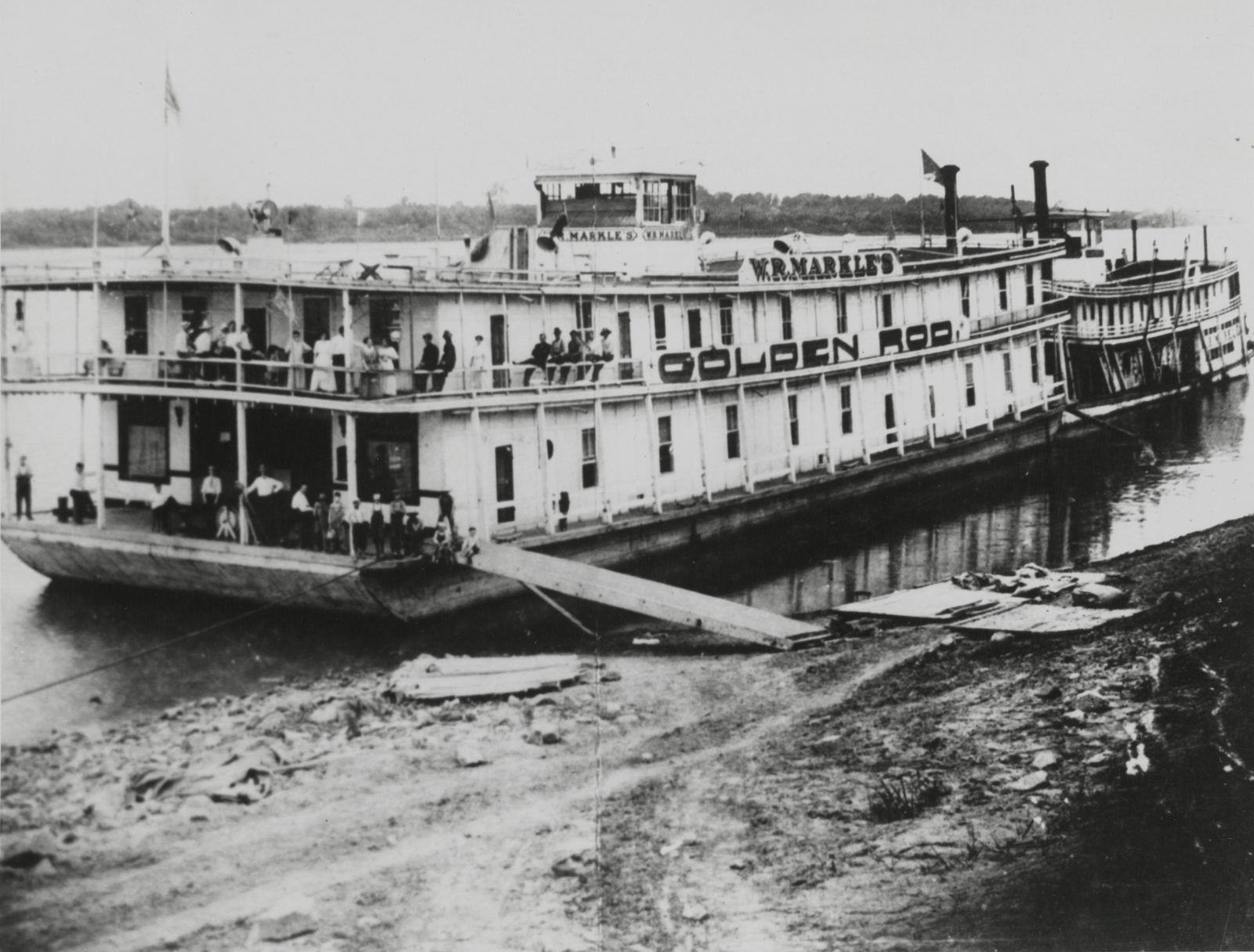
To understand why the calliope became a riverboat instrument, one has to understand what a showboat was and what problem it needed to solve. A showboat was a floating theatre — a barge or steamer fitted out as an auditorium — that worked its way down a river system, tying up at one river town after another to play a night or two and then moving on (American Heritage). The audience did not come to a fixed address; the theatre came to them. And a theatre that arrives by water, unannounced, at a landing that may be a mile from the town it serves, has a marketing problem that a fixed playhouse never has: it has to tell the town it has arrived.
The steam calliope solved that problem with brute acoustic force. As covered in Vol 2, a steam whistle blown at roughly 100–180 psi (est.) radiates orders of magnitude more acoustic power than a wind-blown organ pipe, and the compass of a calliope — a full graded rank of such whistles — could be heard for miles (Wikipedia: Calliope; Steamboats.org). Stoddard’s very first instrument was reportedly audible about five miles (8 km) off and was banned within Worcester city limits for exactly that reason (Wikipedia: Joshua C. Stoddard). Mounted on a boat’s upper deck and played on approach, such an instrument became a loud- hailer: a device whose entire purpose was to reach across water and farmland and summon a population that could not yet see the boat down to the levee.
The tradition on the western rivers dates to roughly 1865 (Steamboats.org). By convention the calliope was played as the boat came into a landing — the sound carrying ahead of the hull, rolling over the bluffs, pulling children and shopkeepers and farmhands down to the riverbank before the gangplank was even run out. It was advertising, timetable, and spectacle in one. A boat that could be heard was a boat whose show would be full.
6.1.1 Why the sound is unmistakable
The showboat calliope has a sonic signature that no other instrument shares, and it is worth naming its three components because each is an engineering consequence rather than an aesthetic choice.
- It is loud — not merely loud for a musical instrument, but loud on the scale of an industrial signalling device, because it is one. The sound source is a near-choked steam jet at boiler pressure (Vol 2), not a low-velocity wind jet at a fraction of a psi.
- It is slightly out of tune, always. As Vol 3 established, the pitch of a steam whistle rises (sharpens) as blowing pressure and steam temperature rise, because the resonant frequency of the bell goes as f ≈ c/(4L) and the speed of sound c in the steam climbs with temperature (Wikipedia: Steam whistle; Wikipedia: Calliope). A rank tuned in cool, wet steam plays sharp once the boiler is hot and the steam has dried, and no two whistles drift by exactly the same amount. “Accurate tuning is nearly impossible” (Wikipedia: Calliope) is not a knock on the builders — it is physics — and the resulting sour, wavering chord is the instrument’s fingerprint.
- It is inseparable from steam itself — the visible white plume above each whistle (which, as Vol 3 stressed, is condensation, wet exhaust, not the dry working steam) means the calliope is a thing one both hears for miles and sees once close: a boat crowned in white plumes, howling a tune.
Loud, slightly out of tune, and plumed: that combination is why a recording of a riverboat calliope is identifiable in the first bar, and why no sampled or synthesized imitation quite reproduces it — the sound is genuinely enormous, and genuinely a little wrong.
6.2 The riverboat deck layout
The showboat calliope is an exercise in putting a small pressure-vessel installation on the top of a moving building. The layout is worth drawing because it explains both the sound (the whistles sit as high as possible, to throw the sound out over the water) and the single most important engineering innovation of the modern era — the remote keyboard, treated in §3.1 below and in Vol 4.
Steam is raised in a boiler low in the hull — on a working steamer, often the main or an auxiliary “doctor” boiler; the calliope taps that supply (Vol 3). A steam line carries pressurized steam up through the decks to a manifold on the upper deck (the texas or hurricane deck), where per-note valves tee off to a graded whistle bank mounted in the open air so its plumes and its sound clear the superstructure. The player, historically, sat at a keyboard right beside that whistle bank — in the heat, the noise, and the scalding drift of the plumes.
Figure 6-1. Riverboat calliope deck layout: steam is raised low in the hull, piped up to a manifold and graded whistle bank high on the upper deck (so the sound and plumes clear the boat), and — after 1960 — driven from a keyboard set a safe distance away from the heat and scald of the whistles (Steamboats.org).
6.3 The named boats
Three riverboats anchor the modern story of the playable steam calliope. Two of them still carry working instruments a visitor can hear.
6.3.1 The Delta Queen — the remote keyboard (1960)
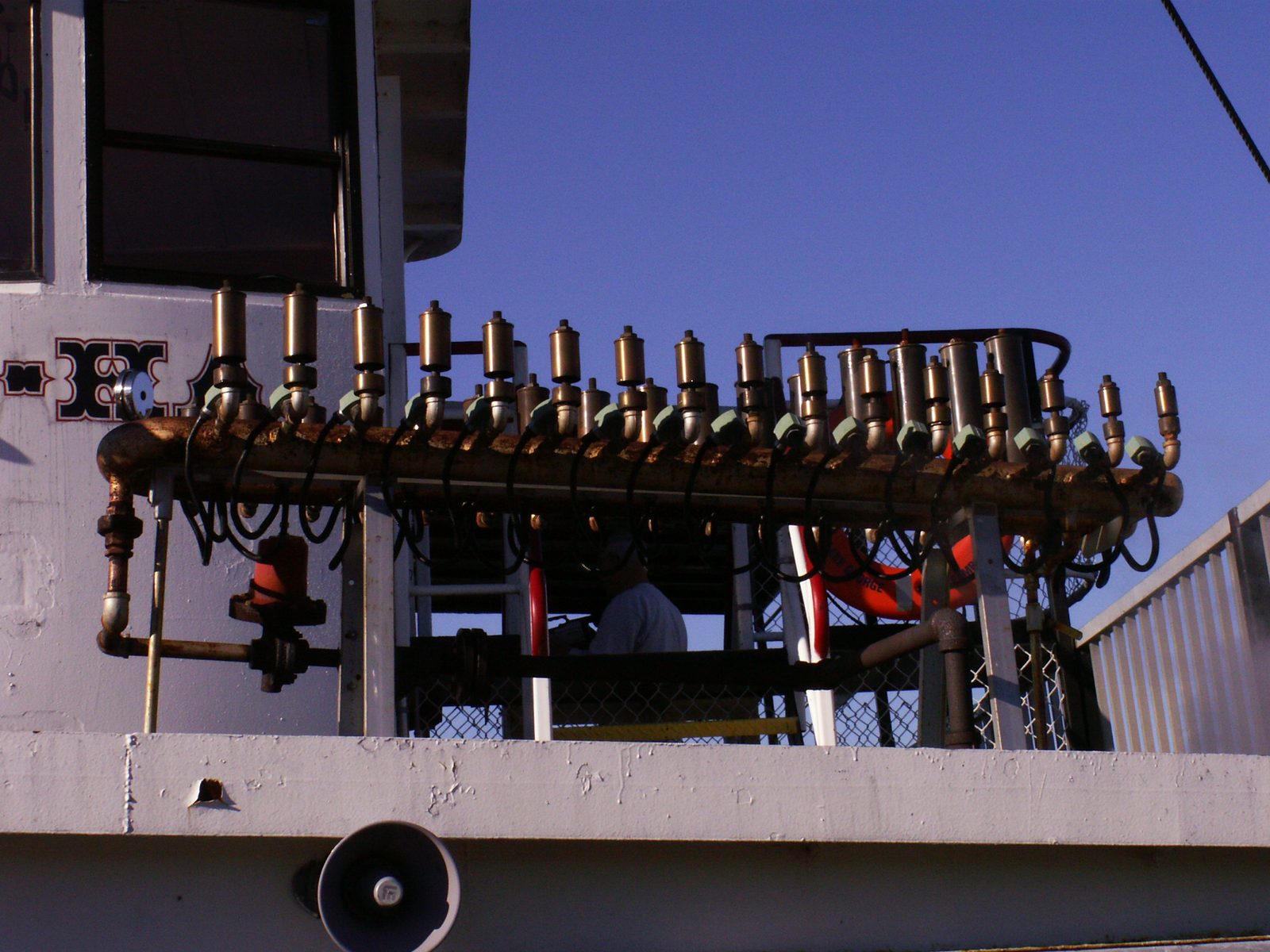
The Delta Queen carries a 32-note steam calliope, and its instrument marks the single most important engineering advance in the playing of the boat calliope: the remote keyboard, installed in 1960 (Steamboats.org).
The problem the remote keyboard solved is the one Figure 6-1 makes plain. Traditionally the player sat immediately beside the whistle bank, because the keys mechanically opened the valves right there — which meant playing the instrument amounted to sitting in a cloud of scalding wet steam, beside a rank of whistles loud enough to be heard for miles, on a hot manifold. It was, by every account, a punishing place to make music. The 1960 installation on the Delta Queen relocated the keyboard to a safe distance from the whistles, linking the keys to the valves at the manifold so the player was no longer parked in the plume (Steamboats.org). The engineering of that separation — running the action across a distance while keeping key response crisp — is the subject of Vol 4; what matters here is that it made the boat calliope humanely playable and set the pattern that later installations followed.
The remote keyboard was the work of Commodore E. J. Quinby, and the whistles he used were not new castings but salvaged from the showboat Water Queen (Steamboats.org). That provenance is characteristic of the tradition: the stock of good steam whistles is finite and old, most of it made by one Cincinnati firm (§4), and instruments are routinely rebuilt from the whistles of earlier boats. The Delta Queen’s voice, in a real sense, is the Water Queen’s voice, moved to a new hull and given a keyboard a man could sit at.
6.3.2 The Str. Natchez — the aurora effect (1975)
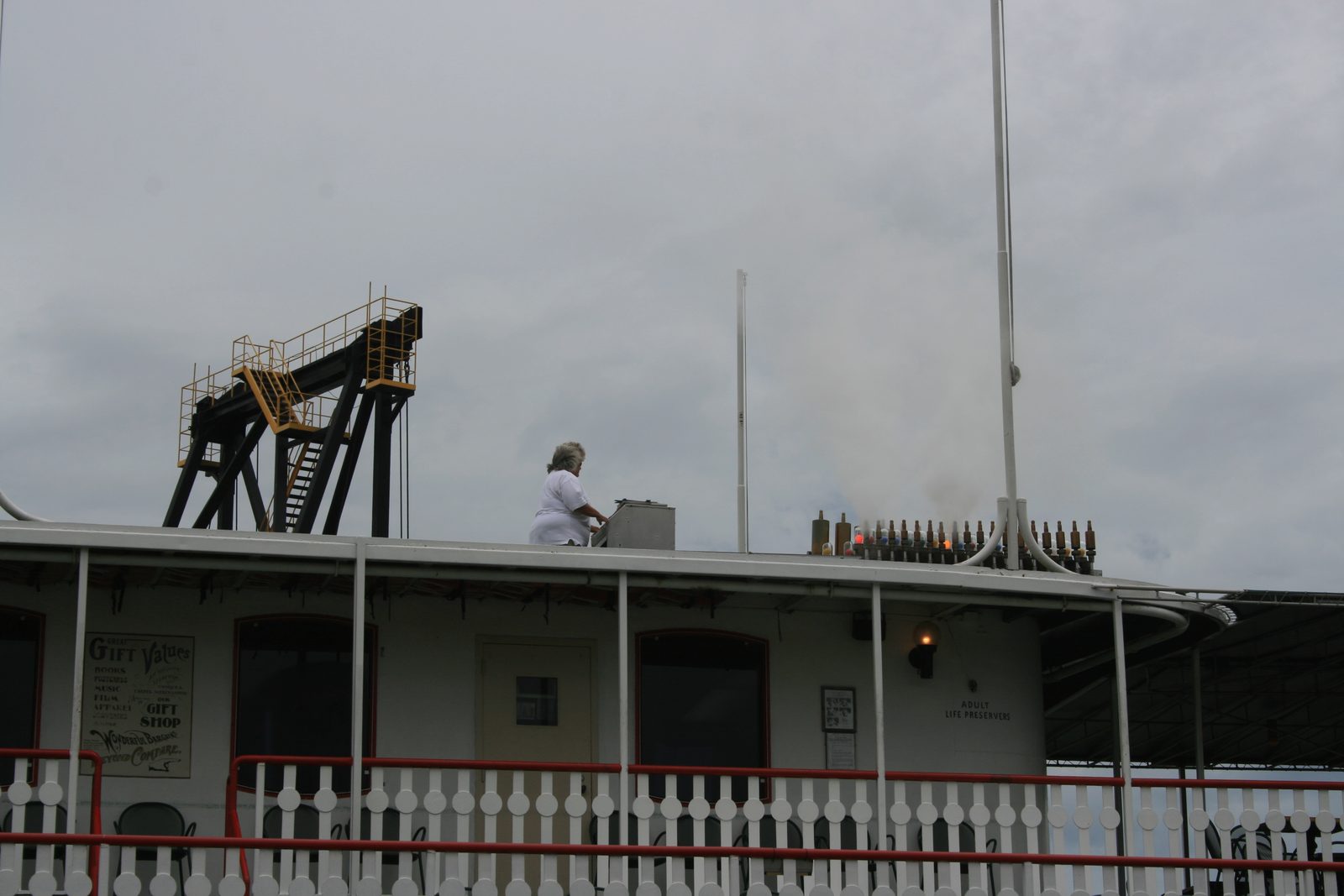
The Str. Natchez — the New Orleans excursion steamer — was christened in 1975 and carries a 32-note steam calliope built as a replica of the Nichol originals (Steamboat Natchez). It is, today, one of the most reliably playable steam calliopes in the world: a visitor to the New Orleans riverfront can hear it played on a regular schedule, which makes the Natchez the single best place to encounter a true steam calliope in ordinary operation.
The Natchez instrument adds a piece of showmanship the older boats lacked: a set of synchronized colored lights, one per whistle, which flash in step with the notes as they sound — an effect the boat calls the “aurora effect” (Steamboat Natchez). Each whistle, when its valve opens and it speaks, lights its own lamp; a run up the compass becomes a run of color as well as of pitch, and a chord lights a cluster of lamps at once. It is a purely visual embellishment — it changes nothing about the steam, the pitch, or the acoustics — but it turns the already-spectacular sight of a plumed whistle bank into a synchronized light show, and it is a large part of why the Natchez calliope is the popular image of the instrument today.
The Natchez pages describe the steam calliope as “a uniquely American” instrument (Steamboat Natchez), and the boat leans into that identity: the 32-note count, the Nichol-replica whistles, and the aurora lights together make the Natchez a deliberate, living reconstruction of the classic boat calliope rather than a museum piece behind glass.
6.3.3 The Belle of Louisville
The Belle of Louisville — the veteran excursion steamer on the Ohio River at Louisville, Kentucky — likewise carries a steam calliope and belongs in any short list of the named boats whose instruments define the surviving tradition (Steamboats.org). Together with the Natchez and the Delta Queen, the Belle represents the small population of hulls on which the boat calliope has remained a working instrument — played for arrivals, excursions, and events — rather than a preserved curiosity. The exact current playing status of any individual boat’s calliope varies over time with restoration cycles and the vessel’s own operational status (est.); what is stable is the trio’s place at the center of the living riverboat-calliope tradition.
6.4 The maker of record: Thomas J. Nichol of Cincinnati
Behind almost every surviving steam boat calliope stands one name. Thomas J. Nichol of Cincinnati, Ohio, working in the late 1800s and early 1900s, built most of the steam calliopes that survive on the western-rivers boats (Steamboats.org). He is the maker of record for the type in the same way that a single workshop can come to define an entire class of instrument — the reference build against which later work is measured.
Nichol’s standing explains two facts already met in this volume. First, it is why the Natchez calliope is described as a Nichol replica (§3.2): to build a “correct” boat calliope in the modern era is, in practice, to reproduce a Nichol instrument, because the Nichol whistles and their voicing are the classic sound (Steamboat Natchez). Second, it is why instruments are so often rebuilt from salvaged whistles rather than newly cast (as on the Delta Queen, §3.1): the existing Nichol whistles are prized, finite, and effectively irreplaceable at their original quality, so the tradition conserves and recirculates them.
A boat calliope, then, is rarely a from-scratch object. It is more usually a curation — a hull, a boiler tap, a manifold and an action, and a rank of aging Nichol (or Nichol-pattern) whistles gathered, tuned as well as the physics allows (Vol 3), and set going. The “great instruments” are great in part because they are careful assemblies of scarce historic parts around a common Cincinnati ancestor.
6.5 The circus calliope: the boiler at the end of the parade
The other great home of the steam calliope was not the river but the circus parade, and there the instrument had a fixed and ceremonial role: it closed the parade (Wikipedia: Calliope; American Heritage).
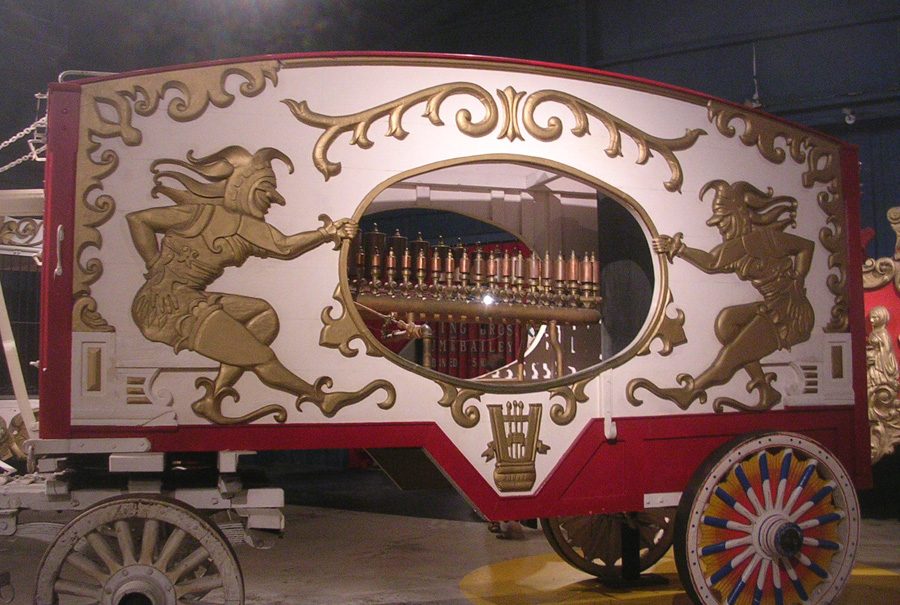
The traditional street parade that a circus staged through a town on its arrival was a build of escalating spectacle — bands, animals, wagons, riders — and it ended, by long convention, with the steam calliope on its gilded wagon as the finale. The phrase that captured the arrangement was “the boiler at the end of the parade”: the calliope wagon carried its own fired boiler, raising steam as it rolled, and brought up the rear throwing plumes and howling a tune. Placing it last was not accident. The calliope was the loudest and most arresting thing in the procession, and — exactly as on the showboat (§1) — its real function was to summon the crowd: to reach the people who had not come out to the street yet, to signal that the show had arrived, and to leave the parade ringing in the town’s ears as it passed. The most spectacular element went last, as the crowd-gathering finale.
The circus calliope was a true steam instrument in the classic period — a fired boiler on a wagon, feeding a whistle bank — and so it shares the whole engineering story of Vols 2–4: the same near-choked steam jets, the same pressure-and-temperature pitch drift, the same visible condensing plume. What it did not share was the boat’s fixed installation; the circus instrument was mobile, self-contained, and gilded for display, a rolling pressure vessel dressed as a carnival float.
6.6 The living tradition: air-calliope makers
The steam calliope’s classic era — Stoddard’s patent in 1855, the boat era, the circus era — is history. But the instrument did not die, because a parallel, lower-pressure branch of the family carried the sound forward and is still being built new today. That branch is the air calliope, and Vol 5 treats it in full; this section places it in the “great instruments” story as the living tradition, and keeps the critical distinction sharp.
The essential guardrail, restated: an air calliope (Tangley’s trademarked “Calliaphone” and its cousins) sounds tuned whistles on compressed air at roughly ½–1 psi, with no boiler — cheaper, safer, and portable (Vol 5; Mechanical Music Press). A steam calliope sounds them on boiler steam at ~100–180 psi (est.). They are three orders of magnitude apart in working pressure. Many, indeed most, of the “calliopes” one can actually buy, see on a bandwagon, or hear at a fairground today are air calliopes, not steam. When this volume speaks of the living tradition of new-built instruments, it is almost entirely an air tradition — and it is the sibling wind-blown fairground instrument, not the boat, that the air calliope most resembles in its portability and its blower-fed operation (cross-ref the sibling dive “Fairground & Dutch Street Organs”).
The makers who define that living air tradition are:
- Tangley Company, Muscatine, Iowa — maker of the trademarked Calliaphone, whose 43-note flagship is the archetypal air calliope (Mechanical Music Press). Tangley’s instruments established the compact, blower- fed, roll-or-keyboard air calliope as the popular successor to the steam boat instrument.
- National Calliope Corporation, Kansas City (grown from the Harrington assets) — maker of the 53-whistle Model B, playing from 65-note “A” rolls (Mechanical Music Press). The National/Harrington line represents the larger, later air instruments.
- The Miner Company — one of the last living calliope builders, producing modern Tangley-style air calliope replicas today (Miner Company; Missouri Life). The Miner Company is the direct answer to the question “is anyone still building these?”: yes, in the air branch, one of the last workshops keeping the note-count and construction of the classic Tangley alive.
The through-line is that the sound — a bank of tuned whistles, howling a tune, unmistakable — survives and is still being manufactured, even though the steam that originally drove it has largely given way to a safer, portable air supply. The romance of the boiler belongs mostly to the past; the note itself is still in production.
6.7 A timeline of notable calliopes
Figure 6-2. A timeline of notable calliopes, steam instruments above the line and air instruments below: from Stoddard’s 1855 patent through the ~1865 boat era and the Nichol workshop, to the Delta Queen’s 1960 remote keyboard and the 1975 Str. Natchez, alongside the parallel air-calliope line (Tangley c.1915, National 1927) that continues in production with builders such as the Miner Company (Wikipedia: Calliope; Steamboats.org; Steamboat Natchez; Mechanical Music Press; Miner Company).
6.7.1 Notable-instruments table
The instruments and makers named across this volume, summarized. “Steam” denotes a boiler-fed instrument; “air” denotes a blower-fed Calliaphone-type instrument (Vol 5). Note counts are whistle counts (one whistle per note; Vol 1).
Table 1 — 7.1 Notable-instruments table
| Instrument / maker | Notes | Maker / era | Steam or air | Status / significance |
|---|---|---|---|---|
| Stoddard’s first calliope | 15 whistles | J. C. Stoddard, 1855 (patent) | Steam | Historic; pinned cylinder, the archetype (Wikipedia: Stoddard) |
| Nichol boat calliopes | ~32 typical | T. J. Nichol, Cincinnati, late 1800s–early 1900s | Steam | Maker of record; most survivors are Nichol builds (Steamboats.org) |
| Delta Queen | 32-note | Remote kbd 1960, Cmdr. E. J. Quinby | Steam | 1960 remote keyboard; whistles from showboat Water Queen (Steamboats.org) |
| Str. Natchez | 32-note | Christened 1975; Nichol replica | Steam | Playable in New Orleans; “aurora effect” lamps, one per whistle (Steamboat Natchez) |
| Belle of Louisville | steam calliope | veteran Ohio-River steamer | Steam | Among the surviving playable boat instruments (Steamboats.org) |
| Circus parade calliope | varies (est.) | classic-era circus | Steam | Closed the parade — “the boiler at the end” (Wikipedia; American Heritage) |
| Tangley Calliaphone | 43-note | Tangley Co., Muscatine IA, from ~1915 | Air | Archetypal air calliope; portable, no boiler (Mechanical Music Press) |
| National Model B | 53-whistle | National Calliope Corp., Kansas City, 1927 | Air | Larger air instrument; 65-note “A” rolls (Mechanical Music Press) |
| Miner Company replicas | Tangley-pattern | Miner Company, today | Air | One of the last living builders; modern air replicas (Miner Company) |
6.8 What survives and where to hear one
For the enthusiast the practical question is: where can a person actually stand in front of one of these and hear it? The answer sorts cleanly into the two branches.
Playable steam calliopes. The true boiler-fed instrument is now rare, and the short list of places to hear one played on a regular basis is short by nature:
- The Str. Natchez, New Orleans — the most dependable public encounter with a true steam calliope, a 32-note Nichol-replica instrument played on the New Orleans riverfront (Steamboat Natchez). For a first-time listener wanting to hear the genuine article — loud, sour, plumed — this is the reference destination.
- The Belle of Louisville, Louisville — a veteran steamer whose steam calliope is part of the surviving playable population (Steamboats.org).
- The Delta Queen and other historic hulls — carriers of instruments whose playing status tracks the vessel’s own operational and restoration state over time (est.); the 32-note, remote-keyboard, Water Queen-whistled instrument remains one of the landmark boat calliopes regardless of a given season’s schedule (Steamboats.org).
Circus and museum instruments. Surviving circus calliopes — the gilded parade wagons of §5 — turn up in circus museums and heritage collections and at occasional heritage-parade appearances; these are the place to see the mobile, self-contained “boiler at the end of the parade” as an object, whether or not it is fired on a given day.
Air calliopes — the everyday encounter. By far the most common living encounter with “a calliope” is with an air instrument (§6): a Tangley-pattern Calliaphone or a modern replica, blown at ½–1 psi, appearing at fairs, festivals, and events on a bandwagon or trailer. Because builders such as the Miner Company still produce them (Miner Company), it is the branch a present-day listener is most likely to meet — and the honest guardrail for the enthusiast is to check the machine: a boiler and plumes means steam; a blower and a tank means air. Both are calliopes; only the first is the boat instrument this dive is chiefly about.
6.8.1 The enthusiast community
The calliope survives not only as hardware but as a small, dedicated community. The mechanical-music world — the registries, collectors, and restorers documented by sources such as Mechanical Music Press — maintains the census of surviving air calliopes (maker, note count, serial, current owner) that keeps the Tangley and National instruments identifiable and repairable (Mechanical Music Press). On the steam side, the boats and their operating companies (Steamboats.org; Steamboat Natchez) are the custodians of the playing tradition, and the steamboat-heritage community carries the lore — the ~1865 origin on the western rivers, the Nichol provenance, the Water Queen whistles — that this volume has drawn on throughout. The instrument’s continued existence is, in the end, a community achievement: scarce historic whistles conserved and recirculated, a few boats kept in steam, and a handful of builders still turning out the air version so the sound does not go silent.
6.9 Summary
- The showboat/riverboat calliope (a tradition dating to ~1865 on the western rivers) served as the boat’s advertising loud-hailer, played on approach to summon a town to the levee — its function following directly from the instrument’s extreme, boiler-driven loudness (Steamboats.org; American Heritage).
- Three named boats anchor the surviving tradition: the Delta Queen (32-note; its 1960 remote keyboard by Commodore E. J. Quinby, using whistles salvaged from the showboat Water Queen); the Str. Natchez (32-note, christened 1975, a Nichol replica, with the synchronized colored “aurora effect” lamps, one per whistle); and the Belle of Louisville (Steamboats.org; Steamboat Natchez).
- The maker of record for boat calliopes is Thomas J. Nichol of Cincinnati, Ohio (late 1800s–early 1900s), who built most of the survivors — which is why modern “correct” instruments are Nichol replicas and why scarce Nichol whistles are conserved and recirculated (Steamboats.org).
- The circus calliope traditionally closed the parade — “the boiler at the end of the parade” — the crowd-summoning finale on a gilded steam wagon (Wikipedia: Calliope; American Heritage).
- The living tradition is chiefly the air branch — Tangley (Calliaphone, 43-note), National/Harrington (Model B, 53-whistle), and the Miner Company still building new air replicas today — which must be kept rigorously distinct from the boiler-fed steam instrument (Vol 5; Mechanical Music Press; Miner Company).
- To hear a true steam calliope, the reference destinations are the playable riverboat instruments — the Str. Natchez in New Orleans and the Belle of Louisville — with circus/museum instruments and the enthusiast community keeping the rest of the tradition alive (Steamboat Natchez; Steamboats.org).
Reference material — the pressure ladder, the whistle/note-count tables, the tuning table, the glossary, and the full cross-index — is collected in Vol 7, “Reference & Cheatsheet.” The boiler and steam-supply engineering behind every instrument named here is in Vol 3; the air-versus-steam distinction is in Vol 5; and the wind-blown cousin of the whole family is the sibling dive “Fairground & Dutch Street Organs.”
Comments (0)