Steam Organs And Calliopes · Volume 3
Steam Organs & Calliopes — Vol 03: Boiler & Steam Supply
Where the instrument stops being an instrument and becomes a pressure vessel. The calliope’s compass is a rank of tuned whistles (Vol 2), and its keys or roll admit steam to those whistles through valves (Vol 4). This volume covers the plant behind the valves: the boiler that raises the steam, the header that distributes it, the difference between wet and dry steam, and the single fact that governs everything a calliopist fights against — the pitch of the instrument tracks the temperature of the steam, so it never truly stays in tune.
3.1 The boiler as a pressure vessel
A pipe organ is a wind instrument in the strict sense: its pipes are blown by air at a few inches of water column — on the order of 0.18 psi for a small barrel or busker organ (see “Wind Systems”). A steam calliope is not a wind instrument in that sense at all. Its sound source is a rank of steam whistles, and a steam whistle is a piece of industrial pressure equipment. The working fluid is not air moved by a bellows but steam raised in a boiler and delivered at pressures three orders of magnitude higher than any wind organ ever sees.
That single change of regime — from a bellows-and-reservoir wind supply to a fired boiler — is what makes the calliope loud enough to be heard for miles, and it is also what makes it nearly impossible to keep in tune. Both consequences flow from the same plant. This volume treats that plant as what it is: a small steam installation whose “load” happens to be a set of musical whistles.
3.1.1 Where the steam comes from
On a riverboat, the calliope was rarely given a dedicated boiler of its own. Steam was drawn from the vessel’s existing plant — either the main propulsion boilers or a smaller auxiliary boiler. On steamboats the auxiliary boiler that fed deck machinery, the dynamo, and similar services was traditionally called the “doctor” (the name properly belongs to the auxiliary feed/utility engine, and by extension its boiler). A calliope tapped into this supply through its own steam line and a shut-off valve, so that the instrument could be charged with steam when it was to be played and isolated when it was not.
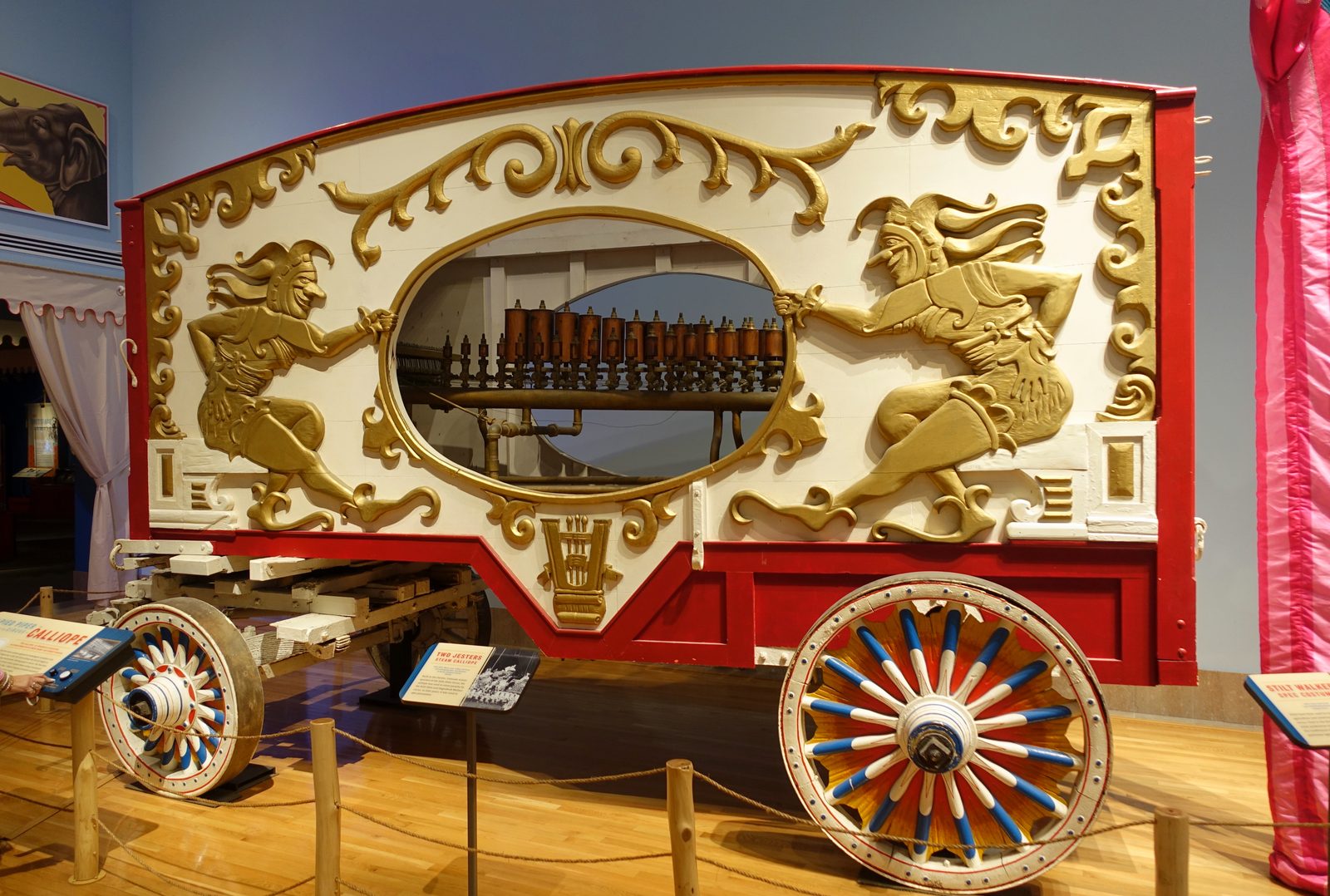
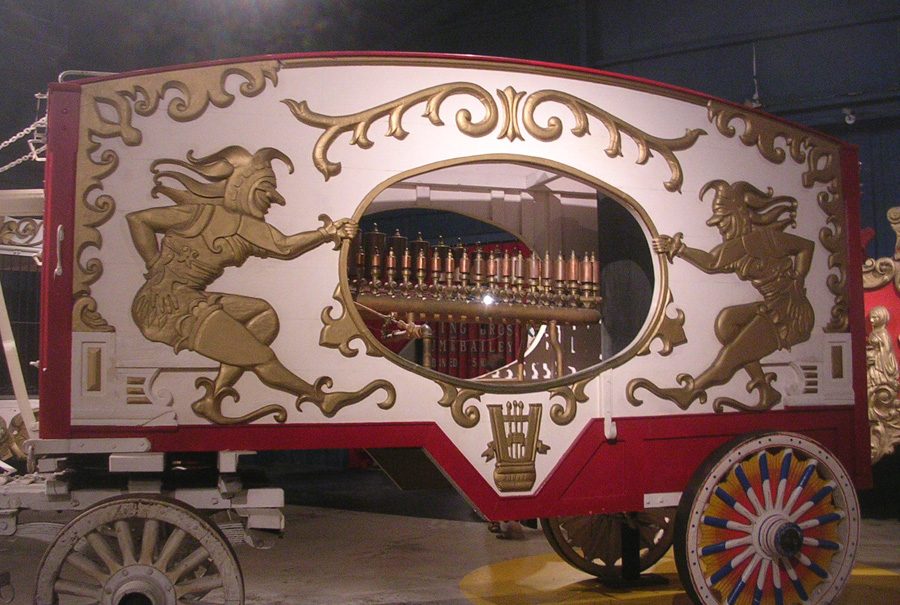
A land-based circus or fairground calliope carried the boiler on the wagon itself: a fired boiler, its firebox, water and fuel, mounted on the same chassis as the whistles — the “boiler at the end of the parade” that closed the circus procession. In every case the essential arrangement is the same: a fired pressure vessel raises steam, a line carries it to the instrument, and a manifold distributes it to the individual whistle valves.
3.1.2 Working pressure
The headline number for a steam calliope is its working pressure — the gauge pressure of the steam feeding the whistles. Steam-calliope working pressure is best given as a band rather than a single figure, because it depended on the boiler the instrument was tapped into:
- Stoddard’s original instrument was reportedly fed steam at about 180 psi. This is the one historical calliope pressure figure that is documented, and it sits near the top of the useful range.
- Industrial steam whistles run at roughly 100–300 psig, with some large installations going to 600 psig (Wikipedia: Steam whistle). A steam calliope’s whistles sit in the lower part of that same band.
- Taken together, a reasonable generic working figure of ~100–180 psi (est.) covers most steam calliopes. Any specific boat or wagon should be quoted from its own documentation; absent that, the ~100–180 psi band is the figure to use, and it is an estimate, not a measured value for a particular instrument.
For scale, the pressure ladder that runs through this whole dive:
Table 1 — For scale, the pressure ladder that runs through this whole dive
| Instrument | Working pressure | Fluid | Supply |
|---|---|---|---|
| Low-pressure wind organ | ~5 in H₂O ≈ 0.18 psi | Air | Bellows + reservoir |
| Air calliope (calliaphone) | ~½–1 psi | Compressed air | Blower / tank |
| Steam calliope | ~100–180 psi (est.) | Steam | Fired boiler |
A steam calliope therefore runs at roughly 500–1000× the pressure of a wind organ and about 100–180× that of an air calliope. It is not a bellows instrument scaled up; it is a different machine. Steam versus air versus low-pressure wind are kept rigorously distinct throughout this dive — the air calliope (the Tangley “Calliaphone” and its kin) is covered in Vol 5, and it has no boiler at all.
Note — psi vs psig. Working pressure is quoted here as gauge pressure (psig): pressure above the surrounding atmosphere, which is what a boiler gauge reads and what drives steam out through the whistle. Steam-table saturation temperatures below are indexed the same way (0 psig = 1 atmosphere absolute). The distinction matters when the numbers are cross-checked against a steam table, which is usually tabulated in absolute pressure (psia): 0 psig ≈ 14.7 psia.
3.2 Saturated versus superheated steam
Everything about the calliope’s tuning behaviour rides on the state of the steam reaching the whistles, so the two states of steam must be defined precisely.
3.2.1 Saturated (wet) steam: temperature fixed by pressure
Saturated steam is steam at the boiling point corresponding to its pressure — steam in equilibrium with the boiling water that produced it. Its defining property, and the one that matters for tuning, is that its temperature is fixed by its pressure. At a given pressure there is exactly one temperature at which water boils and steam and water coexist; raise the pressure and that temperature rises with it. A boiler generating saturated steam cannot make the steam hotter without also raising the pressure, and vice versa. The two move together along the saturation curve.
A short saturated-steam table makes the relationship concrete. All temperatures are estimates read from a standard steam table and rounded; they should be verified against a steam table for any precise work, but they are accurate enough to show the trend and the working range of a calliope.
Table 2 — 2.1 Saturated (wet) steam: temperature fixed by pressure
| Gauge pressure (psig) | Absolute (psia) | Saturation temp (°C) | Saturation temp (°F) |
|---|---|---|---|
| 0 (1 atm) | ~14.7 | ≈100 | ≈212 |
| 15 | ~30 | ≈121 | ≈250 |
| 50 | ~65 | ≈150 | ≈300 |
| 100 | ~115 | ≈170 | ≈338 |
| 150 | ~165 | ≈186 | ≈366 |
| 180 | ~195 | ≈190 | ≈379 |
(All °C/°F values est.; verify against a steam table.)
So the calliope’s working band, ~100–180 psig, corresponds to saturated-steam temperatures of roughly 170–190 °C. Note how the curve flattens as pressure climbs: the first 15 psig buys ~21 °C, but the step from 150 to 180 psig buys only a few degrees. The temperature is a strong function of pressure at low pressure and a weak one at high pressure.
Real boiler steam drawn straight off the water is rarely perfectly dry. It carries entrained water droplets — it is wet saturated steam, and the mass fraction that is actually vapour is its dryness fraction or quality. Wet steam matters to a calliope because those droplets both rob the jet of energy and, as discussed below, are the source of the visible plume.
3.2.2 Superheated (dry) steam: hotter than saturation
Superheated steam is steam that has been heated above the saturation temperature for its pressure. Once every droplet has boiled away and the steam is dry, adding more heat no longer boils water — it simply raises the temperature of the vapour while the pressure stays put. Steam at 100 psig and 250 °C is superheated by about 80 °C above its ~170 °C saturation point; it is at the same pressure as the saturated steam but substantially hotter and lower in density.
The practical routes to superheat on a calliope are usually incidental rather than deliberate. A boiler may deliver mildly superheated steam; more often, steam sitting in a long, sun-warmed, or externally heated header, or throttled through a valve, arrives at the whistle hotter and drier than it left the water. What matters for this volume is the direction: superheating raises the steam temperature at a fixed pressure, and — as Section 3 shows — that drives the whistle sharp.
3.2.3 The plume is condensation, not the working steam
A steam calliope in full cry throws up a dramatic white plume, and it is worth stating plainly what that plume is: the visible white cloud is condensation — tiny water droplets forming as the exhaust steam expands, cools, and mixes with cooler air. It is not the dry working steam inside the whistle.
Dry steam, whether saturated or superheated, is a transparent gas; it is invisible, exactly as the air it displaces is invisible. The moment that steam leaves the whistle bell it drops in pressure and temperature and mixes with the atmosphere, and much of it re-condenses into a fog of liquid droplets — the same physics as breath fogging on a cold day, or the “steam” above a kettle (which is likewise condensed droplets, not the clear vapour immediately at the spout). So the plume is a picture of the steam after it has done its acoustic work and begun to condense, not of the steam that is actually sounding the note. The working steam is the clear, hot, higher-pressure gas inside the bell; the plume is its wet, cooling exhaust. Describing the visible cloud as “superheated steam” gets it backwards — superheated steam is precisely the state that is not visible.
This distinction is not merely pedantic. A wet, condensing plume is a sign that the whistle is being fed relatively cool, wet steam; a whistle running on hotter, drier steam throws a thinner, shorter plume because less of the exhaust immediately condenses. The look of the plume is a rough temperature gauge — and therefore a rough tuning gauge — which is the subject of the next section.
3.3 The tuning problem: why the calliope will not stay in tune
This is the payoff of the volume, and the direction of the effect must be stated correctly, because it is easy to get backwards. The rule is: as the steam gets hotter, drier, or higher in pressure, every whistle goes sharp; as the steam cools, turns wet, or drops in pressure, every whistle goes flat. A calliope is tuned for one steam condition and drifts away from it as conditions change.
3.3.1 The mechanism, in one line
The physics is deferred in its full form to “How Organ Pipes Make Sound,” and the whistle geometry to Vol 2, but the load-bearing chain is short enough to state here:
- A whistle sounds at the resonant frequency of its bell. For a closed (stopped) cylindrical bell of effective length L, that is the quarter-wave resonance f ≈ c / (4L), where c is the speed of sound in the steam filling the bell. (The bell length is fixed by construction — see Vol 2.)
- The speed of sound in a gas rises with its absolute temperature: c ∝ √T, with T in kelvin. Hotter gas carries sound faster.
- Combine them. With L fixed, f ∝ c ∝ √T. The whistle’s pitch tracks the square root of the absolute temperature of the steam inside it.
Every element of the calliope’s tuning instability follows from that one proportionality. The bell cannot change length in real time, so the only thing that moves the pitch is the speed of sound in the steam — and that is set by the steam’s temperature.
3.3.2 Temperature: the direct lever
Because f ∝ √T, heating the steam sharpens the note and cooling it flattens the note. This is why Wikipedia states of the calliope that “the pitch of each note is largely affected by the temperature of the steam, [so] accurate tuning is nearly impossible” (Wikipedia: Calliope). The instrument is tuned at one steam temperature, and any departure from it detunes the whole rank at once — since all the bells see the same steam, they all shift in the same direction together (which at least keeps the instrument roughly in tune with itself even as it drifts away from concert pitch).
How much drift? Because f ∝ √T, the pitch interval between two steam temperatures is:
cents ≈ 600 × log₂(T₂ / T₁), with T₁ and T₂ in kelvin.
(The 600 rather than 1200 is the square root: doubling the frequency is 1200 cents, and f goes as √T, so a doubling of pitch would need a quadrupling of absolute temperature.) Worked examples across a calliope’s plausible steam range:
Table 3 — absolute temperature.) Worked examples across a calliope's plausible steam range
| Tuned at (saturated) | Drifts to | ΔT | Pitch shift |
|---|---|---|---|
| 150 °C (423 K) | 170 °C (443 K) | +20 °C | ≈ +40 cents (sharp) |
| 170 °C (443 K) | 200 °C (473 K) | +30 °C | ≈ +57 cents (sharp) |
| 170 °C (443 K), saturated | 250 °C (523 K), superheated | +80 °C | ≈ +144 cents (sharp, ~1½ semitones) |
| 170 °C (443 K) | 140 °C (413 K) | −30 °C | ≈ −60 cents (flat) |
(Temperatures est.; cents computed from f ∝ √T.)
The lesson is stark. A quarter-tone of drift (~50 cents) needs only a ~25–30 °C swing in steam temperature — well within the difference between a boiler just brought up and one that has been holding pressure for an hour, or between wet saturated steam and mildly superheated steam. Push the whistle from cool wet steam to genuinely superheated steam and it can go more than a semitone sharp. No mechanical tuning that assumes a fixed pitch can survive that.
3.3.3 Pressure: the indirect lever (and its own direct one)
Raising the blowing pressure also sharpens the note, and Wikipedia records a concrete case: a single steam whistle could be driven “from E to D-flat” — a large upward shift — by raising the blowing pressure (Wikipedia: Steam whistle). There are two reasons pressure moves pitch, and they reinforce each other in the sharp direction:
- Through temperature (saturated steam). For saturated steam, temperature is locked to pressure (Section 2.1). Raise the boiler pressure and the saturation temperature rises with it — from ~170 °C at 100 psig to ~190 °C at 180 psig (est.) — so c rises, so f rises. The pressure lever is, in part, just the temperature lever wearing a different hat.
- Directly, at the jet. Higher supply pressure also raises the velocity of the steam jet crossing the bell lip and shifts the edge-tone/feedback regime that couples the jet to the resonance (the jet acoustics belong to Vol 2 and “How Organ Pipes Make Sound”). This can pull the sounding pitch above the bare quarter-wave resonance, and it grows stronger as pressure rises. It is why a whistle’s pitch keeps climbing with pressure even beyond what the temperature change alone would predict, and why the documented “E to D-flat” excursion is so large.
Both channels point the same way: more pressure → hotter and faster steam → sharper note. There is no operating regime in which raising the pressure or the temperature of the steam flattens the pitch.
3.3.4 The consequence: “tuned for one temperature”
Put together, the calliope is an instrument whose tuning reference is not a fixed mechanical length but a thermodynamic condition. Its bells are cut and voiced to play in tune at one steam temperature and pressure — in practice, whatever condition prevailed when the tuner set them. As the boiler warms through the day, as the header heats or cools, as steam is drawn hard (dropping pressure) or left to sit (drying and warming), the whole rank slides sharp and flat around that reference. This is the deep reason a steam calliope is famous for its wild, slightly-out-of-tune sound: it is not poor workmanship but physics. The tuner tunes it once, “for one temperature,” and the steam takes it from there.
The three fluid conditions and their pitch effects, collected:
Table 4 — The three fluid conditions and their pitch effects, collected
| Change in the steam | Speed of sound c | Effect on pitch |
|---|---|---|
| Hotter (warmer boiler / superheated) | rises (c ∝ √T) | sharper ↑ |
| Cooler (cold boiler / wet exhaust) | falls | flatter ↓ |
| Higher blowing pressure | rises (hotter saturated steam + faster jet) | sharper ↑ |
| Lower blowing pressure | falls | flatter ↓ |
| Drier / more superheated | rises (hotter at same pressure) | sharper ↑ |
| Wetter (higher moisture, droplets) | falls (cooler, denser) | flatter ↓ |
3.4 Diagrams
3.4.1 Steam supply schematic
The plant, end to end: a fired boiler holds the working pressure; a lagged steam line carries steam to a manifold (header); from the header, a valve per note tees off to its own graded whistle. The whistle bank runs from long bells (low notes) to short bells (high notes), throwing a condensing plume when it sounds. On riverboats after 1960, a remote keyboard could sit at a safe distance from the whistles, driving the valves through mechanical, pneumatic, or electric linkages (the action is Vol 4).
Figure 3-1. Boiler → manifold/header → whistle-bank steam supply. The fired boiler holds the working pressure (~100–180 psi, est.); a shut-off isolates the instrument; the header distributes steam to a valve per note; each valve feeds one graded whistle. Bells shorten left to right (low to high). The shaded plumes are condensation, not the dry working steam. A remote keyboard (riverboat practice from 1960) drives the valves through an action linkage — the subject of Vol 4.
3.4.2 Pressure / temperature versus pitch drift
The second diagram is the whole tuning argument in one picture: pitch (in cents, relative to the tuning reference) plotted against steam temperature and the pressure that tracks it for saturated steam. A note set in tune in cool, wet steam climbs sharp as the steam warms, dries, and (if pressure rises) superheats; it falls flat if the steam cools. The curve is the √T law: f ∝ c ∝ √T.
Figure 3-2. Pitch drift versus steam temperature and pressure. With the bell length L fixed, pitch follows f ∝ c ∝ √T. A note tuned at ~170 °C saturated steam (0 cents) rides sharp — tens of cents, up past a semitone — as the steam warms toward and beyond its saturation temperature and into superheat, and flat as it cools and turns wet. Higher saturated pressure means higher temperature, so the pressure axis (top) tracks the same curve in the sharp direction.
3.5 The manifold (header) and steam distribution
Between the boiler and the whistles sits the manifold, also called the header or steam gallery. It is a length of heavy pipe — a plenum — kept at boiler pressure, from which each whistle’s valve draws its steam. Its job is simple in principle: present every whistle with the same supply pressure so that the rank plays as a set, and give each per-note valve a clean tap.
Several practical points follow from putting a header between the boiler and the whistles:
- Common supply, common drift. Because every whistle is fed from the same header at the same pressure and temperature, the whole rank drifts together. This is the small mercy of the calliope’s tuning instability: as the steam condition changes, the instrument moves sharp or flat more or less as a unit, so it stays roughly in tune with itself even while wandering away from any fixed external pitch. A header that developed a strong temperature gradient along its length — hotter near the boiler, cooler at the far end — would let the two ends of the compass drift apart, which is one reason headers are kept short and lagged.
- Condensate management. Steam sitting in a header loses heat through the pipe wall and condenses; liquid water collects at low points. Slugs of condensate reaching a whistle waste steam, cool the bell (flattening it momentarily), and can make a whistle spit rather than speak cleanly. Well-arranged plants slope the header to drain and fit a drain or trap at the low point to clear condensate, and are warmed through (“blown down”) before playing so the whistles speak on dry steam rather than a cold, wet charge.
- Pressure drop under load. When many keys are held at once, the combined steam demand can pull the header pressure down below the boiler’s gauge reading, because the supply line and the boiler’s steaming rate are finite. A pressure sag means a momentary flattening across the rank — the calliope leans flat on big chords and recovers as demand eases. A generously sized header and supply line, and adequate boiler capacity, keep that sag small.
- The tap to each valve. Each note’s valve tees off the header; the valve, and the action that opens it, are the subject of Vol 4. The header simply has to hold pressure and deliver it. Its sizing, and the sizing of the line back to the boiler, set the ceiling on how many notes can sound at full pressure at once.
The header is thus the point at which the “steam supply” ends and the “instrument” begins: everything upstream of it is a steam plant; everything downstream — valves, whistles, tuning — is the calliope proper.
3.6 Boiler safety
A steam calliope is a small steam installation, and the boiler behind it demands the same respect as any other fired pressure vessel. The tuning problems above are the musician’s headache; the safety points below are the reason a calliope boiler is engineering equipment, not a stage prop.
- The safety valve is not optional. A boiler generating steam at ~100–180 psig stores a large amount of energy. The safety (relief) valve is the primary protection: it lifts automatically if pressure exceeds the set limit and vents steam to atmosphere, capping the pressure regardless of firing. A calliope’s own steam draw is small and intermittent, so the safety valve on the parent boiler governs the whole plant. It is never to be defeated, gagged, or overloaded to raise pressure “for a louder note” — the historical temptation, and a dangerous one, since more pressure does raise both loudness and pitch (Section 3.3).
- Gauge and gauge glass. A pressure gauge shows the working pressure at a glance, and a water gauge glass shows the boiler water level. Low water is the classic boiler hazard: uncovering the heated surfaces can overheat and fail them, with catastrophic results. The calliopist tapping steam off a boat’s boiler is a customer of the engine crew that watches these; the land-based circus plant needs its own competent attendant.
- Feedwater. Steam drawn off to the whistles and vented as plume is water leaving the boiler, and it must be replaced by a feedwater supply (pump or injector) to hold the level. A calliope played hard is a real, if modest, steam load on its parent boiler.
- Isolation. The shut-off valve in the steam line lets the instrument be isolated from the boiler when not in use, so the whistle valves and their packing are not held at pressure and temperature continuously, and so the instrument can be worked on safely while the boiler stays up for other services.
- Hot everything. Steam at ~170–190 °C, and the header and whistles carrying it, will cause severe burns on contact. Lagging (insulation) on the line and header is as much for crew protection and heat conservation as for keeping the steam dry. A remote keyboard at a safe distance from the whistle bank (riverboat practice from 1960, covered in Vol 4) is in part a safety measure: it keeps the player away from the heat, noise, and steam of the whistles.
3.7 Summary
- A steam calliope is a pressure vessel with whistles on it. Its steam comes from a fired boiler — the vessel’s main or auxiliary (“doctor”) boiler on a riverboat, a wagon-mounted boiler on a circus plant — at a working pressure of ~100–180 psi (est.) (Stoddard’s original ~180 psi; industrial whistles run 100–300 psig, some to 600). That is ~500–1000× a wind organ and ~100–180× an air calliope. Steam, air, and low-pressure wind are three distinct regimes.
- Saturated (wet) steam is at the boiling point for its pressure, and its temperature is fixed by pressure — roughly 170–190 °C across ~100–180 psig (est.; verify against a steam table). Superheated (dry) steam is hotter than that at the same pressure.
- The visible white plume is condensation — water droplets forming as the exhaust steam cools and mixes with air — not the dry working steam, which is a transparent gas inside the bell.
- The tuning problem, direction correct: with the bell length fixed, f ≈ c/(4L) and c ∝ √T, so f ∝ √T. Hotter, drier, or higher-pressure steam makes every whistle sharper; cooler, wetter, lower-pressure steam makes it flatter. A ~25–30 °C temperature swing is roughly a quarter-tone; wet-to- superheated can exceed a semitone. Raising blowing pressure also sharpens, both through the saturated temperature rise and directly at the jet (Wikipedia: Steam whistle — one whistle driven “from E to D-flat”). Hence “the pitch of each note is largely affected by the temperature of the steam, [so] accurate tuning is nearly impossible” (Wikipedia: Calliope): the instrument is tuned “for one temperature” and drifts constantly.
- The manifold/header holds boiler pressure and distributes it to a valve per note, so the whole rank drifts together; condensate draining, pressure sag under load, and header temperature gradients are the practical concerns.
- Boiler safety — safety valve, gauge and gauge glass, feedwater, isolation, and hot surfaces — is not optional: a calliope boiler is fired pressure equipment, and raising pressure for volume raises both loudness and pitch at a real hazard.
Cross-references. The steam whistle itself — orifice, steam-way, bell, and why it is so loud — is Vol 2. The acoustic reason c ∝ √T shifts the pitch (the jet/edge-tone and standing-wave physics) is “How Organ Pipes Make Sound”. How keys and rolls admit steam to each whistle, and the remote keyboard, are Vol 4. The low-pressure wind contrast is “Wind Systems”; the boiler-free air calliope (the calliaphone) is Vol 5.
Steam-property figures (saturation temperatures) are estimates read from a standard steam table and should be verified there; calliope working pressures other than Stoddard’s ~180 psi and the 100–300 psig industrial-whistle band are marked (est.).
Comments (0)