Materials Construction And Restoration · Volume 7
Materials, Construction & Restoration — Vol 07: Antique-Organ Restoration
The six volumes before this one built up a palette: the woods a mechanical organ is made of and how they move (Vol 2), the leathers and flexibles that seal it (Vol 3), the metals and fasteners that spring and pin it (Vol 4), the glues that hold it together (Vol 5), and the finishes that protect it (Vol 6). Each carried the same classic-versus-modern axis, and each stopped at the same boundary: it named the material and said what it costs over time, but it did not say when the classic material is obligatory and when the modern one is legitimate. That decision is a question of ethics before it is a question of technique, and it is the subject of this final volume.
7.1 What this volume does
Vol 7 has two jobs. The first is the restoration capstone: the conservation ethics — reversibility, minimal intervention, documentation — that decide how an antique mechanical organ should be treated, and the hands-on technique of re-leathering, re-pinning, and repairing wood, each cross-referenced back to the volume that owns its material. The second job is to be the dive’s reference apparatus: the consolidated tables (adhesives, leathers, alloys, wood movement), a glossary, a cross-index into Vols 1–6 and the sibling dives, and a bibliography. A reader who wants the argument reads §§7.2–7.4; a reader at the bench who wants a number reads §§7.5–7.8.
7.2 The ethics of restoration
Restoring an antique instrument is not the same activity as building a new one, and the difference is not one of skill. A new busker organ has no history to destroy; every choice its builder makes is reversible in the only sense that matters, because the object did not exist before. An antique mechanical organ is the opposite: it is a physical document. Its original leather records a tannage, its glue lines record a shop practice, its barrel pins record a musical arrangement, and its tool-marks record the hands that made it. A restorer who returns it to playing condition can, in the same motion, erase every one of those records. The conservation bodies that oversee mechanical music — the Musical Box Society International and its sibling communities, the Carousel Organ Association of America and the Automatic Musical Instrument Collectors’ Association — exist in large part to hold that tension in view (MBSI). Three principles govern the work.
7.2.1 The reversibility principle
The first and most important rule is reversibility. Stated in the standard conservation form (attributed to the instrument scholar Cary Karp and carried by the conservation-of-instruments literature), it is the rule that a restorer should make “no modifications that cannot be easily and completely undone in light of future improved knowledge” (Conservation-of-instruments wiki). The clause “in light of future improved knowledge” is the heart of it: the point is not merely that a future owner might dislike the work, but that conservation knowledge itself improves, and today’s confident intervention may be tomorrow’s recognised mistake. The only defence against that is to ensure that anything done now can be undone later without loss to the original material.
This is precisely the property that made hot hide glue the classic organ’s adhesive and makes it the restorer’s adhesive still: it is fully reversible with heat and moisture, it forms a hard, brittle bond that fractures cleanly at the glue line without tearing the wood, and a joint reopened with heat and moisture lets its parts separate and clean up easily (Player-Care hide Q&A; AIC WAG; general hide-glue literature). Vol 5 §5.2.4 develops the point in full; here it is enough to see that the reversibility principle is not an abstraction but a direct instruction about which glue to reach for. The same logic extends to every material: a like-for-like leather set with liquid hide glue can be peeled and renewed by the next restorer; a modern skin bonded with contact cement or epoxy cannot.
7.2.2 Minimal intervention
The second rule is minimal intervention: do as little as the object requires, and no more. A part that is sound is left alone even if it is not pristine; a part that can be stabilised is stabilised rather than replaced; cleaning stops short of stripping. The instinct a restorer has to fight is the urge to make the instrument new, because “new” and “original” are usually incompatible — every surface brought back to factory freshness is a surface whose age, patina, and tool-marks have been sanded, scraped, or polished away. Minimal intervention is the discipline that keeps the reversibility principle honest: the less that is done, the less there is to undo, and the more of the original document survives.
7.2.3 Documentation
The third rule is documentation. Every serious restoration keeps a written and photographic record of all work carried out (Conservation-of-instruments wiki; MBSI). The record serves three purposes. It tells a future restorer what was done and what is original — without it, a later worker cannot know whether a joint is a 19th-century hide-glued original or a 1980s repair, and so cannot judge how to treat it. It records why each decision was made, so the reasoning can be re-examined as knowledge improves. And it captures the state of the object before intervention, including details (a pin pattern, a maker’s mark, an old repair) that the restoration itself may cover or remove. Photographs before, during, and after — and notes on materials used, especially any modern or irreversible material — are not paperwork appended to the job; they are part of the job. If a modern permanent adhesive must be used on an otherwise hide-glued antique, the documentation of that fact is what keeps the instrument honest for the next hands (Vol 5 §5.8).
7.2.4 Conserve, restore, or replace — the central tension
These three rules collide in a single practical question that every antique organ poses: should a given part be conserved as-is, restored to function, or replaced outright? The three are a spectrum of increasing intervention and decreasing originality.
- Conserve — stabilise and preserve the original material without returning it to function. A red-rotted bellows leather (Vol 3 §3.2) might be consolidated and kept as evidence rather than made to hold air again. Maximum originality, but the instrument may not play.
- Restore — return the part to working order, accepting that doing so consumes some original material. Re-leathering a bellows makes the organ play again but discards the original skin and its tannage record. This is where most working restorations live, and where the reversibility principle earns its keep: restore with reversible materials (like-for-like leather, hide glue) and the restoration is itself undoable.
- Replace — fit a new part where the original is beyond saving. A shattered pipe or a woodworm-destroyed rail may leave no choice. Least original; the replaced part should be documented and, ideally, the original retained.
The tension is real and unresolvable in the abstract: restoring playability can destroy original material and tool-marks (Conservation-of-instruments wiki). A museum weighs the scale toward conserve; a working collection that plays its organs weighs it toward restore. Neither is wrong, but the choice must be made deliberately, documented, and — wherever the scale lands — executed with the most reversible materials the job allows.
7.2.5 The decision tree
Figure 7.1 — The conserve-restore-replace decision tree with the reversibility gate at its centre. A sound part is left alone; an unsound but stabilisable part is consolidated in place; a part needing renewal passes the reversibility gate and is restored with reversible, like-for-like materials wherever possible, and replaced only when the original is beyond saving. Every path ends in documentation, and minimal intervention biases every choice toward the least-intervention option.
7.3 Tying the ethics to the materials
The ethics above are not a separate subject from the six material volumes — they are the reason those volumes kept a classic and a modern column side by side. The reversibility principle sorts the whole palette into two working recipes, and naming them plainly is the point of the dive.
The museum-grade recipe is reversible throughout. Its adhesive is hot hide glue (or, for setting thin leathers, liquid hide glue), because it is the only fully reversible structural adhesive — heat and moisture reopen it and fresh glue re-bonds it, leaving the wood undamaged (Vol 5; Player-Care hide Q&A). Its leather is like-for-like: thin alum-tawed sheepskin or a trade-specification pneumatic leather that matches the original tannage, set so a future restorer can peel and renew it (Vol 3; CCI Notes 8/2). Its finish is a reversible spirit finish — shellac or French polish, re-dissolvable in alcohol — over the original surface rather than a permanent film (Vol 6). And its wood repairs use matching species, quartersawn and grain-oriented to move with the original (Vol 2). Every element can be undone in light of future improved knowledge; nothing forecloses a later, better repair.
The working-organ recipe optimises for a playing instrument. Its adhesive is PVA / aliphatic wood glue — the busker builder John Smith’s own recommendation for most of a build — cheap, forgiving, strong on porous wood, but not practically reversible (Vol 5; jsart125, Spehar). Its bellows covering may be blackout / bellows cloth glued with Copydex, where cost and uniformity outweigh authenticity (Vol 3; jsart135, Wright). Its finish may be a durable modern film. This recipe is entirely legitimate for a hobby instrument that is built to be played, cranked, and occasionally knocked — and for an antique that a working collection has consciously decided to keep playing rather than conserve.
The error to avoid is neither recipe but the unconsidered mixing of them: reaching for epoxy or CA on an instrument a future restorer will want to open, or re-leathering a museum piece in a chrome-tanned skin and a PVA that can never be cleanly removed. The cheat card below states both recipes at a glance.
Figure 7.2 — The restoration material cheat card. The museum-grade column (hide glue, alum-tawed / like-for-like leather, shellac, matching quartersawn wood) is reversible throughout; the working-organ column (PVA, sheep leather or blackout cloth, a modern film, Baltic birch plywood) optimises for a playing instrument. Both are legitimate; the error is the unconsidered mixing that leaves an irreversible material buried in an otherwise reversible instrument.
7.4 Restoration technique
The technique below is deliberately compact, because each operation’s material is owned by an earlier volume and is cross-referenced rather than repeated. What is new here is the sequence and the conservation judgement wrapped around it.
7.4.1 Re-leathering bellows and reservoir
A leaking bellows is the commonest reason an antique organ falls silent, and re-leathering it is the archetypal restoration operation. The sequence is:
- Document first. Photograph the bellows intact, note the covering material, tannage where identifiable (a soft white skin suggests alum-tawed; a firm brown one that sheds red powder is vegetable-tanned in red rot — Vol 3 §3.2), the fold layout, and any maker’s marks, before anything is removed.
- Strip the old covering. Peel the perished leather or cloth from the frames. On a hide-glued original this is often possible with heat and moisture, which softens the glue and lets the old skin and glue separate and clean up easily (Player-Care hide Q&A; Popular Woodworking) — the reversibility principle paying off at the bench.
- Clean the frames. Remove old glue and leather residue back to sound wood without gouging the surface or removing tool-marks; minimal intervention applies to the frame as much as to the covering.
- Recover. Cut and fit new thin sheep / lamb skin for a like-for-like restoration, or blackout / bellows cloth for a working recover, easing the leather into the corners where it can stretch to take up a fold (Vol 3 §2.1). Glue with PVA for leather-to-wood on a working job, Copydex for blackout cloth (which PVA will not grip), or hide glue where the restoration must stay reversible (Vol 5; jsart135, Wright).
The mechanics of the bellows and reservoir — the feeder action, the spring set (the hobby build’s 8-pound bellows spring), and how they regulate the ~5 in H₂O (≈ 127 mm ≈ 1.245 kPa) wind — belong to the Wind Systems dive and are not re-derived here.
7.4.2 Re-leathering pneumatics and pouches
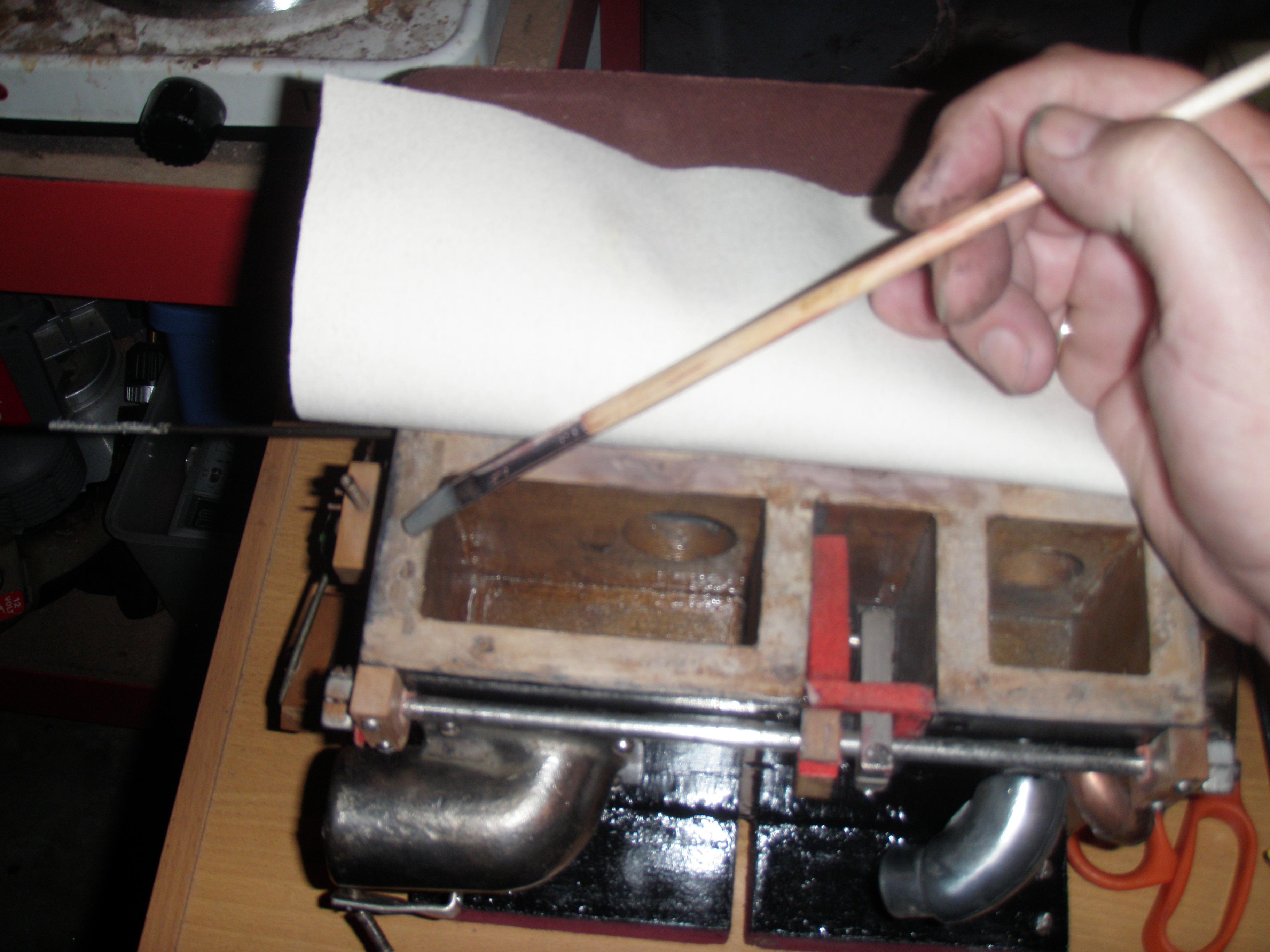
Pneumatics and pouches are the fine end of the same operation, and the trade convention — best documented in the closely related player-piano world — is specific and easy to get backwards. The new covering is a very thin, sealed-pore pneumatic / pouch leather (Vol 3 §2.2). A pouch is installed matte (flesh) side to the wood, because the glossy grain side will not take glue; the glossy face is domed over a coin or forming disc to shape the small dome, and the whole is set into the pouch well with liquid hide glue (Nola Piano). Liquid hide glue is the correct adhesive here for the conservation reason that it stays reversible: the next restorer, decades on, can release it with moisture and re-leather again without damaging the well. Figure 3-2 in Vol 3 shows the operation in section; the matte-side rule and the coin-forming step are repeated here only because they are the two details a first-time re-leatherer most often reverses.
7.4.3 Cleaning and re-pinning barrels
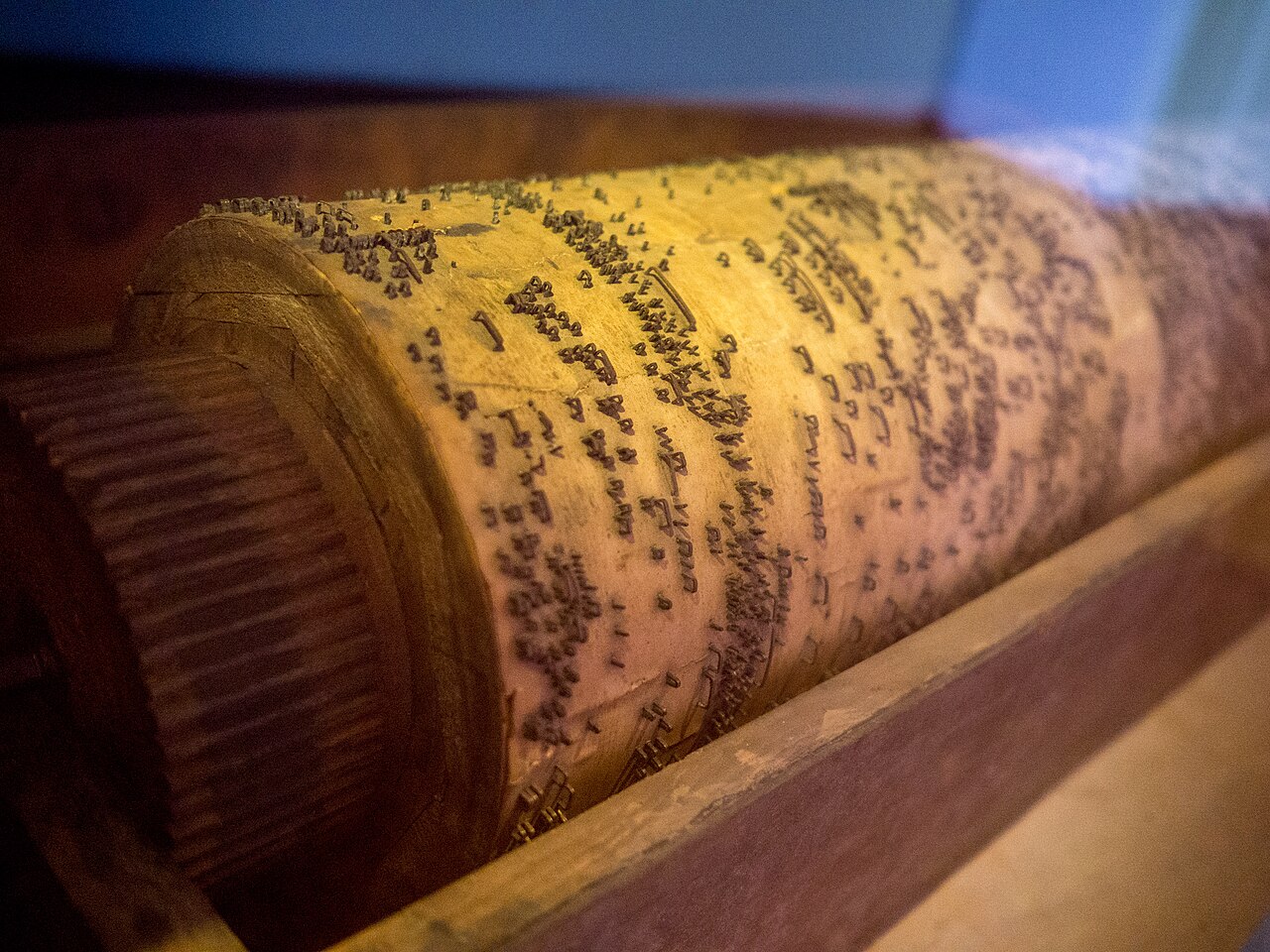
The barrel organ — the pinned-cylinder ancestor of the whole family — presents a restoration problem the crank organ does not: the musical arrangement itself is recorded in metal pins driven into a wooden barrel, and those pins are both the program and an irreplaceable historical document. Cleaning is the conservative operation: dust, old wax, and corrosion are removed from the pins and bridges with the gentlest effective method, working toward legibility of the arrangement rather than cosmetic brightness, and documenting the pin pattern photographically before any work (a barrel’s pinning is a musical score that exists in no other copy).
Re-pinning — driving new pins to replace lost or bent ones, or to restore a worn barrel — is far more invasive and sits at the replace end of the spectrum: every new pin is a modern intervention into an original document, and a mis-set pin is a wrong note pinned permanently into the instrument. The exact historic practice — pin alloy, diameter, driving depth, staggering, and the waxing or quilling of the bridges — is large-organ and antique-specialist territory, and the specific figures are marked (est.) here because they were not confirmed against a COAA or MBSI technical source for this dive. The conservation rule, however, is clear regardless of the numbers: photograph and map the original pinning exhaustively first, replace the minimum necessary, retain removed original pins where practical, and document every change — because an under-documented re-pin can silently rewrite the music the barrel was built to play.
7.4.4 Woodworm, cracks, and warping
Wood problems are the third great class of antique-organ repair, and each has a conservation-minded technique. The material science behind all of them — that wood moves because it is hygroscopic, that tangential movement is about twice radial (T/R ≈ 2), that all the damaging movement happens below the fibre saturation point (≈ 30 % MC), and that indoor organ wood lives at 6–12 % EMC — is owned by Vol 2 and is not re-derived here.
- Woodworm. Active infestation (fresh, pale frass and clean-edged flight holes) is treated first; then weakened timber is consolidated — a low-viscosity consolidant introduced to re-bind the honeycombed wood — rather than replaced wholesale, so the original member and its surface survive. Structural members eaten past load-bearing may need replacement, documented.
- Cracks. A crack is the record of past movement below the FSP. It is cleaned and, where structural, closed with a spline — a thin strip of matching wood let into a sawn kerf along the crack, grain aligned — or filled with a matching wood sliver, glued reversibly with hide glue on a conservation job. A crack that is stable and cosmetic is often best left, per minimal intervention.
- Warping and cupping. A cupped chest top or bellows board is a wind leak. Gentle re-humidification and clamping can coax a warped board back toward flat; where it will not hold, a repair may add a batten or replace the board in quartersawn stock, which moves about half as much across its width as the flat-sawn board that likely cupped in the first place (Vol 2 §4.4). Veneer patches repair local surface damage with matching veneer, again glued reversibly where the piece warrants it.
7.4.5 Choosing classic or modern in the repair
Every operation above forks on the same question the whole dive has asked: classic, reversible materials, or modern, convenient ones? The answer follows from where the instrument sits on the conserve-restore-replace spectrum of §7.2.4. An antique being returned toward museum condition takes the museum-grade recipe of §7.3 throughout — hide glue, like-for-like tawed or pneumatic leather, matching quartersawn wood, reversible finish — because its value is as a document and its future must stay open. A working hobby organ, or an antique a collection has consciously chosen to keep playing, may legitimately take the modern recipe where it serves — PVA, sheep leather or blackout cloth, stable plywood — provided the choice is deliberate and, where an irreversible material goes into an old instrument, documented. The material is never “right” in the abstract; it is right or wrong relative to what the instrument is for.
7.5 Reference apparatus — the consolidated tables
The four tables below gather the load-bearing numbers from Vols 2–6 into one place, consistent with the source volumes. Each is a summary; the owning volume carries the full treatment and the citations.
7.5.1 Adhesives (consistent with Vol 5)
Table 1 — 7.5.1 Adhesives (consistent with Vol 5)
| Adhesive | Era | Reversible? | Open time | Conservation-OK? | Primary use |
|---|---|---|---|---|---|
| Hot hide glue | classic | fully (heat + moisture) | ~1–2 min | yes | antique joinery; museum-grade restoration |
| Fish glue | classic | yes | long | yes | cold-set reversible classic joints |
| Liquid hide glue | classic-style | yes | long | yes | setting thin pouch / pneumatic leather |
| PVA / aliphatic | modern | no (creeps) | long | no | most of a working busker build (John Smith) |
| Contact cement (Copydex) | modern | no | flash-off, then instant | no | gluing blackout / bellows cloth |
| Epoxy | modern | no (permanent) | varies | no | stubborn metal / gap joints (overkill on a busker) |
| Hot-melt | modern | partly | very short | no | tacking, jigs, temporary holds |
| CA (cyanoacrylate) | modern | no (permanent) | instant | no | small non-porous spot repairs |
Hide glue is graded by gram strength (≈ 192 = the standard general-purpose furniture grade; higher gram = shorter open time); its ~1–2 min open time is at normal room temperature and RH, and it sets as it cools (Vol 5; Player-Care; Popular Woodworking; Tools for Working Wood). PVA set/cure times (~30 min / ~24 h) are general woodworking values (est.).
7.5.2 Leathers (consistent with Vol 3)
Table 2 — 7.5.2 Leathers (consistent with Vol 3)
| Leather | Where used | Tannage | Classic / modern |
|---|---|---|---|
| Thin sheep / lamb skin | bellows, reservoir folds & gussets | traditionally alum-tawed | classic |
| Pneumatic / pouch leather (African Hairsheep, CTL Tan) | pouches, pneumatics, flap valves | pore-sealed, tanned to spec | classic (trade standard) |
| Membrane leather < 0.5 mm | valve faces & flaps | hobby stock | classic-style |
| Kangaroo / kid | thin-and-strong special cases | ≈ 1 mm / < 3 oz (est.) | classic specialty |
| Alum-tawed (“white”) leather | conservation re-leather | aluminium salts (not tanned) | classic |
| Vegetable-tanned leather | older / antique coverings | plant tannins; prone to red rot | classic (problematic) |
| Chrome-tanned leather | general modern leather | chromium salts | modern |
| Blackout / bellows cloth | large / light-use bellows | rubberised coated fabric | modern (glue with Copydex) |
Alum-tawed is rot-resistant but moisture-sensitive / water-reversible; red rot is a vegetable-tan disease driven by sulfuric acid, worst in skins made c. 1850–1900; chrome is the modern general tannage (Vol 3; CCI Notes 8/2; Red rot wiki). Pouch leather installs matte side to the wood, liquid hide glue (Nola Piano).
7.5.3 Metal pipe alloys (consistent with Vol 4)
Table 3 — 7.5.3 Metal pipe alloys (consistent with Vol 4)
| Alloy / metal | Composition | Character / use | Column |
|---|---|---|---|
| Common metal | ≈ 30 % tin / 70 % lead | economy interior ranks; dull, soft | classic (antique/large-organ) |
| Spotted metal | ≈ 50/50 tin-lead (45–55 % Pb) | visible crystal “spots”; prized façade metal | classic |
| Plain / high-tin metal | ≈ 75 % tin / 25 % lead | bright, hard, ringing | classic |
| Antimonial lead | ≈ 94 % lead / 6 % antimony (est.) | lead stiffened with antimony, not tin | classic |
| Organ zinc | cold-rolled zinc sheet | bass pipes > ~4′ C; rolled & soldered | classic |
| Brass | Cu-Zn | pins, springs, reed tongues & freins, fittings | classic |
| Spring / piano (music) wire | tempered steel | reservoir & bellows springs (hobby 8 lb spring), tuning wires | classic → modern |
| Solder | soft tin-lead | metal-pipe seams | classic |
Metal pipes are the antique / large-organ side of the story: most busker and hobby organs voice on wooden (beech) pipes — pipe making is owned by the Building Organ Pipes dive (Vol 4; OHS works21; toff.org.uk; Fisk).
7.5.4 Wood movement (consistent with Vol 2)
Table 4 — 7.5.4 Wood movement (consistent with Vol 2)
| Property | Value | Consequence |
|---|---|---|
| Tangential / radial ratio (T/R) | ≈ 2 | tangential shrinkage ≈ twice radial |
| Flat-sawn vs quartersawn | quartersawn moves ~½ as much across width | quartersawn is the stable choice for chests, walls, soundboards |
| Fibre Saturation Point (FSP) | ≈ 30 % MC | all damaging movement happens below the FSP |
| Indoor EMC | 6–12 % (at RH ≈ 30–50 %) | where indoor organ wood lives and moves |
| Engineered stock | Baltic birch ply, MDF | cross-plies cancel movement; stable, cheap (modern default) |
Values from the Wood Database and Wagner/EMC references (Vol 2). The John Smith Universal’s case is ¼ in (≈ 6 mm) Baltic birch ply, pipe walls ⅛ in (≈ 3 mm), glued with PVA — kept identical across the dive.
Glossary
- Hide glue (hot) — animal-collagen glue applied hot, graded by gram strength; fully reversible with heat + moisture; hard/brittle bond; the classic organ/piano adhesive (Vol 5).
- Gram strength — grading of hide glue by gel strength; higher = stronger and tackier but shorter open time; ≈ 192 = standard furniture grade.
- Fish glue — cold-applied liquid animal glue; long open time; reversible; a classic alternative to hot hide glue.
- PVA / aliphatic — modern white/yellow “wood” glue; long open time, cheap, water cleanup; not practically reversible and won’t grip non-porous surfaces; John Smith’s recommended busker adhesive.
- Copydex — latex/rubber contact adhesive used to glue blackout cloth, which PVA will not hold.
- CA / epoxy / hot-melt — modern adhesives: instant on non-porous (CA), strongest and gap-filling but toxic (epoxy), soft and fast (hot-melt); all effectively irreversible.
- Alum-tawed (“tawed” / white) leather — skin worked with aluminium (alum) salts (not tanned); soft, white, rot-resistant but water-reversible / moisture-sensitive; the classic organ leather.
- Vegetable-tanned leather — tannin-tanned leather; prone to red rot, especially 1850–1900 acid-tanned skins.
- Red rot — degradation of vegetable-tanned leather to red powder when tannin meets sulfuric acid / high RH / SO₂; the classic “why old leather fails.”
- Pneumatic / pouch leather — very thin, pore-sealed sheepskin (Columbia African-Hairsheep “CTL Tan”) for pouches, pneumatics, and flap valves.
- Membrane leather — hobby valve/pouch leather thinner than 0.5 mm.
- Blackout cloth / bellows cloth — rubberised/coated fabric; the modern bellows-cover substitute for leather.
- Spotted metal — tin-lead pipe alloy ≈ 50/50 (45–55 % lead) with visible crystal “spots.”
- Common metal — pipe alloy ≈ 30 % tin / 70 % lead.
- Organ zinc — cold-rolled zinc sheet for large bass pipes (> ~4′ C).
- Quartersawn / flat-sawn — grain orientation; quartersawn moves ~half as much across its width (T/R ≈ 2) → the stable choice.
- EMC / FSP — Equilibrium Moisture Content (target 6–12 % indoors) / Fibre Saturation Point (≈ 30 %); below FSP, wood moves.
- Cyanoacrylate — the chemical name for CA / “superglue.”
- Baltic birch — void-free multi-ply birch plywood; the modern hobby case stock.
- Reversibility principle — the conservation rule to use nothing that cannot be easily and completely undone in light of future improved knowledge (Karp).
- Minimal intervention — do only as much as the object requires; leave sound material alone.
- Conserve / restore / replace — the spectrum from preserving original material as-is, to returning a part to function, to fitting a new part.
Spelling watch: tawed, alum-tawed, spotted metal, quartersawn, cyanoacrylate, Copydex, Baltic birch, Jäger & Brommer, Waldkirch.
7.6 Cross-index — topics to volumes and sibling dives
Table 5 — 7.7 Cross-index — topics to volumes and sibling dives
| Topic | This dive | Sibling dive |
|---|---|---|
| Reversibility, minimal intervention, documentation | Vol 7 §7.2 | — |
| Hide glue vs PVA; gram strength; open time | Vol 5; Vol 7 §7.5.1 | The John Smith Universal Organ (PVA build) |
| Which leather goes where; tannage; red rot | Vol 3; Vol 7 §7.5.2 | Wind Systems (bellows mechanics) |
| Re-leathering bellows | Vol 7 §7.4.1; Vol 3 | Wind Systems |
| Re-leathering pneumatics / pouches | Vol 7 §7.4.2; Vol 3 §2.5 | — |
| Cleaning & re-pinning barrels | Vol 7 §7.4.3 (est.) | — |
| Woodworm, cracks, warping; splines, veneer patches | Vol 7 §7.4.4; Vol 2 §4 | The Case, Façade & Figures |
| Wood movement (T/R, FSP, EMC); quartersawn vs flat-sawn | Vol 2; Vol 7 §7.5.4 | Building Organ Pipes (pipe wood) |
| Metal pipe alloys; spotted/common metal; zinc | Vol 4; Vol 7 §7.5.3 | Building Organ Pipes; How Organ Pipes Make Sound |
| Reed tongues, freins; springs; piano wire | Vol 4 | Tuning & Voicing |
| Finishes; reversibility of finish; RH/UV preservation | Vol 6 | The Case, Façade & Figures (decoration) |
| Wind pressure (~5 in H₂O ≈ 127 mm ≈ 1.245 kPa) | context only | Wind Systems |
| Scale names (20 = Frei/Raffin; 26 = Alderman); note ≠ pipe count | context only | The Hobby Crank Organ; The John Smith Universal Organ |
| Classic-vs-modern material palette (overview) | Vol 1 | The Hobby Crank Organ |
7.7 Bibliography
Restoration ethics.
- Conservation and restoration of musical instruments (Conservation-of-instruments wiki) — the reversibility principle (Karp), minimal intervention, documentation, and the conserve-vs-restore-vs-replace tension.
- Musical Box Society International (MBSI), About — the mechanical-music conservation body; with COAA (Carousel Organ Association of America) and AMICA (Automatic Musical Instrument Collectors’ Association) as sibling communities.
Adhesives.
- Player-Care, Hot Hide Glue Q&A (Craig Brougher) — hot hide glue’s reversibility (reheating and dampening reactivate the joint) and its hard, airtight bond. (The hard-brittle clean break and multi-century longevity are standard hide-glue and conservation properties — AIC WAG and the lutherie/woodworking literature — not specific to this page.)
- Popular Woodworking, A Quick Guide to Hot Hide Glue; Tools for Working Wood — gram strength (≈ 192 furniture grade), open time, higher gram = shorter open time.
- AIC Wooden Artifacts Group (Buck, 1990) — conservation-grade study of animal glues and reversibility.
- jsart125, Thomas N. Spehar, Glue Clues (melright.com/busker) — the hobby glue palette; John Smith’s PVA recommendation.
Leathers.
- Columbia Organ Leathers (columbiaorgan.com; player-care.com mirror) — African Hairsheep pneumatic leather, CTL Tan pore-sealing, kangaroo.
- Organ Supply Industries, Felt & Leather catalog — the organ-supply house stock.
- Nola Piano, Replacing Player Piano Pouches — matte-side-to-wood, liquid hide glue.
- CCI Notes 8/2; MFA Cameo; Popov Leather — alum-tawed leather (rot-resistant, moisture-sensitive).
- Red rot (Wikipedia; Conservation-Wiki) — vegetable-tan degradation, 1850–1900.
- jsart135, Melvyn Wright, Leather or Blackout Cloth? (melright.com/busker) — the classic-vs-modern bellows-covering comparison; Copydex on blackout cloth.
- hobbycrankorgan.com (en_31toets, en_materiaal, en_pijp) — sheep-leather bellows, membrane leather < 0.5 mm, 8 lb bellows spring, beech pipes.
Metals.
- Organ Historical Society, Pipe Materials (works21) — tin-lead alloys, zinc for basses.
- toff.org.uk, Pipe Metal; grokipedia, Organ pipe; C. B. Fisk, Some Thoughts on Pipe Metal — alloy ratios and their effect on tone and structure.
Woods.
- The Wood Database, Dimensional Shrinkage — T/R ≈ 2; quartersawn vs flat-sawn.
- Wagner Meters / PSU / Lignomat — EMC (6–12 % indoors), FSP (≈ 30 %).
Finishes & preservation.
- Vol 6 sources — shellac/French polish, oil, varnish, wax vs polyurethane/acrylic; RH/UV/SO₂ preservation.
7.8 Closing
This volume, and the dive it closes, has argued a single idea from seven directions: that the choice of material in a mechanical organ is never only a question of what works, but of what can be undone. A new hobby busker organ is correctly built with PVA, sheep leather or blackout cloth, and Baltic birch plywood, because it is built to be played and its builder — John Smith among them — values a forgiving, cheap, strong joint over a reversibility he will likely never need. An antique organ is correctly restored with hide glue, like-for-like tawed or pneumatic leather, matching quartersawn wood, and a reversible finish, because it is a document whose future must stay open to a restorer who will one day know more than the present one does. The reversibility principle, minimal intervention, and documentation are the three rules that keep that future open; the conserve-restore-replace spectrum is where the rules are applied; and the tables, glossary, and cross-index above are the bench reference that puts the right material in the right hand. Both traditions are legitimate. The craft is in knowing, deliberately and every time, which instrument is in front of you.
Comments (0)