Materials Construction And Restoration · Volume 6
Materials, Construction & Restoration — Vol 06: Finishes & Preservation
A mechanical organ is an assembly of hygroscopic, reactive materials — wood that breathes, leather that rots, metal that corrodes — held together by glue and sealed by a finish, and then, uniquely among cabinet instruments, carried out of doors to be played in a market square or on a fairground. Everything the earlier volumes described as a material property becomes, in service, a preservation problem: the wood movement of Vol 2, the leather chemistry of Vol 3, the metal alloys of Vol 4 and the glue lines of Vol 5 all degrade along the same few axes — moisture, heat, light and airborne pollution. This volume treats the last line of defence and the environment that tests it: what a finish actually does for the wood (and what it cannot do), the classic-vs-modern split between reversible and irreversible finishes, and the environmental preservation science that governs how each of the three material families ages. It closes with a practical storage-and-handling regime for a portable instrument that lives partly outside.
The organizing axis of the whole dive holds here as sharply as anywhere. A classic finish — shellac, a drying oil, a spirit or oil varnish, wax — is a comparatively thin, comparatively soft barrier that can be re-dissolved and removed; it is conservation-friendly precisely because it is reversible. A modern film finish — polyurethane, catalysed acrylic, some water-based coatings — is a tougher, more moisture-resistant, cross-linked plastic skin that, once cured, cannot be cleanly removed without abrading or chemically destroying it. Neither is “right.” A player’s working busker organ that gets rained on and manhandled wants durability; a museum-grade antique wants reversibility. This volume states the trade-off and the science behind it.
Two scope boundaries bound the volume. The decorative finish — colour, sheen, the Bauernmalerei show front, gilding, graining, French-polished show cases as an aesthetic — belongs to The Case, Façade & Figures (Dive 11); that dive owns the look. This volume owns the preservation science: a finish as a moisture barrier and a protective layer, and the environment it must survive. Where the two touch (a French polish is both a beautiful surface and a moisture retarder), this volume cites Dive 11 for the how-to and treats only the physics. And Vol 7 — Antique-Organ Restoration owns the ethics and technique of intervention; this volume supplies the preservation rationale that Vol 7 acts on.
6.1 What a finish actually does for the wood
Before cataloguing the finishes it is worth being exact about the job, because the popular intuition — that a finish “seals” wood and stops it moving — is wrong, and building a preservation regime on it leads to cracked cases and sprung joints.
6.1.1 A finish raises the moisture barrier; it does not stop the exchange
Wood is hygroscopic. As Vol 2 established, a piece of wood is dimensionally stable only when its moisture content (MC) equals the ambient equilibrium moisture content (EMC) set by the surrounding relative humidity (RH) and temperature; below the fibre saturation point (FSP ≈ 30 % MC) every change in EMC is a change in dimension (Wagner/EMC). Indoor woodwork settles at EMC ≈ 6–12 % across an indoor RH of roughly 30–50 % (Wagner/EMC).
A finish does not change that equilibrium — it changes the rate at which the wood approaches it. A film or a saturated surface increases the diffusion resistance of the wood’s outer boundary, so a short-term swing in ambient RH (a damp evening, a heated hall) is slowed at the surface and may pass before the core of the timber ever “feels” it. Over a long, steady change of season the wood still reaches the new EMC, and still moves the full amount Vol 2’s tangential and radial figures predict (T/R ≈ 2; Wood Database). The correct mental model is a retarder, not a seal: the finish flattens the peaks of the RH curve and buys time, which is exactly what protects glue lines and pipe walls from the fast transients, but it cannot repeal the wood’s response to a sustained climate. This is why environmental control (§3) does the heavy lifting and the finish is the second line of defence, not the first.
The effectiveness varies enormously by finish type and, above all, by film completeness. A finish is only a moisture retarder where it is continuous and on every face; an organ case sealed on the show side but left raw inside the windchest cavity and on the panel backs will still take up and give off moisture through the unfinished faces, and — worse — will do so unevenly across the two faces of a panel, which is itself a cause of cupping. Classic practice’s habit of finishing show surfaces only is an aesthetic choice with a preservation cost that Vol 2’s movement science makes explicit.
Note — the finish/movement tie to Vol 2. A finish raises the barrier to EMC swings; it does not remove the swing. Design for movement first (quartersawn, grain-oriented, floating panels — Vol 2), then finish to slow the transients. A finish is never a substitute for correct wood selection and joinery.
6.1.2 Protection against handling, abrasion and UV
Beyond moisture, a finish is a wear layer and a light filter:
- Handling and abrasion. A busker organ is carried, set on trestles, knocked by an audience and packed into a vehicle. A finish takes the scuffs, sweat, spills and grime that would otherwise soil and swell the raw wood, and — on a film finish especially — can be cleaned. Bare wood absorbs hand oils and dirt and cannot be wiped clean.
- Ultraviolet light. Sunlight’s UV component photo-degrades both the wood’s lignin (greying, surface checking) and many finishes and colourants. Some finishes filter UV better than others; oil-based films and shellac absorb part of the near-UV, while clear water-based acrylics historically passed more UV unless a specific absorber is added (est., general coatings knowledge). Because a crank organ is played in direct sun, UV protection is a real preservation criterion, not a cosmetic one — and it is treated again under environment (§3.3).
- Consolidation of the surface. On soft show woods and on the balsa/basswood or beech pipe woods of the hobby corpus (Vol 2), a finish stiffens and toughens a fragile surface, resisting dings that would otherwise dent an unfinished pipe mouth or moulding.
6.1.3 Reversibility — the conservation axis
The property that matters most to a restorer is whether the finish can be removed without harming the wood or the tool-marks under it. This is the same reversibility principle that governs glue choice in Vol 5 and restoration ethics in Vol 7: a conservator prefers materials that a future, better-informed worker can easily and completely undo. A finish that must be sanded off takes original surface — and history — with it. Reversibility sorts the whole finish palette into two columns, and §2 is organised around exactly that split.
6.2 The finish palette — classic vs modern
The finishes fall into two families along the reversibility axis. The classic family is thin, repairable, and soluble in a benign solvent; the modern family is a tough cured film that resists moisture and abrasion better but resists removal just as well.
6.2.1 Classic, reversible finishes
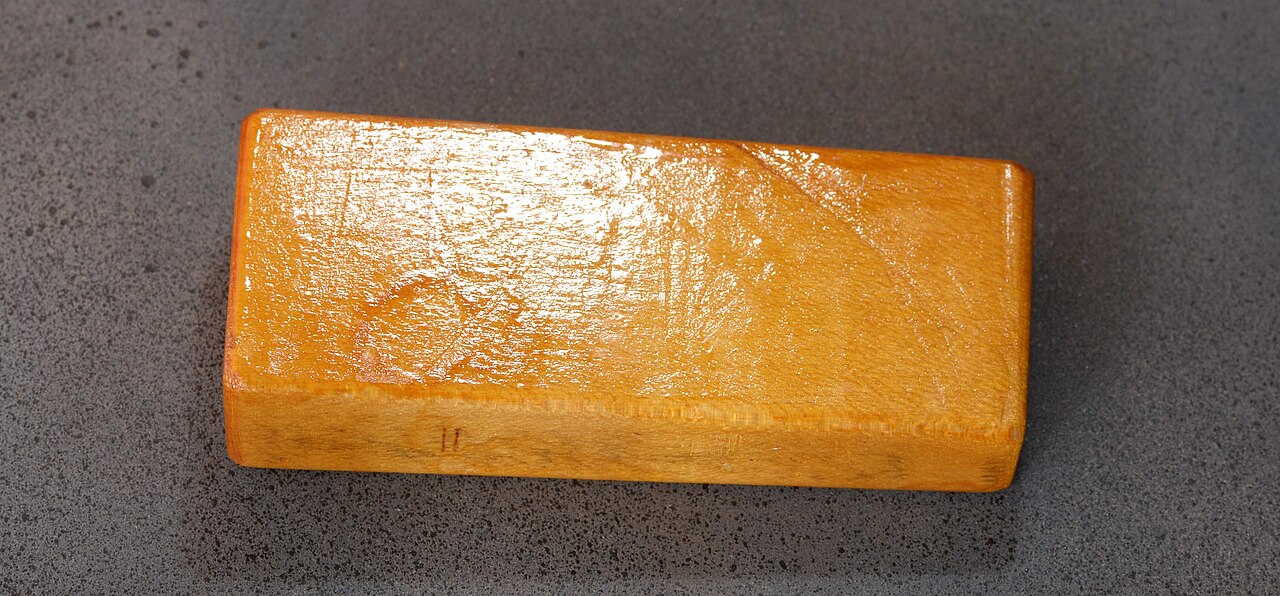
- Shellac and French polish. A spirit finish: shellac resin (a secretion of the lac insect) dissolved in ethanol, built either as brushed/padded coats or, in its highest form, as French polish — many thin pad-applied layers lubricated with a trace of oil. Shellac is the archetypal reversible finish: it re-dissolves in its own solvent (alcohol), so a scratch can be spirited-in and blended invisibly, and the whole film can be removed with alcohol without attacking the wood. It is a modest moisture retarder — better than wax or bare oil, less than a thick varnish or polyurethane — and it is not water- or alcohol-proof (a wet glass rings it, spirits soften it). Its reparability and reversibility, not its toughness, are why it is the conservator’s default show finish. (Decorative build-up: The Case, Façade & Figures.)
- Drying oils — linseed and tung. Boiled linseed oil and tung oil are penetrating finishes that cure in the wood by oxidative polymerisation rather than sitting on it as a thick film. They give a low-build, easily renewed, in-the-wood protection: modest moisture resistance, very easy to refresh (wipe on another coat), and effectively reversible in the sense that they add little removable film. Tung is more water-resistant and cures harder than linseed (est., general finishing knowledge). They are the traditional choice where a natural, repairable surface is wanted over a hard shell.
- Spirit and oil varnishes. Traditional varnishes are natural resins (copal, dammar, rosin, sandarac) either dissolved in a spirit (spirit varnish, akin to shellac in reversibility) or cooked into a drying oil (oil varnish, tougher and more water-resistant but slower and softer than modern synthetics). Oil varnishes build a real protective film with good moisture resistance; their reversibility is intermediate — softer and more solvent-responsive than polyurethane, harder to remove than shellac.
- Wax. Beeswax and carnauba pastes are the least protective and the most reversible finish: a thin sacrificial layer that adds sheen and a slight water bead, wipes off with a mild solvent or fresh wax, and offers almost no structural moisture barrier. Wax’s role is a maintenance top-coat over shellac or bare wood and as a barrier for metal (see §3.4), not a primary wood seal.
6.2.2 Modern, effectively irreversible finishes
- Polyurethane. A cured synthetic film — oil-modified (wiping/brushing) or two-part — that cross-links into a tough, water- and abrasion-resistant plastic skin. It is the best durability and moisture barrier of the common finishes and the correct choice for a hard-used working organ’s exterior. Its conservation cost is that, once cured, it is effectively irreversible: it does not re-dissolve in a benign solvent, so removal means aggressive stripping or sanding that takes surface and tool-marks with it. A polyurethane scratch also cannot be spirited-in and blended the way a shellac scratch can — it is repaired by re-coating an area or the whole surface.
- Acrylic (solvent and catalysed). Acrylic lacquers and catalysed acrylics form clear, stable, non-yellowing films. Solvent acrylics remain somewhat solvent-responsive (a partial reversibility, useful in conservation coatings), but catalysed/cross-linked acrylics behave like polyurethane — a permanent film. Clear acrylics historically passed more UV unless an absorber is included (est.), a point that matters for an instrument used in sun.
- Water-based finishes. Water-borne acrylic/polyurethane dispersions cure to a clear, low-odour, low-yellowing film. They are convenient and comparatively benign to apply, give a moderate-to-good moisture barrier once cured, and — being cross-linked films — are, like their solvent cousins, not readily reversible. Their water carrier also raises the grain and can wet a delicate substrate on application, a handling caution rather than a preservation one.
6.2.3 Finish-family table
The following table ranks the palette on the four preservation criteria that matter — reversibility, physical protection, moisture-barrier strength, and conservation acceptability. Rankings are relative and qualitative; where a value is not from a cited source it is marked (est.).
Table 1 — 2.3 Finish-family table
| Finish | Era | Reversible? | Physical protection | Moisture barrier | Conservation-OK? |
|---|---|---|---|---|---|
| Shellac / French polish | Classic | Yes — alcohol (est.) | Low–moderate | Moderate | Yes (preferred show finish) |
| Drying oil (linseed/tung) | Classic | Effectively — low film (est.) | Low (in-wood) | Low–moderate | Yes |
| Spirit varnish | Classic | Yes — spirit (est.) | Moderate | Moderate | Yes |
| Oil varnish | Classic | Partial (est.) | Moderate–high | Good | Usually |
| Wax (beeswax/carnauba) | Classic | Yes — solvent/fresh wax (est.) | Very low | Very low | Yes (top-coat) |
| Polyurethane | Modern | No — cured film | High | High | No (irreversible) |
| Acrylic (catalysed) | Modern | No — cross-linked (est.) | High | High | No |
| Acrylic (solvent lacquer) | Modern | Partial — solvent (est.) | Moderate–high | Good | Sometimes (coatings) |
| Water-based acrylic/PU | Modern | No — cured film (est.) | Moderate–high | Moderate–good | No |
The pattern is the whole teaching point of the volume: protection and irreversibility rise together. The tougher and more moisture-proof the finish, the harder it is to undo. A restorer weighs a working organ’s need for durability against an antique’s need for reversibility, exactly as Vol 5 weighs PVA against hide glue — and the same instrument may honestly carry different answers on different parts (a polyurethaned base that takes the knocks, a shellacked show front that a future hand can repair).
6.2.4 Figure — the finish-family map
Figure 6.1 — The finish palette on two axes. The classic family (shellac, drying oils, spirit/oil varnish, wax) clusters toward high reversibility and low-to-moderate protection; the modern films (polyurethane, catalysed acrylic, water-based coatings) cluster toward high protection and low reversibility. The dashed trend captures the volume’s headline: you buy durability with irreversibility.
6.3 Environmental preservation — the four agents against the three materials
A finish is one defence; the environment is the assault, and it is more decisive than any finish. Four environmental agents — relative humidity, temperature, light/UV, and airborne pollution — attack the three material families the earlier volumes described. The controlling insight is that the same few variables drive wood movement (Vol 2), leather red rot (Vol 3) and metal corrosion (Vol 4) at once, so a single environmental regime protects all three, and a single lapse (a damp shed, a sunny window, a sulphurous city) harms all three together.
6.3.1 Relative humidity — the master variable
RH is the single most important environmental control for a mechanical organ because it drives the two worst failure modes at once: wood movement and leather degradation.
- On wood (Vol 2). Every change in RH changes the EMC and therefore the dimensions of every wooden part below FSP. Swings are worse than any steady value — a case that cycles wet-dry-wet racks its joints, splits panels, unseats pipes and cracks glue lines by fatigue, whereas the same wood held at a steady (even imperfect) RH simply sits. The preservation goal is therefore stability first, target value second.
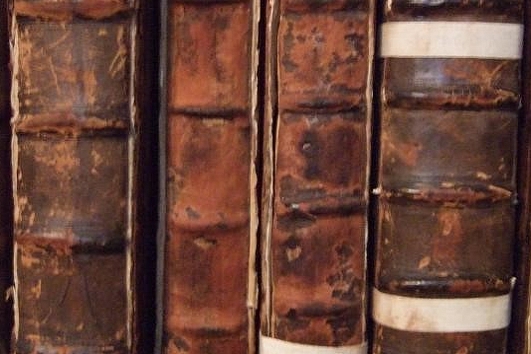
- On leather (Vol 3). High RH and heat accelerate red rot — the acid hydrolysis of vegetable-tanned leather into red powder, driven by residual sulfuric acid and worsened by SO₂ pollution (Red rot wiki). High RH also promotes mould on any leather and swells and stiffens the bellows and pouch skins; very low RH desiccates and embrittles them. Alum-tawed skins (Vol 3), though rot-resistant, are moisture-sensitive and water-reversible — high RH is specifically bad for them (CCI 8/2).
- On glue (Vol 5). Hide glue is reactivated by heat and moisture, so a sustained damp environment can soften and creep a hide-glue joint; PVA is less moisture-sensitive once cured but can cold-creep under load in the heat.
A stable band of roughly RH 40–55 % (est.) is a defensible compromise: dry enough to slow red rot and mould, damp enough to keep leather supple and avoid desiccation cracking, and — crucially — held stable so the wood is not cycled. Museum practice commonly targets a comparable mid-range with tight tolerance rather than a specific magic number; the exact band here is marked (est.) as it is a reasoned compromise across the three materials rather than a single cited value. What is not estimated is the direction of the science: swings are the enemy, and the mid-40s-to-mid-50s % RH range keeps all three families out of their worst regimes.
Warning — the cycling trap. A cheap shed or garage that runs 30 % RH in a dry winter week and 80 % RH in a wet one is worse than a steady 60 % RH, even though 60 % is “too high,” because it is the amplitude of the swing that fatigues wood joints and glue lines (Vol 2). Stabilise first; optimise second.
6.3.2 Temperature
Temperature acts on preservation in three ways. First, at fixed absolute humidity, temperature and RH move inversely — heat a cold damp room and RH falls, which is why an organ carried from a cold van into a heated hall sees a fast RH drop and a moisture transient at its surface. Second, heat accelerates chemistry: red-rot hydrolysis and most degradation reactions roughly speed up with temperature, so a hot attic ages leather and finish faster than a cool room (Red rot wiki; general kinetics, est.). Third, extremes soften or embrittle materials — heat softens wax and hide glue and can slump a soft finish; cold embrittles leather and finish films and makes them prone to cracking on handling. A stable, moderate temperature — roughly 15–22 °C (est.) for storage, avoiding attics and unheated vehicles left in sun or frost — supports the RH target and slows the chemistry. As with RH, stability matters more than the exact figure.
6.3.3 Light and UV
Ultraviolet and strong visible light photo-degrade organic materials across the board: wood lignin greys and surface-checks, leather dyes and finishes fade and embrittle, and many finish films chalk and lose adhesion. A crank organ is designed to be played in the open, so its show surfaces take direct sun in service — an unavoidable exposure that makes UV a genuine preservation concern. The mitigations are behavioural and material: store and transport covered and out of direct sun; in service, avoid leaving the instrument standing in full sun between performances; and, where a finish is being renewed on a hard-used organ, prefer a film with UV resistance or an added UV absorber over a clear coating that passes UV (est.). Light damage is cumulative and irreversible — a faded, checked surface cannot be un-faded — so the cheapest protection is simply keeping the instrument covered whenever it is not being played.
6.3.4 Atmospheric pollution — SO₂ and the acids
Airborne pollution, historically sulphur dioxide (SO₂) from coal and traffic and its acid products, is the classic “invisible” agent and it attacks all three families:
- Leather. SO₂ is absorbed by vegetable-tanned leather and oxidised to sulfuric acid in situ, which is precisely the acid that drives red rot — urban, industrial-era atmospheres are a documented accelerant of leather decay (Red rot wiki). This is one of the strongest reasons to store an antique organ’s leather-bearing parts in clean, filtered air rather than an open urban shed.
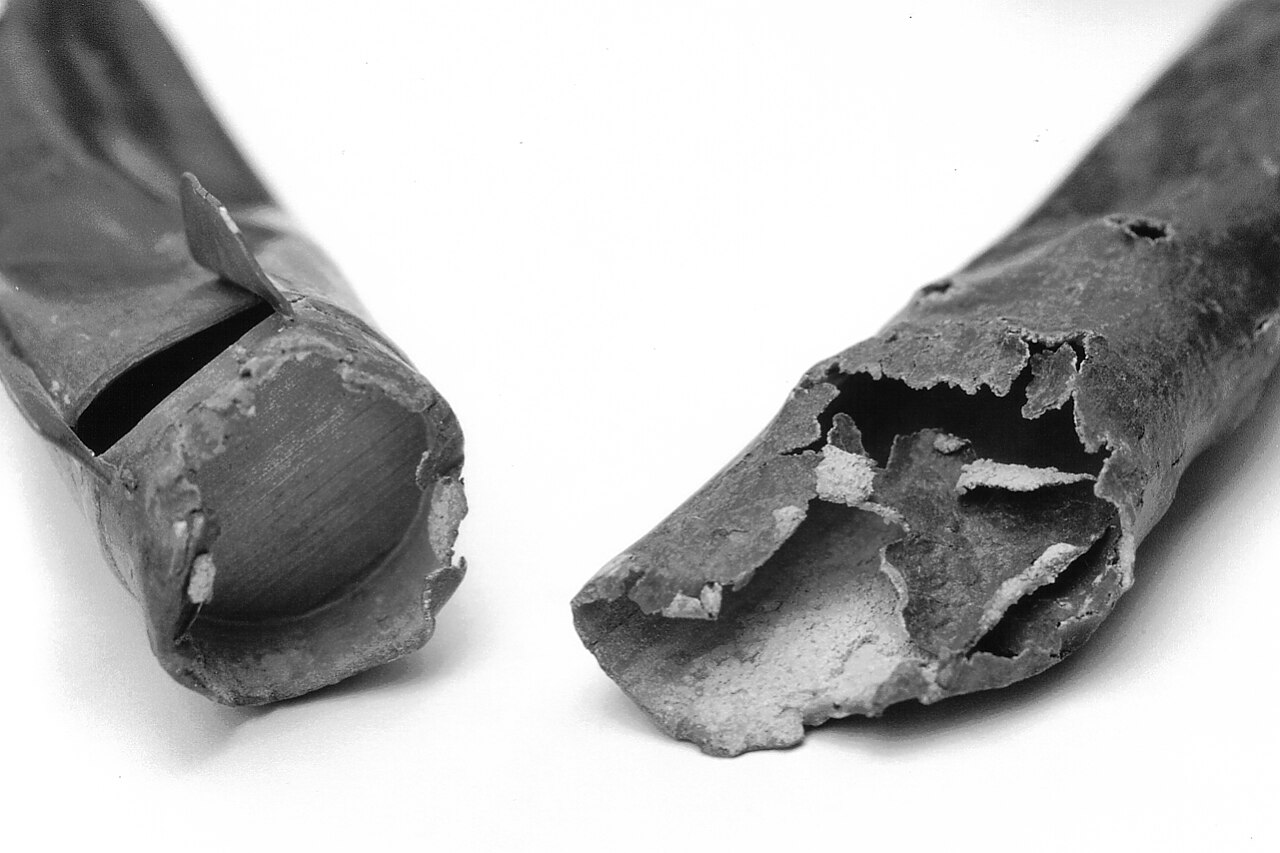
- Metal (Vol 4). Acidic and sulphur-bearing atmospheres corrode the tin-lead pipe alloys and the brass and steel fittings. Lead is especially vulnerable to organic acids (acetic and formic vapours from oak, some woods, and certain finishes and adhesives in a closed case), forming a white lead-carbonate/lead- acetate corrosion that can consume a lead-rich pipe — a real hazard for the spotted-metal (≈50/50) and common-metal (≈30/70 tin-lead) pipes of Vol 4 stored in a sealed oak cabinet. Tin pest — the low-temperature allotropic crumbling of tin to grey powder — is a further, temperature-driven metal risk on high-tin pipes, though it is slow and rare in practice for these alloys and is flagged here as the metal analogue of the organic decays (est., cross-ref Vol 4).
- Wood and finish. Acid pollution dulls and degrades finishes and, with moisture, contributes to surface deterioration.
The practical corollary: store in clean, stable, filtered air where possible, and never seal lead-bearing metal pipes in a closed case built or lined with materials that off-gas organic acids (oak, some adhesives, some finishes while curing) — a specific corrosion trap that ties Vol 4’s alloys to Vol 5’s glues and this volume’s finishes.
6.3.5 Figure — environment against the three material families
Figure 6.2 — The environment-versus-materials matrix. Shaded cells mark the worst pairings: unstable/high RH against wood movement and against leather red rot, heat against leather chemistry, and SO₂/pollution against both leather (as in-situ sulfuric acid) and lead-tin metal. A single stable, cool, clean, shaded environment protects all three families at once; a single bad store harms all three together.
6.3.6 Environment → damage table
Table 2 — 3.6 Environment → damage table
| Agent | Wood (Vol 2) | Leather (Vol 3) | Metal (Vol 4) |
|---|---|---|---|
| High / unstable RH | Movement, cupping, cracks, racked joints, crept glue lines | Red rot + mould accelerated; skins swell/stiffen; tawed skins moisture-sensitive | Corrosion in presence of acids/salts |
| Heat | Drops RH (transient); softens hide glue/wax; can slump soft finish | Speeds red-rot hydrolysis; desiccates and embrittles | Accelerates all corrosion chemistry |
| UV / light | Greys lignin; surface checks; finish chalks/fades | Fades dyes; embrittles leather and finish | Little direct; degrades any finish on metal |
| SO₂ / pollution | Acid dulls and degrades finish; with moisture, surface decay | Oxidised to H₂SO₄ in situ → primary red-rot driver (Red rot wiki) | Corrodes tin-lead pipes; organic acids attack lead (est., Vol 4) |
6.4 Storage, handling and a practical preservation regime
A mechanical organ is unusual among cabinet instruments in that it is designed to leave the house: it is carried, transported, set up outdoors, played in sun and weather, then packed away. Its preservation regime therefore has two halves — how it is stored between outings, and how it is handled and acclimatised around a performance.
6.4.1 Storage between outings
- Stable climate first. Store in a heated, occupied space, not an unheated shed, garage, attic or cellar. The aim is a stable RH ~40–55 % (est.) and a moderate, steady temperature ~15–22 °C (est.) — the values from §3, chosen to keep wood from cycling and leather from both rot (too damp/warm) and desiccation (too dry). Stability beats any specific number.
- Out of damp and off cold floors. Keep the instrument off a concrete floor and away from external walls where local RH runs high; a cellar or unheated garage is the classic red-rot and mould incubator (§3.1, §3.4).
- Covered, in the dark. A breathable dust cover keeps light off the finish and leather (UV fade, §3.3) and dust out of the pipework, while allowing slow moisture exchange rather than trapping condensation. Avoid a sealed impermeable wrap, which can trap moisture against the wood and metal and — if the case or wrap off-gasses organic acids — accelerate lead corrosion (§3.4).
- Clean air around the metal and leather. Where an antique’s leather and lead-bearing pipes are stored, prefer clean, filtered air and avoid enclosing them with oak or freshly finished/glued materials that off-gas acids (§3.4, cross-ref Vol 4 and Vol 5).
- Mind the springs and leather under load. Bellows and reservoir springs (the hobby 8 lb spring and the steel/piano-wire springs of Vol 4) hold the leather under tension in storage; long storage under load, in poor climate, is where bellows leather sets, cracks or red-rots. Long-term storage benefits from relieving spring load where the design allows (est.).
6.4.2 Handling, transport and seasonal acclimatisation
- Transport cushioned and shaded. Carry the organ padded against knocks (the finish is the wear layer, §1.2) and out of direct sun in a vehicle, which can reach oven temperatures that soften finish and wax, dry and crack leather, and spike the internal RH swing on unloading (§3.2).
- Acclimatise across climate boundaries. The sharpest moisture transients come from moving the instrument between very different climates — a cold damp van to a hot dry hall, or an air-conditioned room to a humid outdoor square. Allow the organ to sit, covered, and approach the new climate gradually before hard play, so the surface transient (which the finish slows, §1.1) passes without shocking glue lines and tuning. Seasonal changes deserve the same patience: an organ brought out for a summer season should be re-acclimatised rather than forced.
- Out of sun and rain in service. Between performances, keep the instrument shaded and covered; do not leave it standing in full sun (UV and heat, §3.3) or exposed to rain and dew, which drive the RH swings and wet the leather and metal directly. A canopy or the cover, and a dry night’s storage, close the day’s exposure.
- Wipe, do not soak, and re-wax. Clean the finished surfaces by wiping, not wetting; renew a wax top-coat periodically as a cheap, reversible refresh of the moisture and handling barrier (§2.1). Address a finish nick promptly on a working organ to keep the barrier continuous (§1.1).
6.4.3 The regime in one paragraph
The preservation of a mechanical organ reduces to a short, cheap discipline justified by the whole earlier science: keep it stable, cool, dry-ish, dark, clean and covered between outings (RH ~40–55 %, ~15–22 °C, both est. and both steady), off damp floors and out of sheds; acclimatise it gradually across climate boundaries so the wood is not cycled and the surface transients pass; keep it shaded, covered and dry in service so UV, heat and rain do not do in a season what a good store prevents in a decade; and keep the metal and leather in clean air, never sealed up with acid-off-gassing materials. The finish is the last line of defence, not the first — a reversible classic finish on the parts a future restorer must repair, a durable modern film where a working organ takes its knocks, and, above all, an environment that never lets any of the three material families reach its worst regime.
6.5 Cross-references
- Vol 2 — Woods. The EMC/FSP and T/R ≈ 2 movement science this volume’s moisture-barrier argument rests on; a finish retards but does not repeal it.
- Vol 3 — Leathers & Flexibles. Red rot, tannage (veg-tan vulnerable, alum-tawed rot-resistant but moisture-sensitive) and the bellows/pouch skins whose degradation §3 accelerates.
- Vol 4 — Metals & Fasteners. The tin-lead pipe alloys (spotted ≈50/50, common ≈30/70), brass and steel whose corrosion §3.4 drives; the tin-pest note.
- Vol 5 — Glues & Adhesives. The reversibility axis shared with finishes; hide glue’s heat/moisture sensitivity under §3’s climate.
- Vol 7 — Antique-Organ Restoration. Owns the ethics and technique of intervention this volume’s preservation rationale feeds.
- The Case, Façade & Figures (Dive 11). Owns the decorative finish how-to (colour, sheen, gilding, French-polish build-up as an aesthetic); this volume owns the preservation science.
Sources
- Wood Database — Dimensional Shrinkage (T/R ≈ 2, quartersawn stability): the wood-movement basis for the finish-as-retarder argument (Wood Database).
- Wagner Meters / EMC references — hygroscopicity, FSP ≈ 30 %, indoor EMC 6–12 % (Wagner/EMC).
- Red rot (Wikipedia) and Conservation-Wiki — vegetable-tan degradation, in-situ sulfuric acid, SO₂/RH/heat acceleration (Red rot wiki).
- CCI Notes 8/2 — care of alum, vegetable and mineral leathers; moisture sensitivity of tawed skins (CCI 8/2).
- OHS Pipe Materials (works21) — tin-lead pipe alloys and their behaviour, the metal-corrosion cross-reference (OHS works21).
- General finishing and coatings knowledge for finish-specific moisture, reversibility and UV behaviour is marked (est.) where not from a cited page; the RH ~40–55 % and ~15–22 °C storage bands are reasoned compromises across the three material families and are marked (est.).
Comments (0)