Materials Construction And Restoration · Volume 2
Materials, Construction & Restoration — Vol 02: Woods
Wood is the substance a mechanical organ is mostly made of, and it is also the substance that fights back. Everything else in the palette — leather, metal, glue, finish — is chosen partly to work with the wood, and the biggest single reason an old organ cracks, leaks, goes out of tune or jams is that its wood has moved. This volume treats wood as a material: where it goes in a small hand-cranked busker/street organ (20–31 note) and in the antiques it descends from, which species are used for the case and which for the pipes, and — the engineer’s core of the volume — the moisture-and-movement science that decides whether a joint stays airtight or splits.
The organizing axis for the whole dive holds here: classic vs modern. Classic organ practice is solid, quartersawn, grain-oriented timber, hide-glued so it can move and be un-made again. Modern hobby practice — the John Smith Universal busker and the amateur builds documented at hobbycrankorgan.com — leans hard on engineered sheet stock (Baltic birch plywood, MDF, composites) that is dimensionally stable, cheap and available, glued with PVA. Neither is “right”; they answer different questions. This volume states the trade-off and gives the numbers behind it.
Two cross-references bound the scope. Pipe making — how a wooden flue pipe is cut, mitred and voiced — belongs to Building Organ Pipes; this volume covers only the pipe wood as a material. Case decoration — carving, painting, gilding, the Bauernmalerei show front — belongs to The Case, Façade & Figures (Dive 11); this volume covers only the case wood as a structural material. Glues are Vol 5 and finishes are Vol 6; both are named here only where the wood forces the choice.
2.1 Where wood goes in a mechanical organ
Before the species and the movement science, it helps to fix the roles wood plays. A small crank organ uses wood in four load-bearing ways, and the requirements differ enough that the same board is rarely right for two of them.
- The case / body — the box that carries everything, resists the crank and bellows loads, and (on the show side) is the decorated façade. It wants stiffness, dimensional stability, and a good glue and finish surface. Movement here racks joints and opens seams.
- The windchest and structural internals — the chest that holds wind under pressure, the pallet box, the keyframe, the bearing blocks. These must stay flat and airtight under a standing pressure of about 5 in H₂O (127 mm ≈ 1.245 kPa) (see Wind Systems for the pressure itself). A chest top that cups or a split in a chest wall is a wind leak and a wrong-note.
- The pipe walls and blocks — for the many wooden pipes of a hobby organ, the wood is an acoustic boundary and an airtight box at once. It must be stable, fine-grained, and hold a crisp mouth edge.
- Trim, fronts and show parts — the decorative pipe fronts, mouldings and carved scroll. Here appearance leads, and modern builds freely mix a hardwood show face over an engineered substrate.
Each role reappears below with its classic and modern material.
2.2 Case and body woods
2.2.1 Classic solids
Historic organ cases and the structural carcase of antique barrel and fair organs are solid timber, chosen for stiffness, workability and looks:
- Softwoods — spruce, pine, fir. The traditional carcase and internal timber. Straight-grained, light, stiff for their weight, easy to work and glue. European spruce and pine are the classic choice for chests, wind trunks and the hidden structure, exactly as in larger pipe-organ practice. Their low density keeps a portable organ light.
- Beech. A dense, hard, close-grained, near-featureless hardwood — the workhorse hardwood of European organ building. It machines cleanly, holds an edge and a screw, and is dimensionally well-behaved once seasoned. Beech turns up throughout the hobby corpus as well (see §3).
- Mahogany. A stable, moderately dense hardwood prized because it moves relatively little and finishes beautifully — traditional for show cases and better-grade internal parts.
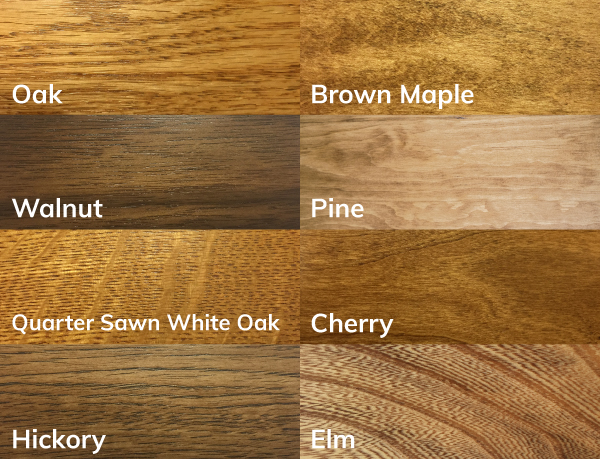
- Walnut. A dense, strong, handsome hardwood used for show parts and, on the John Smith Universal, the pipe fronts (JS Universal). Decorative first, structural second.
Density and typical movement figures for these are collected in the table in §6 (Wood Database).
2.2.2 Modern sheet stock
The defining modern move — and the reason a first-time builder can produce an airtight organ — is to build the case and much of the structure from engineered sheet stock instead of solid wood. The John Smith Universal is the canonical worked example: case of ¼ in (nominal 6 mm) Baltic birch plywood, pipe walls of ⅛ in (nominal 3 mm) Baltic ply, glued with PVA (JS Universal).
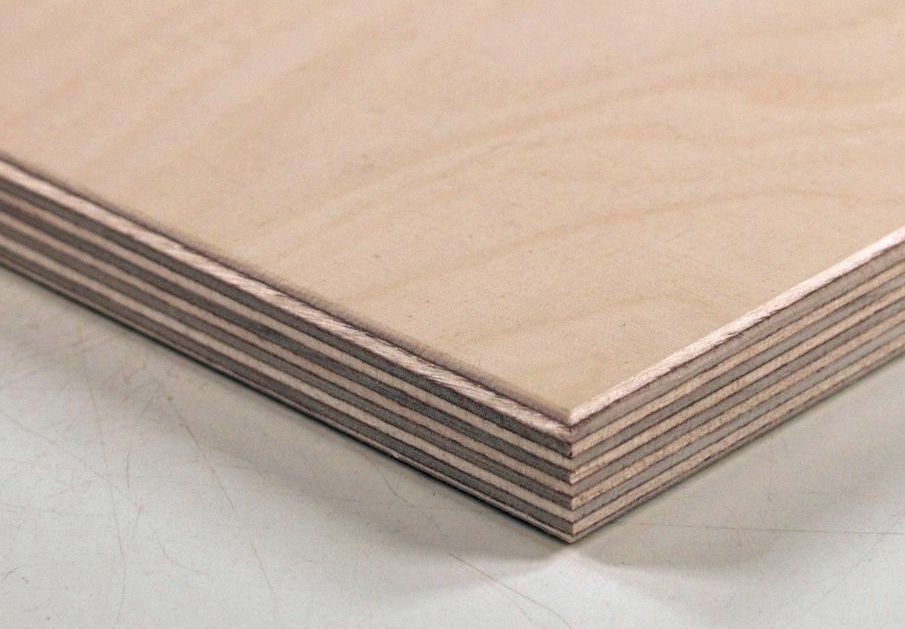
- Baltic birch plywood. Multi-ply birch with thin, void-free plies and no gaps in the core — far more uniform than construction plywood. Because alternate plies run at right angles, the wood movement of one layer is largely cancelled by its neighbours (§4.4), so a Baltic birch panel stays flat and holds its dimensions across humidity swings that would cup a solid board. It is stiff, strong for its weight, takes a screw or a glued joint on the face, and its clean laminated edge is itself a decorative motif on many hobby organs. This is the default case and chest material of the modern busker build.
- “Concrete plywood” (concrete-form / shuttering ply). A phenolic-faced, exterior-glued plywood made for casting concrete formwork. Its draw for organ builders is a hard, sealed, water-resistant face and a fully weatherproof glue line — useful for a street organ that lives outdoors and for wind-carrying parts where a slick, sealed internal surface is welcome. Heavier and less refined than Baltic birch, it is chosen for toughness, not looks.
- MDF (medium-density fibreboard). A homogeneous, grain-free board of resin-bonded wood fibre. It has no grain direction at all, so it carves, routs and profiles cleanly in any orientation and takes crisp detail — which is why it is a favourite for carved scroll, mouldings and decorative fronts that will be painted (cross-ref The Case, Façade & Figures for the decoration itself). Its weaknesses are real: it is heavy, it has little screw-holding strength in the edge, and it swells badly and irreversibly if it ever gets wet, so it is a show / interior-detail material, not a structural or exposed one.
- Composites and modern boards. Builders also reach for hardwood-veneered MDF or ply (a real wood face over a stable core, the best of both for show panels), and occasional plastics and aluminium where a part need not be wood at all (cross-ref Vol 4, Metals & Fasteners).
2.2.3 The engineered-vs-solid trade-off, stated
The choice between §2.1 and §2.2 is the same trade-off that runs through the whole dive, in its wood form:
Table 1 — dive, in its wood form
| Solid timber (classic) | Sheet stock — ply / MDF (modern) | |
|---|---|---|
| Dimensional stability | Moves with humidity; must be quartersawn and grain-oriented (§4) | Stable; cross-plies cancel movement (ply) or no grain at all (MDF) |
| Cost & availability | Good clear quartersawn stock is dear and getting scarce | Cheap, uniform, available in large flat panels |
| Skill needed | Grain reading, seasoning, movement allowances | Cut a flat panel to size and glue it |
| Authenticity | Correct for an antique restoration | Correct for a modern hobby build; anachronistic on an antique |
| Reversibility / repair | Hide-glued solid wood is repairable and reversible (Vol 5) | Damaged ply/MDF is usually replaced, not repaired; edges don’t take fresh joinery well |
| Weight | Softwoods light; hardwoods heavier | Ply moderate; MDF heavy |
The short version: stability and cost favour sheet stock; authenticity and reversibility favour solid wood. A player’s working busker organ is entirely right to be Baltic-birch-and-PVA; a museum-grade restoration of a Waldkirch fair organ is entirely wrong to be, and should stay solid-and-hide-glue (cross-ref Vol 5, and Vol 7 on restoration ethics). The engineering reason sheet stock wins on stability is the subject of §4.
Figure 2 — Classic solid vs modern sheet stock. A solid board has a single grain direction and so moves and cups across its width; Baltic birch plywood lays its plies at 90° so their movements cancel and the panel stays flat; MDF has no grain direction at all and carves cleanly in any way but swells irreversibly if wetted. The bars restate the trade-off: sheet stock wins on stability and cost, solid wood wins on authenticity and reversibility. (Wood Database; JS Universal.)
2.3 Pipe tonewoods
Most small busker and hobby organs are wooden-piped, so the pipe wood is a central material choice — and a different one from the case, because a pipe wall is an acoustic boundary and an airtight box that must hold a fine mouth edge. This section covers the wood; the pipe making (cut-up, mouth, stopper, voicing) belongs to Building Organ Pipes and is not repeated here.
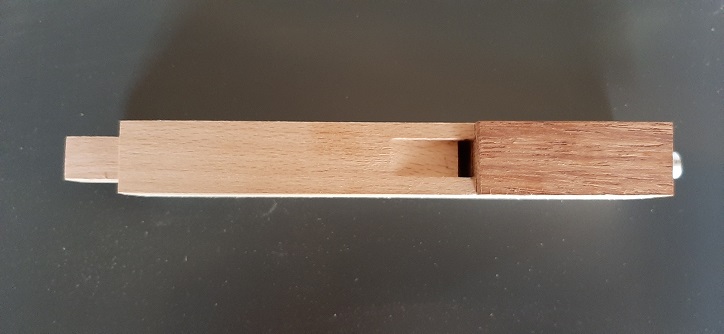
- Beech — the hobby default. The amateur corpus favours beech for pipes: strong, dense, close- and even-grained, it holds a crisp mouth lip, glues and finishes well, and its handsome even figure makes it suitable for the decorative front slats that show on the pipe face (en_pijp, en_31toets). A beech pipe is durable and stable, which is why builders reach for it despite its weight relative to the softwoods.
- Balsa and basswood — the John Smith plans. The John Smith designs specify balsa and basswood for the pipe bodies (JS Universal). The logic is the opposite of beech’s: balsa is extremely light and soft, trivially easy to cut and sand, and — for a pipe body that is not a structural member — its low mass and easy working outweigh its fragility. Basswood (European lime/linden’s cousin) is a fine, even-grained, low-movement, easily worked hardwood, the classic carver’s and pattern-maker’s wood, and a forgiving pipe material. Both keep a hobby pipe rank cheap, light and quick to build.
- Classic pipe woods — spruce, pine, mahogany. Traditional wooden organ pipes are made from quartersawn spruce or pine for the resonating walls (the same stability logic as a soundboard, §4.5) and mahogany for stability and for caps, blocks and the parts that must stay dead flat (cross-ref Building Organ Pipes). Quartersawn stock is preferred for pipe walls specifically because it moves least across its width (§4.3) and so keeps the pipe airtight and its mouth geometry stable.
Whatever the species, the pipe-wood requirement is the same as the chest requirement — stay flat and airtight — which is exactly the requirement the next section explains how to meet.
2.4 The wood-movement science
This is the engineer’s core of the volume. Wood movement is not a defect or a sign of poor material; it is an unavoidable property of the substance, and the whole art is anticipating it. The claims below are drawn from the Wood Database’s shrinkage data and the Wagner Meters / PSU treatment of equilibrium moisture content (Wood Database; Wagner/EMC).
2.4.1 Wood is hygroscopic — it tracks the ambient humidity
Wood is hygroscopic: it continuously exchanges moisture with the surrounding air, gaining moisture as relative humidity (RH) rises and losing it as RH falls. Its moisture content (MC), expressed as a percentage of oven-dry weight, is only stable when it equals the equilibrium moisture content (EMC) — the MC at which the wood neither gains nor loses moisture at the current temperature and RH (Wagner/EMC). A board is never “finished drying” in any permanent sense; it simply sits at whatever EMC its environment dictates, and it re-equilibrates whenever that environment changes. An organ that lived for a century in a damp hall and is moved into a centrally heated modern room will dry further and will move, no matter how old it is.
Representative indoor figures (Wagner/EMC):
- Indoor RH ≈ 30–50 % → indoor wood EMC ≈ 6–12 %.
- This is the target moisture band for interior woodwork, and the band a restored organ should be conditioned to and kept in.
2.4.2 The Fibre Saturation Point — where movement begins
Wood holds moisture in two places: free water in the cell cavities, and bound water held within the cell walls. The Fibre Saturation Point (FSP), at roughly 30 % MC, is the moisture content at which all the free water is gone but the cell walls are still fully saturated (Wagner/EMC).
The FSP is the hinge of the whole subject:
- Above the FSP (MC > ≈30 %) — losing free water from the cell cavities does not change the wood’s dimensions. Green wood drying from, say, 60 % down to 30 % barely moves.
- Below the FSP (MC < ≈30 %) — moisture now leaves the cell walls, and the walls shrink as it does. All dimensional movement — all the shrinking, swelling, cupping, cracking and joint failure — happens below the FSP, in the band the wood actually occupies in service.
Since indoor organ wood lives at 6–12 % MC, it is always well below the FSP, always on the moving part of the curve. Seasonal swings between (say) 6 % in a dry heated winter and 12 % in a humid summer are swings the wood answers with real dimensional change — and that change, resisted by a joint or a glued panel, is what splits it.
2.4.3 Anisotropy — tangential ≈ 2× radial (T/R ≈ 2)
Wood does not move equally in all directions. It moves in three very different amounts along its three axes:
- Longitudinal (along the grain) — negligible, a few tenths of one percent; treated as zero for practical purposes.
- Radial (across the growth rings, toward the pith) — moderate.
- Tangential (parallel to the growth rings, around the tree) — the largest, and the one that matters.
The load-bearing rule: tangential shrinkage is about twice radial shrinkage — the T/R ratio is roughly 2 (Wood Database). A board’s total across-the-width movement therefore depends critically on how the grain is oriented within it — which is set by how the board was sawn from the log.
2.4.4 Quartersawn vs flat-sawn — the practical consequence
Because tangential movement is about double radial, the way a board is cut from the log decides how much it moves and whether it stays flat:
- Flat-sawn (plain-sawn) — the growth rings run roughly parallel to the wide face (they arch across the board’s thickness). The board’s width is therefore mostly in the tangential direction, so a flat-sawn board moves the most across its width and tends to cup (curl away from the pith side) as it dries, because the two faces shrink by different tangential amounts. Flat-sawn stock is cheaper and shows the bold “cathedral” figure, but it is the least stable orientation.
- Quartersawn — the growth rings run roughly perpendicular to the wide face (on edge, top to bottom through the board). The board’s width is now mostly in the radial direction, so a quartersawn board moves about half as much across its width as a flat-sawn board of the same species, and it stays flat rather than cupping, because both faces are radial and shrink alike (Wood Database).
The practical rule for organ work follows directly: use quartersawn stock for anything that must stay flat and airtight — chest tops and walls, pallet faces, soundboards, and pipe walls. Quartersawn is the traditional, correct choice for exactly these parts, and it is the reason old chest and pipe stock was riftsawn or quartersawn on purpose, not by accident.
The same physics explains why plywood is stable: it is built from thin veneers laid up with the grain of each ply at 90° to its neighbours, so the large tangential movement of one ply is opposed and largely cancelled by the small longitudinal (near-zero) movement of the plies above and below it. The panel as a whole barely moves and does not cup — which is the whole point of §2.2. MDF goes further and has no grain direction at all, so it has no preferred movement axis (though it swells dramatically if wetted).
Figure 1 — How the cut sets the movement. Tangential shrinkage is about twice radial (T/R ≈ 2), so a quartersawn board (rings perpendicular to the face) moves about half as much across its width and dries flat, while a flat-sawn board (rings parallel to the face) moves most and cups. The strip below shows that all dimensional movement happens below the Fibre Saturation Point (≈30 % MC); indoor organ wood lives at an EMC of 6–12 %, always on the moving part of the curve. (Wood Database; Wagner/EMC.)
2.4.5 Why this cracks joints — and why it argues for sheet stock
Movement below the FSP only causes damage when it is restrained. Three common restraints in an organ:
- A wide solid panel glued or screwed at both edges cannot shrink freely; the tension across the grain pulls until the weakest line — usually a glue joint or a knot — lets go, and the panel splits. This is the classic cracked chest top or split case side.
- Cross-grain construction — gluing one piece with its grain running across another’s — pits the tangential movement of one against the near-zero longitudinal movement of the other. The joint works loose or the wood tears. Traditional joinery avoids locking wide panels cross-grain for exactly this reason (frame-and-panel, floating panels, breadboard ends).
- A moisture gradient — one face wet, one dry, or a fresh water-based finish or glue wetting a surface — makes the two faces move by different amounts and the board cups until they equalize.
The engineering escape from all three is either to respect the movement (choose quartersawn stock, orient the grain, size the joints to allow movement, condition the wood to service EMC before building) or to eliminate the movement by using engineered sheet stock, whose cross-plied or grain-free construction has almost no net movement to restrain (§4.4). This is precisely why the modern hobby build is Baltic birch: not because ply is “better” wood, but because a beginner can build an airtight, stay-flat organ from it without having to master grain reading and movement allowances. The classic builder took the harder road and earned reversibility and authenticity for it (§2.3).
2.5 Seasoning and conditioning in practice
The movement science turns into three shop rules.
Season and condition to service EMC before building. Wood should be brought to the moisture content it will live at — the 6–12 % EMC of a heated interior — and allowed to equilibrate there before it is cut and glued, so that most of its movement has already happened by the time it is in the instrument (Wagner/EMC). Building with stock that is wetter than service EMC guarantees shrinkage, gaping joints and cracks after assembly; building with stock drier than service will let it swell and buckle. A moisture meter reading, or simply acclimatizing the boards in the shop for weeks, is the classic precaution. Kiln- or air-dried “furniture-grade” stock is typically supplied around 6–8 % MC, already in band.
Keep the finished organ in a stable environment. Because the wood tracks ambient RH forever (§4.1), the single most effective preservation measure is a stable RH — avoiding the extremes and, above all, the rapid swings that stress joints. This is the wood side of the preservation argument developed in Vol 6 (finishes slow moisture exchange but never stop it) and Vol 7 (restoration and storage).
Sheet stock sidesteps seasoning — mostly. Baltic birch and MDF arrive stable and need little conditioning for dimensional reasons, though MDF must still be kept dry because it swells irreversibly when wetted, and any solid hardwood show face or trim glued to a stable substrate still moves and can telegraph or split if it is wide and cross-grained. The stability of an engineered panel does not extend to the solid parts fastened to it.
2.6 Species reference — classic vs modern, use, and movement
The table gathers the volume’s woods with their role, their classic-or-modern standing, and a shrinkage/stability note. Movement figures are approximate green-to-oven-dry ranges and are given only to rank the woods against one another; service movement over a 6 % MC seasonal swing is a small fraction of these totals (Wood Database). Values not taken directly from a source table are marked (est.).
Table 2 — 6. Species reference — classic vs modern, use, and movement
| Wood | Classic / Modern | Typical organ use | Movement / stability note |
|---|---|---|---|
| Spruce | Classic | Carcase, chests, wind trunks; classic pipe walls (quartersawn) | Light, stiff, low density; quartersawn spruce is a stable, traditional soundboard/pipe-wall wood (Wood Database) |
| Pine / fir | Classic | Structural internals, some pipe walls | Light, workable; moderate movement; quartersawn for flat parts (Wood Database) |
| Beech | Classic + hobby | Structural hardwood; hobby pipe default, decorative front slats | Dense, even-grained, holds an edge; moves a fair amount tangentially so quartersaw for flat parts (Wood Database; en_pijp, en_31toets) |
| Mahogany | Classic | Show cases, pipe caps/blocks, flat parts | Notably stable, low movement — chosen where dead-flat matters (Wood Database) |
| Walnut | Classic | Show parts; JS Universal pipe fronts | Dense, stable-ish, decorative; used for looks (Wood Database; JS Universal) |
| Balsa | Modern (JS plans) | JS pipe bodies | Extremely light and soft; low mass, easy to work; fragile (JS Universal) |
| Basswood / lime | Classic + modern | Pipe bodies, carving | Fine, even grain, low movement, easy to work — the carver’s/pattern wood (Wood Database; JS Universal) |
| Baltic birch plywood | Modern | JS case ¼ in, pipe walls ⅛ in; hobby chests | Cross-plied → very stable, stays flat; strong, uniform; laminated edge is decorative (JS Universal) |
| “Concrete” / phenolic ply | Modern | Weatherproof case / wind parts for outdoor organs | Sealed hard face, weatherproof glue line; heavy; toughness over looks (est.) |
| MDF | Modern | Carved scroll, mouldings, painted fronts | No grain direction → carves crisply any way; heavy; poor edge screw-hold; swells irreversibly if wet (est.) |
| Veneered MDF / ply composite | Modern | Show panels | Real-wood face over a stable core; face veneer still moves a little (est.) |
2.7 Choosing wood for a build or a restoration
The volume closes on the decision the reader actually faces, framed by the classic-vs-modern axis:
-
A new working busker organ. The modern answer is right and is what the plans assume: Baltic birch plywood case and chest, PVA-glued (Vol 5); beech or the plans’ balsa/basswood for the pipes; MDF for any carved painted scroll; a hardwood show face where looks matter. Stable, cheap, forgiving, and it will stay airtight without the builder having to season and grain-orient solid stock. It is not authentic to an antique, and it is not fully reversible — but a player’s organ does not need to be either (JS Universal; en_pijp, en_31toets).
-
Restoring an antique. The classic answer is required by conservation ethics (Vol 7): repair or replace like for like — quartersawn solid softwood or hardwood matched to the original species and grain orientation, hide-glued so the repair is reversible and the wood can still move as the original does. Slipping a stable modern panel into an antique may hold better in the short term, but it is anachronistic, hard to reverse, and can even harm the original by refusing to move with the surrounding solid wood — a rigid patch in a moving field concentrates stress at its edges. The reversibility principle (Vol 7) is why the harder, classic material is the correct one here.
The through-line of the volume: wood moves, and every material decision in an organ is partly a decision about how to live with that movement. Choose quartersawn and season it and you may build in solid wood and keep it reversible; choose engineered sheet stock and you trade authenticity and repairability for a panel that scarcely moves at all. The John Smith Universal and the hobby corpus made the second choice on purpose; a restorer of a Waldkirch or Jäger & Brommer instrument must make the first. Both are engineering answers to the same hygroscopic fact.
Cross-references: pipe making and voicing → Building Organ Pipes; case decoration (carving, painting, gilding) → The Case, Façade & Figures (Dive 11); glues (PVA vs hide, reversibility) → Vol 5; finishes and preservation (moisture control, environment) → Vol 6; restoration ethics (reversibility, like-for-like) → Vol 7; wind pressure (~5 in H₂O = 127 mm ≈ 1.245 kPa) → Wind Systems.
Sources: Wood Database (dimensional shrinkage, T/R ratio, species data); Wagner/EMC (hygroscopicity, EMC 6–12 %, FSP ≈ 30 %); JS Universal (Baltic birch case/pipe walls, walnut fronts, balsa/basswood pipes); en_pijp and en_31toets (beech hobby pipes and decorative front slats).
Comments (0)