Fender Rhodes Stage 88 · Volume 9
Fender Rhodes Stage 88 — Vol 09: Preamp & Active Conversion
This is the first electronics volume of the bench manual. Everything up to Vol 08 worked on the mechanism — the fork, the action, the voicing, the tuning. This volume picks up exactly where the passive harp’s single ¼″ jack left off (Vol 02 §“The passive harp & wiring”) and asks what to put between that jack and the outside world. A Stage 88 has no onboard preamp, no tone control, and no stereo effect — by design — so the bare harp is an unbuffered, high-impedance source that is easy to load down and impossible to pan. The work here is the active conversion: fitting an internal preamp/buffer that fixes the impedance match, restores level and gain, adds an EQ, and recreates the Suitcase’s stereo “vibrato.” The modern reference unit is the Vintage Vibe StereoVibe; the classic alternative is restoring the original Peterson/Janus electronics; and the historical and current competitors (Dyno-My-Piano, the Avion RetroFlyer) close the volume. The chain deliberately stops at the StereoVibe’s effects loop and stereo outputs — the amplifiers, the phaser, and the chorus that hang off those jacks are Vol 10, and recording levels are Vol 11.
Note: Two electrical figures in this volume are stated with care. The passive harp is described as a high source impedance (the qualitative behavior established in Vol 02, where no confirmed value in Ω was available); the conventional high-impedance instrument-input target of ~1 MΩ is named as the load such a source wants, not as a measured property of the harp. Current StereoVibe model names and prices were re-verified against the live product pages at authoring time and are dated inline; anything not confirmable is flagged “(verify current pricing)” rather than asserted from memory.
9.1 Why the passive Stage wants a preamp
The Stage harp is, electrically, a string of fine-wire pickup coils summed to one mono RCA tie and out to a single ¼″ jack, with nothing active between the tines and the plug (Vol 02 §“The passive harp & wiring”; vintagevibe.com, History of Rhodes Pickups). That has three consequences that a preamp exists to fix:
- High source impedance, easily loaded down. A passive magnetic pickup behaves like a guitar pickup: it is a high-impedance source whose top end depends on what it sees at the other end of the cable. Plugged into a high-impedance load — the conventional instrument-input target is ~1 MΩ — it keeps its treble and level. Plugged into a low-impedance input (a typical line input of ~10–100 kΩ, or a passive DI), the source is loaded down: the high end rolls off (the note goes dull) and the overall level drops. This is why an active DI is generally preferred over a passive one for a bare Stage harp (gearspace.com, Rhodes mike or DI; Vol 02 §“Why the Stage needs what comes after”). A preamp/buffer placed right at the harp presents the ~1 MΩ load the pickups want and then drives a low-impedance line downstream, so the cable and the next input no longer dictate the tone.
- Modest, instrument-level signal. The harp puts out a real but small instrument-level signal, not a mixer-ready line feed. A preamp adds gain to bring it up to a usable level (level-matching is developed for recording in Vol 11).
- No stereo effect and no tone control. The panning “vibrato” that defines the Suitcase lives in that model’s active preamp, never in the harp; and a Stage has no onboard Bass/Treble at all. An active conversion is the only way a Stage gets either (the panner is dissected in §“The stereo ‘vibrato’ is a pan”).
Warn: The single most common mistake is running the bare passive harp into a low-impedance input — a passive DI box, a mixer line input, or a pedal with a low input impedance — and then blaming the piano for sounding dull and quiet. The fix is an active stage at the harp (this volume) or at minimum an active DI (Vol 11): present the pickups the ~1 MΩ load they want before the signal sees any cable run or low-Z input (gearspace.com, Rhodes mike or DI).
9.2 The Vintage Vibe StereoVibe
The Vintage Vibe StereoVibe is an internal preamp built into a replica Rhodes name rail — the long trim strip that carries the “Rhodes” badge across the front of the piano above the keys, which on a Stage is otherwise just a blank rail. The StereoVibe rail drops into that same position, so all of the controls land on the name rail under the player’s hands with no holes cut and no external box. Vintage Vibe’s own summary of the design intent: “No modifications, no cheek block power supply, no wires dangling from your piano” (vintagevibe.com, StereoVibe, accessed June 2026).
The current revision is Rev 8, described by the maker as bringing “Retro Rhodes replacement preamps into the modern age by eliminating the need for continuous AC” (vintagevibe.com / facebook.com, Rev 8 StereoVibe, accessed June 2026). The headline change from earlier units is the power source.
Power — USB-C rechargeable battery (replaced the AC cheek-block supply). Earlier internal preamps and the original Suitcase electronics were powered by an AC cheek-block power supply — a transformer pack mounted in the cheek block (the solid end-block beside the keys) feeding the piano over a multi-pin DIN cable. The StereoVibe replaces all of that with an onboard USB-C rechargeable lithium battery rated at up to 24 hours of continuous use per charge, with an onboard LED battery meter and a supplied USB-A-to-USB-C charging cord and power block (vintagevibepiano.com, StereoVibe Preamp; vintagevibe.com, StereoVibe, accessed June 2026).
Audio features. Re-verified against the live product and features pages (accessed June 2026):
- Click on/off Volume (gain). A volume knob with a detented click off position that also serves as the unit’s power switch.
- Bass and Treble tone controls, each on its own dedicated knob (no stacked pots), plus a voiced midrange bump — “a subtle midrange bump for added warmth and definition,” so the tone cuts through a mix without turning harsh.
- Stereo tremolo with independent Rate and Depth, engaged by a push-button with a status LED. The modulation is voiced to mimic “the 1970s incandescent light bulb found in the desirable Peterson model” — the soft rise/fall of the original optical tremolo rather than a hard electronic chop.
- Stereo headphone output on the rail.
- Mono effects loop (send/return) for inserting outboard effects.
- Stereo outputs (left/right) — the two channels the tremolo pans between.
Mount variants and pricing (re-verified June 2026 — verify current pricing before quoting). The StereoVibe ships as a complete rail “ready to drop in and play,” in MKI and MKII variants to match the two name-rail/electronics-plate styles across the production run:
Table 1 — across the production run
| Variant | Fits | Price (June 2026) |
|---|---|---|
| StereoVibe MKI, 73-note | Mark I name-rail Stage/Suitcase 73 | $595 (verify current pricing) |
| StereoVibe MKI, 88-note | Mark I name-rail Stage/Suitcase 88 | $695 (verify current pricing) |
| StereoVibe MKII | Mark II electronics-plate pianos (73 & 88) | $475 (verify current pricing) |
Note: Prices and the MKI-vs-MKII split were read off vintagevibe.com on the access date and are flagged for re-verification — Vintage Vibe revises models and pricing over time, and the MKII listing showed a single price for both note counts while the MKI listing priced 73 and 88 separately. Match the variant to the piano’s name rail / electronics plate (MKI vs MKII), then confirm the live price; do not quote the figures above as current without checking (vintagevibe.com, StereoVibe and Rhodes MKII StereoVibe, accessed June 2026).
9.2.1 StereoVibe controls
Table 2 — StereoVibe controls
| Control | What it does |
|---|---|
| Volume (click on/off) | Sets output level/gain; the detented click position is the power switch (off). |
| Bass | Low-frequency shelf — body and weight. |
| Treble | High-frequency shelf — attack, bark, and air. |
| Mid bump (voiced, fixed) | A subtle midrange lift for warmth and cut; not a sweepable mid, a voiced accent. |
| Tremolo Rate | Speed of the stereo modulation (how fast it swirls). |
| Tremolo Depth | Intensity of the modulation (how far it pans / how deep the throb). |
| Tremolo on/off (push-button + LED) | Engages/bypasses the stereo tremolo; status LED shows state. |
| Headphone jack | Onboard stereo headphone monitoring. |
| Effects loop (send/return) | Mono insert point for outboard effects ahead of the outputs (Vol 10). |
| Stereo outputs L / R | The two channels the tremolo pans between → to amps/console (Vol 10/11). |
| USB-C charge port + LED battery meter | Recharges the lithium battery (~24 h/charge); meter shows remaining charge. |
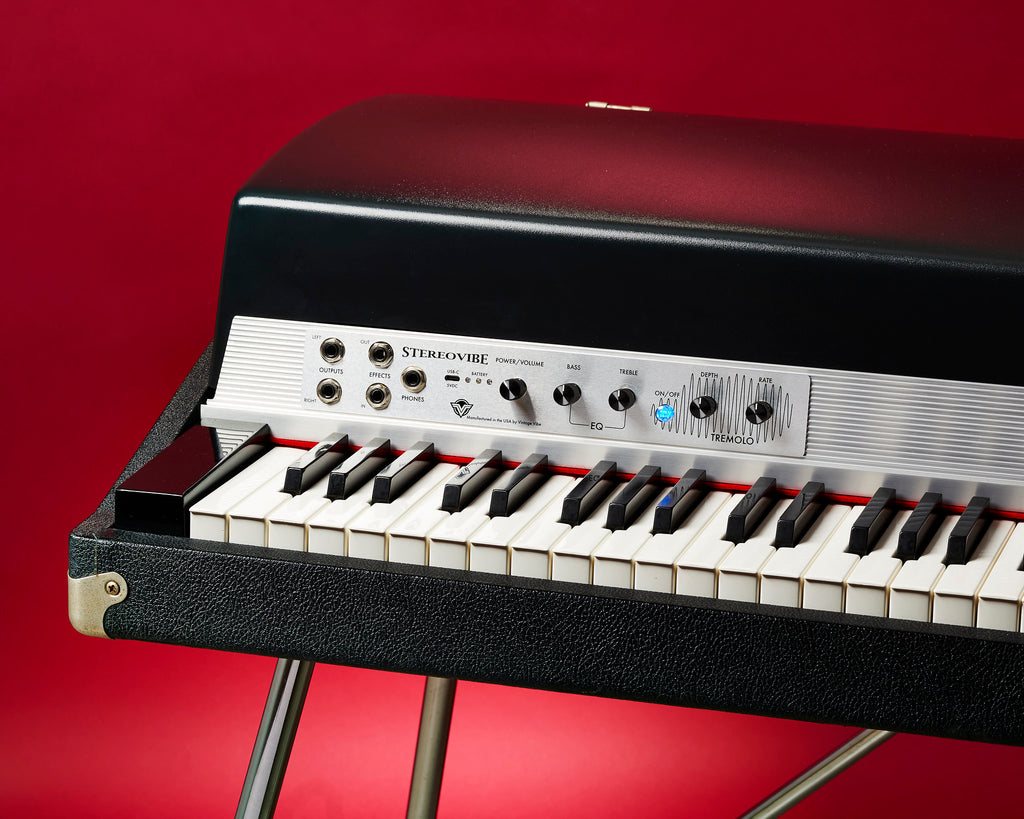
9.3 Installing it
The StereoVibe is a no-solder, no-modification swap: the original blank Stage name rail comes off, the StereoVibe rail goes on in its place using the same screws, and the harp’s existing RCA output plugs into the unit instead of into the case wiring. The only fitment subtlety is shimming the rail so the lid still closes.
Tools: a #2 Phillips screwdriver (the four name-rail screws); the supplied shims; the supplied USB-A-to-USB-C cable and power block (to charge before first use). No soldering iron is required for the StereoVibe itself.
9.3.1 Step 1 — Unplug the harp RCA from the harp jack
- Open the lid and locate the harp output cable, which terminates in an RCA connector at the harp jack (the same mono RCA tie that carries the summed pickup output off the harp — Vol 02 §“The passive harp & wiring”).
- Unplug the RCA from the harp jack so the harp output is free to route to the new unit instead of to the original case wiring.
9.3.2 Step 2 — Remove the four name-rail screws and fit the StereoVibe rail
- With the #2 Phillips screwdriver, back out the four screws holding the original (blank) name rail to the front of the piano. Keep the four screws — they are reused.
- Lift the original name rail off and set it aside.
- Seat the StereoVibe replica name rail in the same position and fasten it with the four original screws (vintagevibe.com, StereoVibe, accessed June 2026).
9.3.3 Step 3 — Plug the harp RCA into the unit
- Route the harp’s RCA output (freed in Step 1) to the StereoVibe and plug it into the unit’s harp input, so the passive harp now feeds the preamp directly.
9.3.4 Step 4 — Shim the cheek blocks so the lid closes
The replica rail and its controls sit at a slightly different height than the bare original, so the lid angle must be reset or the lid will foul the rail. Vintage Vibe supplies shims for exactly this.
- Fit the supplied shims at the cheek blocks to raise the lid’s resting angle the small amount needed.
- Close the lid and confirm it seats fully without contacting the rail or its controls; add or remove shim thickness until it does.
9.3.5 Step 5 — Charge, then check the outputs
- Charge the battery fully with the supplied USB-A-to-USB-C cable and power block before first use — the LED meter confirms charge.
- Plug the stereo outputs (L/R) into the amp or console, set the click volume off the stop, and verify both channels pass signal; engage the tremolo and confirm the swirl pans between the two outputs (§“The stereo ‘vibrato’ is a pan”).
Warn: The battery ships uncharged — Vintage Vibe sends it depleted to meet lithium-battery shipping regulations — so a freshly installed unit can appear dead until it is charged over USB-C. Charge it fully before assuming a fault (vintagevibe.com, StereoVibe, accessed June 2026).
Warn: Do not skip the shim step. If the lid is forced closed against a rail that sits proud, it can crack the lid or bend the rail/controls. Shim the cheek blocks until the lid closes freely, then verify by closing it fully before the piano is moved or cased.
9.4 The stereo “vibrato” is a pan
The effect every player calls “Rhodes vibrato” is, on a Suitcase, neither vibrato nor — in its famous form — even tremolo. The history matters because the StereoVibe recreates it:
- It started as mono tremolo (square wave). The Suitcase’s earliest built-in effect was “a tremolo effect that varied the amplitude of the piano’s output in a square-wave pattern” — amplitude modulation (loud/soft), not pitch modulation (fenderrhodes.com, Classic Rhodes Effects).
- It became a stereo pan in 1969. “When the Suitcase amps went stereo in 1969, this pattern was translated into a panning effect” — the modulation now moved the signal left↔right across the two speakers instead of chopping a single output up and down, and it was smoothed from the original hard square edge into a gentler sweeping (triangle-like) ramp so the image glides rather than snaps (fenderrhodes.com, Classic Rhodes Effects; forums.musicplayer.com, Mono Tremolo or Stereo Pan Effect for Rhodes?).
- It is mislabeled “Vibrato.” The front panel says “Vibrato” (a pitch variation) for naming consistency with Fender amplifiers, but the circuit is amplitude/pan, with controls for Speed (Rate) and Intensity (Depth) (fenderrhodes.com, Classic Rhodes Effects; Wikipedia, Rhodes piano).
- It cancels in mono. Because the stereo version is a pan — when the left channel rises the right falls by the same amount — summing L and R back together yields a roughly constant level: the swirl disappears when the two channels are collapsed to mono. A mono tremolo, by contrast, survives a mono sum. This is why the effect must be carried on two outputs to be heard as intended.
The StereoVibe recreates the stereo pan across its two outputs — its “stereo tremolo” is this same left↔right panning animation, voiced after the optical (incandescent-bulb) Peterson modulation (vintagevibe.com, StereoVibe; forums.musicplayer.com).
Tip: A quick bench check that an installed StereoVibe (or any panner) is doing the stereo effect and not a mono tremolo: engage the tremolo, then sum the two outputs to mono. If the swirl vanishes to a steady level, the circuit is panning correctly; if it still throbs in mono, it is amplitude-modulating one channel, not panning across two.
9.5 Dialing in tone
With the StereoVibe installed and charged, the front-rail controls are set in a fixed order — gain first, then EQ, then the swirl — so each stage is judged on a clean signal beneath it:
- Set the gain at the click Volume. Bring the Volume up off its click-off stop to a level that drives the amp or console cleanly without the preamp itself clipping; this is the foundation level the EQ and tremolo sit on (recording-level matching is Vol 11).
- Shape body and cut with Bass / Treble + the mid bump. Use Bass for weight and Treble for attack and bark; lean on the voiced midrange bump when the Rhodes needs to cut through a dense mix, and back the treble down toward warmth for a darker, rounder voice. The mid bump is a fixed accent, not a sweepable mid — it adds presence without harshness.
- Add the swirl with tremolo Depth / Rate. Engage the push-button tremolo, then set Depth for how pronounced the left↔right pan is and Rate for how fast it swirls — slow and shallow for a gentle drift, faster and deeper for the classic Suitcase throb. Remember the effect lives across both outputs (§“The stereo ‘vibrato’ is a pan”).
Note: Downstream amp and effect coloration — the Twin/Princeton voicings, the phaser, the chorus — is Vol 10, and it interacts with these settings. Set the StereoVibe to a clean, full starting point here; do the amp-and-pedal voicing in Vol 10 rather than chasing it on the rail.
9.6 Restoring the original electronics instead
A purist refurbish keeps the period electronics rather than fitting a modern rail. On a Suitcase (or a Stage being converted toward Suitcase electronics), the original active stage is a Peterson or later Janus preamp fed by a cheek-block power supply, and the work is rebuild, not replace.
- The Peterson 4-pin preamp. The early Suitcase preamp is the Peterson, identified by its 4-pin DIN socket and concentric potentiometers for tone and vibrato. It is rebuilt — not discarded — with a 4-pin Peterson preamp rebuild kit that renews the parts that age out: “leaky filter capacitors, oxidized jack contacts and faulty connectors are extremely common,” producing loss of supply voltage, increased hum, and intermittent or crackly output (vintagevibe.com, Fender Rhodes 4 Pin Pre-Amp Rebuild Kit / 4 Pin Peterson Amp Module Rebuild Kit, accessed June 2026).
- The Janus preamp. The Janus is the later Suitcase preamp/power-amp design that succeeded the Peterson; its power-supply PCB and amp modules are likewise available as rebuild kits rather than replacements (vintagevibe.com, Rhodes Janus Suitcase parts, accessed June 2026).
- Cheek-block power supplies. The original active electronics are powered from a cheek-block power supply (e.g. the 5-pin cheek-block PSU), the AC pack the StereoVibe’s battery was designed to make unnecessary. These too are rebuilt for the same failure modes — failing filter caps and connectors driving hum and voltage loss (vintagevibe.com, 4-Pin Rhodes Suitcase Power Supply Rebuild Kit / 5 Pin Cheek Block Power Supply, accessed June 2026).
Warn: Vintage power supplies and preamps run on mains-derived voltages and contain aged electrolytic capacitors that can hold charge. Treat a Peterson/Janus rebuild as mains-electronics service — discharge and verify before handling, and rebuild the power supply’s filter caps as the first move, since their failure (hum, voltage sag, crackle) masquerades as a preamp fault (vintagevibe.com, Suitcase Power Supply Rebuild Kit, accessed June 2026).
Note: Restoring original electronics applies to Suitcase electronics or a Stage being converted to them; a stock Stage never had a Peterson/Janus stage to restore (Vol 02 §“The passive harp & wiring”). For a Stage that simply needs to become active, the StereoVibe (above) or the third-party preamps (below) are the direct path; the Peterson/Janus route is for pianos that already carry, or are being built toward, the period Suitcase circuitry.
9.7 Other preamps (Dyno, RetroFlyer)
Two non-Vintage-Vibe preamps round out the field — one historical, one current:
- Dyno-My-Piano (Chuck Monte). The most famous Rhodes preamp modification of the 1970s, built by Chuck Monte, who customized Rhodes (and Wurlitzer, Hohner, Yamaha) pianos for professional use. The “Dyno” preamp carried two pairs of concentric knobs — one pair for Bass Boost and Overtone, the other for Volume and “Normal” (a post-EQ gain control) — and its punchy, bell-like “Dyno Rhodes” voice dominated Top-40 and R&B records into the 1980s (fenderrhodes.com, Dyno-My-Piano: The Chuck Monte Story).
- Avion RetroFlyer. The current heir to that role: an active preamp and tremolo designed to drop into passive Mark I and II Rhodes. Its listed features are a high input impedance stage (“High input impedance with full frequency and dynamic range”), a Volume control, a 7 dB balanced Mid Boost/Cut, a twin-VCA true-stereo tremolo, and an onboard 3-position high-pass filter, built around a “high-headroom, high-detail, low-noise preamp circuit” (avionstudios.com, The RetroFlyer, accessed June 2026). It targets the same job as the StereoVibe — turn a flat, dull passive Stage into a full, voiced, panning instrument — and is positioned explicitly as the modern successor to the Dyno-My-Piano modification (avionstudios.com; soundonsound.com, Avion Studios Retro-Flyer).
Note: A community/reseller figure puts both the Dyno-My-Piano and the RetroFlyer input impedance near ~330 kΩ rather than the ~1 MΩ general instrument target — high enough to preserve the passive harp far better than a 10–100 kΩ line input, and a deliberate voicing choice as much as a load match. This ~330 kΩ value is reported, not vendor-confirmed on the spec page, and is flagged as such; the load principle (a high-impedance active stage at the harp) holds regardless of the exact figure (search-reported; avionstudios.com lists only “high input impedance” without a number).
The chain ends here, at the StereoVibe’s (or RetroFlyer’s) stereo outputs and effects loop. What plugs into those — the amplifiers, the phaser, the chorus, and the rest of the classic Rhodes effects chain — is Vol 10 §“Amplification & the effects chain,” and matching these outputs to a recorder/console is Vol 11 §“Recording & integration.” This volume’s job was only to make the passive Stage active: fix the impedance, restore the level, add the EQ, and put the stereo pan back across two outputs.
Sources
- vintagevibe.com, StereoVibe Preamp for Fender Rhodes MKI Pianos (accessed June 2026) — replica MKI name-rail mount; click on/off volume; Bass/Treble EQ with a mid-EQ “extra bump”; push-button stereo tremolo with indicator light; stereo headphone jack; mono effects loop; stereo outputs; RCA connection to the harp jack; USB-C rechargeable lithium battery with LED battery meter, battery ships uncharged (shipping regulations), supplied USB-A-to-USB-C cord + power block; tremolo “mimics the 1970s incandescent light bulb found in the desirable Peterson model”; install = remove RCA, remove 4 name- rail screws, fit the new rail with the original screws, reconnect RCA, shim to meet lid angle; “No modifications, no cheek block power supply, no wires dangling.” MKI 73-note ~$595, 88-note ~$695 (verify current pricing).
- vintagevibepiano.com, StereoVibe Preamp (accessed June 2026) — USB-C rechargeable lithium battery, up to 24 hours per charge; independent Tremolo Rate and Tremolo Depth; independent Bass and Treble with a subtle midrange bump; click-on/off volume; stereo headphone output; effects loop send/return; controls on an anodized aluminum name rail, “no stacked potentiometers.”
- vintagevibe.com, StereoVibe Preamp for Rhodes MKII Pianos (accessed June 2026) — the MKII variant on its own MKII replica mounting plate, ~$475 (verify current pricing), same four-screw drop-in.
- vintagevibe.com / facebook.com, Rev 8 of the StereoVibe (accessed June 2026) — the current revision is Rev 8, “eliminating the need for continuous AC,” ~15 years of StereoVibe history.
- fenderrhodes.com, Classic Rhodes Effects (history/effects) — the Suitcase effect began as mono tremolo in a square-wave pattern, “when the Suitcase amps went stereo in 1969, this pattern was translated into a panning effect,” mislabeled “Vibrato” for Fender naming consistency, with Speed/Intensity controls.
- fenderrhodes.com, Dyno-My-Piano: The Chuck Monte Story (history/dyno) — Chuck Monte’s Dyno-My-Piano modification, concentric Bass Boost/Overtone and Volume/“Normal” controls, the “Dyno Rhodes” sound on 1970s–80s records.
- forums.musicplayer.com, Mono Tremolo or Stereo Pan Effect for Rhodes? — community confirmation that the stereo Suitcase effect pans L↔R and that the pan cancels toward mono when the channels are summed, versus a mono tremolo that survives a mono sum.
- avionstudios.com, The RetroFlyer — Active Preamp for Passive Rhodes (accessed June 2026) — drop-in active preamp/tremolo for passive Mark I/II; high input impedance; Volume; 7 dB balanced Mid Boost/Cut; twin-VCA true-stereo tremolo; 3-position high-pass filter; positioned as the modern successor to Dyno-My-Piano. soundonsound.com, Avion Studios Retro-Flyer — independent review corroborating the feature set.
- vintagevibe.com, Fender Rhodes 4 Pin Pre-Amp Rebuild Kit, 4 Pin Peterson Amp Module Rebuild Kit, 4 Pin Rhodes Suitcase Power Supply Rebuild Kit, 5 Pin Cheek Block Power Supply, and Janus parts (accessed June 2026) — the Peterson 4-pin DIN / concentric-pot preamp and the later Janus; rebuild kits for leaky filter caps, oxidized jacks, faulty connectors causing voltage loss, hum, crackle; the cheek-block power supply the battery replaces.
- gearspace.com, Rhodes mike or DI (carried from Vol 02) — the passive harp as a high source impedance that an active DI/preamp suits better than a passive one (the low-Z-loads-the-pickups argument).
Flagged as unverified or vendor-sourced, not invented: (1) StereoVibe pricing and the MKI/MKII split — read off vintagevibe.com on the access date (MKI 73 ~$595 / 88 ~$695; MKII ~$475) and explicitly flagged “verify current pricing”, since Vintage Vibe revises models/prices; (2) the ~330 kΩ input impedance attributed to the Dyno-My-Piano and RetroFlyer — search/reseller reported, not stated as a number on the Avion spec page (which says only “high input impedance”) — flagged, with the ~1 MΩ figure given only as the general instrument-input target, not a measured harp value; (3) the triangle-wave description of the stereo pan — the cited fact is the square-wave→pan transition in 1969; the “smoother/triangle-like” sweep is described qualitatively, not as a sourced waveform spec. No impedance, voltage, battery-hour, or price figure beyond those the cited vendor/manufacturer pages state has been invented.
Cross-references: the passive harp, its mono RCA output, and its high source impedance are Vol 02 (Theory of Operation & Signal Path); getting at the harp jack and name rail is Vol 03 (Tools, Bench Setup & Teardown); the cheek block as a case part is Vol 04 (Cabinet & Cosmetics); the amplifiers, phaser, chorus, and the rest of the effects chain that hang off the stereo outputs and effects loop are Vol 10 (Amplification & the Effects Chain); and matching these outputs to a recorder/console (levels, DI) is Vol 11 (Recording & Integration).
Comments (0)