Fender Rhodes Stage 88 · Volume 11
Fender Rhodes Stage 88 — Vol 11: Recording & Integration
This is the reference volume that meets the chain at the studio door. Vol 02 established the bare instrument as a passive, high source impedance, instrument-level source at a single ¼″ jack (Vol 02 §“The passive harp & wiring”); Vol 09 fitted an active preamp that fixes the impedance match and drives a low-impedance, near-line output across two channels; and Vol 10 hung amplifiers and effects off those outputs. This volume answers the next question: how that signal — passive harp, buffered preamp output, or a mic’d amplifier — is captured cleanly into an interface or console, at the right level and into the right impedance, in mono or in stereo, and where the result sits in a wider studio. It also covers the one capability the instrument never had — MIDI — and the aftermarket sensor systems that add it without touching the tone. No new electrical property of the harp is asserted here; the impedance behavior is the qualitative one carried from Vol 02/09, and every level is stated against its reference.
Note: Two figures are stated with care. The passive harp’s source impedance is qualitative — “high source impedance,” exactly as in Vol 02 and Vol 09, with no value in Ω invented; the ~1 MΩ Hi-Z target is named only as the load such a source wants, not as a measured property of the pickups. All signal levels are referenced explicitly: 0 dBu = 0.775 V RMS and 0 dBV = 1.0 V RMS, with professional line at +4 dBu and consumer line at −10 dBV (audiouniversityonline.com, Consumer vs Professional Audio Levels; Wikipedia, Line level). Voltages derived from those references are marked as computed; instrument-level figures, which are not tightly standardized, are flagged (est.).
11.1 DI vs amp
There are two ways to record a Stage, and they capture two different things. The choice is the same one every electromechanical keyboard presents: take the signal direct and keep the instrument’s own voice clean, or mic an amplifier and record the amp and room as part of the sound (fenderrhodesla.com, Recording Fender Rhodes Pianos; gearspace.com, Recording Fender Rhodes).
(a) Direct injection (DI). The cleanest, most controllable capture takes the signal straight into the interface. The critical constraint is impedance: the passive harp output must see a high-impedance load — the conventional instrument-input target is ~1 MΩ — or it loads down exactly as Vol 02/09 warned, going dull and quiet. That means one of:
- An active DI box, whose electronic input stage presents a high input impedance — typically ~1 MΩ — and then delivers a low-impedance, balanced, mic-level signal to an XLR mic preamp. An active DI is preferred over a passive one here precisely because a passive (transformer) DI typically presents only ~50–150 kΩ, low enough to load a passive pickup (soundonsound.com, Prepare to DI!; Vol 09 §“Why the passive Stage wants a preamp”).
- A dedicated Hi-Z “instrument” input on the interface itself — a front-panel input voiced for a ~1 MΩ-class load. Functionally this is the interface’s own DI stage; it removes the need for an outboard box.
- The buffered output of the Vol 09 preamp, which has already solved the problem: the StereoVibe (or equivalent) presents the ~1 MΩ load at the harp and drives a low source impedance line downstream, so its output can run into a line or instrument input over a normal cable with no further impedance concern (Vol 09 §“Why the passive Stage wants a preamp”). Taking the preamp’s two outputs direct also captures its EQ and its stereo pan (fenderrhodesla.com).
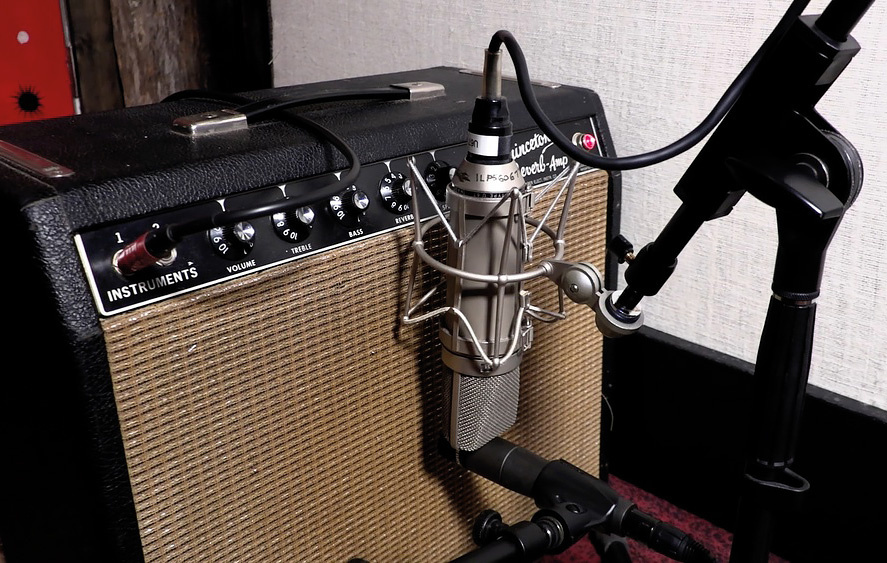
(b) Mic the amp. The alternative records Vol 10’s rig — the amplifier, the speaker, and the room — with one or more microphones in front of the cabinet. This trades the DI’s clean precision for the amp’s color and the room’s air: the speaker’s frequency shaping, the amp’s tube warmth or soft drive, its onboard reverb/tremolo, and the dimensionality of a real acoustic space (fenderrhodesla.com; gearspace.com). The cost is control — the captured tone is committed at the moment of recording, and the Rhodes is mechanically loud, so key clack and pedal noise are picked up by any close mic unless the amp is well separated from the instrument or placed in a different room (gearspace.com, Recording Fender Rhodes).
The two paths are not mutually exclusive: a common studio move is to DI and mic simultaneously — a clean DI track for control and re-amping plus a mic’d-amp track for character — and blend them at mixdown, or to DI clean and re-amp the captured track through Vol 10’s rig afterward (gearspace.com).
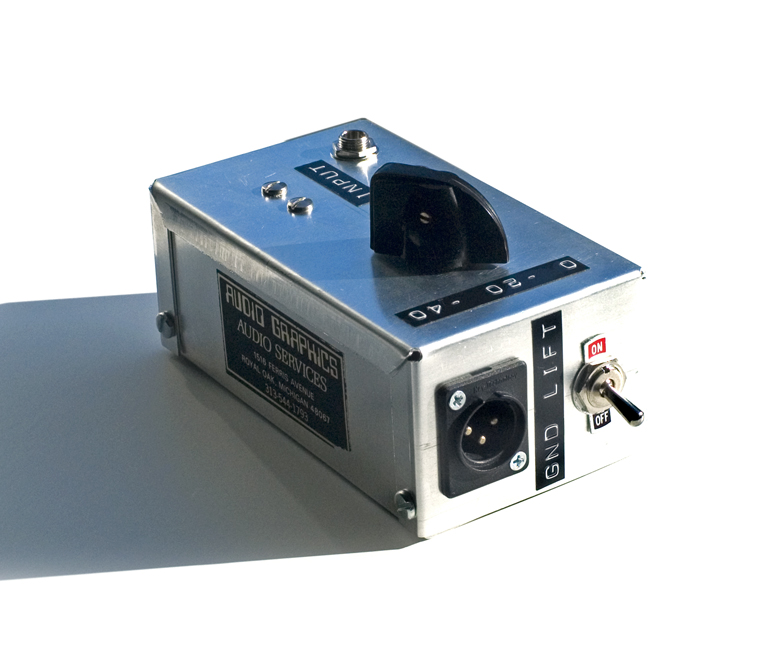
Warn — the Hi-Z requirement. Recording the passive harp direct into a low-impedance input — a passive DI, a console line input, or a mic input — loads the pickups, dulls the top, and drops the level (Vol 02 §“Why the Stage needs what comes after”; Vol 09). The direct path must terminate in a ~1 MΩ-class Hi-Z input (an active DI or an instrument input), or start from the already- buffered Vol 09 output. This is the single most common recording mistake with a bare Stage (soundonsound.com, Prepare to DI!; gearspace.com).
11.2 Levels & impedance
The Stage occupies the instrument-level rung of the standard hierarchy — above mic level, below line level — and, in its passive form, with a high source impedance that no destination input may load down. Capturing it well is a matter of routing each signal to an input designed for its level and its impedance, and then gain-staging up to the converter without clipping (Wikipedia, Line level; soundonsound.com, Prepare to DI!).
Three reference points anchor every figure below: 0 dBu = 0.775 V RMS and 0 dBV = 1.0 V RMS; professional line level is +4 dBu (≈ 1.23 V RMS, computed) and consumer line level is −10 dBV (≈ 0.316 V RMS, computed) — the pro standard sits roughly 12 dB hotter than the consumer one (audiouniversityonline.com; Wikipedia, Line level).
Table 1 — Levels & impedance
| Signal class | Nominal level (with reference) | Source impedance character | What the destination input needs |
|---|---|---|---|
| Mic level | very low — dynamic ≈ −60 dBu, condenser hotter (0 dBu = 0.775 V RMS) | low (≈150–600 Ω, balanced) | a mic preamp (XLR); condensers need +48 V phantom; active DIs need power (phantom or battery) |
| Instrument level — passive Stage harp | instrument level, well below line; no single standard, roughly the −20 dBu region (est.) | high source impedance (Vol 02 — qualitative, no Ω asserted) | a ~1 MΩ Hi-Z input (active DI or instrument input); not a low-Z mic/line input |
| Instrument level — Vol 09 buffered out | near line level | low (buffered, Vol 09) | a line or instrument input — impedance already solved |
| Line level — consumer | −10 dBV ⇒ ≈ 0.316 V RMS (0 dBV = 1.0 V RMS) | low | a line input (≈10 kΩ or higher) |
| Line level — professional | +4 dBu ⇒ ≈ 1.23 V RMS (0 dBu = 0.775 V RMS) | low, often balanced | a line input (≈10 kΩ or higher), balanced |
Gain-staging without loading the pickups. The order is impedance first, gain second. Present the passive harp the ~1 MΩ load it wants (active DI, instrument input, or the Vol 09 buffer) before any cable run or low-Z input touches it; only then raise the now-buffered signal toward line level at the preamp’s gain stage. The DI/interface preamp is set so the loudest passages approach but never reach the converter’s clip point, leaving headroom for the Rhodes’ sharp transient (“bark,” Vol 07). Where the Vol 09 preamp already drives near line level, its hot output can overdrive a sensitive instrument input — trim at the preamp or pad at the interface rather than turning the converter’s gain to its floor (Vol 10 §“Chain order & gain-staging”).
Tip: The fastest way to avoid an impedance error is to read the destination input’s spec, not its connector. A ¼″ jack can be a line input (~10 kΩ), a Hi-Z instrument input (~1 MΩ), or a passive-DI/console input — and only the ~1 MΩ class suits the passive harp. The buffered Vol 09 output is indifferent to this because its source impedance is already low.
11.3 Stereo capture
Stereo only exists once the Stage is active. A bare passive harp is mono (Vol 02 §“The passive harp & wiring”), so a direct capture of it is one channel; a stereo image appears only with the Vol 09 preamp’s two outputs (its tremolo pans between them) or a stereo amp/effects rig (Vol 10 §“Stereo from the preamp”). When that stereo exists, capture both sides or the effect is lost:
- Direct, from the preamp. Take both Vol 09 outputs into two interface channels (a left/right pair), preserving the pan as recorded (fenderrhodesla.com, Recording Fender Rhodes Pianos; Vol 09 §“The stereo ‘vibrato’ is a pan”).
- Mic’d, in stereo. Two amps (the Vol 10 stereo rig) can be mic’d as a pair, or a single cabinet can be captured with a stereo mic technique — though a lone mono amplifier carrying a mono signal yields no true stereo image regardless of how many mics face it; the width must exist in the source.
The same mono-compatibility caution from Vol 09/10 governs the recording. The Rhodes “vibrato” is a pan: when one channel rises the other falls by the same amount, so summing left and right to mono cancels the swirl toward a constant level (Vol 09 §“The stereo ‘vibrato’ is a pan”). A stereo Rhodes track that will ever be folded to mono — a mono master, a club PA, a broadcast feed — must be checked in mono during the session: the pan flattening is expected and benign; what must not happen is the dry tone itself thinning, which signals a phase problem in a stereo effect rather than the intended pan cancellation (Vol 10 §“Stereo from the preamp”).
Note — mono compatibility. Print a stereo Rhodes only when the destination is genuinely stereo, and audition the mono sum before committing. If the piano must live in a mono mix, capturing the pre-pan mono path (the Vol 09 effects-loop point, or the preamp output with the tremolo bypassed) avoids recording a swirl that will vanish on the sum (Vol 09 §“Dialing in tone”).
11.4 MIDI retrofits
A Rhodes has no native MIDI. It is an electromechanical instrument whose pickups generate an audio signal only (Vol 02) — there is no scan matrix, no note data, nothing to transmit. MIDI on a vintage Stage therefore comes from an aftermarket sensor system added under or alongside the keys; the class of product reads the keystrike and emits MIDI, leaving the tone untouched.
- Optical / sensor record strips. The mainstream retrofit is a low-profile optical sensor strip mounted at the keys that senses key movement continuously and outputs standard MIDI. The QRS PNOscan is the representative unit; Vintage Vibe lists it explicitly as retrofittable to an instrument already owned, “such as a Fender Rhodes,” in 64-, 73-, and 88-key lengths, and notes it senses “the entire movement of the key up and down” for accurate capture (vintagevibe.com, QRS MIDI PNOscan). It is non-invasive — no added key weight, no mechanical linkage — so it does not alter the action feel.
- Factory keybed sensing (modern Rhodes only, for context). Native MIDI now exists on the current Rhodes MK8 via a proprietary keybed-sensing system introduced in 2025 — but that is a feature of the new instrument, not a kit for a vintage Stage, and is noted here only to mark the boundary (soundonsound.com, Rhodes reveal MIDI MK8 system; musicplayers.com, Rhodes Announces the MIDI MK8).
What these systems can and cannot do. They can capture the performance — note on/off, dynamics from key velocity, and (for continuous-sensing strips) key position — as a MIDI stream to drive a DAW, a sampler, a software instrument, or a player-piano system; this allows layering a virtual instrument under the real Rhodes, recording a take as editable MIDI, or transcribing a performance. They cannot give the Rhodes a sound engine it never had — the PNOscan generates no audio itself, only MIDI data (vintagevibe.com) — and they do not convert the instrument’s audio into MIDI (no pitch-to-MIDI tracking is implied), nor do they change the acoustic-electric tone, which is still captured by the DI or mic paths above. The MIDI layer and the audio layer are independent: the sensor system records what was played, while the DI/amp records what was heard.
11.5 Where it sits in the studio
The Stage’s capture chain is one input to a larger room, and it interfaces with two of the hub’s planned studio-gear areas (referenced generically — these are sibling areas that may not yet be authored):
- Audio Control. The direct/DI front end, the impedance and level matching of this volume, patching and routing, and the analog-to-digital conversion are the province of the hub’s Audio Control area. The Stage presents that area a classic problem case — a passive, high-impedance, instrument-level source needing a Hi-Z front end — and the general DI, gain-staging, and converter practice lives there.
- Mixing & Monitoring. Once captured, the Rhodes track is balanced, panned, and EQ’d against the rest of the arrangement, and its mono-compatibility is verified, in the hub’s Mixing & Monitoring area. The pan-cancellation behavior documented above and in Vol 09/10 is a mix-stage concern as much as a capture one.
Within the Rhodes deep dive itself, this volume closes the signal-path arc: Vol 02 made the source, Vol 09 made it active, Vol 10 amplified and colored it, and Vol 11 captured it. The reference tables and the full bibliography are gathered in Vol 12 §“Reference & Cheatsheet.”
Sources
- soundonsound.com, Prepare to DI! — a DI box interfaces an instrument with a console: it accepts a high-impedance, unbalanced instrument signal, presents a high input impedance to preserve tone, and delivers a low-impedance, balanced, microphone-level output to an XLR mic preamp. A passive (transformer) DI presents only ~50–150 kΩ, low enough to load a passive pickup, whereas an active DI presents ~1 MΩ or so and better preserves a passive source — the basis for preferring an active DI on a bare Stage harp.
- audiouniversityonline.com, Consumer vs Professional Audio Levels: −10 dBV vs +4 dBu — 0 dBV = 1.0 V, 0 dBu = 0.775 V; professional line level +4 dBu sits about 12 dB above consumer line level −10 dBV.
- Wikipedia, Line level — the level hierarchy (mic / instrument / line / speaker), nominal +4 dBu professional and −10 dBV consumer line levels, and instrument-level signals as the weak pickup-level rung between mic and line requiring a preamp to reach line level.
- fenderrhodesla.com, Recording Fender Rhodes Pianos — the two capture methods: DI the preamp output (two channels) to keep the preamp sound, vibrato, and EQ clean, vs two microphones on the amp cabinet for a richer, amplified sound; an accessory/clean output for a vibrato-free signal suited to re-amplification or digital processing.
- gearspace.com, Recording Fender Rhodes and Rhodes mike or DI (the latter carried from Vol 02/09) — engineering practice: the passive harp as a high-impedance source better served by an active DI; the Rhodes is mechanically loud, so close-micing an amp captures key/pedal noise unless the amp is well separated; the hybrid DI-plus-mic / DI-then-reamp workflow.
- vintagevibe.com, QRS MIDI PNOscan (accessed June 2026) — an optical sensor record strip that senses the entire up/down movement of the keys continuously, exports standard MIDI files, is non-invasive (no added key weight, no mechanical linkage), is offered in 64/73/88-key lengths, can be retrofitted to a Fender Rhodes, and generates no audio itself (MIDI data only).
- soundonsound.com, Rhodes reveal MIDI MK8 system; musicplayers.com, Rhodes Announces the MIDI MK8 — native MIDI on the modern Rhodes MK8 via a proprietary keybed-sensing system (2025), cited only to bound the vintage-vs-modern distinction; not a retrofit for a Stage 88.
Flagged as computed, qualitative, or vendor-sourced — not invented: (1) the derived line-level voltages −10 dBV ≈ 0.316 V RMS and +4 dBu ≈ 1.23 V RMS are computed from the stated references (0 dBV = 1.0 V, 0 dBu = 0.775 V), not asserted independently; (2) the passive harp’s high source impedance is qualitative, carried from Vol 02/09, with no Ω value invented, and ~1 MΩ is named only as the general Hi-Z load target; (3) the instrument-level figure (~−20 dBu region) is flagged (est.) because instrument level is not tightly standardized; (4) active-DI ~1 MΩ and passive-DI ~50–150 kΩ input impedances are the general values from the DI reference, not measurements of any specific box; (5) PNOscan behavior and the MK8 MIDI system are taken from the cited vendor/press pages — pricing is not quoted here and should be re-verified before use.
Cross-references: the passive, mono, high-impedance, instrument-level harp output is Vol 02 (Theory of Operation & Signal Path); the buffered/active output and the impedance fix are Vol 09 (Preamp & Active Conversion); the amplifier, the effects, and the stereo/mono-sum behavior of the mic’d rig are Vol 10 (Amplification & the Effects Chain); the bark/transient that sets recording headroom is Vol 07 (Voicing & Tone); and the consolidated spec tables and bibliography are Vol 12 (Reference & Cheatsheet). The wider capture and mix context is the hub’s Audio Control and Mixing & Monitoring areas.
Comments (0)