Fender Rhodes Stage 88 · Volume 12
Fender Rhodes Stage 88 — Vol 12: Reference & Cheatsheet
This volume consolidates the values established across Vols 01–11 into a single
bench reference: the at-a-glance spec tables (Stage 88 Mark I vs Mark II), the
tine/tone-generator reference, the regulation spec tables, the voicing and tuning
references, a preamp-and-levels quick card, the refurbish tool and consumable
list, and a de-duplicated bibliography of every source cited in the deep dive. It
introduces no new measurements: every consolidated value is traceable to the
volume it came from, cited as “Vol N §…” beside the original source where useful.
Where two volumes stated a value differently, the difference is reconciled — or,
where genuinely in conflict, flagged — in a > **Note:** or in §“Cross-volume
discrepancies” at the end.
Note: Values carried here marked (est.), (unverified), or (verify current pricing) were already flagged as approximate, vendor-sourced, or unconfirmed in their origin volume; they are repeated with the same flag rather than hardened into specifications. Every clearance is given in fractional inch and millimetre exactly as in its origin volume (chiefly Vol 06); durometer is in Shore; signal levels are stated against their reference (dBu/dBV); frequencies in Hz.
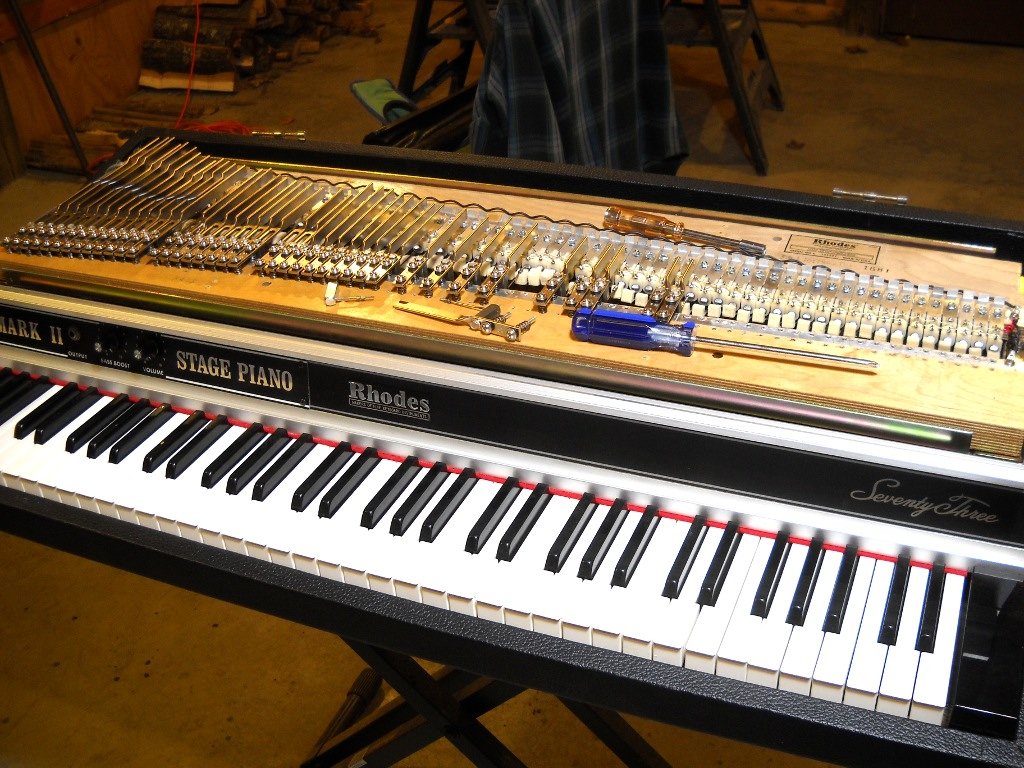
12.1 Stage 88 at a glance
The subject of record is the canonical passive Stage 88 across the Mark I (1970–1979) and Mark II (1979–1983) generations; the Mark V (1984) Stage 88 appeared in brochures but was never sold, so a genuine Stage 88 is in practice a Mark I or Mark II (Vol 01 §“Mark I / Mark II / Mark V”).
12.1.1 Stage 88 — Mark I vs Mark II
Table 1 — Stage 88 — Mark I vs Mark II
| Parameter | Mark I (1970–1979) | Mark II (1979–1983) | Source |
|---|---|---|---|
| Compass | 88 notes, A0–C8 (full piano), A4 = 440 Hz | 88 notes, A0–C8, A4 = 440 Hz | Vol 01 §“What the Stage 88 is” / §“Stage 73 vs 88” |
| Approx. case length | ≈ 53.5 in (≈ 1359 mm) | ≈ 53.5 in (≈ 1359 mm) | Vol 01 §“Stage 73 vs 88” |
| Approx. weight | ≈ 160 lb (≈ 73 kg) (est.) | ≈ 160 lb (≈ 73 kg) (est.) | Vol 01 §“Stage 73 vs 88” (community figure, flagged est.) |
| Keybed | Wooden keys | Wooden, then plastic keys from 1980 | Vol 01 §“Mark I / Mark II / Mark V” / §“Dating” |
| Top lid / harp cover | Sculpted/raised lid; early “sparkle top,” later flat-black tolex | Flat harp cover; removable music rack | Vol 01 §“Mark I / Mark II / Mark V” |
| Name rail badge | ”Fender Rhodes” to ~1974, then “Rhodes" | "Rhodes” | Vol 01 §“Mark I / Mark II / Mark V” / §“Dating” |
| Onboard electronics | None — passive pickups straight to one ¼″ jack | None — passive | Vol 01 §“Suitcase vs Stage”; Vol 02 §“The passive harp & wiring” |
| Output character | Passive, mono, high source impedance, instrument level (no preamp, no power amp, no speaker) | Passive, mono, high source impedance, instrument level | Vol 02 §“The passive harp & wiring” |
Note (88-note first-shipment year): The 88-note model is dated 1971 by some sources and 1972 by others; the exact first-shipment year is (est.) and both are recorded, not resolved (Vol 01 §“Mark I / Mark II / Mark V”, Notes). The Mark I line start is likewise dated 1969/1970 by source.
Note (weight/length): The Stage 88 ≈ 160 lb figure is a community value flagged (est.) — Stage 88 curb weights are not factory-documented (Vol 01 §“Stage 73 vs 88”; ep-forum.com weight thread). The Stage 73 (for contrast) is ≈ 130–140 lb (≈ 59–64 kg) and ≈ 45 in, more consistently reported. The 53.5 in → mm conversion here is computed from the inch figure, not an independent source.
12.1.2 Generational mechanical-change timeline (Mark I unless noted)
Table 2 — Generational mechanical-change timeline (Mark I unless noted)
| Change | Date (per origin volume) | Source |
|---|---|---|
| Hammer tips felt → neoprene | 1971 (Vol 01); ~1970–71 (Vol 06) | Vol 01 §“Mark I / Mark II / Mark V”; Vol 06 §“Hammer tips” |
| Tine supplier Raymac (centerless-ground) → Torrington (swaged) | ~1971 (Vol 02 / Vol 05) | Vol 02 §“Warn — tines”; Vol 05 §“Sourcing tines” |
| Pickup shortened (≈ 3.5″ → ≈ 3″); 0.020″ mid/upper gap allowed | March 1972 | Vol 07 §“Tine-to-pickup gap” |
| Molded plastic hammers | 1976–77 | Vol 01 §“Mark I / Mark II / Mark V” |
| Tine supplier → Schaller (shorter/steeper taper) | ~1977–end of production | Vol 05 §“Sourcing tines” |
| Wooden → plastic keys (Mark II) | 1980 | Vol 01 §“Mark I / Mark II / Mark V” |
Note (swaged-tine date — reconciled): An earlier draft of Vol 01 dated the swaging change to 1978; it has been corrected to the Raymac → Torrington transition ~1971 (Vol 02, Vol 05), so all volumes now agree on ~1971.
12.2 Tine & tone-generator reference
Each note is one asymmetric tuning fork — a thin tine (lower leg, struck, carries pitch) clamped to a heavy tonebar (upper leg, stores/returns energy → sustain) on rubber grommets, sensed by an electromagnetic pickup at the tine tip (Vol 02 §“The asymmetric tuning fork”; Vol 05 §“The tone generator at the bench”). Coarse pitch is the tine’s cut length (fn ∝ 1/L²); the tuning spring on every tine is the fine vernier (Vol 02 §“Pitch is set by tine length”; Vol 08).
12.2.1 Tine numbering & the per-note length gap
Table 3 — Tine numbering & the per-note length gap
| Item | Value / status | Source |
|---|---|---|
| Tine numbering convention | #0 through #73 (≈ E1 at the bottom to E7 at the top) — a Vintage Vibe position index, not a count of all 88 keys | Vol 05 §“Sourcing tines” |
| How a specific tine is identified | note name + tine number + model (the #0–#73 index alone does not pin a note on an 88) | Vol 05 §“Sourcing tines” |
| Tine geometry | All tines “are of the same configuration and vary only in length” | Vol 05 §“Removing & replacing a tine” |
| Per-note length table | UNVERIFIED — not reproduced. Lives only in the image-scanned VV/factory cutting-chart PDF (Figure 6-2); read off the chart on the bench | Vol 05 §“Sourcing tines” / §Sources |
| Tine wire gauge / diameter | UNVERIFIED — not published on the VV tine page; not invented | Vol 05 §“Sourcing tines” |
| Tuning spring | One on every tine; sold separately from tines | Vol 05 §“Sourcing tines”; Vol 02 §“Pitch is set by tine length” |
| Grommet durometer / compound | UNVERIFIED — vendor describes qualitatively only; no numeric hardness published | Vol 05 §“Tonebar grommets & screws” |
Warn: No per-note tine length and no tine wire gauge are tabulated here, because none was confirmable from the consulted sources (the figures live inside a scanned-image cutting chart). They must be read off the actual cutting chart, not taken from this volume — Vol 05 deliberately does not state them and neither does this consolidation (Vol 05 §“Sourcing tines”).
12.2.2 Tine taper by era (the variable that must match the piano)
Table 4 — Tine taper by era (the variable that must match the piano)
| Taper / supplier | Era (approx.) | Profile | Character | Source |
|---|---|---|---|---|
| Raymac | 1960s, pre-1971 | Gradual taper, center-less grind | Earliest; longer, gradual taper — match early pianos only | Vol 05 §“Sourcing tines” |
| Torrington | ~1971–1976 | Shorter taper, swaged | Most common; the modern reference (VV replicates it) | Vol 05 §“Sourcing tines” |
| Singer | ~1976–1977 | Between Torrington and Schaller | Short-run supplier (noted to avoid mis-matching) | Vol 05 §“Sourcing tines” |
| Schaller | ~1977–end | Shorter and steeper | Worst-sustaining OEM taper; steep taper shifts strike point | Vol 05 §“Sourcing tines” |
12.2.3 Tone-generator wrench/screw sizes
Table 5 — Tone-generator wrench/screw sizes
| Fastener | Size | Note | Source |
|---|---|---|---|
| Tonebar mounting screws (×2 per generator) | #2 Phillips | Through washer/grommet/spring; set/removed gently, never power-driven | Vol 05 §“The tone generator at the bench” / §“Tonebar grommets & screws” |
| Tine clamp screw (“Tone Generator Mounting Screw”) | 5/16″ (7.938 mm) | Factory power-torqued; vise the assembly before loosening | Vol 05 §“Removing & replacing a tine” |
| Volume Adjustment Screw (pickup arm) | ¼″ (6.350 mm) | Slides the pickup arm to reset level | Vol 05 §“Refit”; Vol 07 §“Tine-to-pickup gap” |
| Timbre Adjustment Screw (front tonebar mounting screw) | #2 Phillips | Sets tine height vs. pickup centerline | Vol 05 §“Refit”; Vol 07 §“Tine vertical alignment” |
12.3 Regulation spec tables
Factory figures are from the Rhodes service manual Chapter Four — Dimensional Standards and Adjustments; field figures are attributed to their named source. Values are copied exactly from Vol 06, in fractional inch and millimetre. The regulation order is strict — leveling → key dip → escapement → strike line → dampers → hammer tips — and “when Key Dip is changed, reestablishment of Escapement and Striking Line is required” (Vol 06 §“The regulation sequence”).
12.3.1 Core regulation targets
Table 6 — Core regulation targets
| Adjustment | Target (manual Ch.4) | Tolerance / range | mm | Source |
|---|---|---|---|---|
| Key dip | 3/8″ | ± 1/32″ (11/32″–13/32″) | 9.525 mm (± 0.794; 8.731–10.319) | Vol 06 §“Key dip” |
| Key dip — field tolerance | 3/8″ | ± 1/16″ (Vintage Vibe) | 9.525 mm (± 1.588) | Vol 06 §“Key dip” |
| Tone-bar coil-spring height | factory 3/8″ | 3/16″ – 1/2″ | factory 9.525 mm; 4.762 – 12.700 mm | Vol 06 §“Escapement / let-off” |
| Strike line — bass | ~2-1/4″ | hammer-tip leading edge → tone-generator leading edge | 57.150 mm | Vol 06 §“Strike line” |
| Strike line — treble | ~1/8″ | (re-verified against Ch.4) | 3.175 mm | Vol 06 §“Strike line” |
| Damper lift | 3/8″ – 1/2″ | clearance when keyed; firm on tine at rest | 9.525 – 12.700 mm | Vol 06 §“Damper regulation” |
| Escapement — ideal (treble limit) | 1/32″ | the most-responsive gap; impossible in the bass | 0.794 mm | Vol 06 §“Escapement / let-off” |
12.3.2 Escapement (let-off) by zone — GRADUATED, never uniform
Table 7 — Escapement (let-off) by zone — GRADUATED, never uniform
| Zone | Service manual Ch.4 | Field / secondary practice | mm (field range) | Source |
|---|---|---|---|---|
| Extreme bass | 1/4″ – 3/8″ | 3/16″ – 3/8″ (Vintage Vibe / common) | 4.762 – 9.525 mm | Vol 06 §“Escapement / let-off” |
| Mid | (graduated between) | 1/16″ – 1/8″ | 1.588 – 3.175 mm | Vol 06 §“Escapement / let-off” |
| Extreme treble | 1/32″ – 3/32″ | 1/32″ – 3/32″ | 0.794 – 2.381 mm | Vol 06 §“Escapement / let-off” |
Note (escapement zone boundaries — flagged conflict, internal to Vol 06): Three sources draw the zones differently — manual Ch.4 (bass 1/4″–3/8″, treble 1/32″–3/32″), Vintage Vibe (bass floor 3/16″, mid 1/16″–1/8″), and Steve’s Corner (a continuous taper ~1/2″ at low E to ~1/16″ at high E). All agree on the shape — wide bass, tight treble, smoothly graduated — and differ only at the boundaries. The manual figures are the reference; the others are stated, not averaged (Vol 06 §“Escapement / let-off”, Flagged note).
12.3.3 Hammer-tip durometer & height zones
Table 8 — Hammer-tip durometer & height zones
| Zone (bass → treble) | Shore — Steve’s Corner | Modern field (VV / Avion) | Source |
|---|---|---|---|
| 1 (bass) | ~30 | ~40 | Vol 06 §“Hammer tips” |
| 2 | ~50 | ~50 | Vol 06 §“Hammer tips” |
| 3 (mid) | ~70 | ~70 | Vol 06 §“Hammer tips” |
| 4 | ~90 | ~90 | Vol 06 §“Hammer tips” |
| 5 (treble) | hard maple | wood core | Vol 06 §“Hammer tips” |
- Canonical progression: ≈ 30 / 50 / 70 / 90 / hard maple (Steve’s Corner); modern kits ≈ 40 / 50 / 70 / 90 / wood. Exact key boundaries vary by supplier and by 73- vs 88-key bed — both progressions stated, not resolved (Vol 06 §“Hammer tips”).
- Tip height — graduated: ~1/4″ (6.350 mm) in the bass to 7/16″ (11.112 mm) in the treble — a 3/16″ (4.762 mm) overall increase (Vol 06 §“Hammer tips”). Original square tips were “3/8″ (9.525 mm) square” before the height-graduated profile (Vol 06 §“Hammer tips”).
- Square → graduated cutover: no clean year and no clean Mark I/Mark II split in the sources; commonly placed ~1977 but approximate — verify per keybed by inspecting the tips (Vol 06 §“Hammer tips”, Flagged note).
12.3.4 Regulation targets at a glance
12.4 Voicing reference
Voicing couples three independent levers into one even, barking scale: hammer-tip hardness (set in Vol 06), tine height vs. the pickup centerline (Timbre Adjustment Screw — sets harmonic content), and the tine-to-pickup gap (Volume Adjustment Screw — sets level/dynamics). Pitch is not voiced — it is re-checked on a strobe after any move (Vol 07 §“What voicing is”).
Table 9 — Voicing reference
| Lever (adjuster) | Setting | Result | Source |
|---|---|---|---|
| Tine height (Timbre Adj. Screw, #2 Phillips) | Slightly above dead center of the pickup (target) | THE BARK — fundamental + tine/tonebar overtones both speak | Vol 07 §“Tine vertical alignment” (Ch.4) |
| Far above center | Dull / muddy — fundamental swamps overtones | Vol 07 §“Tine vertical alignment” | |
| At / below center | Thin / weak — upward-biased swing barely crosses the pole | Vol 07 §“Tine vertical alignment” | |
| Tine-to-pickup gap (Volume Adj. Screw, ¼″ / 6.350 mm wrench) | 1/16″ – 1/8″ (1.588 – 3.175 mm) (nominal window) | Closer = louder + more dynamic + more bark/bell; wider = warmer/smoother | Vol 07 §“Tine-to-pickup gap” (Ch.4) |
| 0.020″ (0.508 mm) — post-March-1972, mid/upper only | More output and dynamics | Vol 07 §“Tine-to-pickup gap” (Ch.4) | |
| Past clearance (too close) | Fault — tine strikes the pickup: buzz / clack / choke | Vol 07 §“Tine-to-pickup gap” | |
| Hammer-tip hardness (Vol 06 durometer kit) | Soft | Rounded “thunk”, fundamental-weighted | Vol 07 §“Tip hardness × tine height × gap” |
| Hard | Bright “clank”, stronger upper harmonics | Vol 07 §“Tip hardness × tine height × gap” |
- Steve’s Corner zone-specific end-of-tine-to-pole-tip gaps (same geometry as Ch.4, read zone by zone): 1/16″ (1.588 mm) bass / 1/32″ (0.794 mm) mid / 1/16″ (1.588 mm) wood-tip (treble) — the mid figure sits inside Ch.4’s own post-March-1972 0.020″ allowance (Vol 07 §Sources). Not a different geometry; a value choice within the same window.
- After any tine is bent, raised, or lowered: “Pitch should be re-established” on the strobe (Vol 07 §“Re-establish pitch on the strobe”; Vol 08).
12.5 Tuning reference
Pitch is the last bench pass. Coarse pitch is the tine’s cut length; the tuning spring is the fine vernier on every tine (Vol 08 §“How a Rhodes tunes”).
Table 10 — Tuning reference
| Item | Value | Source |
|---|---|---|
| Reference pitch | A = 440 Hz (factory machines derived it from the 60 Hz mains line; dial 0 = A440) | Vol 08 §“The strobe method & A=440” |
| Tuning-spring direction | OUT toward the tip → FLATTER; IN toward the base → SHARPER | Vol 08 §“How a Rhodes tunes” |
| Tuning-spring usable travel | ≈ ±1-1/2 semitones (“1-1/2 steps above or below optimum”) from the cut-length pitch; beyond that, re-cut the tine | Vol 08 §“How a Rhodes tunes” |
| By-ear method | Octave-beat: nudge sharp, slide spring back (outward) until the beat disappears; ~5 s/note trained | Vol 08 §“The by-ear octave-beat method” |
| Strobe method | Set A = 440 first; tune each note to a stationary display (Peterson StroboStomp / iStroboSoft) | Vol 08 §“The strobe method & A=440” |
12.5.1 Temperament — equal vs stretch (genuine source conflict)
Table 11 — Temperament — equal vs stretch (genuine source conflict)
| Target | What it is | Who recommends it | Source |
|---|---|---|---|
| Equal temperament (factory baseline) | Every note at exact pitch; dial 0 across the whole keyboard | The factory/manual (“RHODES Pianos are not stretch tuned at the factory”); recommended for ensemble, recording, pitch-critical contexts | Vol 08 §“Tempering: equal vs stretch” |
| Light stretch (working-tech refinement) | Highs a little sharp, lows a little flat, by ear | Many techs / soloists (fenderrhodesla.com; gearspace.com) — for solo warmth / “acoustic vibe” | Vol 08 §“Tempering: equal vs stretch” |
Note (the temperament conflict): The sources genuinely disagree on which sounds “right.” Chapter Five states the factory default is equal temperament yet also supplies an optional cents chart for a slight stretch; fenderrhodesla.com and much of the tech community prefer a light stretch because pure equal temperament can sound dull at the extremes. The baseline target is equal temperament; the common refinement is a light stretch. The operator must choose the target deliberately — neither is “wrong” (Vol 08 §“Tempering”). Any per-note cents figures for a stretch are (est.)/illustrative — the manual’s actual chart is not reproduced (Vol 08 §Sources).
12.6 Preamp & levels quick card
A stock Stage is passive — no onboard preamp, tone control, or stereo effect. An active conversion (Vol 09) fixes the impedance match, restores level/gain, adds EQ, and recreates the Suitcase’s stereo pan (“vibrato”). The signal levels below are the recording reference from Vol 11.
12.6.1 Level & impedance hierarchy
Reference points: 0 dBu = 0.775 V RMS, 0 dBV = 1.0 V RMS (Vol 11 §“Levels & impedance”).
Table 12 — Level & impedance hierarchy
| Signal class | Nominal level (with reference) | Source impedance | Destination needs | Source |
|---|---|---|---|---|
| Mic level | dynamic ≈ −60 dBu (0 dBu = 0.775 V RMS) | low, ≈ 150–600 Ω balanced | mic preamp (XLR); condensers need +48 V | Vol 11 §“Levels & impedance” |
| Instrument — passive Stage harp | instrument level, roughly the −20 dBu region (est.) | high source impedance (qualitative; no Ω asserted) | a ~1 MΩ Hi-Z input (active DI or instrument in) — not a low-Z mic/line input | Vol 11 §“Levels & impedance”; Vol 02 §“The passive harp & wiring” |
| Instrument — Vol 09 buffered out | near line level | low (buffered) | line or instrument input — impedance already solved | Vol 11 §“Levels & impedance”; Vol 09 |
| Line — consumer | −10 dBV ⇒ ≈ 0.316 V RMS (computed) | low | line input (≈ 10 kΩ+) | Vol 11 §“Levels & impedance” |
| Line — professional | +4 dBu ⇒ ≈ 1.23 V RMS (computed) | low, often balanced | line input (≈ 10 kΩ+), balanced | Vol 11 §“Levels & impedance” |
Warn — the Hi-Z requirement: Recording the passive harp direct into a low-impedance input (passive DI, console line, or mic input ≈ 10–100 kΩ) loads the pickups, dulls the top, and drops the level. The direct path must terminate in a ~1 MΩ-class Hi-Z input (active DI ≈ 1 MΩ, or an instrument input), or start from the already-buffered Vol 09 output. Passive (transformer) DIs present only ≈ 50–150 kΩ — too low (Vol 11 §“DI vs amp”; Vol 02 §“Why the Stage needs what comes after”; Vol 09 §“Why the passive Stage wants a preamp”).
12.6.2 Active-conversion reference (Vol 09)
Table 13 — Active-conversion reference (Vol 09)
| Item | Value | Source |
|---|---|---|
| Vintage Vibe StereoVibe | Replica name-rail preamp; click Volume, Bass/Treble + voiced mid bump, stereo tremolo (Rate/Depth), headphone out, mono FX loop, stereo outs | Vol 09 §“The Vintage Vibe StereoVibe” |
| StereoVibe power | USB-C rechargeable lithium battery, up to 24 h/charge; ships uncharged; current revision Rev 8 | Vol 09 §“The Vintage Vibe StereoVibe” |
| StereoVibe MKI, 73-note | $595 (verify current pricing) | Vol 09 §“The Vintage Vibe StereoVibe” |
| StereoVibe MKI, 88-note | $695 (verify current pricing) | Vol 09 §“The Vintage Vibe StereoVibe” |
| StereoVibe MKII (73 & 88) | $475 (verify current pricing) | Vol 09 §“The Vintage Vibe StereoVibe” |
| High-Z load target a passive harp wants | ~1 MΩ (named as the load, not a measured harp value) | Vol 09 §“Why the passive Stage wants a preamp”; Vol 11 |
| Dyno-My-Piano / Avion RetroFlyer input Z | ~330 kΩ (reported, not vendor-confirmed) | Vol 09 §“Other preamps”, Flagged note |
| Stereo “vibrato” | A pan (L↔R), not pitch vibrato — cancels in mono; carry on both outputs | Vol 09 §“The stereo ‘vibrato’ is a pan” |
Note (StereoVibe pricing — flagged): The MKI/MKII prices were read off vintagevibe.com on the access date (June 2026) and are flagged “verify current pricing” — Vintage Vibe revises models and prices over time, and the MKII listing showed one price for both note counts (Vol 09 §“The Vintage Vibe StereoVibe”, Note). Match the variant to the piano’s name rail / electronics plate, then confirm the live figure.
12.7 Refurb tool & consumable list
Consolidated from Vol 03 §“The refurb toolkit” / §“Consumables & replacement stock.” Tool brands are named only where a specific Rhodes-purpose product exists; generic tools are left to the technician’s preferred supplier.
12.7.1 Tools
Table 14 — Tools
| Tool | Use | Source / spec |
|---|---|---|
| #2 Phillips screwdriver | Nameboard, keybed, most cabinet/rail hardware — most-used tool | Hardware store |
| 6″ long-shaft #2 Phillips | Tone-bar / timbre screws inside the harp (voicing, Vol 07) | 6″+ shaft clears the tonebars |
| Small flat-blade screwdriver | Damper release-bar screws; bushings/clips | 1/8″–3/16″ blade |
| ¼″ (6.350 mm) nut driver / wrench | Tine-screw / Volume Adjustment Screw (Vol 05/07) | Nut driver preferred |
| 5/16″ (7.938 mm) nut driver / wrench | Tone-generator mounting / tine clamp screw (Vol 05) | Ratchet wrench helps |
| Side cutters (flush) | Cutting replacement tines to length vs. the chart (Vol 05) | Sharp flush-cut |
| Bench vise (soft jaws) | Clamping the tone generator to break the power-torqued tine clamp screw loose | Jaw pads protect finish |
| Weighted key-dip block | Reading key dip (target 3/8″ / 9.525 mm; Vol 06) | Avion Studios “Weighted Key Dip Block” |
| Black-key height tool | Setting sharps to the leveled naturals (Vol 06) | Avion Studios “Black Key Height Tool” |
| Strobe tuner | A=440 + tempering (Vol 08); pitch re-check after voicing (Vol 07) | Peterson StroboPlus/StroboClip or iStroboSoft |
| Heat gun | Softening old tolex adhesive; re-laying tolex (Vol 04) | Variable-temp preferred |
| Utility knife + steel straightedge | Trimming tolex / cutting the old covering as a pattern (Vol 04) | Fresh blades |
| Staple gun | Edge-stapling tolex at seams (Vol 04) | Light-duty |
| Contact cement | Bonding tolex (Vol 04) | Neoprene cement or VV tolex glue |
| Sandpaper + tack cloth | Case prep / lid refinish (Vol 04) | Assorted grits |
| Wood glue + filler + clamps | Case-joint / rear-panel repair (Vol 04) | Bar/pipe clamps |
| Evapo-Rust (or equivalent) | De-rusting corners, latches, harp/leg hardware (Vol 04) | Non-acid, reusable |
| Soft-jaw pliers / nut drivers | Legs, crossbars, center leg-brace knob (Vol 04) | — |
| Labeled parts bins + zip bags + marker | Sorting/bagging fasteners per sub-assembly | The biggest reassembly time-saver |
| Camera / phone | Documenting every state before/during teardown | Any phone camera |
12.7.2 Consumables & replacement stock
Table 15 — Consumables & replacement stock
| Item | For | Source / note |
|---|---|---|
| Replacement tines (#0–#73 index) | Snapped/fatigued tines (break at the base) | Vintage Vibe; cut from blanks vs. the Ch.6 chart |
| Tonebar grommets | Hardened grommets choke sustain / thin tone | Vintage Vibe / Tropical Fish — replacement “paramount to voicing” |
| Tuning springs | Lost/corroded springs | Vintage Vibe (sold separately from tines) |
| Hammer tips | Worn/hardened/grooved; graduated durometer set | Vintage Vibe / Steve’s Corner |
| Key bushings / felts / punchings | Key leveling and dip shims | Vintage Vibe; assorted thicknesses |
| Bridle straps | Perished/torn damper-arm straps | Vintage Vibe |
| Sustain rod + guide cup | Original thin guide cup “usually broke or went missing”; rod seats in the guide cup, not the center hole | Vintage Vibe / Custom Vintage Keyboards reinforced cup |
| Tolex kit | Re-covering the case (Vol 04) | Vintage Vibe pre-cut kit |
| Hardware — corners, latches, badges, screws | Rusted/missing case & harp hardware | Vintage Vibe / Tropical Fish |
| Tonebar screw + washer + grommet kit | Matched stack — straight screws (“bent screws cause voicing nightmares”) | Vintage Vibe (73-/88-note quantity) |
| Contact cement/tolex glue, staples, sandpaper, tack cloth, wood glue, filler | Cabinet cosmetics consumables (Vol 04) | Hardware store / Vintage Vibe |
12.8 Cross-volume discrepancies
Found while consolidating; flagged, not silently resolved.
-
Swaged-tine date (resolved). An earlier draft of Vol 01 §“Mark I / Mark II / Mark V” listed “swaged tines (1978)”. Swaging as a manufacturing method began with the Raymac → Torrington transition ~1971 (Vol 02 §“…tines”, Vol 05 §“Sourcing tines”), and Vol 01 has been corrected to ~1971. The later Schaller taper (~1977–end of production) is also swaged but shorter/steeper — a separate, later change. All volumes now agree on ~1971.
-
Hammer-tip felt → neoprene date (minor). Vol 01 gives 1971; Vol 06 §“Hammer tips” gives ~1970–71. Consistent in substance (the 1971 figure falls inside the 1970–71 window); noted for completeness.
-
Key-pedestal “bump” framing (minor / ambiguous). Vol 01 §“Mark I / Mark II / Mark V” lists a “key-pedestal ‘bump’ mod (1977)” as a period change, while Vol 06 §“The Miracle Mod” describes the bump as a 1960s feature that was lost on the 1972–1977 models and is revived by the aftermarket Miracle Mod. The two are not obviously the same event; Vol 01’s 1977 “bump mod” is not cross-referenced to Vol 06’s account, so the relationship is left open rather than asserted.
-
Tone-bar suspension height vs. coil-spring height range (apparent only, different references). Vol 05 §Sources cites a vendor description that the mounting spring “suspends the bar just under a half inch from the rail,” while Vol 06 §“Escapement / let-off” gives the tone-bar assembly height as adjustable 3/16″–1/2″, factory 3/8″ (9.525 mm). These measure different things (the spring’s free suspension vs. the regulated bar height) and both sit within the 3/16″–1/2″ band; recorded as an apparent discrepancy, not a real one.
No value in this volume was invented; every figure above matches its origin volume, and the unverified/estimated items (Stage 88 weight, per-note tine length, tine gauge, grommet durometer, StereoVibe pricing, instrument-level dBu, stretch cents) carry the same flags they were given upstream.
Sources
Consolidated and de-duplicated from the “Sources” sections of Vols 01–11. Unverified or estimated items are flagged in the tables above; this bibliography lists the full references grouped by type.
Primary factory service manual (fenderrhodes.com — Rhodes Keyboard Instruments service manual)
- Chapter One: The Rhodes Tone Source — asymmetric tine/tonebar fork; tonebar stores/returns energy; coil spring as pitch control; >6,000,000-blow tine fatigue test (Vols 01, 02, 05).
- Chapter Three: Instructions for Disassembly — full teardown sequence, harp-cover rear-corner lift, nameboard 4 screws, harp 14 mounting / 4 support / 2 pivot-link screws, hammer/keyboard/action-rail removal (Vol 03).
- Chapter Four: Dimensional Standards and Adjustments — key dip 3/8″ ± 1/32″, escapement zones, tone-bar height 3/16″–1/2″ (factory 3/8″), strike line 2-1/4″→1/8″, damper lift 3/8″–1/2″, hammer-tip heights 1/4″→7/16″, tine-to-pickup gap 1/16″–1/8″ and the 0.020″ post-March-1972 allowance, Timbre/Volume adjustments (Vols 06, 07).
- Chapter Five: Tuning the Rhodes Piano — tuning-spring direction and ±1-1/2-step
range, octave-beat method, strobe/60 Hz reference, A440, equal-temperament default
- optional stretch chart (Vol 08).
- Chapter Six: Repair Procedures and Techniques — twelve-step tine replacement, ¼″/5/16″ wrenches, side cutters, bench-vise step, cutting chart Fig. 6-2 (Vol 05).
- manualslib.com, Rhodes Piano Service Manual p.8 — corroborating teardown scan (Vol 03).
Steve’s Corner (fenderrhodes.com/service)
- Escapement & Strike Line — continuous-taper escapement (~1/2″ low-E → ~1/16″ high-E), harp-support spacer method, strike point “past the tapered section” (Vol 06).
- Hammer Tips — durometer zones ~30/50/70/90/maple, 3/8″-square original tips, “thunk/clank,” shave max ~twice (Vol 06).
- Ideal Tine Settings — eye-then-ear voicing, low viewing angle, strobe pitch re-check, zone-specific tine-end-to-pole-tip gaps (Vol 07).
Fender Rhodes history & effects (fenderrhodes.com)
- Mark I (1969–74 / 1975–79), Mark II & III, Mark V, history, How old is my Rhodes? — model lineage, name-rail/key changes, date codes, Stage-88 specs (Vol 01).
- Classic Rhodes Effects — square-wave tremolo → 1969 stereo pan; phaser/chorus/ wah/ring-mod history (Vols 09, 10).
- Dyno-My-Piano: The Chuck Monte Story (Vol 09); Amplifiers — Twin Reverb, Super Satellite, Janus I (Vol 10).
- fenderrhodesla.com — Rhodes Piano Tines by Year (Vol 05); Rhodes Piano Tuning: Stretch vs Equal Temperament (Vol 08); Recording Fender Rhodes Pianos (Vol 11).
Restoration vendors & shops
- vintagevibe.com / vintagevibepiano.com — tines (#0–#73, tapers, Torrington spec), tonebar screw+grommet kits, tuning springs, hammer-tip guide, 5 Easy Ways to Make Your Rhodes Play Better, Miracle Mod, StereoVibe (Rev 8, USB-C battery, pricing), Peterson/Janus & cheek-block power-supply rebuild kits, QRS PNOscan, History of Rhodes Pickups, harp RCA (Vols 03, 05, 06, 09, 11).
- Tropical Fish — grommet sets and case/harp hardware (Vol 03).
- chicagoelectricpiano.com — Mark I vs Mark II, How to date a Rhodes, The Fender Rhodes “Bark” (Vols 01, 07).
- retrolinear.com — MK.I Torrington / Schaller / Raymac-Singer tine timeline (Vol 05).
- jupitervintagepianos.com — Tone Bar Screw (two-screw count), Pickup (Rhodes) (≈3″ vs ≈3.5″), What is the Bump Mod? (Vols 05, 06, 07).
- shadetreekeys.com — Tines and Tone Bars (two screws / “just under a half inch”), Miracle Mod (Vols 05, 06).
- cvkeyboards.com (Custom Vintage Keyboards) — reinforced sustain guide cup (Vol 03).
- avionstudios.com — Weighted Key Dip Block, Black Key Height Tool, Hammer Tip Sets, The RetroFlyer (Vols 03, 06, 09).
Academic & acoustic analysis
- mat.ucsb.edu, Gregory Shear, The Electromagnetically Sustained Rhodes Piano (UCSB thesis) — clamped-free cantilever / inharmonic overtones, pickup voicing (Vols 02, 07).
- ISMA 2014 (conforg.fr), Non-Linear Behaviour in Sound Production of the Rhodes Piano; DEGA/DAGA 2017, Tone Production of the Wurlitzer and Rhodes E-Pianos — beam models, phase-locked coupling, fn ∝ 1/L² (Vol 02).
- soundgirls.org, The Fender Rhodes — asymmetric fork and pickup voicing (Vols 02, 07).
Recording, levels & amplification
- soundonsound.com — Prepare to DI! (active vs passive DI impedance), Avion Studios Retro-Flyer, Rhodes reveal MIDI MK8 system (Vols 09, 11).
- audiouniversityonline.com, Consumer vs Professional Audio Levels — 0 dBu / 0 dBV references, +4 dBu vs −10 dBV (Vol 11).
- en.wikipedia.org — Rhodes piano (mechanism, Stage vs Suitcase, cultural arc); Line level (level hierarchy) (Vols 01, 02, 11).
- petersontuners.com — iStroboSoft / StroboStomp (Vol 08).
- vintagerockkeyboards.com, Twin Reverb (Vol 10); guitarchalk.com / ep-forum.com (Small Stone vs Phase 90) (Vol 10); strymon.net / articles.boss.info (pedal-chain order) (Vol 10).
- gearspace.com — Rhodes mike or DI, Recording Fender Rhodes, Stretch tuning VS. Equal Temperament, Twin Reverb or Deluxe Reverb, Suitcase-vs-Stage thread (Vols 01, 02, 08, 09, 10, 11).
- forums.musicplayer.com — Mono Tremolo or Stereo Pan Effect for Rhodes? (Vol 09); musicplayers.com — Rhodes Announces the MIDI MK8 (Vol 11).
Community / cultural & dimensional
- ep-forum.com (weight thread), reverb.com — Stage 73/88 weight/dimension community figures, flagged (est.) (Vol 01).
- system-audio.com, redbullmusicacademy daily, rhodesmusic.com — cultural arc and dated exemplar recordings (Vol 01).
Cross-references: overview, lineage, Mark I/II/V, Stage 73 vs 88 Vol 01; tine/tonebar fork, pickup, passive harp, signal path Vol 02; tools, teardown, consumables Vol 03; cabinet, tolex, legs, sustain pedal Vol 04; tines, tonebars, grommets, tapers Vol 05; action regulation (dip, escapement, strike line, dampers, hammer tips, Miracle Mod) Vol 06; voicing and the bark Vol 07; tuning, the tuning spring, equal vs stretch Vol 08; preamp and active conversion Vol 09; amplification and effects Vol 10; recording, levels, DI Vol 11.
Comments (0)