Fender Rhodes Stage 88 · Volume 8
Fender Rhodes Stage 88 — Vol 08: Tuning & Tempering
This is the tuning volume of the refurbishment bench manual — the pass that puts the keyboard back on pitch after the mechanical work is done. Any tine cut and coarse-tuned in Vol 05, and any tine bent, raised, or lowered while voicing in Vol 07, leaves the note close but not final; this volume brings the whole instrument to a reference pitch and a chosen temperament. It rests on the same fork drawn in Vol 02 and Vol 05 — the asymmetric tine/tonebar tuning fork — and on the one part on that fork that exists only to trim pitch: the tuning spring wound on the tine. The work splits into three things the volume keeps separate: how a single note is moved (the spring as a vernier), how the operator finds the target (by ear against the octave, or by strobe against A=440 Hz), and what target to aim at (the temperament choice — equal vs. stretch, where the sources genuinely disagree).
Note: Pitch is the last of the bench passes, on purpose. The tuning spring only trims a tine whose length and clamp are already final (Vol 05 §“Removing & replacing a tine”), and the strobe re-check that closes the voicing pass (Vol 07 §“Re-establish pitch on the strobe”) hands the actual tempering of the keyboard here. Tuning a fork whose tonebar still sways on a hardened grommet, or whose tine is still being bent for level, is tuning a moving target — settle the mechanics first, temper last.
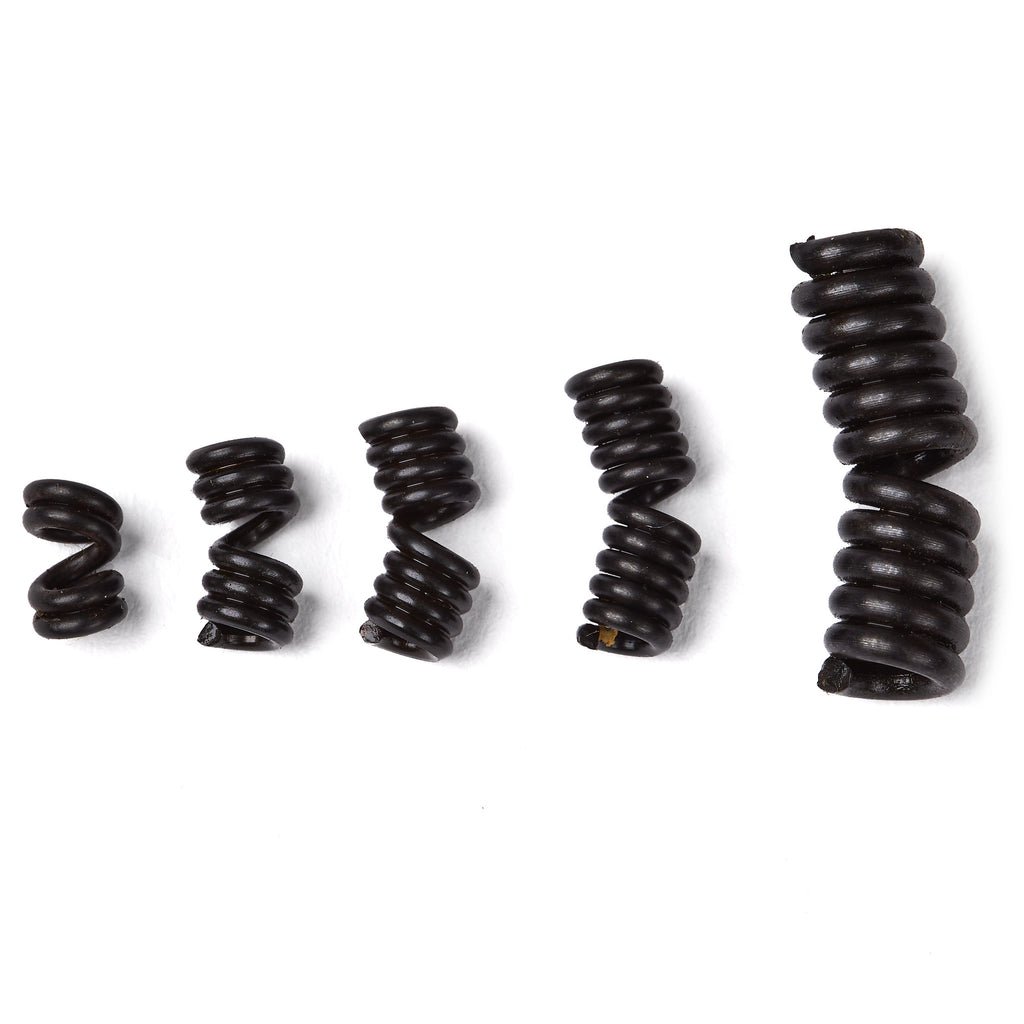
8.1 How a Rhodes tunes (the tuning spring)
A Rhodes note has two pitch controls, and they work at very different scales. The coarse control is the cut length of the tine — a shorter tine rings sharper, set once with the side cutters against the cutting chart (Vol 05 §“Cut the new tine to length against the chart”). The fine control — the vernier used for all routine tuning — is the tuning spring: a small crimped coil spring wound onto the tine that “acts as a counter-weight and, therefore, as a pitch control” (fenderrhodes.com, Chapter One; Vol 02 §“Pitch is set by tine length”). Sliding that counterweight along the tine moves the vibrating mass and so trims the pitch without recutting anything.
The direction is the one fact the operator must never get backwards, and Chapter Five states it plainly: “Moving it outward, away from the fixed end of the Tine, will cause a drop in pitch. Conversely, moving it inward, toward the fixed end of the Tine, will cause a rise in pitch” (fenderrhodes.com, Chapter Five). The fixed end is the base where the tine clamps to the tonebar; the free end is the tip in front of the pickup. So slide the spring OUT toward the tip → the note goes FLATTER; slide it IN toward the base → the note goes SHARPER. The usable travel is bounded: the spring can move the note “as much as 1-1/2 steps above or below optimum” (fenderrhodes.com, Chapter Five) — roughly ±1-1/2 semitones from the tine’s cut-length pitch. Beyond that the spring runs out of tine to grip, and the correction has to come from the cut length instead (Vol 05). This is consistent with the coarse step in Vol 05 §“Tune the new tine,” which slides the same spring to bring a fresh tine into its octave before the keyboard is tempered here.
8.1.1 The tuning spring as a pitch vernier
Warn: Get the direction right before moving anything: out toward the tip flattens, in toward the base sharpens (fenderrhodes.com, Chapter Five). Sliding the spring the wrong way drives the note away from target and wastes the octave reference. And do not force the spring past its travel to chase a note that is more than about ±1-1/2 semitones off — that over-stresses the tine at the base (the fatigue point where tines break, Vol 05 §“Removing & replacing a tine”) and still will not reach pitch. A note that far out wants a re-cut tine length (Vol 05), not a forced spring.
8.2 The by-ear octave-beat method
The factory method in Chapter Five needs no electronics at all — it tunes each note against the note one octave below it and listens for the beat (the slow pulsing that two nearly-in-tune pitches make) to disappear. It is fast once practiced: the manual claims ~5 seconds per note for a trained operator. The example below tunes Middle C against the C an octave below, exactly as the manual gives it; the same pluck-and-slide is then walked up and down the keyboard as on a string piano.
Tools: the tuning spring itself (slid by hand or with a small flat tool); the piano’s amplifier and speaker on, volume up, so both notes are clearly audible; a reference pitch for the starting note (a strobe or fork — §“The strobe method & A=440”); the harp accessible (Vol 03 §“Harp removal & action access”).
8.2.1 Step 1 — Orient the harp and mark the notes
- Rotate the harp to a vertical (upright) position for access to the springs along the tines (fenderrhodes.com, Chapter Five).
- Mark the tonebar letter names along the harp so each tine’s note is identified at a glance before tuning begins — this prevents tuning a note to the wrong octave reference.
8.2.2 Step 2 — Sound the note and its octave below together
- With the amplifier on and volume up, pluck the target tine with the right hand and, at the same time, pluck the same note one octave below with the left hand — the manual uses Middle C plucked against the C an octave below it (fenderrhodes.com, Chapter Five).
- Listen for the beat between the two — a slow wah–wah–wah pulsing whose rate falls to zero as the two pitches converge.
8.2.3 Step 3 — Nudge sharp, then slide back until the beat disappears
- Move the tuning spring at the target note slightly so the note rises a little sharp of the octave below (the manual slides the Middle C spring “slightly upward so as to cause a slight rise in pitch”) (fenderrhodes.com, Chapter Five).
- Continuing to pluck both notes, slowly slide the spring back (outward, toward the tip — flattening the note) and listen as the beat slows.
- Stop the instant the beat disappears — “you continue this process until there is no longer a discernable beat” (fenderrhodes.com, Chapter Five). At that point the target note is a pure octave above its neighbor. With practice this takes about 5 seconds.
8.2.4 Step 4 — Work up and down the keyboard
- Repeat note by note, each time tuning the target tine against the already-tuned note an octave below (and the next octave up against it), working outward from the reference octave up and down the keyboard as on a string piano (fenderrhodes.com, Chapter Five).
- Re-check a few reference notes (the Cs and Fs used for the strike-line and voicing passes, Vol 06–07) after a full sweep, since tuning one note can shift the ear’s sense of its neighbors.
Warn: Always approach the final pitch from the sharp side, sliding the spring back (outward) to drop into tune — the manual’s nudge-sharp-then-ease-flat sequence. Sliding up into pitch from below leaves the spring loaded against its travel and the note liable to creep; easing down onto the beat-null seats it cleanly. And tune only against a note already known-good: chaining octaves off a note that is itself off pitch propagates the error across the whole keyboard. Establish one reference note first (§“The strobe method & A=440”).
8.3 The strobe method & A=440
The electronic method sets an absolute reference instead of a relative one. A strobe tuner displays a band or spinning wheel that appears to stand still when the note is in tune and drifts one way when the note is sharp, the other way when flat — so the operator slides the spring until the pattern stops moving. The reference is set first: tune the strobe so that A = 440 Hz, then tune every note to it. The factory tuners derived that reference from the 60 Hz mains line — “the 60 cycle signal coming from the electrical outlet” — with the dial calibrated so that, at dial 0, the machine reads A440, “the standard arbitrarily determined as an international standard” (fenderrhodes.com, Chapter Five). Modern equivalents are the Peterson strobes — the StroboStomp pedal and the iStroboSoft app — which take the Rhodes signal directly by plug-in and resolve pitch to a fraction of a cent (petersontuners.com, iStroboSoft).
Tools: a strobe tuner (Peterson StroboStomp / iStroboSoft, or a mechanical strobe); a direct line from the Rhodes harp/output into the tuner’s input (the passive harp signal, Vol 02 §“The passive harp & wiring”); the tuning spring, slid by hand.
8.3.1 Step 1 — Set the reference to A=440 Hz
- Calibrate the strobe so A = 440 Hz reads stopped at dial 0 — on the factory machines this referenced the 60 Hz line; on a modern strobe it is the default Concert-A setting (fenderrhodes.com, Chapter Five; petersontuners.com, iStroboSoft).
- Confirm the reference on a known A before tuning the rest of the keyboard, so every note is trimmed against a verified 440 Hz.
8.3.2 Step 2 — Read each note and slide the spring to “stopped”
- Play the note into the strobe and watch the band/wheel: drift one direction means sharp, the other means flat (fenderrhodes.com, Chapter Five).
- Slide the tuning spring to stop the drift — out toward the tip if the note reads sharp (to flatten it), in toward the base if it reads flat (to sharpen it) — until the pattern appears stationary. A stationary strobe is the in-tune indication.
8.3.3 Step 3 — Choose the temperament target before sweeping the keyboard
- Decide the temperament first (§“Tempering: equal vs stretch”), because it changes what “in tune” means on the dial: an unstretched equal temperament holds the dial at 0 across the whole keyboard, whereas a stretch target deliberately offsets the dial a few cents sharp in the treble and a few cents flat in the bass.
- Sweep the keyboard to the chosen target, re-checking the reference A periodically.
Warn: Set A = 440 Hz first, then tune everything to it — calibrating the reference after some notes are already tuned forces a second pass over the whole keyboard. And a stationary strobe means only that the note matches the dial setting: if the dial is at flat 0 across the board, the strobe will read perfectly in tune while many techs hear the result as dull or subtly out of tune (the equal-vs-stretch dispute below). The strobe enforces whatever target it is set to — it does not choose the target.
8.4 Tempering: equal vs stretch
Tempering is the choice of target, not a way of moving the spring — and here the sources genuinely disagree, so both positions are stated and the conflict is flagged rather than averaged. The split is between the factory/manual baseline (equal temperament) and the common working-tech refinement (a light stretch).
Baseline — equal temperament, not stretch-tuned (the factory/manual position). Chapter Five is explicit that “RHODES Pianos are not stretch tuned at the factory. Instead, they are tuned to equal temperament” (fenderrhodes.com, Chapter Five), and fenderrhodesla.com agrees on the historical fact: “Rhodes pianos rolled out of the original factory in equal temperament” (fenderrhodesla.com, Rhodes Piano Tuning: Stretch vs Equal Temperament). In equal temperament every note is tuned to its exact mathematical pitch, which on a strobe means dial 0 across the entire keyboard — no per-note cents offset. The manual treats this as the default; fenderrhodesla.com recommends it for ensemble use, recording, and any context where pitch accuracy against other instruments is critical.
Common refinement — a light stretch by ear (the working-tech position). Many technicians deliberately stretch-tune: set A = 440 Hz on the strobe, then tune the octaves by ear so the highs land a little sharp and the lows a little flat of strict equal temperament. The justification is perceptual, not mathematical: “How we hear pitch is not uniform across the entire range” — in the bass, equal-tempered notes “will often sound sharp,” and in the treble they “may still sound flat to our ears,” so a mathematically perfect tuning can sound out of tune (fenderrhodesla.com). The same source recommends a stretch for “expressive solo performances” and a “classic, ‘acoustic’ vibe,” and offers a moderate “Studio Tuning” as a middle ground; the broader tech community debates the same trade-off (gearspace.com, Stretch tuning VS. Equal Temperament Rhodes).
The conflict, stated plainly. Even the factory manual is not internally tidy: Chapter Five states the factory default is equal temperament yet also supplies an optional cents chart for those who want the extra “brilliance” a slight stretch gives (fenderrhodes.com, Chapter Five). So the honest position for a refurbish is: the baseline target is equal temperament (flat 0 on the strobe, the factory standard and the right call for recording/ensemble), and the common refinement is a light stretch (highs slightly sharp, lows slightly flat, by ear) preferred by many techs and soloists who find pure equal temperament dull. The sources disagree on which sounds “right,” and that disagreement is a matter of taste and context, not of fact — the operator picks the target deliberately before sweeping the strobe.
8.4.1 Equal temperament vs. a gentle stretch — the target on the dial
Warn: The most common avoidable error here is tuning unstretched equal temperament to a strobe and assuming the job is done. A strobe parked at dial 0 across the keyboard will read every note perfectly in tune, yet a meaningful share of techs and players hear that result as dull or subtly out of tune in the extreme bass and treble — which is the whole reason the stretch refinement exists (fenderrhodesla.com). Neither target is “wrong”: equal temperament is correct for ensemble/recording and is the factory standard; a light stretch is the common refinement for solo warmth. The error is failing to choose — pick the target deliberately, do not back into flat-0 by default and then wonder why the highs sound thin.
8.5 Tuning toolset & workflow
The whole tuning pass needs almost no special equipment — the spring is moved by hand, and the only instrument is the reference.
Table 1 — Tuning toolset & workflow
| Tool | Role in tuning |
|---|---|
| Tuning spring (already on every tine, Vol 05) | The vernier itself — slid out toward the tip to flatten, in toward the base to sharpen, within ±1-1/2 semitones of the cut-length pitch (fenderrhodes.com, Chapter Five). |
| Amplifier + speaker (or monitor) | Both notes must be clearly audible for the by-ear beat method; the harp signal also feeds the strobe. |
| Strobe tuner (Peterson StroboStomp / iStroboSoft, or mechanical) | The absolute reference — set A = 440 Hz first, read sharp/flat drift, tune to a stationary display (fenderrhodes.com, Chapter Five; petersontuners.com). |
| Small flat tool (optional) | Nudging a stiff spring that resists a fingertip; the spring is otherwise moved by hand. |
Workflow. The pass runs in a fixed order so a note is never tuned against an unknown:
- Settle the mechanics first — every tine cut, clamped, and voiced (Vol 05, Vol 07); tuning a swaying or still-being-bent fork is tuning a moving target.
- Choose the temperament — equal (flat 0) or a light stretch (§“Tempering: equal vs stretch”) — before touching the strobe, because it sets what “in tune” means.
- Set the reference — calibrate the strobe to A = 440 Hz (dial 0), and/or tune one reference octave by ear against a verified pitch.
- Sweep the keyboard — trim each note’s spring to the chosen target, by the octave-beat method, the strobe, or both (strobe for the reference and the dial-0 notes, ear for the stretched octaves).
- Re-check reference notes and confirm the voicing pass did not pull a note off pitch (Vol 07 §“Re-establish pitch on the strobe”).
Note: The by-ear and strobe methods are complementary, not exclusive. A common workflow sets A = 440 Hz on the strobe as the anchor, then tunes the octaves by ear for whatever stretch is wanted — the strobe guarantees the absolute reference and the ear places the per-octave stretch the strobe-at-dial-0 would flatten out. For a strict equal temperament, the strobe alone (dial 0 across) is sufficient and repeatable.
Sources
- fenderrhodes.com, Chapter Five: Tuning the Rhodes Piano (Rhodes Keyboard Instruments factory service manual) — the load-bearing source for this volume. The tuning spring as a counterweight pitch control and its direction: “Moving it outward, away from the fixed end of the Tine, will cause a drop in pitch. Conversely, moving it inward, toward the fixed end of the Tine, will cause a rise in pitch”, with a usable range of “as much as 1-1/2 steps above or below optimum” (≈ ±1-1/2 semitones). The by-ear octave-beat method: rotate the harp vertical, mark the tonebar letter names, pluck the target note (Middle C) against the note an octave below it with the amplifier on, nudge the spring “slightly upward so as to cause a slight rise in pitch,” then slide it back until “there is no longer a discernable beat,” restoring pitch “within five seconds” with practice, working up and down the keyboard. The strobe method: the wheel/band “appear[s] to be stopped” when in tune and drifts sharp/flat otherwise; calibration references “the 60 cycle signal coming from the electrical outlet,” with dial 0 = A440, “the standard arbitrarily determined as an international standard.” Temperament: “RHODES Pianos are not stretch tuned at the factory. Instead, they are tuned to equal temperament,” with an optional cents chart offered for those wanting added brilliance.
- fenderrhodesla.com, Rhodes Piano Tuning: Stretch vs Equal Temperament — the working-tech case for a light stretch and the explicit counterpoint to the manual’s flat equal temperament. Confirms the factory fact (“Rhodes pianos rolled out of the original factory in equal temperament”) but argues that because “how we hear pitch is not uniform across the entire range,” equal-tempered bass notes “will often sound sharp” and treble notes “may still sound flat to our ears,” so a mathematically perfect tuning can sound out of tune. Recommends stretch for “expressive solo performances” / a “classic, ‘acoustic’ vibe,” equal temperament for “ensemble use, recording, or where pitch accuracy is critical,” and offers a moderate “Studio Tuning” middle ground. This is the source explicitly in tension with Chapter Five’s flat-equal-temperament default.
- gearspace.com, Stretch tuning VS. Equal Temperament Rhodes — the tech-community discussion of the same trade-off (set A=440 on a strobe, then stretch octaves by ear vs. hold strict equal temperament), corroborating that the choice is a genuine, unsettled matter of taste and context among working technicians rather than a single correct answer.
- petersontuners.com, iStroboSoft / StroboStomp — the modern strobe instruments named in the toolset: real strobe-method tuning to a fraction of a cent, signal taken by plug-in, with an adjustable Concert-A reference and stretch (“sweetened”) tuning options — the present-day equivalent of the manual’s electronic strobe.
- Cross-references: the asymmetric tine/tonebar fork and the tuning spring as a counterweight pitch control are Vol 02 (Theory of Operation & Signal Path); the tuning spring on the tine, the cut-length coarse pitch control, and the coarse octave-tune of a fresh tine are Vol 05 (Tines, Tonebars & Grommets); and the strobe pitch re-check after any tine is bent, raised, or lowered during voicing is Vol 07 (Voicing & Tone), which hands the actual keyboard tempering to this volume.
Flagged as conflicting or illustrative, not invented: (1) the equal-vs-stretch temperament choice is a genuine source disagreement, stated as such — Chapter Five’s factory default is equal temperament (flat 0 on the strobe), while fenderrhodesla.com and much of the tech community (gearspace.com) prefer a light stretch (highs sharp, lows flat) because pure equal temperament can sound out of tune; both are presented and the conflict is attributed to its sources rather than resolved. (2) The cents values in the tempering SVG (≈ −5 cents bass to ≈ +5 cents treble) are illustrative of the direction only, marked (est.) — the manual’s actual stretch chart is published as part of Chapter Five and its exact per-note figures are not reproduced here; only the direction (highs sharp, lows flat, crossing 0 in the middle) is sourced. (3) The spring range is given as ±1-1/2 semitones, the manual’s “1-1/2 steps above or below optimum” rendered in semitones for consistency with the rest of the manual. No frequency, cents value, or range has been invented beyond the manual’s own figures; A=440 Hz and the 60 Hz line reference are quoted from Chapter Five.
Comments (0)