Fender Rhodes Stage 88 · Volume 10
Fender Rhodes Stage 88 — Vol 10: Amplification & the Effects Chain
This is the second electronics volume, and it begins exactly where Vol 09 stopped. Vol 09 took the passive harp (Vol 02 §“The passive harp & wiring”) and made it active — fixing the impedance match, adding gain and EQ, and putting the stereo pan back across two outputs — and then deliberately ended at the preamp’s mono effects loop and stereo outputs. This volume is everything that hangs off those jacks: the amplifier(s) the rig drives into, the outboard effects that give the Rhodes its recognizable 1970s voices, the order those effects go in, and how the whole downstream chain is gain-staged from an instrument-level source to a line- or speaker-level destination. It does not re-describe the onboard preamp, its EQ, or its built-in stereo tremolo/pan — that circuit is Vol 09, and is referenced here only as the upstream block this chain plugs into. Recording, DI, and mic’ing the result is Vol 11.
Note: Effect descriptions in this volume are kept qualitative wherever no manufacturer spec is sourced. Where a level or impedance figure appears it is stated with its reference (dBu/dBV, Ω); amplifier wattages are quoted from the cited pages. Artist/record associations are attributed to the source that makes them (chiefly fenderrhodes.com) and are framed as examples the source connects with a sound, never as a claim that a given record used a given exact box.
10.1 Amplifying the Stage
A Stage has no speaker of its own — unlike the Suitcase, whose name comes from its integrated powered cabinet, a Stage is a top on legs and must be plugged into something external (Vol 01 §“Suitcase vs Stage”). What that “something” is shapes the tone as much as any pedal.
The Fender Twin Reverb — the canonical Rhodes amp. The reference amplifier for the Rhodes is the Fender Twin Reverb, a 2×12″, roughly 85 W tube combo. Its standing is not arbitrary: it was the amp used at the factory to test the pianos, so the instruments were voiced to sound their best through it (fenderrhodes.com, Amplifiers). Two properties make it suit the Rhodes specifically:
- Clean headroom. The Rhodes is a percussive, dynamic, full-range source with strong fundamentals in the low mids and a sharp transient (“bark,” Vol 07). It rewards an amp that stays clean while loud so the bell tone and the attack come through without the amp folding into distortion. The Twin is prized by keyboard players for exactly this — it stays clean at high volume where a smaller guitar amp would already be breaking up (fenderrhodes.com, Amplifiers; vintagerockkeyboards.com, Twin Reverb: a classic amp for electric pianos).
- Useful onboard color when wanted. The Twin’s vibrato channel carries spring reverb and optical (photocell) tremolo, and its tubes give a soft overdrive when pushed — a touch of grit on top of an otherwise clean platform (fenderrhodes.com, Amplifiers and Classic Rhodes Effects). This is the “Rhodes through a Twin” sound: clean, dimensional, with reverb and a hint of tube warmth.
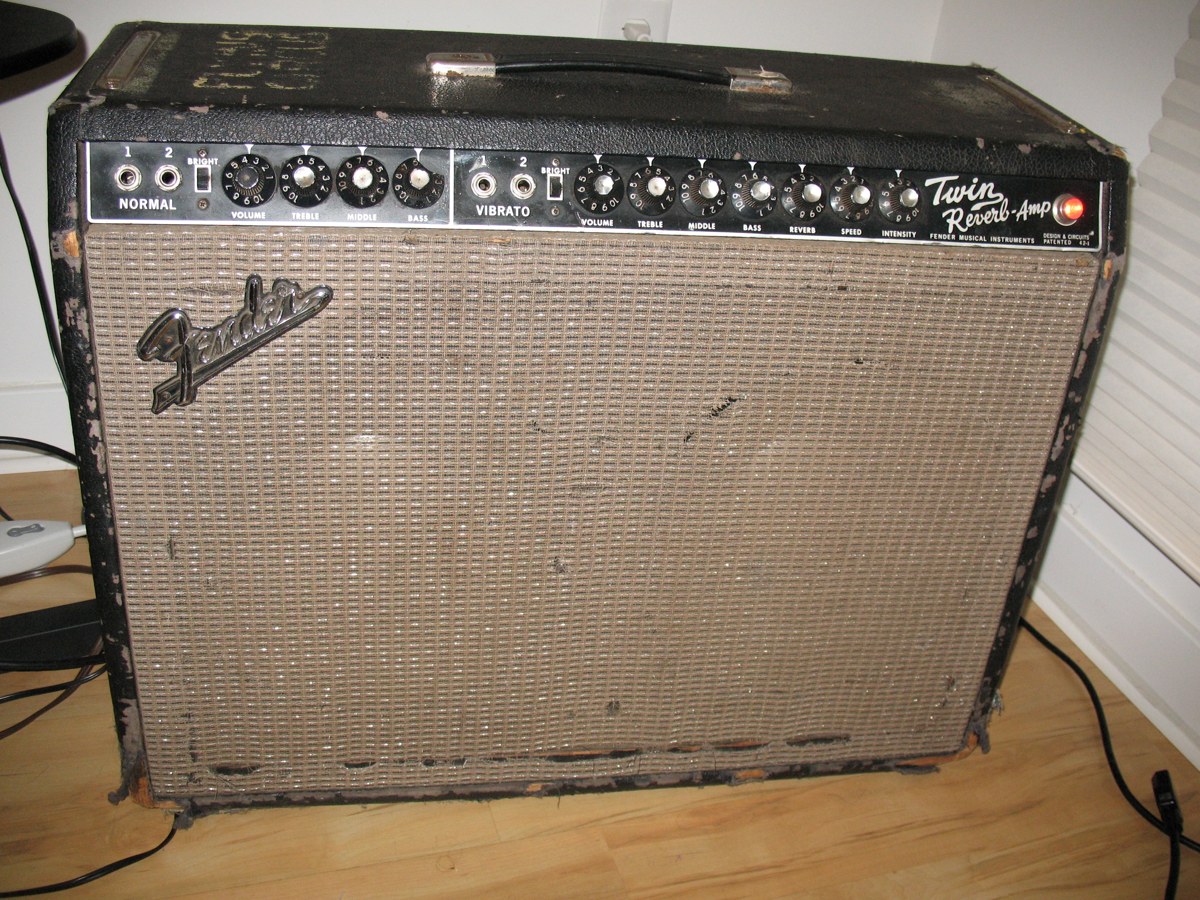
Other amp choices. The Twin is the reference, not the only option:
- Dedicated keyboard amps / FRFR & PA. Because a Stage is full-range and (when active, Vol 09) stereo, a flat, full-range, powered (FRFR) monitor, a dedicated keyboard combo, or a PA / monitor wedge reproduces it with the least coloration — the right answer when the goal is the piano’s own voice plus whatever the pedals add, rather than a guitar-amp character. These also make stereo trivial (two boxes, or a stereo PA feed).
- Guitar combos for character. Smaller tube combos (e.g. a Fender Deluxe Reverb) trade headroom for earlier, sweeter breakup — useful for a dirtier, more compressed Rhodes, less so for a pristine clean tone. The trade-off is exactly the headroom point above (gearspace.com, Twin Reverb or Deluxe Reverb for Rhodes).
- Roland JC-120 Jazz Chorus. A solid-state combo whose built-in stereo chorus is itself one of the classic lush-Rhodes effects (fenderrhodes.com, Classic Rhodes Effects; see §“The signature effects”).
Stereo or mono into the amp. With the Vol 09 preamp fitted, the rig can run stereo — the two preamp outputs into two amps, so the onboard pan (and any stereo modulation) is heard as a moving image — or mono, one output into one amp. The mono/stereo decision is not just convenience: because the onboard effect is a pan, collapsing to mono changes what is heard (Vol 09 §“The stereo ‘vibrato’ is a pan”). That mechanism, and how to place a stereo effects rig around it, is §“Stereo from the preamp” below.
10.2 The signature effects
This is the heart of the volume. The effects below are what turn an amplified Stage into the recognizable Rhodes voices of the 1970s and after. The onboard tremolo/pan is not in this list — it lives in the preamp (Vol 09); everything here is outboard, plugged into the preamp’s effects loop or strung between its outputs and the amp.
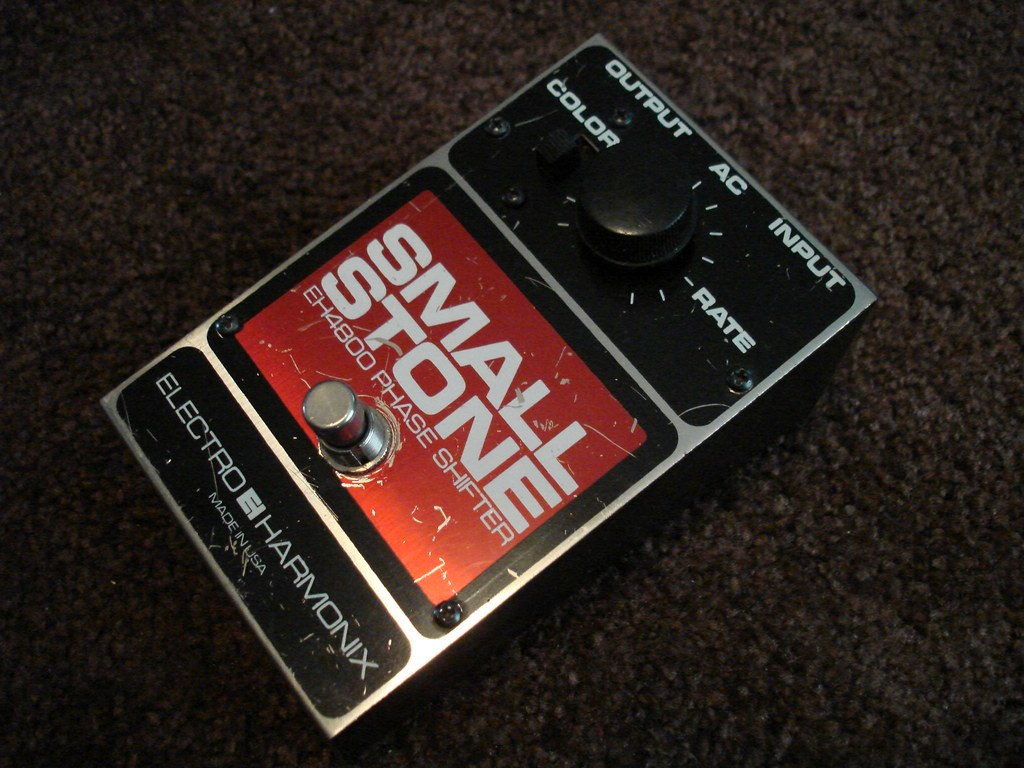
Phaser — the signature Rhodes modulation. A phaser splits the signal, shifts the phase of one copy through a sweeping series of all-pass stages, and recombines it, producing moving notches in the frequency response — a swirling, vocal, “underwater” animation. It suits the Rhodes because the instrument’s sustained, harmonically rich tones give the sweep something to act on, and the result is the quintessential “phased electric piano” of the era. The two canonical boxes both appeared in 1974 and are both four-stage analog phasers:
- The Electro-Harmonix Small Stone — arguably the canonical Rhodes phaser, with a Rate knob and a Color switch that deepens the effect (fenderrhodes.com, Classic Rhodes Effects; guitarchalk.com, Small Stone vs Phase 90).
- The MXR Phase 90 — the orange single-knob (Speed) box, the other staple of the sound (fenderrhodes.com, Classic Rhodes Effects; ep-forum.com).
- The Uni-Vibe is sometimes grouped here — a related phase/chorus-vibrato modulation listed among the classic Rhodes effects (fenderrhodes.com, Classic Rhodes Effects).
Chorus — lush, stereo width. A chorus delays and pitch-modulates a copy of the signal and mixes it back, thickening and widening the tone; in stereo it spreads the Rhodes across the image for the lush, shimmering ballad sound. Classic units include the BOSS CE-1 Chorus Ensemble (stereo out, with a deeper pitch-modulated vibrato mode) and the Roland JC-120 Jazz Chorus amplifier’s built-in stereo chorus (fenderrhodes.com, Classic Rhodes Effects).
Tremolo / auto-pan (outboard). The onboard stereo tremolo/pan is Vol 09. For a Stage running without the active preamp — a bare passive harp into a single amp, or into an active DI — the swirl has to come from outboard gear: an amp’s own tube tremolo (the Twin’s, above), a mono tremolo pedal, or a stereo tremolo / auto-panner placed across two outputs to recreate the left↔right pan. The distinction matters because a mono tremolo survives a mono sum while a stereo pan cancels in mono (Vol 09 §“The stereo ‘vibrato’ is a pan”) — so an outboard panner needs the same two-amp stereo rig the onboard effect does.
Overdrive / drive — the bark and growl. Pushed into mild distortion, the Rhodes takes on a “barking” or “growling” edge that cuts through a band — the gritty fusion and rock Rhodes voice. This is usually a light, low-gain drive: the amp’s own tube clipping when turned up (the Twin), the slight overdrive of the original Suitcase preamp when driven, or a low-gain overdrive pedal in front of the amp. Heavy distortion tends to mush the Rhodes’ complex attack, so the classic move is a touch of drive for harmonic thickening, not full saturation (fenderrhodes.com, Classic Rhodes Effects).
Wah, envelope filter, and other filters — funk Rhodes. A wah pedal sweeps a resonant bandpass filter, emphasizing the midrange and pulling out the bell tone for a vocal, expressive funk voice; combined with a fuzz it becomes the “fuzz-wah” heard in early jazz-fusion Rhodes. An envelope filter / auto-wah does the same sweep automatically off the playing dynamics, for a hands-free funk-clav-like quack. fenderrhodes.com associates the wah’d Rhodes with the jazz-fusion players of the era (e.g. Herbie Hancock, Chick Corea, Joe Zawinul) (fenderrhodes.com, Classic Rhodes Effects).
Ring modulator (brief). A ring modulator multiplies the Rhodes against an oscillator to produce clangorous, inharmonic, bell-and-metal timbres — a special-use color the source associates with fusion experimentation (e.g. Jan Hammer with the Mahavishnu Orchestra), not an everyday effect (fenderrhodes.com, Classic Rhodes Effects).
10.2.1 Effects palette
Table 1 — Effects palette
| Effect | What it does | Typical setting / placement | Representative unit |
|---|---|---|---|
| Phaser | Sweeping phase-notch swirl; the signature 1970s “phased Rhodes” | Modulation slot, after any drive; moderate rate/depth; mono or stereo | EHX Small Stone; MXR Phase 90 (both 1974) |
| Chorus | Thickens/widens via delayed, pitch-modulated copy; lush in stereo | Modulation slot; stereo across two outputs for width | BOSS CE-1; Roland JC-120 (amp chorus) |
| Tremolo / auto-pan (outboard) | Amplitude throb (mono) or L↔R pan (stereo) — for a Stage without the Vol 09 preamp | Amp’s tube tremolo, or a pedal; a stereo panner needs two amps | Amp tremolo (Twin); outboard stereo tremolo/auto-panner |
| Overdrive / drive | Mild harmonic grit — the “bark/growl” | Light; in the loop or front of amp, before modulation; or the amp’s own tube clip | Low-gain overdrive pedal; Twin tube clip; Suitcase-preamp drive |
| Compressor | Evens dynamics, sustains the bell tone, adds punch | Early in the chain (a dynamics block); subtle for keys | Studio/pedal compressor (generic) |
| Wah / envelope filter | Resonant sweeping bandpass — funk voice | Filter block, early (often ahead of drive); pedal-swept or auto | Wah pedal; auto-wah / envelope filter; fuzz-wah |
| Reverb / delay | Space and depth | Last — in the amp’s FX loop or after the rig; the Twin’s spring reverb is onboard | Twin spring reverb; outboard delay/reverb |
| Ring modulator | Inharmonic, clangorous bell/metal timbres | Special-use, typically early; sparing | Ring modulator (generic) |
10.3 Chain order & gain-staging
Effects are not order-neutral: a drive followed by a phaser sounds different from a phaser followed by a drive, and the wrong order can amplify noise or muddy the attack. The conventional pedal order, adapted from standard practice to the Rhodes, runs from dynamics/filter → gain → modulation → time (strymon.net, Setting up your effect signal chain; bossus / articles.boss.info, Order of operation):
- Dynamics & filter first — compressor, wah / envelope filter. Compressing before drive gives the drive a steadier input; filters early shape what the rest of the chain acts on.
- Gain next — overdrive / drive. Distortion wants a clean, controlled input and should sit before modulation, so the phaser/chorus animate the driven tone rather than feeding dirt into the modulator.
- Modulation — phaser, then chorus (or either order; players rarely run both hard at once, so the order between two modulations matters little).
- Time / space last — delay and reverb. On an amp that has an effects loop, place them in the loop so they sit after the preamp gain and stay clear (strymon.net). Note the Twin Reverb has no FX loop, so with that amp time effects go in front of it (or use the Twin’s onboard spring reverb); the loop advice applies only to amps that have one.
Where the preamp’s effects loop sits. The Vol 09 preamp exposes a mono effects loop (send/return) ahead of its internal stereo pan and outputs. That placement is deliberate and useful: mono effects — compressor, drive, a mono phaser — belong in that loop, before the pan, so they process a single coherent signal; stereo effects (stereo chorus, stereo phaser) belong after the two outputs, where there are two channels to spread across. Putting a stereo effect in the mono loop throws away its width; putting a mono drive after the pan doubles the gear and can fight the panning. (Onboard loop/output architecture: Vol 09 §“The Vintage Vibe StereoVibe.”)
Gain-staging the passive Stage → preamp → effects → amp. Each stage should be driven to a healthy level without clipping the next:
- Harp → preamp. The passive harp is a high-impedance, instrument-level source (Vol 02; Vol 09 §“Why the passive Stage wants a preamp”). The preamp presents the ~1 MΩ load the pickups want and raises the signal toward line level — by convention referenced to +4 dBu (professional) or −10 dBV (consumer). Set the preamp’s gain (Vol 09’s click Volume) so it drives the chain cleanly without the preamp itself clipping.
- Through the effects. Many pedals expect an instrument-level input; a hot line-level preamp output can overdrive a pedal’s front end (sometimes a desired drive, often unwanted fizz). Trim the preamp output, or use pedals with input gain controls, so each effect sees a level it likes.
- Into the amp. The amp’s input wants a controlled level; set the amp’s volume for clean headroom (the Twin point above) and let the preamp/pedals set the working level ahead of it. Detailed level-matching for a recorder or console — nominal levels, DI, pads — is Vol 11 §“Recording & integration.”
Tip — phaser placement. Put the phaser (and chorus) after any overdrive, not before. A phaser ahead of a drive feeds the drive a constantly shifting spectrum, which smears the distortion; a phaser after the drive sweeps a stable, already- driven tone and stays musical. The same logic puts time/space (reverb, delay) last of all.
10.4 Stereo from the preamp
The Vol 09 preamp’s two outputs make a stereo rig possible; whether to use it is a real decision, because the onboard effect is a pan, not a mono tremolo.
- Two outputs → two amps = the intended effect. Running both preamp outputs into two amplifiers (or two PA/FRFR channels) reproduces the onboard tremolo as a moving left↔right image — the classic Suitcase swirl — and lets any stereo modulation (chorus, stereo phaser) open up across the field. This is the setup the effect was designed for (Vol 09 §“The stereo ‘vibrato’ is a pan”).
- One output → one amp = mono, and the pan collapses. Summing the two channels to mono makes the pan cancel toward a constant level — the swirl largely disappears (Vol 09). Mono is fine for a dry, centered Rhodes, or where only one amp is available, but it is not how to hear the onboard pan. Effects that are amplitude- or tone-based (mono tremolo, drive, wah) survive a mono sum; the pan does not.
- Placement around the pan. Keep mono processing (dynamics, drive) in the preamp’s mono effects loop, before the pan; keep stereo processing (chorus, stereo phaser) after the two outputs, across the stereo field (§“Chain order & gain-staging”). Inserting a stereo effect ahead of the pan, or a phase-inverting box in only one channel, can fight the pan and even cause partial cancellation when the rig is later summed to mono for broadcast or a mono PA.
Note — check mono compatibility. Any rig that will ever be summed to mono (a mono PA, a broadcast feed, a single FOH channel) should be bench-checked in mono: engage the onboard pan and the stereo effects, then collapse L+R and listen. The pan will flatten by design (Vol 09); what must not happen is the dry tone itself thinning out, which signals a phase problem in a stereo effect rather than the intended pan cancellation. Mono summing for recording is developed in Vol 11.
10.5 Dialing classic tones
A few recognizable Rhodes voices and the chains that get there. These are described as families of sound, with exemplars the cited source associates with them — not as claims that a specific record used a specific box.
- Clean and dimensional (“Rhodes through a Twin”). Preamp set clean and full (Vol 09 §“Dialing in tone”) → into a Twin Reverb with its spring reverb up a touch → stereo if two amps are available. Add the onboard stereo tremolo (Vol 09) for the Suitcase swirl. The whole point is headroom: let the bell tone and attack stand clear (fenderrhodes.com, Amplifiers).
- Phased ballad Rhodes. Clean preamp → phaser (Small Stone or Phase 90) at a slow rate and moderate depth → amp; optionally stereo chorus after the outputs for extra width. fenderrhodes.com connects the phased electric-piano sound with recordings such as Billy Joel’s “Just the Way You Are” and Paul Simon’s “Still Crazy After All These Years” — cited as examples of the sound the source associates with a phaser, not as a gear bill of materials (fenderrhodes.com, Classic Rhodes Effects).
- Lush stereo chorus. Clean preamp → stereo chorus (a CE-1, or a JC-120’s built-in chorus) across two outputs/amps → minimal drive. The widest, shimmering ballad voice (fenderrhodes.com, Classic Rhodes Effects).
- Barking / growling Rhodes. Preamp pushed, plus a light overdrive (or the Twin’s own tube clip) → optional phaser after the drive → amp. A touch of dirt for cut and harmonic thickening, not full saturation (fenderrhodes.com, Classic Rhodes Effects).
- Funk Rhodes. Wah or envelope filter early in the chain (often ahead of a light drive), pulling the bell tone into a vocal, expressive midrange — the jazz-funk voice the source associates with the early-fusion players (fenderrhodes.com, Classic Rhodes Effects).
Note: The amp and effects above interact with the onboard preamp settings, not replace them. Set the preamp to a clean, full starting point (Vol 09 §“Dialing in tone”), then do the amp-and-pedal voicing here. Where this chain has to meet a recorder, console, or DI — and how to mic the amp — is Vol 11 §“Recording & integration.”
Sources
- fenderrhodes.com, Classic Rhodes Effects (history/effects) — the outboard effects associated with the Rhodes: phaser (Electro-Harmonix Small Stone, MXR Phase 90, Uni-Vibe); chorus (BOSS CE-1 Chorus Ensemble, Roland JC-120); wah (emphasized midrange, removes the bell tone; fuzz-wah) associated with jazz-fusion players (Herbie Hancock, Chick Corea, Joe Zawinul); overdrive via the Twin’s tubes and the original Suitcase preamp’s slight drive; ring modulator (associated with Jan Hammer / Mahavishnu); and the phased electric-piano sound associated with Billy Joel’s “Just the Way You Are” and Paul Simon’s “Still Crazy After All These Years.” Artist/record associations are taken as the page states them and framed as exemplars, not as confirmed gear lists.
- fenderrhodes.com, Amplifiers (pianos/amp) — the Fender Twin Reverb as “the original (and still preferred)” Rhodes amp, used at the factory to test the pianos, so they were voiced to sound best through it; a 2×12″ combo with vibrato, tube overdrive, and spring reverb. The Super Satellite System (1972, paired 2×12″ cabinets at 100 W each; a master cabinet running mono at half power) and the Janus I (1978, each cabinet an independent stereo amp).
- vintagerockkeyboards.com, Twin Reverb: a classic amp for electric pianos (accessed June 2026) — the Twin’s clean headroom at volume as the reason keyboard players favor it over smaller guitar combos.
- gearspace.com, Twin Reverb or Deluxe Reverb for Rhodes — the headroom trade-off between a larger clean amp (Twin) and a smaller, earlier-breakup combo (Deluxe).
- guitarchalk.com, EHX Small Stone vs MXR Phase 90; ep-forum.com, Small Stone vs Phase 90 — both pedals are four-stage analog phasers introduced in 1974; the Small Stone adds a Color switch, the Phase 90 is a single-knob (Speed) box; both are staples of the phased-Rhodes sound. (Tone-comparison references only; the gear’s Rhodes pedigree is from fenderrhodes.com.)
- strymon.net, Setting up your effect signal chain; articles.boss.info, Order of operation: a guide to effects signal chain — the conventional pedal order (dynamics/filter → gain → modulation → time), with drive before modulation and reverb/delay last (often in the amp’s FX loop). Applied here to the Rhodes; ordering principles, not Rhodes-specific claims.
- Cross-volume: the onboard preamp, its EQ, and its stereo tremolo/pan, plus the mono effects loop and stereo outputs this chain plugs into, are Vol 09 (Preamp & Active Conversion); the passive harp as a high-impedance, instrument- level source is Vol 02 (Theory of Operation & Signal Path); the Suitcase vs Stage distinction and the era’s players/voices are Vol 01 (Overview & History); matching this chain to a recorder/console, DI, mic’ing the amp, and mono-sum levels is Vol 11 (Recording & Integration).
Flagged as attributed or general, not invented: (1) Artist/record associations (Billy Joel, Paul Simon, Herbie Hancock, Chick Corea, Joe Zawinul, Jan Hammer) are taken verbatim from fenderrhodes.com’s effects history and framed as examples of a sound, never as a verified statement that a given record used a given exact unit. (2) Pedal-order guidance is the general dynamics→gain→modulation→time convention from pedal-chain references, applied to the Rhodes — not a Rhodes-specific measured rule. (3) Levels are stated as conventions with their reference (+4 dBu professional, −10 dBV consumer); no measured harp output level is asserted here (that is Vol 11). (4) Amp wattages (Twin ~85 W; Super Satellite 100 W/cabinet) are quoted from the cited pages, not estimated. Effect descriptions are kept qualitative where no manufacturer spec was sourced.
Comments (0)