Fairground And Dutch Street Organs · Volume 7
Fairground & Dutch Street Organs — Vol 07: Reference & Cheatsheet
This closing volume gathers the dive’s facts into reference form: a maker and
tradition timeline, the key-scale ladder as a table, the four-traditions
comparison, the wind-versus-steam contrast, a glossary of maker and tradition
terms, a preservation and collections note, a cross-index to Vols 1–6 and the
sibling dives of the Mechanical Organs program, and a bibliography. It repeats
almost nothing at length — the argument is in Vols 1–6; here it is condensed for
the bench and the print-out. Every figure and date is stated to match the earlier
volumes and the program’s other dives; where a specific is not directly attested
in a cited source it is marked (est.).
Two framing points govern the whole apparatus and are worth restating before the tables begin. First, these are low-pressure WIND organs — pipes admitted from cardboard book (or paper roll) at a few inches of water column, on the order of 0.1–0.2 psi — and not steam instruments; the steam cousin is the calliope of Dive 13, at roughly 100–180 psi. Second, the “key” number of a scale is not the pipe count: a scale figure counts the playing and registration positions the reading frame recognises, and each key is voiced across several ranks, so a grand organ carries several hundred pipes for a few dozen keys. Both points recur in the tables below because both are the errors most worth guarding against.
7.1 Maker & tradition timeline
The timeline below runs from the founding of organ building at Waldkirch to the end of Wurlitzer organ production. It is deliberately spare — a chronological spine, not a narrative; the narrative is Vol 2 (“History & the Makers”). Dates follow the cited sources; the single genuine conflict, the end of Gavioli organ-making, is shown as the span c.1910–12 with both dates noted, exactly as Vol 2 states it.
Table 1 — 1. Maker & tradition timeline
| Year | Event | Source |
|---|---|---|
| 1799 | Organ building founded at Waldkirch, Baden, by Matthias Martin — the town becomes “the town of mechanical organs.” | Wikipedia: Waldkirch |
| 1806 | Gavioli firm founded at Cavezzo, Italy, by Giacomo Gavioli. | Wikipedia: Gavioli |
| 1829 | Ignaz Bruder founds the Bruder family organ business at Waldkirch. | Wikipedia: Waldkirch |
| 1839 | Limonaire Frères founded in Paris by brothers Joseph and Antoine Limonaire. | Wikipedia: Limonaire Frères |
| 1845 | Ludovico Gavioli moves the Gavioli business to Paris. | Wikipedia: Gavioli |
| 1878 | Anselme Gavioli invents the frein, a metal reed/brake device for string-like voicing. | Wikipedia: Gavioli |
| 1892 | Anselme Gavioli patents cardboard BOOK MUSIC — folded sheets read by a key frame; the pivot of the whole tradition. | Wikipedia: Book music; Gavioli |
| 1893 | Eugene de Kleist (ex-Limonaire) begins US band-organ production (Martinsville → North Tonawanda, NY). | Wikipedia: North Tonawanda Barrel Organ Factory |
| 1898 | Gavioli opens a Waldkirch branch plant (Richard Bruder a director). | Wikipedia: Waldkirch |
| 1903 | DeKleist Musical Instrument Mfg Co incorporated (North Tonawanda). Leon Warnies orders the first book organs for his Amsterdam street-organ renters. | Wikipedia: North Tonawanda Barrel Organ Factory; COAA (van Oost) |
| 1908 | Wurlitzer buys out de Kleist → Rudolph Wurlitzer Co of North Tonawanda. Limonaire takes over Gavioli’s Waldkirch premises. | Wikipedia: North Tonawanda Barrel Organ Factory; Limonaire Frères |
| c.1910–12 | Gavioli organ-making ends; the business passes to Limonaire Frères. (Fairground-organ article: 1910; Gavioli article: 1912 — both cited, neither silently chosen.) | Wikipedia: Fairground organ; Gavioli |
| 1912 | Limonaire builds a new Waldkirch factory. | Wikipedia: Limonaire Frères |
| 1920 | Carl Frei settles at Breda, Netherlands, and begins building his own street organs; defines the classic Dutch voicing. | Wikipedia: Carl Frei |
| mid-1920s | Decline begins — fairground organs supplied virtually all ambient fair music “until the advent of effective electrical sound amplification in the mid-1920s.” | Wikipedia: Fairground organ |
| 1926 | Limonaire’s confiscated German (Waldkirch) factory sold to Alfred Bruder. | Wikipedia: Limonaire Frères |
| 1929 | Limonaire Frères liquidation. | Wikipedia: Limonaire Frères |
| 1942 | Wurlitzer organ production ceases (the last a style 165 in a 157 case). | Wikipedia: North Tonawanda Barrel Organ Factory |
The same chronology is drawn as a visual spine below.
7.2 Key-scale comparison table
The scale ladder, gathered from Vol 3 into one table. Each row gives a real,
documented scale, its maker associations, its tradition, and an estimated pipe and
rank count. The rightmost column is the point of the whole table: the pipe
figure dwarfs the key figure, because each key is voiced across several ranks. The
pipe and rank estimates are marked (est.) throughout — they vary instrument by
instrument and are not fixed by any single cited source; only the key numbers and
the maker associations are attested (MBSI; Dean Organ Builders; Wikipedia: Carl
Frei). For the mechanism that turns one key into many speaking pipes, see
“Building Organ Pipes” and “Wind Systems”; for the reading frame that counts the
keys, Vol 3.
Table 2 — 2. Key-scale comparison table
| Scale (keys) | Maker(s) | Tradition | ≈ Pipes across ranks (est.) |
|---|---|---|---|
| 20 | Carl Frei / Raffin, Deleika, Dean (trade-name scale) | Street / busker (small cousin) | ≈ 25–35 pipes across ~1–2 ranks (est.) |
| 46 | Gavioli, Wilhelm Bruder (models 76/77) | Fairground | ≈ 130–200 pipes across ~4–5 ranks (est.) |
| 52 | Ruth, Gasparini, Koenigsberg, Limonaire, Verbeeck, Bursens | Fairground / dance | ≈ 160–260 pipes across ~4–6 ranks (est.) |
| 87 | Gavioli (“one of the most popular, versatile fairground scales”) | Fairground | ≈ 350–450 pipes across ~7–9 ranks (est.) |
| 89 | Marenghi 89, Gavioli 89 (G4 / VB); also Gaudin, Chiappa, Frei | Fairground | ≈ 350–500 pipes across ~7–9 ranks (est.) |
| 98 | Marenghi (further expansion of the 89; shares the 89’s playing notes) | Fairground / concert | ≈ 400–550 pipes across ~8–10 ranks (est.) |
| 112 | Carl Frei Traveling Concert Organ (his largest) | Concert / fairground | ≈ 450–650 pipes across ~9–12 ranks (est.) |
Sources for the key figures and maker associations: MBSI, “87, 89, and 98 Gavioli”; Dean Organ Builders, maker/scale table; Wikipedia, “Carl Frei” (the 112-key). Reminder from Vol 3: the intermediate scales (35/45 Limonaire; 47/49 Marenghi; 57–72 Ruth/Bruder/Wellershaus/Gavioli/Frei; 79–116 Mortier/Decap/ Marenghi/Richter) fill the ladder between these rungs. And the standing caution: a key count is not a pipe count — the 89-key Marenghi has an 89-position frame, not 89 pipes.
<rect x="190" y="162" width="160" height="66" fill="none" stroke="currentColor" stroke-width="1"/>
<text x="200" y="180" font-weight="bold">DANCE</text>
<text x="200" y="197">Belgium</text>
<text x="200" y="213">indoor, book+roll, quiet</text>

<rect x="360" y="162" width="160" height="66" fill="none" stroke="currentColor" stroke-width="1"/>
<text x="370" y="180" font-weight="bold">STREET</text>
<text x="370" y="197">Netherlands (draaiorgel)</text>
<text x="370" y="213">street corner, book</text>

<rect x="530" y="162" width="170" height="66" fill="none" stroke="currentColor" stroke-width="1"/>
<text x="540" y="180" font-weight="bold">BAND</text>
<text x="540" y="197">United States</text>
<text x="540" y="213">carousel, roll</text>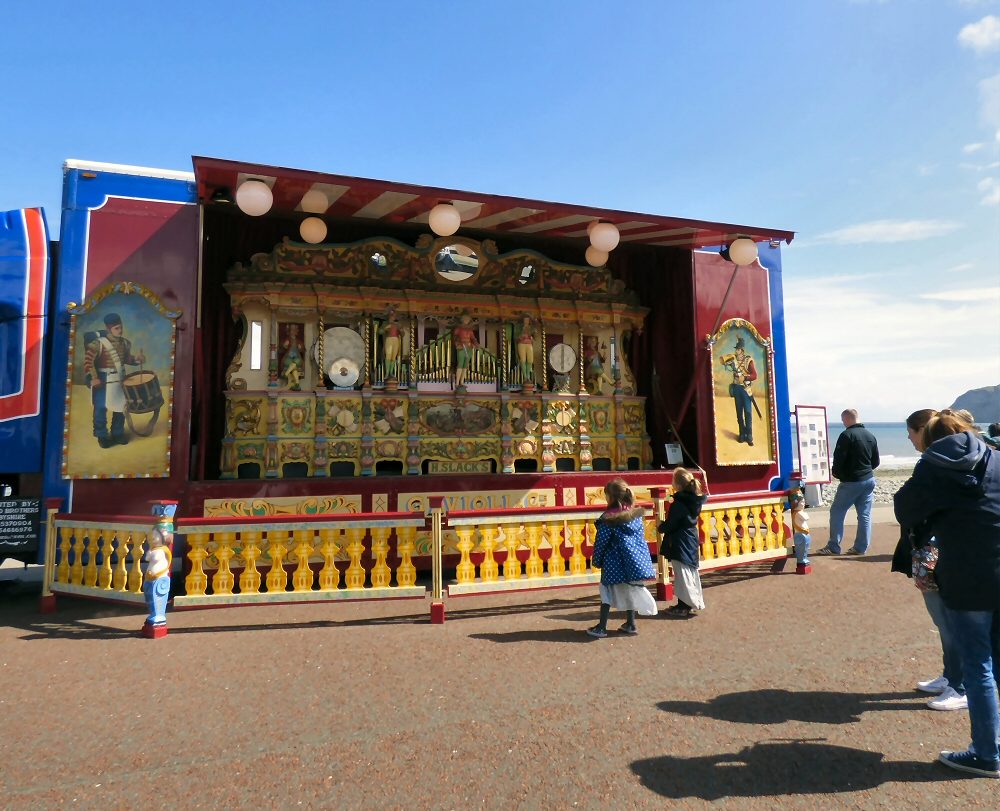
7.3 Four-traditions comparison table
The four traditions gathered into one comparison. Vol 1 introduced them and drew the loudness contrast; this table adds façade style and consolidates the maker lists for reference. They are cousins, not synonyms — the single most important distinction the dive maintains after wind-versus-steam.
Table 3 — 3. Four-traditions comparison table
| Field | Fairground | Dance | Street | Band |
|---|---|---|---|---|
| Country of origin | France / Germany | Belgium | Netherlands | United States |
| Typical setting | Big outdoor fair, over rides | Indoor ballroom / café | Street corner (draaiorgel / pierement) | Carousel / merry-go-round / circus |
| Music medium | Book (cardboard) | Book and roll | Book (cardboard) | Roll (paper) |
| Loudness | Loudest — built to carry outdoors | Quietest — voiced for indoors | Loud for a street corner; below fairground | Loud, band-imitative |
| Façade style | Ornate French Baroque/Rococo (Gavioli, Marenghi); Waldkirch carved-figure fronts (Bruder, Ruth) | Art Nouveau → Art Deco (Mortier, Decap): mirrored, geometric, back-lit | Bright Dutch mirror-and-scroll front, moving pierrot/conductor figures | Carousel-scale carved front; display pipes and drums |
| Key makers | Gavioli, Marenghi, Limonaire (FR); Bruder, Ruth, Wellershaus (DE) | Mortier, Decap, Bursens (BE) | Warnies & Perlee (Amsterdam rental); Carl Frei (voicing) | Wurlitzer, Artizan, North Tonawanda MIW; de Kleist |
Sources: Wikipedia, “Fairground organ”, “Dance organ”, “Dutch street organ”, “Band organ”; MBSI; Dean Organ Builders. Note the two organs most often confused with each other and with the calliope are the fairground organ and the American band organ: both large, both on midways — but the fairground organ is French/German and book-played, the band organ American and roll-played, and neither is steam.
7.4 Wind versus steam — the contrast to keep
The guardrail restated as a reference bar. Every organ in this dive is a low-pressure wind instrument; the steam cousin is the calliope of Dive 13. The two live three orders of magnitude apart in pressure, which is why they are on different branches of the family and are built on entirely different physics.
Table 4 — 4. Wind versus steam — the contrast to keep
| Property | Wind organ (this dive) | Steam calliope (Dive 13) |
|---|---|---|
| Working pressure | A few inches of water column, ≈ 0.1–0.2 psi | ≈ 100–180 psi steam |
| Sounding medium | Air past flue and reed pipes | Steam through cast/heavy whistles |
| Energy source | Feeder bellows worked by crank or motor | Boiler and firebox |
| Voicing | Blended ranks imitating an orchestra | Single brutal timbre, carries for miles |
| Described by | Key scale and ranks | Number of whistles and steam pressure |
| Examples | Fairground / dance / street / band organs | Steam calliope, steam whistle organ |
If a source quotes inches of water, it is a wind organ and belongs to this dive; if it quotes psi of steam, it belongs to Dive 13. A band organ works its pipes on a tenth of a pound of wind; a calliope blows its whistles on well over a hundred pounds of steam. Never call a fairground, dance, street or band organ “steam.” (Figure 2 in Vol 1 draws the same contrast on a logarithmic pressure axis; the bar is not repeated here.)
7.5 Maker & tradition glossary
Definitions reused verbatim in substance from the dive’s source anchors and the earlier volumes, so the terms mean the same thing here as where they were introduced.
- Fairground organ — a large mechanical WIND organ “covering the wind and percussive sections of an orchestra,” of French origin (Gavioli); ornate proscenium front; book- or roll-operated; the loudest of the traditions, built to carry across an open fair. (Wikipedia: Fairground organ.)
- Dance organ — the Belgian indoor-ballroom organ (Mortier, Decap, Bursens); quieter than a fairground organ; façade evolves Art Nouveau → Art Deco; book and roll operated. (Wikipedia: Dance organ.)
- Street organ / draaiorgel / pierement — the Dutch street organ: large, book-played, originally hand-cranked (the grinder works both the bellows/reservoir and the book feed); the Amsterdam rental tradition. Draaiorgel = “turning organ”; pierement is the colloquial name. (Wikipedia: Dutch street organ; COAA.)
- Band organ — the American term (Wurlitzer, Artizan, North Tonawanda) for a roll-operated fairground/carousel organ built to imitate a human band. (Wikipedia: Band organ.)
- Military band organ — a large band organ (e.g. the Wurlitzer 160 “Mammoth”) voiced to imitate a military brass band. (Wikipedia: Band organ.)
- Book music — folded cardboard sheets punched with holes; Anselme Gavioli’s 1892 system; read by a key frame; sturdy, humidity-stable, needs no rewind. (Wikipedia: Book music.)
- Key frame — the reading head: keys (small pivoted levers) rock up through the book’s holes and mechanically open the pipe valves. (Wikipedia: Book music.)
- Keyless (frame) — the refined reader in which the holes admit wind directly (a pneumatic reader), sparing the books from mechanical-key wear; a scale specified as “keyless.” (Wikipedia: Book music.)
- Scale / “key” count (e.g. 20, 46, 52, 87, 89, 98, 112) — the number of playing plus registration positions the frame reads; NOT the pipe count (grand organs voice each key across several ranks → hundreds of pipes). (MBSI; Dean Organ Builders.)
- Frein — Gavioli’s 1878 metal reed/brake device giving string-like (cello/violin) voicing; distinct from the 1892 book patent. (Wikipedia: Gavioli.)
- Proscenium / façade — the ornate carved-and-gilded front “designed to attract attention,” with display and dummy/mute pipes, fretwork, name-board, crest, and often animated figures. (Wikipedia: Fairground organ; see Vol 4.)
- Automata / animated figures — the moving figures on the front: a conductor beating time, bell-ringers/women striking bells, drummers, dancers, plus visible glockenspiel and drums. (Wikipedia: Fairground organ.)
- Swell / expression — shutters that open and close to vary loudness, registered from the book; the fairground organ’s expression device. (Cross-ref “Wind Systems”; see Vol 4.)
- Waldkirch — the Baden town (organ building from 1799, Matthias Martin; Bruder from 1829) that was the German centre of fairground/street-organ building (Bruder, Ruth, Frei, plus Gavioli’s and Limonaire’s German works). (Wikipedia: Waldkirch.)
- Gavioli — Italian-founded (1806), Paris-based (from 1845) firm; Anselme Gavioli’s 1892 book-music patent made it the pre-eminent fair-organ builder; organ-making ended c.1910–12, passing to Limonaire Frères. (Wikipedia: Gavioli.)
- Carl Frei — Waldkirch-trained builder (b. 1884 Schiltach, d. 1967 Waldkirch) who moved to Breda in 1920 and defined the classic Dutch street-organ sound (bourdon céleste, undamaris); his name is attached, by trade convention, to both the small 20-note busker scale (Dean Organ Builders) and the grand Dutch organs / his 112-key concert organ. (Wikipedia: Carl Frei; Dean Organ Builders.)
7.6 Preservation & collections
The grand wind organs are living machines: the surviving instruments are played, restored and rallied by a network of societies, museums and collectors. The principal bodies an enthusiast will meet:
- FOPS — the Fair Organ Preservation Society (UK). The central society for fairground and street-organ preservation in Britain, publishing the Key Frame journal and running the rally and register culture that keeps surviving organs playing. The authoritative first stop for maker facts, key-frame and keyless detail, and the enthusiast rally calendar. (fops.org)
- COAA — the Carousel Organ Association of America (US). The American band- and street-organ body, publisher of the quarterly Carousel Organ journal, whose archive carries deep maker and Dutch-street-organ history (e.g. Hans van Oost on the Warnies/Limonaire/Carl Frei Amsterdam tradition). The reference for the US band-organ side and the North Tonawanda makers. (coaa.us)
- MBSI — the Musical Box Society International. The broad mechanical-music society whose Mechanical Music resources include the authoritative account of the 87/89/98 Gavioli scales cited throughout this dive; a standing reference for scale and maker facts across the mechanical-organ family. (mbsi.org; mechanicalmusic.org)
- Museums and the rally scene. The Fairground Heritage Trust (UK) preserves fairground organs within the wider showman’s heritage and publishes learning material on the Gavioli book-music breakthrough and the key frame. In the Netherlands the street-organ tradition is preserved by dedicated draaiorgel museums and the Amsterdam rental workshops’ descendants (the Perlee lineage). Across Europe and North America, working organs appear at fairs, carousels, steam and organ rallies, and specialist auctions (the Milhous and comparable collections have moved documented grand Gavioli and Marenghi organs). Restoration firms such as Dean Organ Builders (UK) both maintain surviving instruments and publish the maker/scale reference tables this dive draws on.
For the societies as historical sources rather than as living bodies, see the bibliography (§8) and the source anchors; the point of this section is that the grand wind organ is not a museum fossil but a maintained, played and rallied instrument with an active enthusiast community on both sides of the Atlantic.
7.7 Cross-index
Where each topic is treated — within this dive (Vols 1–6) and across the sibling dives of the Mechanical Organs program. Cross-references are written “Vol N” for this dive and by dive title for the siblings, matching the wording used throughout.
7.7.1 Within this dive (Vols 1–6)
Table 5 — 7.1 Within this dive (Vols 1–6)
| Topic | Volume |
|---|---|
| The grand wind branch; how it differs from the busker organ; the family tree | Vol 1 — The Grand Wind Branch |
| Four traditions introduced and kept distinct; wind-not-steam; key ≠ pipe | Vol 1 — The Grand Wind Branch |
| The deep maker survey (Gavioli, Limonaire, Marenghi, Bruder, Ruth, Wellershaus); the decline | Vol 2 — History & the Makers |
| Book music, the key frame and the keyless refinement; book vs barrel vs roll; the scale ladder | Vol 3 — Book Music & the Key Frame |
| The grand proscenium/façade, the automata, swell/expression, national front styles | Vol 4 — The Grand Façade |
| The Dutch street organ (draaiorgel/pierement); Warnies’ 1903 order; Perlee; Carl Frei the German→Dutch link | Vol 5 — The Dutch Street Organ |
| The Belgian dance organ (Mortier, Decap, Bursens); the American band organ (de Kleist → Wurlitzer) | Vol 6 — Dance Organs & Band Organs |
| Timeline, key-scale table, four-traditions table, glossary, preservation, bibliography | Vol 7 — Reference & Cheatsheet (this volume) |
7.7.2 To the sibling dives (Mechanical Organs program)
Table 6 — 7.2 To the sibling dives (Mechanical Organs program)
| Topic | Sibling dive |
|---|---|
| The general maker narrative and the wider mechanical-organ lineage (complement, not repeat) | A History of Mechanical Organs |
| The hole-to-note encoding theory — how punched holes become notes (book/roll/barrel mechanism) | Encoding the Music |
| General case construction and materials (this dive delivers the grand-front survey it deferred) | The Case, Façade & Figures |
| The STEAM cousin — the calliope at ~100–180 psi (the loud, non-wind relative) | Steam Organs & Calliopes |
| The wind supply — reservoir, bellows, the ~0.1–0.2 psi figure, swell/expression | Wind Systems |
| Ranks, voicing and the pipe/rank arithmetic behind “key ≠ pipe count” | Building Organ Pipes |
| The small 20-note amateur build path; the Carl Frei / Raffin busker scale | The Hobby Crank Organ |
| A worked grand-scale build reference (the largest of the amateur/kit designs) | The John Smith Universal Organ |
| The crank as the drive — one handle working both bellows and the book/roll feed | Turning the Crank |
7.8 Bibliography
Primary web sources, as cited throughout the dive. Wikipedia articles are cited for the maker and tradition facts; MBSI and Dean Organ Builders for the scales; the preservation societies and the Fairground Heritage Trust for corroboration and the living scene.
Wikipedia (encyclopaedic maker/tradition facts):
- “Fairground organ” — definition, origin, book/barrel/roll, façade and automata, makers, the mid-1920s decline; the Gavioli “ceased 1910” figure.
- “Book music” — Anselme Gavioli’s 1892 patent, the key frame, the keyless refinement, book vs barrel vs roll.
- “Gavioli” — firm founded 1806 Cavezzo; Paris from 1845; the 1878 frein; the 1892 book patent; ceased organ-making 1912; remainder to Limonaire.
- “Limonaire Frères” — founded 1839 Paris; “Orchestrophone”; Gavioli’s Waldkirch works 1908; new Waldkirch factory 1912; German factory to Alfred Bruder 1926; liquidation 1929.
- “Dutch street organ” — the draaiorgel; book music; hand-cranked bellows + book feed; slightly smaller than the fairground organ.
- “Carl Frei” — b. 1884 Schiltach, d. 1967 Waldkirch; Waldkirch training; Breda from 1920; bourdon céleste and undamaris; the 112-key Traveling Concert Organ.
- “Dance organ” — Belgian tradition; Mortier, Decap, Bursens; roll and book; indoor and quieter; Art Nouveau → Art Deco façades.
- “Band organ” — the US term; Wurlitzer, Artizan; barrel → book → paper roll; carousel and circus use.
- “North Tonawanda Barrel Organ Factory” — de Kleist 1893; DeKleist Co. 1903; Wurlitzer buys 1908; Wurlitzer organ production ceased 1942.
- “Waldkirch” — organ building founded 1799 by Matthias Martin; Bruder from 1829; Ruth, Frei; the Gavioli/Limonaire German works.
Mechanical-music and trade references:
- MBSI / Mechanical Music, “87, 89, and 98 Gavioli” — the popular fairground scales and their expansion; makers who used them (Marenghi, Gaudin, Chiappa, Frei).
- Dean Organ Builders, organ-scales table — the maker/key-count ladder (20 busker through 116-key concert) and the trade-name attribution of the 20-note “Carl Frei / Raffin” scale.
Preservation and heritage bodies:
- Fairground Heritage Trust, ”…Thank You for the Music” — the UK fairground- organ heritage narrative (Gavioli book breakthrough, key frame, maker culture).
- COAA — Carousel Organ Association of America and its Carousel Organ journal archive (incl. van Oost, “Dutch Street Organs”: Warnies/Limonaire/Frei).
- FOPS — Fair Organ Preservation Society and its Key Frame journal.
- MBSI — Musical Box Society International.
Discrepancy on record: the “Fairground organ” article dates the end of Gavioli
organ-making to 1910, the “Gavioli” article to 1912; this dive states the
hand-over to Limonaire Frères as c.1910–12 and cites both, silently choosing
neither. The Amsterdam “~40 rented street organs” figure and all pipe/rank counts
in §2 are marked (est.); the Wurlitzer roll-style hole/track counts referenced
in Vol 6 are likewise marked (est.) pending the roll catalogues.
7.9 Closing note — the capstone of the program
This is the final reference volume of “Fairground & Dutch Street Organs,” and this dive is the capstone of the Mechanical Organs program. The program began with a single player and twenty keys — the small busker crank organ of the Track 1 and hobby-build dives, one operator turning one handle. This dive is that instrument’s grand relatives: the same low-pressure wind, the same punched-card idea, the same family of flue and reed pipes — scaled up from one player’s twenty notes to a near-hundred-key frame driving several hundred pipes across a dozen ranks, fronted by a carved-and-gilded proscenium with a conductor beating time and figures striking bells, on a machine the size of a semi-trailer.
The thread that runs the whole length of the range is a name that appears at both ends of it: Carl Frei, whose trade name sits on the small 20-note busker scale and who, at Breda from 1920, defined the voicing of the grand Dutch street organ and built a 112-key concert organ. From twenty keys to a hundred and twelve, from a buskers’ handcart to a fairground proscenium, it is one instrument’s family — and it is, throughout, a wind organ. The steam cousin, loud and singular, is the calliope of Dive 13; that is the one branch of the family this survey does not claim, and the one distinction most worth carrying away. Everything in this dive speaks its pipes on a few inches of water, and everything counts its keys in the frame while its pipes number in the hundreds.
Comments (0)