Fairground And Dutch Street Organs · Volume 1
Fairground & Dutch Street Organs — Vol 01: The Grand Wind Branch
This is the capstone survey of the Mechanical Organs program (Dive 14). Where the earlier dives followed one player and a single 20-note book — the small busker crank organ of “The Hobby Crank Organ” and “The John Smith Universal Organ” — this dive climbs the same family tree to its grandest limbs: the semi-trailer-sized proscenium organs that filled fairgrounds, ballrooms, streets and carousels for the better part of a century. The machines change scale by two orders of magnitude, but the operating principle does not: these are still low-pressure wind instruments, pipes admitted from punched music by a mechanical reader, driven by bellows that a crank or a motor works. The purpose of this first volume is to fix the map before the detail arrives — what the grand family is, how its four regional traditions differ, why “wind” and not “steam” is the defining word, why a “key” count is not a pipe count, and how the six volumes that follow are laid out.
1.1 What “grand” means here
The busker organ profiled earlier in the program is a one-person instrument: roughly a 20-note scale, a single or double rank of pipes, a hand crank, a case a strong adult can carry or wheel. Scale that picture up and almost every dimension grows at once.
- Playing scale. A grand organ reads a few dozen “keys” — commonly in the 40s to the 90s, and past 110 on the largest concert machines — rather than the busker’s 20 (Dean Organ Builders; MBSI: “87, 89, and 98 Gavioli”).
- Pipework. Those keys are voiced across several ranks — bourdon, open flutes, violin and cello strings, piccolo, trumpet, trombone, plus tuned and untuned percussion — so the pipe count runs into the hundreds, not the dozens. The key count and the pipe count are different numbers, a point §4 returns to and hammers.
- Music medium. The grand tradition is built on cardboard book music — folded, fan-fed sheets punched with holes — patented by Anselme Gavioli in 1892 (Wikipedia: Book music). The American branch moved instead to the perforated paper roll (Wikipedia: Band organ). Barrels — the pinned wooden cylinders of the earliest mechanical organs — are the medium both traditions grew out of and left behind. The book-versus-roll-versus-barrel encoding theory is the subject of “Encoding the Music” (Dive 4); this dive covers the fairground book-music tradition, not the hole-to-note mechanism.
- The front. A busker organ is a plain box with a decorated panel. A grand organ faces the crowd with an ornate carved-and-gilded proscenium — columns, a name-board, a crest, ranks of display pipes (many of them mute dummies for show), fretwork, and often animated figures: a conductor beating time, bell-ringers, drummers, dancers (Wikipedia: Fairground organ). The front was “designed to attract attention,” and delivering its full survey is one of this dive’s jobs (see §6).
- Size and power. The largest fairground and dance organs are, in the plain words of the source, “semi-trailer-sized” (Wikipedia: Dutch street organ), and were moved on their own wagons or trailers. Wind is supplied by feeder bellows and a reservoir driven originally by the same crank the operator turned, later by an electric or petrol motor.
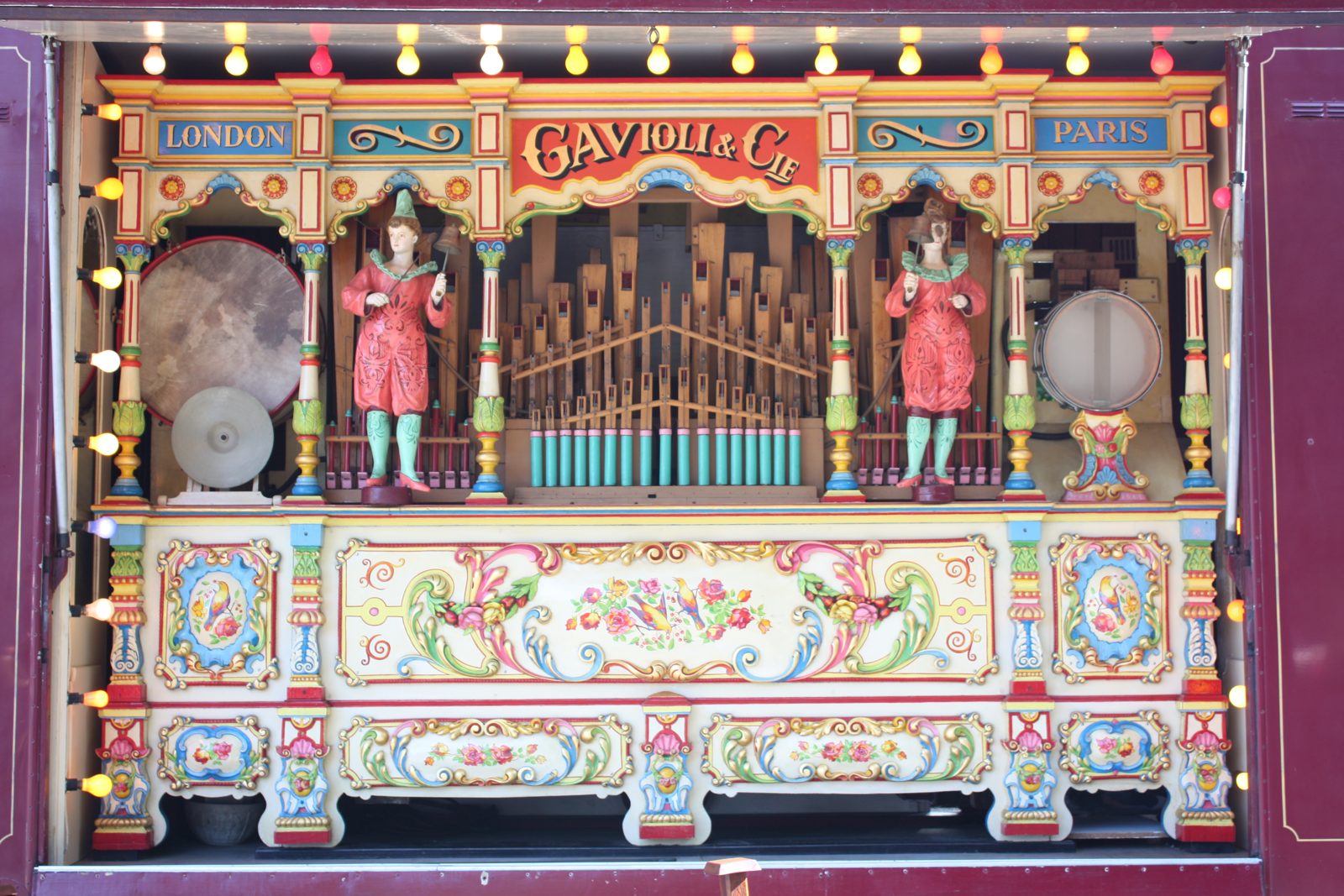
None of this changes the physics established in the program’s theory dives. Turning the crank still works a bellows; the bellows still feed a reservoir; the reservoir still holds wind at a few inches of water while a reading frame decides which pallets open. The grand organ is the busker organ writ large, with more ranks, a bigger book, and a front built to sell tickets.
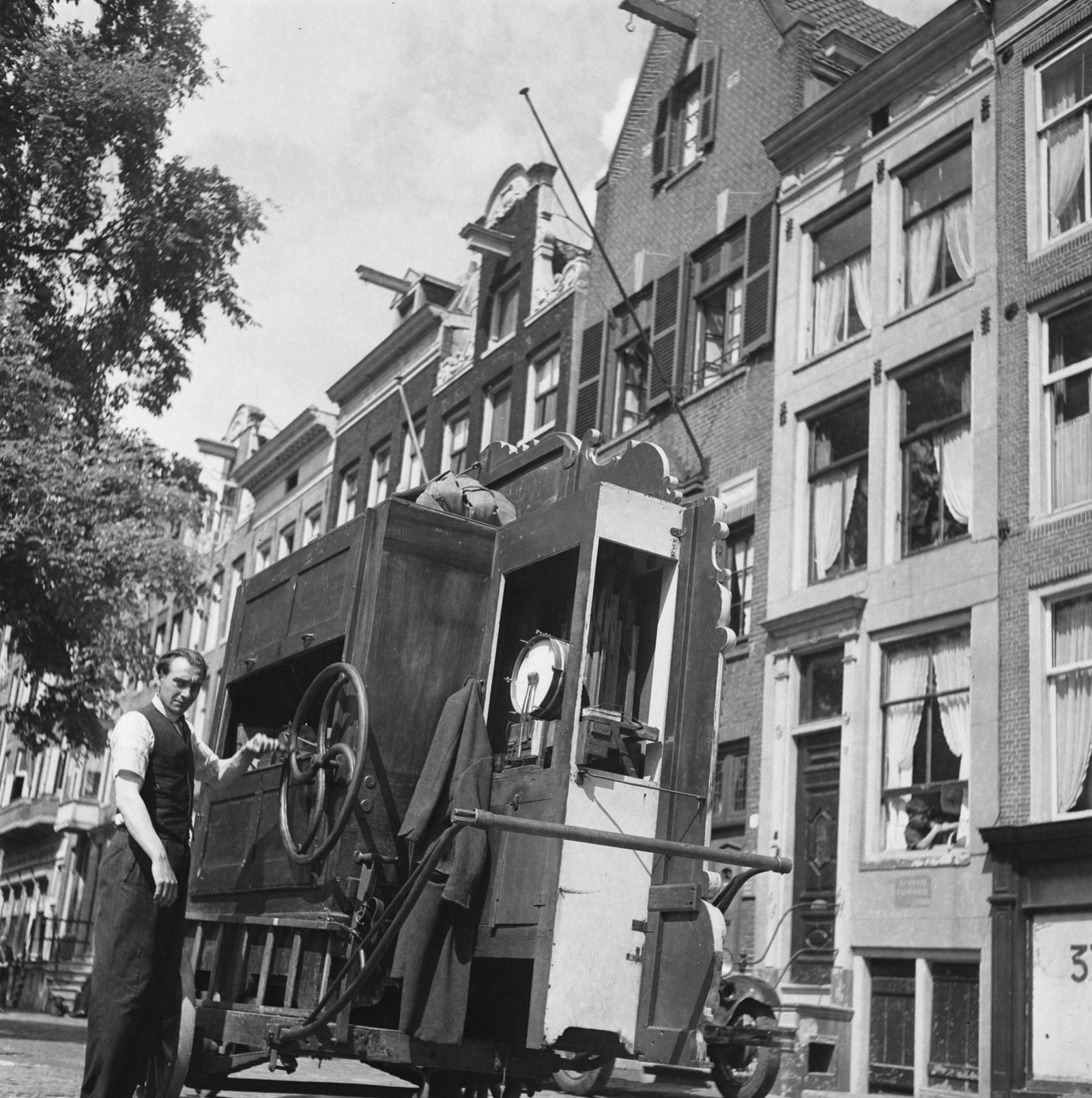
What does change with scale is the division of labour. On a busker organ one person supplies wind, feeds the book and works the whole instrument by turning a single handle. On a grand fairground organ the wind demand of several hundred pipes speaking at once is far beyond what one arm can sustain, so the motive power moves off the operator: a petrol or electric motor drives the feeder bellows and pulls the book through the frame, and the “operator” becomes a proprietor who starts tunes, changes books and tends the machine rather than a player who powers it. The Dutch street organ sits deliberately between these extremes — large enough to need a substantial reservoir, small enough that the orgelman still turns a handle that works both the bellows and the book feed (Wikipedia: Dutch street organ). Where a given organ falls on that scale — hand-cranked, motor-driven, or trailer-mounted with its own engine — is one of the quickest ways to place it in its tradition, and it is a thread that runs through Vols 5 and 6.
1.2 The four traditions — cousins, not synonyms
The single most common error in casual writing about these machines is to treat “fairground organ,” “dance organ,” “street organ” and “band organ” as loose synonyms for “big pipe organ on a fair.” They are not. They are four distinct regional traditions, each with its own country of origin, its own setting, its own preferred music medium and its own loudness envelope. Keeping them apart is a structural requirement of this dive, and the whole of Vols 4–6 depends on the distinction.
1.2.1 Fairground organ — the big outdoor French/German machine
The fairground organ is the archetype: a large mechanical wind organ built to be heard outdoors over rides and crowds, “covering the wind and percussive sections of an orchestra” (Wikipedia: Fairground organ). It originated in Paris — Gavioli’s book-music patent of 1892 is the pivot — and its great names are French (Gavioli, Charles Marenghi, Limonaire Frères) and German (the Waldkirch firms Gebrüder Bruder, Andreas Ruth & Sohn, and Gebrüder Wellershaus of Mülheim). It is book-operated, ornately fronted, and the loudest of the four by design.
1.2.2 Dance organ — the Belgian indoor ballroom instrument
The dance organ is a Belgian tradition, built for the café and the dancing hall rather than the open fair. Mortier of Antwerp was predominant by the early 1920s; Gebroeders Decap of Antwerp matched it in the 1930s with their sweeping art-deco façades; Arthur Bursens of Hoboken built smaller café orchestrions under the “Ideal” and “Arburo” names (Wikipedia: Dance organ). Because it plays indoors, the dance organ is voiced to be quieter than the similar fairground organ (Wikipedia: Dance organ), and it is roll and book operated. Its façades trace an Art Nouveau to Art Deco evolution that Vol 4 covers as a distinct national style.
1.2.3 Street organ — the Dutch draaiorgel / pierement
The street organ is the Dutch tradition: the draaiorgel (literally “turning organ”), colloquially the pierement, worked by an orgelman on a busy street corner. It plays book music across multiple pipe ranks and percussion, and it is “slightly smaller than the semi-trailer-sized fairground organ” but still loud enough to be heard easily on a busy street (Wikipedia: Dutch street organ). It sits at the heart of an Amsterdam rental culture that Vol 5 treats in full, and its defining voice was shaped by Carl Frei — the figure who, uniquely, connects the small 20-note busker scale to the grand Dutch organ (see §5).
1.2.4 Band organ — the American machine that imitates a band
The band organ is the American term and the American tradition, so named because it was “designed to mimic the sound of a human band” — specifically a marching or military band (Wikipedia: Band organ). Its makers are American: Rudolph Wurlitzer of North Tonawanda, New York; Artizan Factories, Inc.; and the North Tonawanda Musical Instrument Works. It is characteristically roll-operated (barrels first, then perforated paper rolls), and it lived chiefly on carousels, merry-go-rounds and in circuses. It is a wind organ, not a steam calliope — a distinction §3 makes plainly, because the American fairground is exactly where the two are most often confused.
The four are compared head to head in the table and diagram below.
Table 1 — 2.4 Band organ — the American machine that imitates a band
| Tradition | Country of origin | Typical setting | Music medium | Loudness | Representative makers |
|---|---|---|---|---|---|
| Fairground | France / Germany | Big outdoor fair, over rides | Book (cardboard) | Loudest — built to carry outdoors | Gavioli, Marenghi, Limonaire (FR); Bruder, Ruth, Wellershaus (DE) |
| Dance | Belgium | Indoor ballroom / café | Book and roll | Quieter — voiced for indoors | Mortier, Decap, Bursens |
| Street | Netherlands | Street corner (draaiorgel/pierement) | Book (cardboard) | Loud enough for a busy street; below fairground | Warnies & Perlee (Amsterdam rental); Carl Frei voicing |
| Band | United States | Carousel / merry-go-round / circus | Roll (paper) | Loud, band-imitative | Wurlitzer, Artizan, North Tonawanda MIW |
Sources: Wikipedia “Fairground organ”, “Dance organ”, “Dutch street organ”, “Band organ”; Dean Organ Builders (maker/scale table).
1.3 Wind, not steam — the calliope is the loud cousin
Every organ in this dive is a low-pressure wind instrument. Wind is stored in a reservoir at a pressure of a few inches of water column — on the order of 0.1–0.2 psi — and produced by feeder bellows that the crank or the motor works. That figure is the same one the program’s wind dives use, and it is the number that matters: a fairground, dance, street or band organ speaks its pipes on gentle wind, no different in principle from a church organ or the 20-note busker organ, only larger.
It is worth stating the contrast once, plainly, because it is the single most persistent misconception about these machines: a fairground organ is not a steam organ. The steam instrument is the calliope, the subject of “Steam Organs & Calliopes” (Dive 13). A calliope runs on steam at roughly 100–180 psi — three orders of magnitude above organ wind — which is why it is deafening, why it needs a boiler, and why it belongs to the steam branch of the family and not to the wind branch surveyed here. The confusion is understandable on an American midway, where a steam calliope and a wind band organ might have worked the same fairground within earshot of each other, but they are different machines on different physics. A band organ works pipes on a tenth of a pound of wind; a calliope blows whistles on well over a hundred pounds of steam.
The pressure difference is not a footnote — it dictates the entire construction. Organ wind at a fraction of a psi is held in a reservoir of leather-hinged bellows and admitted past light wooden pallets that a small key or a puff of pilot wind can lift; the pipes are voiced flue and reed resonators of wood and thin metal, tuned and blended into ranks that imitate an orchestra. Calliope steam at a hundred-odd psi needs a boiler, cast or heavy-gauge whistles, high-temperature valves and gasketing, and it produces a single brutal timbre that carries for miles but cannot be blended or voiced with any subtlety. The wind organ is an orchestra in a box; the calliope is a set of steam whistles. Reading a scale specification helps too: a fairground organ is described by its key scale and its ranks, a calliope by its number of whistles and its steam pressure. If a source quotes inches of water, it is a wind organ and belongs in this dive; if it quotes psi of steam, it belongs to Dive 13.
1.4 Key count is not pipe count
A grand organ is described by its scale — a “key” number such as 46, 52, 87, 89 or 98. This number is the count of playing and registration positions the reading frame recognises in the music: the notes it can sound plus the register and effect controls it can switch. It is emphatically not the number of pipes.
The reason is that each playing key is voiced across several ranks simultaneously. An 89-key Marenghi does not have 89 pipes; it has an 89-position frame driving a bourdon rank, open flute ranks, violin and cello string ranks, a piccolo, brass reeds (trumpet, trombone), and tuned percussion — so a single melody key may speak five, six or more pipes at once, and the full instrument carries several hundred pipes (MBSI: “87, 89, and 98 Gavioli”; Dean Organ Builders). The relationship between one key and its many pipes — the ranks, their voicing, the wind that feeds them — belongs to the program’s pipe and wind dives (“Building Organ Pipes”, “Wind Systems”); the point to carry away here is only the arithmetic: keys count the frame’s positions, pipes count the resonators, and the second number is far larger than the first.
The scale ladder below runs from the small busker cousin to the grand concert organ. Every rung is a real, documented scale with a maker association; note how the “key” number never tells the pipe story.
- 20-note — the small street/busker scale of the program’s crank-organ dives, associated in the trade with Carl Frei / Raffin and other small-organ makers (Dean Organ Builders). This is the small cousin, not a grand organ.
- 35 / 45-key — Limonaire (Dean Organ Builders).
- 46-key — Gavioli and Wilhelm Bruder (Dean Organ Builders).
- 47 / 49-key — Marenghi (Dean Organ Builders).
- 52-key — Ruth, Gasparini, Koenigsberg, Limonaire and others (Dean Organ Builders).
- 57–72-key — Ruth, Bruder, Wellershaus, Gavioli, Frei (Dean Organ Builders).
- 87-key Gavioli — “one of the most popular and versatile fairground scales,” later expanded into the 89 and 98 (MBSI).
- 89-key — the 87 expanded; Marenghi 89 and Gavioli 89, also used by Gaudin, Chiappa and Carl Frei (MBSI).
- 98-key — Marenghi’s further expansion of the 89, sharing the 89’s playing notes so music transfers between them (MBSI).
- 112-key — the Carl Frei Traveling Concert Organ, his largest instrument (Wikipedia: Carl Frei).
<rect x="120" y="66" width="69" height="16" opacity="0.35"/>
<text x="10" y="79" font-size="11">46 Gavioli</text>
<text x="199" y="79" font-size="10" fill="currentColor">Gavioli / W. Bruder</text>

<rect x="120" y="92" width="78" height="16" opacity="0.4"/>
<text x="10" y="105" font-size="11">52 Ruth</text>
<text x="208" y="105" font-size="10" fill="currentColor">Ruth, Limonaire</text>

<rect x="120" y="118" width="130" height="16" opacity="0.45"/>
<text x="10" y="131" font-size="11">87 Gavioli</text>
<text x="260" y="131" font-size="10" fill="currentColor">popular fairground scale</text>

<rect x="120" y="144" width="133" height="16" opacity="0.5"/>
<text x="10" y="157" font-size="11">89 Marenghi</text>
<text x="263" y="157" font-size="10" fill="currentColor">87 expanded</text>

<rect x="120" y="170" width="147" height="16" opacity="0.55"/>
<text x="10" y="183" font-size="11">98 Marenghi</text>
<text x="277" y="183" font-size="10" fill="currentColor">89 expanded, same notes</text>

<rect x="120" y="196" width="168" height="16" opacity="0.6"/>
<text x="10" y="209" font-size="11">112 Frei</text>
<text x="298" y="209" font-size="10" fill="currentColor">Traveling Concert Organ</text>1.5 Carl Frei — the name on both ends of the ladder
One figure ties the top and bottom of that ladder together, which is why his name recurs across the whole program. Carl Frei (b. 4 April 1884, Schiltach; d. 10 May 1967, Waldkirch) trained at the Waldkirch music academy from age nine and from age fourteen worked for Bruder, Gavioli, Mortier and DeVreese across Waldkirch and Paris (Wikipedia: Carl Frei). After the First World War he moved to Breda in the Netherlands to repair street organs, began building his own from 1920, and there defined the classic Dutch street-organ voice — creating the bourdon céleste register and the undamaris stop (Wikipedia: Carl Frei). His largest instrument was the 112-key Carl Frei Traveling Concert Organ (Wikipedia: Carl Frei).
Frei’s name therefore sits at both extremes of the program’s scale range: on the small 20-note “Carl Frei” busker book/roll scale (a trade attribution recorded by Dean Organ Builders and program convention, not a claim the Wikipedia biography itself makes) and on the grand Dutch street organs and the 112-key concert organ. That is the literal thread connecting “The Hobby Crank Organ” and “The John Smith Universal Organ” at one end of the program to this capstone dive at the other. The busker-scale name is kept identical to those sibling dives deliberately; it is the same Carl Frei.
His story also anchors the program’s German-to-Dutch geography. Frei trained in Waldkirch, the Baden town in the southern Black Forest that is “the town of mechanical organs,” where organ building was founded by Matthias Martin in 1799 and the Bruder family business began in 1829 under Ignaz Bruder (Wikipedia: Waldkirch). Those Waldkirch facts are held identical to “The Hobby Crank Organ” dive — they do not drift between volumes — and Vol 2 develops the full maker geography from them.
1.6 What this dive owns, and what it defers elsewhere
This dive has a defined lane in the program, and part of its job is to stay in it.
- It owns the grand-organ survey. The big proscenium-fronted book and roll organs and their makers are covered here and not elsewhere. The program’s smaller organs — the church organ, the barrel organ, the 20-note busker crank organ — belong to the Track-1 theory dives and the two hobby-build dives; this dive is their grand relatives.
- It delivers the grand-front survey that “The Case, Façade & Figures” (Dive 11) deferred here. That dive covers general case construction and materials, but it explicitly punted the ornate proscenium, the animated figures, the swell shutters and the national front styles to Dive 14. Vol 4 pays that debt: the carved-and-gilded proscenium “designed to attract attention,” the automata (the baton conductor, the bell-ringers, the drummers and dancers), and the contrast of national fronts — French Baroque and Rococo, the Waldkirch carved-figure style, the bright Dutch draaiorgel front, and the Belgian Art Nouveau to Art Deco dance façade (Wikipedia: Fairground organ; Dutch street organ; Dance organ).
- It complements “A History of Mechanical Organs” (Dive 1); it does not repeat it. Dive 1 tells the general maker story of mechanical organs at large. This dive cross-references that narrative and goes deep only on the fairground, Dutch and band specifics — Gavioli’s book breakthrough, the scale families, the maker culture — not the general history over again.
- It defers encoding theory to “Encoding the Music” (Dive 4). How a punched hole becomes a sounding note — the key frame’s mechanics, the keyless refinement, book versus roll versus barrel as encodings — is Dive 4’s subject. This dive covers the fairground book-music tradition: Gavioli’s 1892 patent as a cultural and commercial pivot, the scales that grew from it, the maker rivalries. It cross-refers Dive 4 for the mechanism rather than re-deriving it.
- It cross-refers “Steam Organs & Calliopes” (Dive 13) both ways. The calliope is the steam cousin on the other branch of the family; §3 fixed the contrast and Vol 6 restates it where the American band organ and the calliope share a midway.
1.6.1 The mechanical-organ family tree
The whole family fits on one diagram. A single ancestor — the mechanical organ, a set of pipes admitted from stored music — divides first by motive medium: wind against steam. The wind branch is the large one, and it subdivides into the small, domestic and portable organs (church, barrel, and the 20-note busker crank organ of the hobby-build dives) and the grand organs of this dive — fairground, dance, street and band. The steam branch has effectively one member: the calliope of Dive 13.
1.7 Roadmap of Vols 2–7
The remaining six volumes take the map drawn here and fill it in.
- Vol 2 — History & the Makers. The deep maker survey that complements Dive 1: Gavioli from its 1806 Cavezzo founding, Ludovico’s move to Paris in 1845, Anselme’s frein (1878) and book-music patent (1892), and the passing of the business to Limonaire Frères c.1910–12 (the two published dates reconciled, both cited); Limonaire itself (1839; the “Orchestrophone”; Gavioli’s Waldkirch works in 1908; liquidation 1929); Marenghi to Gaudin; the Waldkirch firms (Bruder from 1829, Ruth, Wellershaus, under the town’s 1799 founding); and the decline of the whole tradition “until the advent of effective electrical sound amplification in the mid-1920s” (Wikipedia: Fairground organ).
- Vol 3 — Book Music & the Key Frame. Gavioli’s 1892 cardboard book as the pivot of the whole grand tradition: the key frame (keys rocking up through the holes to open valves) and the keyless refinement (holes admitting wind directly); why book beat both the pinned barrel and the paper roll; and the key-scale ladder in full detail, with the key-count-is-not-pipe-count point pressed at every rung. Cross-refers Dive 4 for the encoding mechanism.
- Vol 4 — The Grand Façade. The survey Dive 11 deferred here: the carved-and-gilded proscenium, the display and dummy pipes, the fretwork and name-board and crest, the swell/expression shutters, the animated figures, and the four national front styles.
- Vol 5 — The Dutch Street Organ. The draaiorgel and pierement in full: large, book-played, originally hand-cranked; the Amsterdam rental tradition (Leon Warnies’ 1903 book-organ order displacing the cylinder organs; the fleet of rented street organs; the Perlee workshop); and Carl Frei as the German-to-Dutch link.
- Vol 6 — Dance Organs & Band Organs. The Belgian dance organ (Mortier, Decap, Bursens; indoor, quieter, roll and book) and the American band organ (Wurlitzer via de Kleist 1893 to the end of production in 1942; Artizan and North Tonawanda; the Wurlitzer roll styles; carousel and circus use) — with the wind-not-steam contrast restated where the band organ and the calliope share a midway.
- Vol 7 — Reference & Cheatsheet. The maker and tradition timeline, the full key-scale comparison table, the four-traditions comparison, the wind-versus-steam contrast, a maker/tradition glossary, a preservation and collections note (FOPS, COAA, MBSI), a cross-index to Vols 1–6 and the sibling dives, and the bibliography.
With the map fixed — grand not busker, wind not steam, keys not pipes, and four traditions kept distinct — Vol 2 begins with the makers who built these machines.
Comments (0)