Fairground And Dutch Street Organs · Volume 4
Fairground & Dutch Street Organs — Vol 04: The Grand Façade
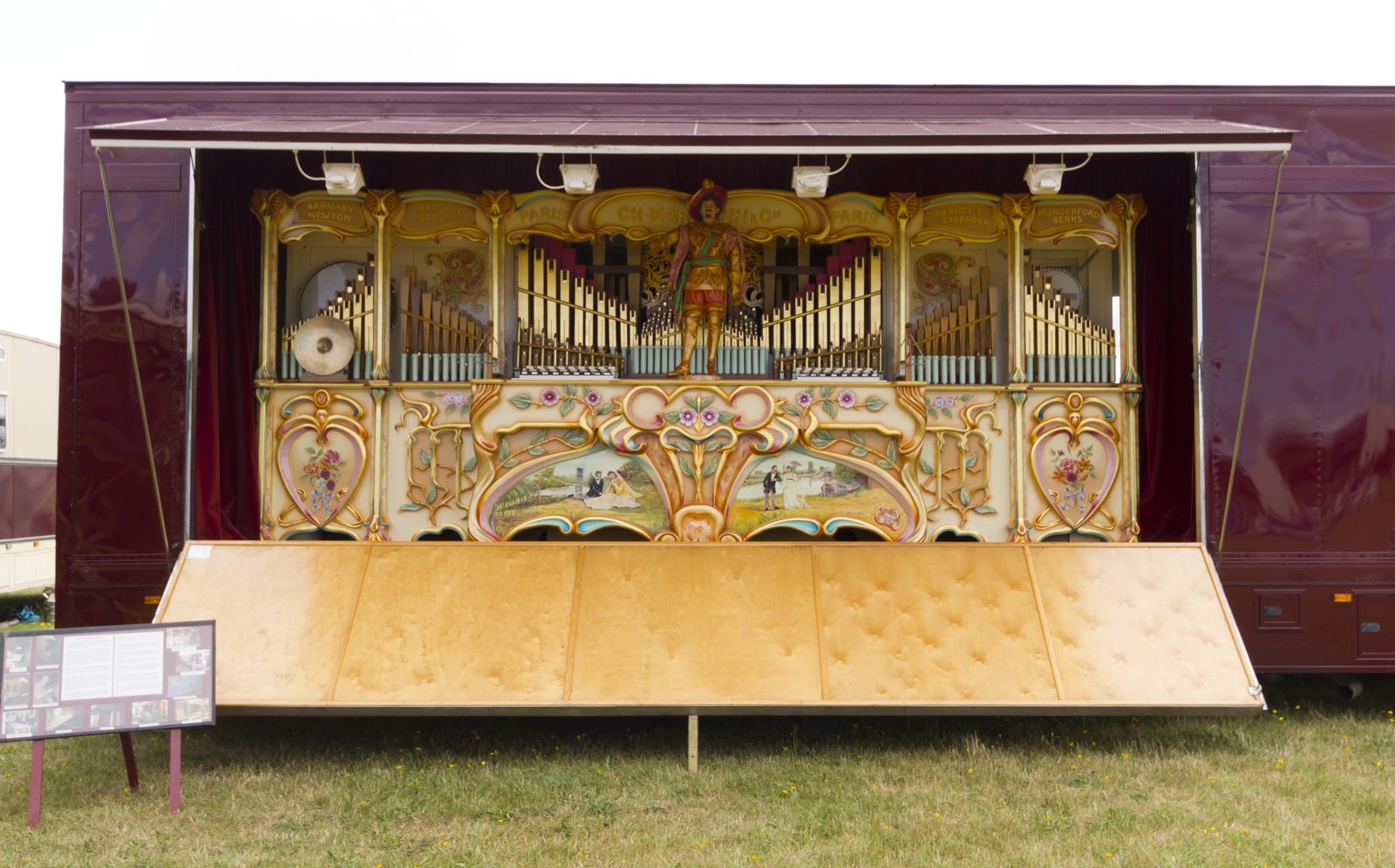
The grand fairground, street, dance and band organs are unusual among musical instruments in that a large fraction of their engineering effort is spent on the part that makes no sound at all. The façade — the ornate carved-and-gilded front the public sees — is, in the words of the reference, “designed to attract attention” (Wikipedia: Fairground organ). It is showman’s architecture: a proscenium of columns, crests, name-boards, ranks of display pipes, fretwork, and moving figures, wrapped around the pipework and wind system covered in the sibling volumes. This volume delivers the grand-front survey that the “The Case, Façade & Figures” dive (Dive 11) explicitly deferred here. That dive owns general case construction, joinery, materials, finishes, and the small busker organ’s front, together with the mechanical drives that make figures move; this volume covers the grand fairground/street/dance front as a tradition — its parts, its purpose as advertising, its automata, its expression system, and the distinct national styles that a trained eye reads at a glance.
The framing to hold throughout: the front is a piece of advertising. A fairground organ earned its keep by pulling a crowd off the midway toward a particular ride, and a Dutch street organ by holding passers-by long enough to drop a coin. Every carved column, mirror, gilded scroll and nodding figure is in service of that commercial job. The instrument behind it is superb, but the front is a billboard that happens to be attached to an orchestra.
4.1 The proscenium: an advertising front
4.1.1 Why the front is so large
A grand organ is a big machine — the Dutch street organ is described as “slightly smaller than the semi-trailer-sized fairground organ” (Wikipedia: Dutch street organ), and a full fairground organ genuinely approaches that scale. That size is set by the pipework: an 89-key Gavioli or Marenghi scale is not 89 pipes but several hundred, voiced across many ranks — bourdon, violin, cello, flute, piccolo, trumpet, trombone, plus glockenspiel and drums (see Vol 3 for the key-count-versus-pipe-count point, and cross-ref “Wind Systems” and “Building Organ Pipes” for the ranks themselves). All of that must stand upright behind a weather board and a facing.
Rather than hide that bulk, the trade turned the whole broad face of the machine into a stage front — a proscenium, borrowing the theatre term for the framed opening through which an audience views a performance. The proscenium arch frames the “performers”: the visible pipes and the animated figures. Its proportions are generous because it has to be legible from across a noisy, crowded fairground, and it is elevated and raked so that its detail reads from below.
4.1.2 The standard elements
A grand front is built up from a fairly stable vocabulary of parts, whatever the national style. The following table separates each element into what it is and whether its job is decorative, functional, or both. This is the organising idea of the whole volume: on a grand front, appearance and function are deliberately tangled, and the display pipes are the sharpest example.
Table 1 — 1.2 The standard elements
| Façade element | What it is | Decorative or functional |
|---|---|---|
| Crest / cresting | The carved top piece — often a cartouche, coat of arms, lyre, or figure group crowning the arch | Decorative (advertising) |
| Name-board | A prominent panel carrying the maker’s or showman’s name in gilt or painted lettering | Decorative + commercial branding |
| Carved columns / pilasters | Turned or carved uprights framing the central bays, often gilded or barley-twisted | Decorative; occasionally structural framing |
| Display pipes | The ranks of pipes shown across the front; some speak, many are dummy/mute (see §1.4) | Mixed — part functional, part purely visual |
| Pipe-shades / fretwork | Pierced carved panels above and between pipe ranks | Decorative; also masks the pipe tops and lets sound through |
| Swell shutters | Louvred/hinged panels in front of an enclosed pipe section (see §3) | Functional (expression) — often disguised as decoration |
| Sound openings / grilles | Fretted or louvred panels through which the enclosed pipes speak | Functional; styled to match |
| Animated figures / automata | Moving conductor, bell-ringers, drummers, dancers (see §2) | Decorative advertising + real percussion (bells, drums) |
| Mirrors / bevelled glass | Reflective panels, characteristic of the Dutch and Belgian fronts | Decorative; multiply light and motion |
| Side wings / return flats | The angled or curved outer panels that widen the apparent front | Decorative; increase visual presence |
The point of the table is that almost nothing on the front is only decorative and almost nothing is only functional. The swell shutters modulate loudness but are carved to vanish into the ornament; the fretwork both hides pipe tops and lets sound out; the bells the figures strike are real percussion ranks and a visual draw. This dual duty is the signature of the grand-front tradition.
4.1.3 Proportion, elevation and the name-board
Two proportional habits distinguish the grand front from an ordinary cabinet. The first is elevation and rake: the whole front is tall for its depth and is tipped back slightly, so that its carved detail and the motion of its figures read from below, from the eye-line of a crowd standing on the ground. The second is symmetry about a central axis: the composition is built outward in matched bays from a central feature — usually the swell box, the conductor, or a central tower of the largest display pipes — because a symmetrical front reads as a single grand object at a distance, where an asymmetric one would look like a jumble of cabinetry. (Precise proportional ratios were never standardised across the trade and are best treated as (est.) for any given instrument; the habits of elevation and central symmetry, however, are near-universal on grand fronts.)
The name-board deserves particular attention, because it is the front’s most literal piece of advertising. It carries, in bold gilt or painted lettering across the top of the composition, the name that the front exists to sell — sometimes the maker (Gavioli, Marenghi, Bruder), but very often the showman who owned the organ and the ride it fronted, since the organ’s job was to advertise that attraction on that midway. Over a long working life an organ might be re-fronted or re-lettered more than once as it changed hands, which is one reason the maker of a surviving front cannot always be read straight from its name-board. The name-board makes explicit what the rest of the front implies: this is architecture built to carry a brand.
4.1.4 Display pipes: speaking versus dummy
The most important technical subtlety of the grand front concerns its display pipes. A large proscenium presents a broad expanse to be filled, and the most striking way to fill it is with ranks of gleaming pipe fronts — usually the tallest, most visually impressive pipes, arranged in symmetric flats and towers.
On a grand organ, a substantial proportion of these front pipes are dummy (also called mute or display) pipes: they are made purely to be seen and are not connected to the wind chest at all, or are voiced but deliberately not winded. They exist to complete the visual composition, to give height and symmetry, and to hide the working pipework standing behind them. Their real, speaking counterparts — including the loud reed and string ranks — very often sit inside the case, behind fretwork and swell shutters, where they are protected and where their loudness can be controlled. (Exact dummy-to-speaking ratios vary enormously by instrument and are rarely published; treat any specific proportion as (est.).)
This is a genuine contrast with the small busker crank organ, whose front is usually a speaking front: on a 20-note Carl Frei/Raffin-scale organ (see Vol 1, and Dive 11 for the busker case in detail), the handful of pipes shown are mostly the real melody and accompaniment pipes, because the instrument is small, the front is small, and there is neither room nor reason to add non-speaking decoration. The busker builder shows what plays; the grand builder shows what sells, and backs it with a much larger hidden instrument. Dive 11 develops the busker-front case in general; the takeaway here is the inversion of intent — small front, mostly real; grand front, generously padded with dummies.
Figure 4.1 — Anatomy of a grand fairground proscenium. The crest, name-board and carved columns frame the composition; the display flats mix speaking pipes (left, solid) with dummy/mute pipes (right, hollow) to fill the front; the central swell box hides the loud speaking ranks behind louvred shutters; and a row of automata — baton conductor, bell-ringers, drummer — animate the front while the glockenspiel and drums double as real percussion. Not to scale; arrangement is schematic.
4.2 The automata: figures that move to the music
4.2.1 What moves, and why
The living heart of the grand front is its automata — the animated figures. The reference names the archetypes directly: fairground organs were fitted with figures such as “a conductor whose arm moved in time to the music, or women whose arms struck bells” (Wikipedia: Fairground organ). Around those two icons the trade built a repertoire of moving figures:
- The conductor (bandmaster). Usually a central figure, baton or arms rising and falling to beat time. Because the conductor visibly leads, it invites the crowd to hear the machine as a band.
- Bell-ringers. Figures — very often depicted as women — whose arms swing to strike a set of bells. Crucially, this is not mime: the bells are a real percussion rank, so the figures perform genuine music while performing advertising.
- Drummers. Figures whose arms beat visible drums — again real percussion, the bass and snare of the organ’s rhythm section.
- Dancers and other genre figures. Twirling or nodding figures, sometimes themed to the showman’s ride or nationality, added for spectacle.
- The glockenspiel. Not a figure but a visible tuned-bell rank, deliberately placed where its hammers can be seen dancing across the bars — motion as entertainment in its own right.
The organising principle is that on a grand front, the percussion is put on display. Where a concert organ hides its mechanism, the fairground organ turns its drums, bells and glockenspiel outward and gives some of them human avatars, so that the audience watches the music being made. The visible glockenspiel and drums are, in the reference’s framing, played “as visual entertainment” as much as for their sound.
4.2.2 How the motion is produced (in brief)
The drive mechanisms for the figures — the cams, cranks, cranked levers, pneumatic motors and linkages that turn a musical signal into a moving arm — are the province of Dive 11 (“The Case, Façade & Figures”), which covers figure-drive engineering in general. In summary, and to keep this volume self-contained: the motions are taken either mechanically off a rotating shaft driven by the same crank/motor that works the bellows (a cam or crank giving a repetitive arm-beat), or musically off the book/roll itself, where a dedicated track opens a valve that drives a small pneumatic motor so the figure moves in step with the notes it represents. The bell-ringers and drummers are the clearest case of the second kind: the same book perforation that sounds a bell or drum stroke also throws the figure’s arm, so sight and sound are locked together. For the perforation-to-motion chain in engineering detail, cross-ref Dive 11 (figure drives) and Dive 4 (“Encoding the Music”) for how a book/roll track becomes a control signal.
4.2.3 The automaton as advertising
The automata are the sharpest expression of the front-as-billboard idea. A stationary painted front is a poster; a front with a conductor beating time and women striking bells is a performing poster, and motion is far more effective than paint at catching the eye across a crowded fair. The eye is drawn to movement before it registers detail, which is precisely why the trade spent scarce mechanism budget on figures that add no note the pipes could not already sound: the bell-ringer’s arm is worth more as motion seen from a distance than as the bell stroke a hidden hammer could have delivered just as well. The figures also disambiguate the machine: a passer-by who cannot see the pipes understands instantly, from the conductor and the bell-ringers, that this large gilded object is a band. The automata thus do double duty once more — real percussion and irresistible visual advertising — which is exactly the dual-purpose logic that runs through the whole grand-front tradition.
4.3 The swell: expression on a grand front
4.3.1 What the swell does
A grand organ needs dynamics — the ability to play loud and soft — and it achieves them not by changing the wind pressure (that is fixed low; see the wind-not-steam framing in Vol 1 and cross-ref “Wind Systems”) but by enclosing a section of pipes in a box fitted with swell shutters: hinged or louvred panels, much like a venetian blind, across the front of the enclosed pipes. When the shutters are closed, the enclosed ranks are muffled and quiet; when they open, the sound spills out at full loudness. The device is inherited directly from the concert-organ swell box and does the same job. On a grand front the box may hold several ranks at once, so a single shutter movement swells or hushes an entire section of the orchestra — the reeds, the strings, or both — in one gesture, which is what makes the crescendo audible across a fairground.
Because the loud, aggressive ranks — the trumpets, trombones and other reeds, and the strings — are the ones most worth controlling, these are the ranks most often placed inside the swell box behind the shutters, which is another reason the grand front shows so many dummy pipes out front: the pipes that most need protection and control are the very ones kept hidden. The shutters themselves are usually disguised as decoration — carved, louvred panels that read as part of the fretwork until they move.
4.3.2 Registered from the book
On a self-playing organ there is no player’s foot on a swell pedal, so the swell is registered from the music medium. A dedicated register track on the cardboard book (or paper roll) carries perforations that command the shutters: where the arranger wants a crescendo, a perforation opens the shutters; where a soft passage is wanted, another closes them. In this the swell is treated exactly like a stop change — it is one of the “registration positions” counted in the key scale (see Vol 3: a key count is playing plus registration positions, not a pipe count). The wind side of this — how a register perforation admits control wind to a pneumatic that pulls the shutters — belongs to “Wind Systems”; cross-ref it for the pneumatics. The point for the façade is simply that the front’s most important functional element hides in plain sight, carved to look like ornament, and is driven silently by the same book that plays the tune.
4.4 The national front styles
The grand-front tradition is not one style but several, and a trained eye reads a front’s nationality and maker almost before hearing a note. Four traditions dominate, and it is worth keeping them as distinct visually as the instruments themselves are kept distinct (fairground versus street versus dance — see Vol 1’s guardrail). The table and figure below summarise them; the prose then treats each.
Table 2 — 4. The national front styles
| Front style | Tradition / makers | Visual signature | Typical setting |
|---|---|---|---|
| French Baroque / Rococo | Fairground — Gavioli, Marenghi, Limonaire (Paris) | Deep gilded carving, scrolls and cartouches, columns, cherubs; theatrical proscenium | Outdoor fairground / travelling show |
| Waldkirch / German carved-figure | Fairground — Bruder, Ruth, Wellershaus | Robust naturalistic carved figures (bandsmen, musicians), architectural and sculptural rather than mirror-bright | Outdoor fairground / travelling show |
| Dutch draaiorgel | Street — Carl Frei and the Amsterdam workshops | Mirrors and bright scrollwork, jewel colours, often a moving pierrot or conductor; lighter, taller-than-deep street front | Dutch street corner (see Vol 5) |
| Belgian Art Nouveau → Art Deco | Dance — Mortier, Decap (Antwerp) | Flowing Art-Nouveau lines maturing into geometric Art-Deco panels, chrome, coloured glass, back-lighting | Indoor ballroom / dance hall (see Vol 6) |
Figure 4.2 — The four national front styles side by side. French Rococo (Gavioli/Marenghi) leans on gilded carving and cherubs; the German Waldkirch front (Bruder/Ruth) is defined by robust carved standing figures; the Dutch draaiorgel is bright with mirrors, scrollwork and a moving pierrot; the Belgian dance front matures from Art Nouveau into geometric Art-Deco panels with chrome, coloured glass and back-lighting. Each panel is a stylised schematic, not a specific instrument.
4.4.1 French Baroque / Rococo — the fairground front
The Parisian fairground makers set the pattern for the ornate proscenium. Gavioli — the pre-eminent fair-organ builder, and the maker whose 1892 book-music patent made the grand travelling organ practical (see Vol 2) — and its rivals Marenghi and Limonaire clothed their instruments in deep, gilded, Baroque-into-Rococo carving: scrolling cartouches, columns, cherubs and figure groups, all richly gilt and polychromed, framing banks of display pipes under a theatrical arch. The impression is of a fairground opera house in miniature. This is the style most people picture when they hear “fairground organ,” and it is the flagship of the national fronts. It belongs to the outdoor travelling fair, built to dominate a midway. (est. for the specific carving vocabulary of any one surviving front — individual instruments vary, and many were re-fronted over long working lives.)
4.4.2 Waldkirch / German carved-figure — the sculptural front
The German fairground tradition centres on Waldkirch in Baden — “the town of mechanical organs,” where organ building was founded by Matthias Martin in 1799 and the Bruder family firm from 1829 (Wikipedia: Waldkirch; keep these facts identical to the Jäger & Brommer / Hobby-Crank dive). The Waldkirch makers — Gebrüder Bruder, Wilhelm Bruder Söhne, Andreas Ruth & Sohn, and further afield Gebrüder Wellershaus of Mülheim — favoured a more sculptural, architectural front than the Parisians. Its signature is carved figures: standing bandsmen, musicians and allegorical figures worked in the round, giving the front the character of a carved wooden stage peopled with players. Where the French front dazzles with gilt scrollwork, the German front impresses with carpentry and figure-carving. Both are fairground fronts, but the accent differs — Paris gilds, Waldkirch carves.
4.4.3 Dutch draaiorgel — the mirror-and-scroll street front
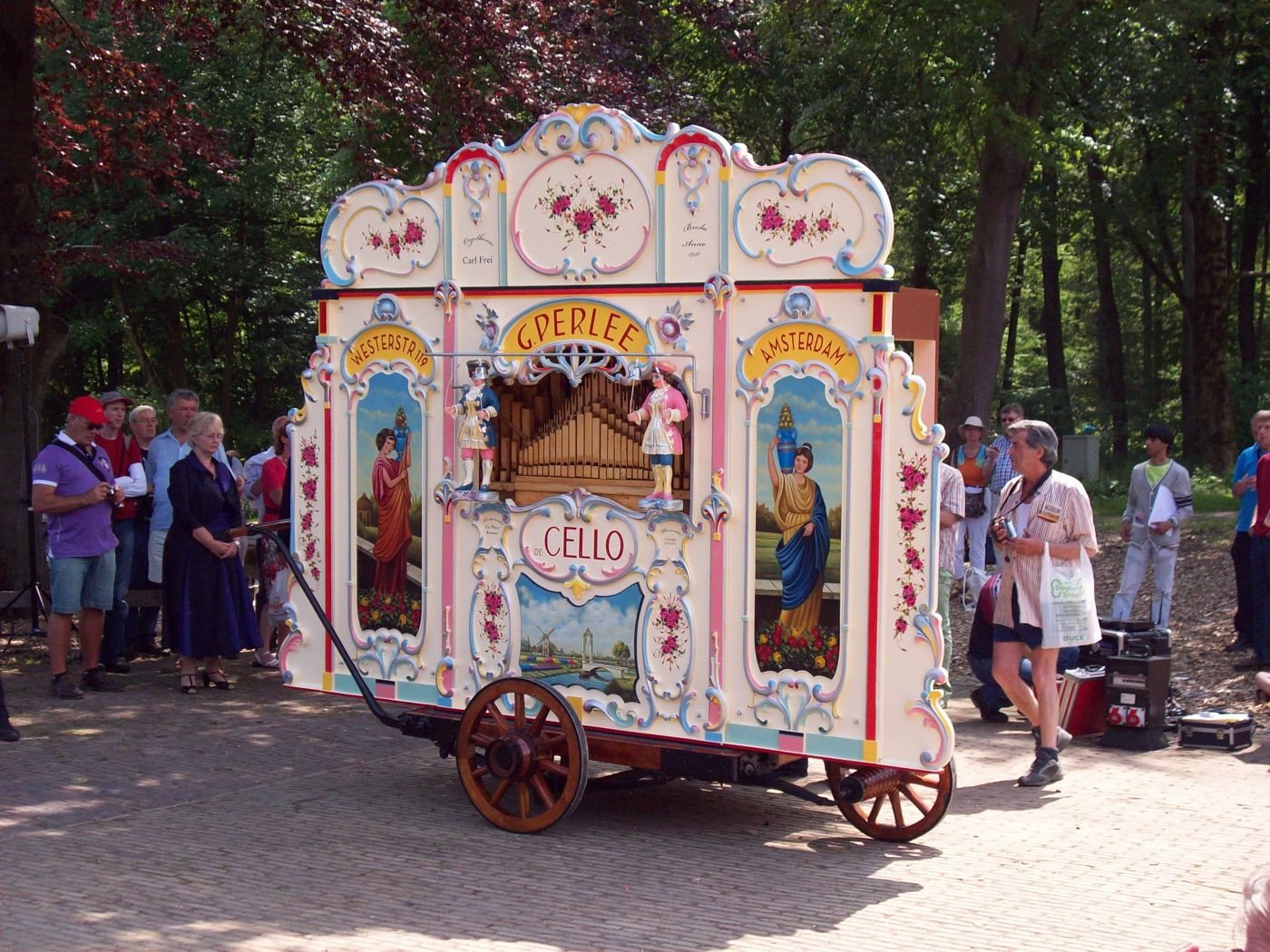
The Dutch street organ (draaiorgel, colloquially pierement) has the most immediately recognisable front of all, and it is a street front, not a fairground one (Wikipedia: Dutch street organ). It is designed to work a busy city street corner rather than a midway, and its front is correspondingly tall and bright rather than deep and theatrical. The signature is mirrors and bevelled glass set among bright, jewel-coloured scrollwork, which multiply the light and the movement and make the organ sparkle in a grey northern street. Moving figures are common — frequently a pierrot or a small conductor nodding and gesturing among the scrolls. The classic Dutch voicing and much of the classic Dutch front are associated with Carl Frei, the Waldkirch-trained builder who moved to Breda and defined the Dutch street-organ sound (see Vol 5 for Frei and the Amsterdam rental tradition in full). The draaiorgel front is thus the German carving tradition transplanted to the Netherlands and reworked around mirrors, brightness and the street.
4.4.4 Belgian Art Nouveau → Art Deco — the dance-organ façade
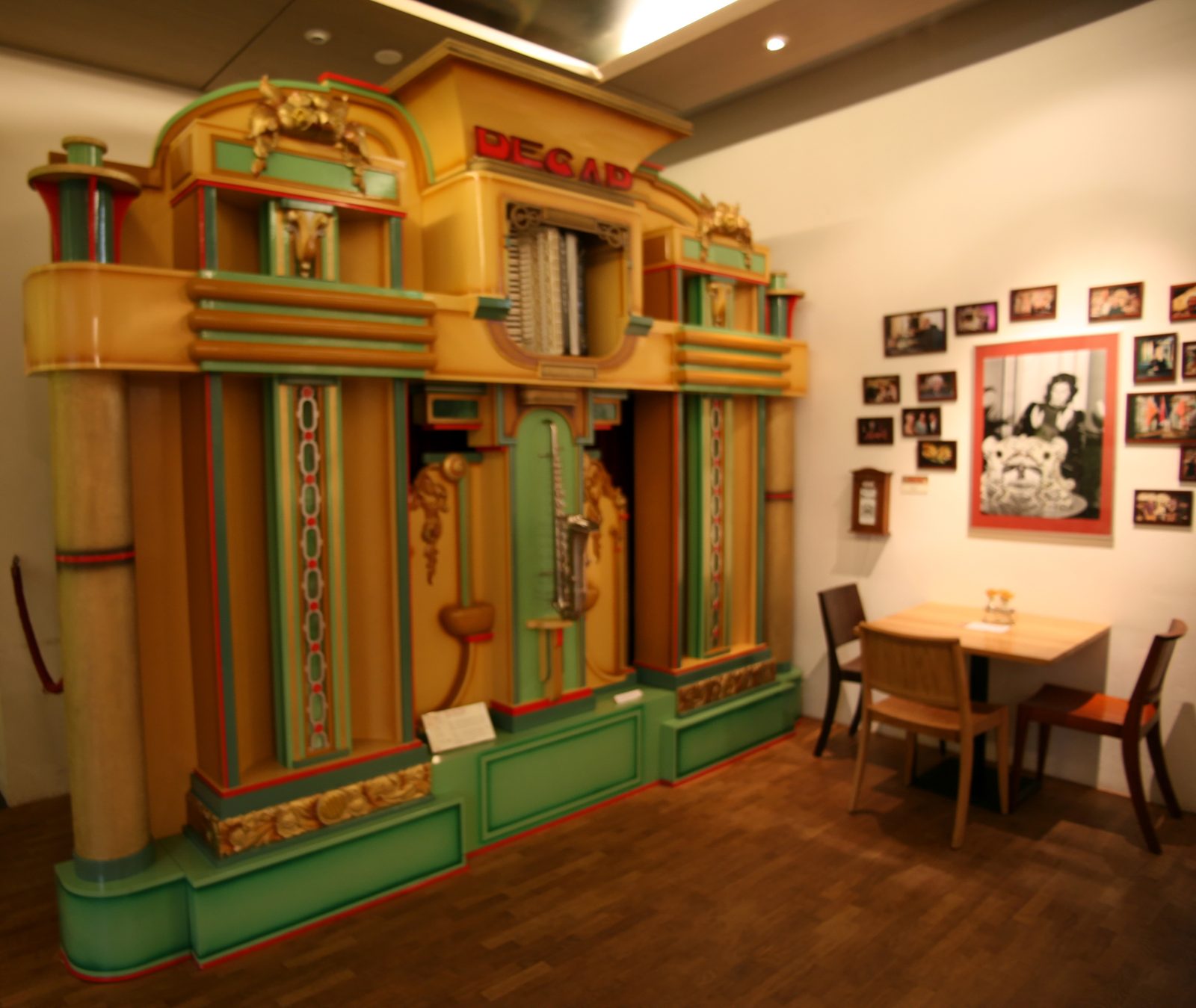
The Belgian dance organ is an indoor instrument — the orchestra of the café and the dance hall, quieter than a fairground organ and built to be seen from across a ballroom floor rather than across a fair (Wikipedia: Dance organ; see Vol 6). Its façade tells the story of early-twentieth-century design in one object. The predominant maker by the early 1920s, Mortier of Antwerp, and its 1930s rival Gebroeders Decap, took the front through a clear evolution: from flowing Art Nouveau lines into bold, geometric Art Deco — stepped and panelled fronts, chrome and mirror, coloured and etched glass, and, crucially, electric back-lighting that made the whole façade glow in a darkened dance hall. This is the one national front designed for artificial light and an interior, and it looks it: less carved gilt, more geometry, glass and illumination. It is the modern end of the grand-front tradition, and a clean visual contrast to the gilded French fairground front it descends from.
4.5 Reading a front: the tradition in summary
Set side by side, the four fronts encode the four traditions. The French Rococo front (Gavioli, Marenghi) and the German carved-figure front (Bruder, Ruth) are both fairground fronts — big, outdoor, theatrical — differing in accent: gilt scrollwork versus sculptural figure-carving. The Dutch draaiorgel front is a street front — bright, mirrored, tall, built for a city corner and associated with Carl Frei. The Belgian front is a dance façade — indoor, back-lit, evolving from Art Nouveau into Art Deco (Mortier, Decap). Keeping these distinct is the same discipline the whole dive insists on: fairground, street and dance are cousins, not synonyms, and their fronts advertise the difference as plainly as their music does.
Underneath the national differences, the same engineering logic runs through every grand front. It is advertising architecture wrapped around an orchestra. The crest, name-board and columns brand and frame it; the display pipes fill it, mixing speaking ranks with dummy/mute pipes to complete the composition — the sharp inversion of the small busker organ’s honest, mostly-speaking front (cross-ref Dive 11). The swell shutters hide the loud ranks and give the machine its dynamics, disguised as ornament and driven silently from the book. And the automata — the conductor beating time, the women striking bells, the drummer, the visible glockenspiel and drums — turn the front into a performing billboard, doing real musical work and irresistible visual advertising at once. The front is, in the end, as much a piece of showman’s architecture as it is part of the instrument; that dual identity is the tradition this volume set out to survey.
For the joinery, timber, gilding, finishes and general case construction beneath all of this, and for the busker organ’s own front and the engineering of the figure drives, cross-ref “The Case, Façade & Figures” (Dive 11). For the pipe ranks the front conceals and the wind that feeds them, cross-ref “Wind Systems” and “Building Organ Pipes.” For the makers whose names ride the name-boards, see Vol 2; for the Dutch street tradition, Vol 5; and for the Belgian dance organ, Vol 6.
Sources
- Wikipedia: Fairground organ — the front “designed to attract attention”; automata (“a conductor whose arm moved in time to the music, or women whose arms struck bells”); visible glockenspiel and drums; the Paris/Waldkirch makers.
- Wikipedia: Dutch street organ — the draaiorgel/pierement; book music; “slightly smaller than the semi-trailer-sized fairground organ”; the street setting.
- Wikipedia: Dance organ — the Belgian indoor tradition; Mortier and Decap; the Art Nouveau → Art Deco façade evolution; quieter than a fairground organ.
- Wikipedia: Waldkirch — “town of mechanical organs”; organ building from 1799 (Matthias Martin); Bruder from 1829; Ruth; Carl Frei.
- Cross-references: Dive 11 “The Case, Façade & Figures” (general case construction, the busker front, figure-drive mechanisms); “Wind Systems” (swell pneumatics, wind); “Encoding the Music” (Dive 4, book/roll control tracks); Vol 2 (makers), Vol 3 (key count versus pipe count), Vol 5 (Dutch street organ), Vol 6 (Belgian dance and American band organs).
Style and proportion claims for individual surviving instruments are marked (est.) where a specific numeric or ornamental detail is not independently sourced; the front vocabulary itself is drawn from the cited references.
Comments (0)