Fairground And Dutch Street Organs · Volume 3
Fairground & Dutch Street Organs — Vol 03: Book Music & the Key Frame
Book music is the single mechanical idea on which the whole grand-organ tradition turns. Before it, a fair organ was a pinned barrel machine: its music lived on a rotating wooden drum, and the drum’s circumference set an absolute ceiling on how long any tune could be. After it, the music lived on a folded cardboard book that fed off one stack and onto another, so a tune could run for as long as the cardboard did — “almost infinitely long” (Wikipedia: Gavioli). Every scale, every maker rivalry, and every semi-trailer- sized proscenium organ surveyed in the sibling volumes of this dive descends from that one substitution: a drum of fixed size replaced by a ribbon of punched card of unbounded length.
This volume covers the fairground book-music tradition and the reading mechanism — the physical system by which a hole in a cardboard book becomes an open pipe valve — together with the key-scale ladder that runs from the 20-key busker organ up to Carl Frei’s 112-key concert organ. It deliberately does not re-derive the hole-to-note encoding theory (which tracks a hole occupies, how a note is laid out along the book, arranging conventions): that is the subject of the companion dive “Encoding the Music” (Dive 4), and this volume cross-refers it rather than repeating it. The ranks of pipes that the keys ultimately drive belong to “Building Organ Pipes” and “Wind Systems”; the general maker narrative (who Gavioli was, the firm’s rise and fall) is developed in Vol 2 (History & the Makers) of this dive; and the ornate front that hides the frame is Vol 4 (The Grand Façade). This volume sits between them: the medium and its reader.
3.1 The pivot: from pinned barrel to punched book
3.1.1 What came before
The earliest self-playing fair and street organs were barrel organs: a wooden cylinder studded with metal pins and bridges rotated under a row of tracker levers. As a pin passed, it lifted a lever, the lever opened a pallet, and a pipe spoke. The barrel was a beautiful and durable store of music, but it had three structural limits that book music would remove:
- Fixed tune length. The full musical content had to fit within one revolution of the drum (or a fixed number of “turns” indexed by a shift mechanism). Tune length was “determined by the physical dimensions” of the barrel (Wikipedia: Book music). A long overture simply would not fit.
- Fixed repertoire per barrel. Re-pinning a barrel was a specialist job; changing the programme meant swapping a heavy, precisely pinned cylinder.
- Limited note count. More notes meant more pin lanes and a longer, heavier barrel — the mechanism did not scale gracefully to the several-dozen-note scales the grand organs would demand.
3.1.2 What book music changed
Book music replaced the drum with folded cardboard sheets punched with holes (Wikipedia: Book music). The cardboard concertinas into a zig-zag stack, feeds horizontally through the reading head, and folds back into a second stack on the far side. Because the book is simply fed through rather than rotated, its length is limited only by how much cardboard one is willing to fold — the tune is unbound from any drum circumference. The same reading head can play any book of the correct scale, so the repertoire becomes a shelf of cheap, swappable books rather than a rack of heavy barrels.
That is the pivot. Everything else in this volume — the key frame, the keyless refinement, the scale ladder — is a consequence of, or an accessory to, the cardboard book.
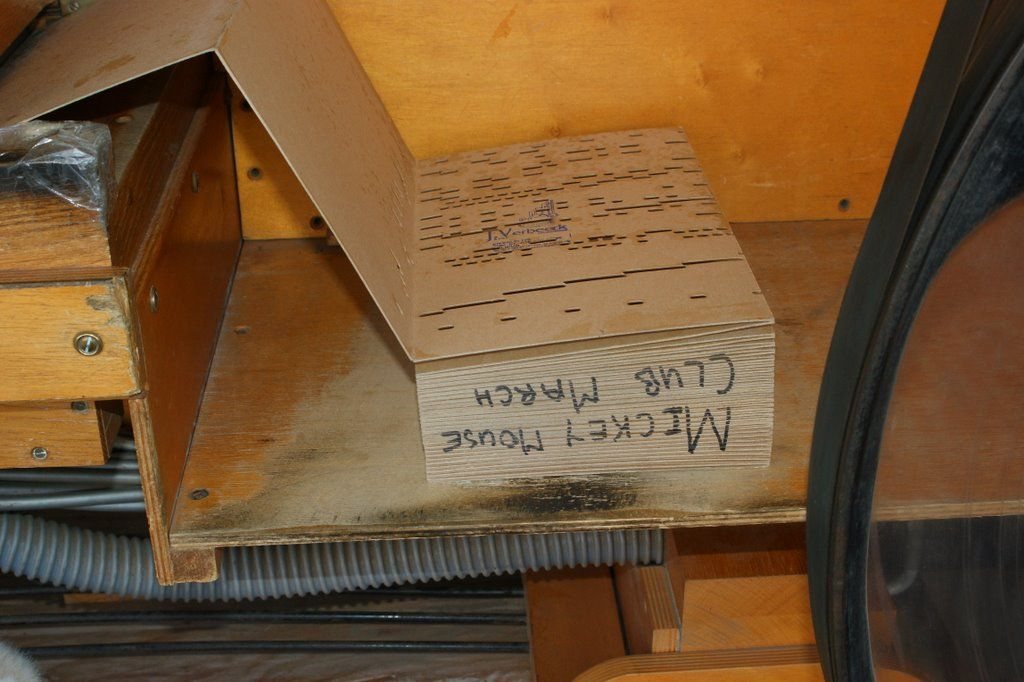
3.2 Anselme Gavioli and the 1892 patent
3.2.1 The patent and the man
Anselme (Anselmo) Gavioli (1828–1902) patented cardboard book music — the “book organ” — in 1892 (Wikipedia: Book music; Wikipedia: Gavioli). He was the grandson of the firm’s founder and by then its guiding technical mind, working from the Gavioli & Cie works in Paris. The full firm history (founded 1806 in Cavezzo, Italy; moved to Paris in 1845; passed to Limonaire Frères c.1910–12) is told in Vol 2 (History & the Makers) and is only summarised here to place the patent: the 1892 book-music patent is the invention that made Gavioli “the most famous and prolific of fair organ builders” (Wikipedia: Gavioli).
Two Gavioli inventions are routinely conflated and must be kept distinct:
- The frein (1878) — a metal reed-brake device that gave the reed pipes a singing, string-like (cello/violin) voicing. This is a voicing device and has nothing to do with the music medium.
- Book music (1892) — the cardboard-book medium and its key-frame reader, the subject of this volume.
The frein predates the book patent by fourteen years; the two solve entirely different problems (tone colour versus music storage) and should never be merged into a single “Gavioli invention.”
3.2.2 The prior art it built on
Book-music-style folded card was not conjured from nothing. Fourneaux’s “Pianista” (1863) had already used a pneumatic card-reading principle for a self-playing piano-pusher (Wikipedia: Book music). Gavioli’s achievement was to adapt and productionise a robust, punched-cardboard book with a mechanical key frame specifically for the demanding, dirty, out-of-doors world of the fair organ — and to build the firm and the scale families that made it the industry standard. The encoding conventions that grew up around that medium are developed in “Encoding the Music” (Dive 4).
3.3 The key frame — the reading head
3.3.1 Principle of operation (the keyed system)
The key frame is the reading head that turns holes into notes. In Gavioli’s original mechanical form it works exactly as its name says (Wikipedia: Book music):
the keys, small levers which rock upwards when a hole passes by, run underneath the book … [and] mechanically open the valves.
Concretely: a row of keys — small pivoted levers, one per track of the scale — runs across the width of the book, underneath it. The book is drawn steadily over the frame. Where the cardboard is solid, it holds each key pressed down. The instant a punched hole arrives over a key, there is nothing to hold that key down, so its sprung tip rocks up into the hole. That small rocking motion is the read event: through a linkage (or, on larger organs, through a pneumatic motor the key triggers), it opens the pipe pallet/valve, admitting wind to the pipe, and the note sounds for exactly as long as the hole is long. When the solid card returns, the key is pushed back down and the pallet closes.
The key frame is therefore a mechanical sampler running at book speed: each key is continuously asking “is there card here or a hole?” and the pattern of holes streaming past is the score.
3.3.2 Note keys versus registration keys
Not every key in a frame plays a pipe. A grand organ’s frame divides its keys into two functional classes, and this distinction recurs throughout the scale ladder below:
- Note keys — the majority. Each governs a musical pitch (or, more precisely, a track that a pitch is wired to). Opening a note key admits wind to whatever pipes are currently switched onto that pitch.
- Registration keys — a minority reserved not for pitches but for register control: turning a whole rank on or off (e.g. bringing in the trumpets or muting the violins), operating the swell/expression shutters, or triggering percussion (bass drum, snare, cymbal, glockenspiel/bells). A registration key changes how the note keys are voiced, not what pitch sounds.
This is why the “key count” of a scale is best read as playing positions plus registration positions the frame reads — a point returned to, and hammered, in §6.3. The exact allocation (how many of an 89-key scale’s keys are melody, bass, accompaniment, counter-melody, or registration) is an encoding question and is laid out in “Encoding the Music” (Dive 4).
3.3.3 The cost of the keyed system
The mechanical key frame has one obvious wear problem: the keys physically drag and rock against the cardboard. Thousands of passes of a treasured book across a row of sprung metal keys abrade the card, ragged the hole edges, and eventually degrade timing and sealing. A fair organ earns its keep by playing the same popular books over and over, so book wear is not a corner case — it is the central maintenance headache of the keyed frame. The fix is the keyless frame.
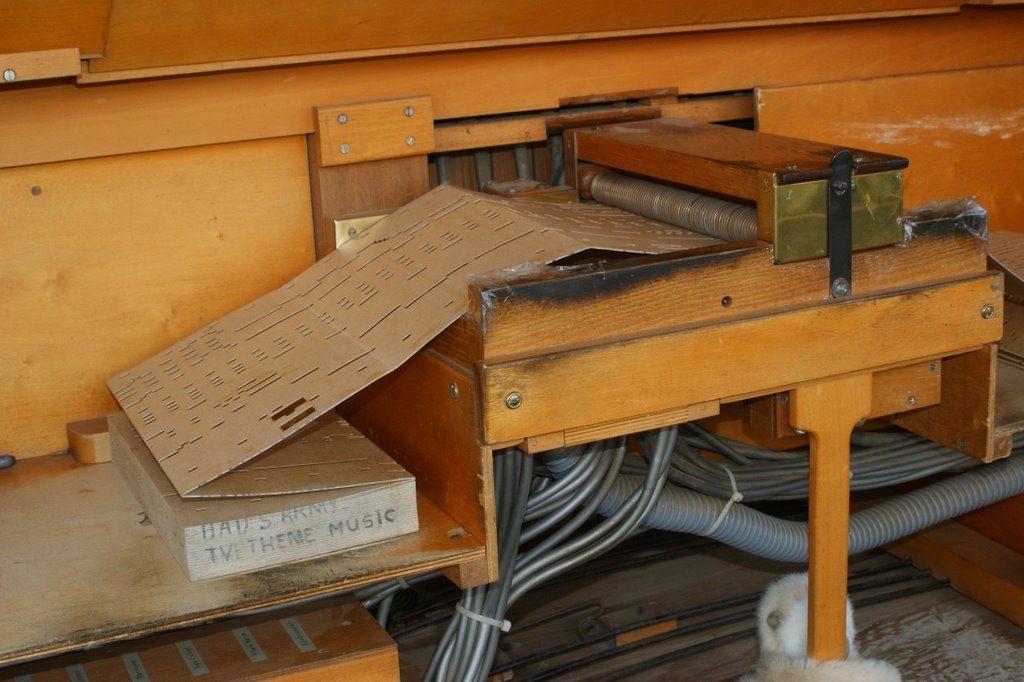
3.4 The keyless frame — the pneumatic refinement
3.4.1 What “keyless” means
The keyless frame is the later refinement that removes the wearing mechanical keys altogether. Instead of a metal key rocking up into each hole, the reading face of a keyless frame is drilled with a row of wind channels, one per track. The book passes over these channels. Where the card is solid, it seals the channel; where a hole passes, it uncovers the channel and lets wind (air) pass through it (Wikipedia: Book music). That admitted puff of wind is the read event — it drives a small pneumatic motor (a pouch or bellows) that opens the pallet.
In short: the keyed frame reads the book mechanically (a lever feels the hole); the keyless frame reads it pneumatically (wind flows through the hole). The keyless frame has no keys touching and abrading the card — hence the name — which is precisely the point:
to stop the [mechanical] keys wearing the books, the holes [instead] allowed air to pass through (Wikipedia: Book music).
A scale built for this reader is specified as “keyless” (for example, many small modern street/busker scales are keyless scales; see §6). It is worth being explicit about the guardrail here: the keyless frame is a later refinement of Gavioli’s book system, not a different medium and not another maker’s invention. It reads the same cardboard books, more gently. The paper roll (see §5.2) is a separate medium entirely and must not be credited with the keyless idea.
3.4.2 Why the keyless frame won for delicate work
The keyless (pneumatic) reader has three practical advantages that made it the standard for organs whose books had to last:
- No book wear from keys — the whole reason for its existence. Air passing through a hole abrades nothing.
- Lighter reading force — because a hole only has to uncover a wind channel rather than release a sprung lever, the book can be thinner and the drag on the feed lighter, which matters for a hand-cranked street organ where the grinder is also working the bellows (cross-ref Vol 5, The Dutch Street Organ, and “Wind Systems”).
- Pneumatic gain — the small admitted puff can be pneumatically amplified to throw a large pallet, so a keyless frame scales cleanly to grand organs with heavy wind demands.
The trade is added pneumatic plumbing (a pouch/motor per channel) and a reading face that must seal well against the card. For the fine encoding detail of how a hole’s length and position map to a sustained note on either reader, see “Encoding the Music” (Dive 4) — this volume stops at the mechanism.
3.5 Why book beats the alternatives
Book music displaced two rival media: the older pinned barrel and the contemporary paper roll. Its advantages over each are structural, not matters of taste.
3.5.1 Book versus the pinned barrel
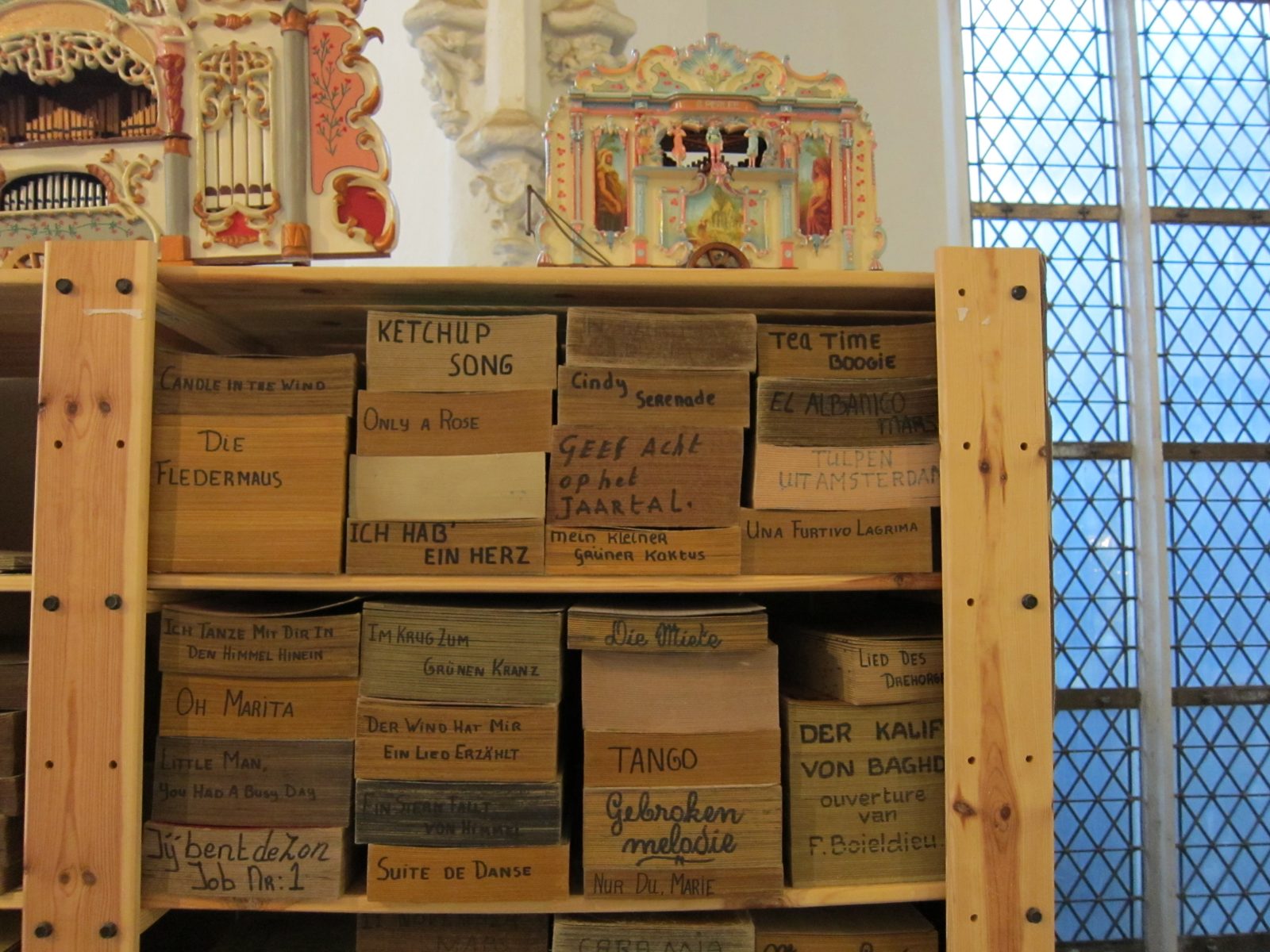
The decisive advantage is tune length. On a barrel, the music must fit the drum; the “length of each tune [is] no longer determined by the physical dimensions” once book music is adopted (Wikipedia: Book music). A book can be as long as one cares to fold, so a tune can be “almost infinitely long” (Wikipedia: Gavioli) — long enough for a full march, waltz medley, or operatic selection with repeats. Secondary advantages: books are cheap to duplicate and store (a shelf of card versus a rack of pinned cylinders), and easy to swap to change the programme.
3.5.2 Book versus the paper roll
The player-piano world standardised on the paper roll, and paper rolls do share book music’s unbounded length. But for the rough service of a fair or street organ, cardboard beats paper on two counts (Wikipedia: Book music):
- Durability and dimensional stability. Cardboard is “sturdy and not subject to expansion and contraction with humidity.” A paper roll, out of doors in a damp English fairground or an Amsterdam drizzle, swells and shrinks with the weather; its tracking drifts and its holes distort. Rigid cardboard holds its registration.
- No rewind. A book needs no rewind: it simply folds from one stack to the other and, at the end, is turned over or re-stacked — there is no long dead interval spooling a roll back to its start. A roll, by contrast, must be rewound before it can play again.
For the indoor, climate-stable, one-machine world of the player piano, the roll was fine; for the outdoor, all-weather, play-it-again world of the fair organ, cardboard book music was the correct engineering choice — which is why the grand European fairground and Dutch street traditions are overwhelmingly book traditions. (The American band organ did in fact move to the paper roll, and the Belgian dance organ used both roll and book; those divergences are the subject of Vol 6, Dance Organs & Band Organs.)
The reading mechanism and the two rival media are drawn together in Figure 3.1.
3.5.3 Figure — book music and the key frame (keyed vs keyless)
3.6 The key-scale ladder
A book organ is defined first of all by its scale — the fixed vocabulary of tracks its frame reads, quoted as a “key” count. Books are cut to a scale and are not interchangeable between scales; a maker’s whole catalogue of music is tied to the scales it supports. The ladder below runs from the small busker organ to the grand concert organ. The two governing facts are: (a) larger key counts buy more notes and more registration/percussion control, and (b) the key count is not the pipe count (§6.3).
3.6.1 The ladder, small to grand
- 20 keys — the small street/busker scale, the standard of the modern hand-cranked one-person organ; makers include Carl Frei and Raffin (Dean Organ Builders). This is the small cousin of everything else in this dive — the same 20-key “Carl Frei / Raffin” busker scale profiled in the Hobby-Crank and Track-1 dives — and it is typically a keyless scale. Do not confuse this small scale with the grand Frei organs at the top of the ladder (§6.2).
- 25–27 keys — small Dutch/Italian street organ scales; Gasparini, Perlee (Dean Organ Builders).
- 35 / 45 keys — Limonaire (Dean Organ Builders).
- 46 keys — Gavioli and Wilhelm Bruder (Dean Organ Builders).
- 47 / 49 keys — Marenghi (Dean Organ Builders).
- 52 keys — a widely shared mid-size scale: Ruth, Gasparini, Limonaire (and others: Koenigsberg, Verbeeck, Bursens) (Dean Organ Builders).
- 57–72 keys — the large fairground band: Ruth, Bruder, Wellershaus, Gavioli, Carl Frei (Dean Organ Builders).
- 87 keys — the Gavioli 87, “one of the most popular and versatile fairground scales” (MBSI: 87/89/98 Gavioli). Also used by Marenghi, Gaudin, Chiappa and Carl Frei.
- 89 keys — the 87 expanded to 89 (MBSI: 87/89/98 Gavioli): the Marenghi 89 and the Gavioli 89 (G4 / VB) scales. Because it grew out of the 87, 87-key music adapts to the 89.
- 98 keys — Marenghi’s further expansion of the 89, engineered to keep the same playing notes as the 89 so that music transfers between them (MBSI: 87/89/98 Gavioli).
- 112 keys — the Carl Frei Traveling Concert Organ, his largest instrument (Wikipedia: Carl Frei). Belongs to the same grand-concert bracket as the largest Mortier/Decap/Marenghi/Richter dance and concert scales.
3.6.2 The two ends of the Carl Frei name
The name Carl Frei appears at both ends of this ladder — on the small 20-key busker scale and on the grand 112-key concert organ — and this is a deliberate point, not a slip. Carl Frei (b. 1884 Schiltach; d. 1967 Waldkirch) was Waldkirch-trained and later defined the classic Dutch street-organ voicing from Breda; his firm’s name is attached to the small busker scale by trade convention (Dean Organ Builders) and to the largest concert organ he built (Wikipedia: Carl Frei). His biography is the subject of Vol 5 (The Dutch Street Organ). The guardrail: never put a grand scale on a busker organ, or a busker scale on a grand organ. A 20-key Frei is a one-person street machine; a 112-key Frei is a semi-trailer-scale concert organ. The shared surname connects them; the scales do not.
3.6.3 Key count is not pipe count
This is the fact to fix above all others. A scale’s “key” number is the number of playing positions plus registration positions the frame reads — melody, bass, accompaniment and counter-melody note keys, plus the registration keys that switch ranks, work the swell shutters, and fire the percussion. It is not the number of pipes.
A grand organ voices each note key across several ranks of pipes. A single melody key might sound, simultaneously, a bourdon, a violin, a cello, a flute, a piccolo, a trumpet and a trombone rank — whichever the current registration has switched on — so one key can command seven or more pipes across the compass, and each rank spans the full set of note keys. Add the glockenspiel/bells, bass drum, snare and cymbal driven by registration keys, and the arithmetic is clear: an 89-key organ has several hundred pipes, not 89. The ranks themselves — how a bourdon differs from a violin pipe, how they are scaled and voiced, and how the low-pressure wind (a few inches of water column, not steam) is supplied to them — are the subject of “Building Organ Pipes” and “Wind Systems”; this volume only insists on the count.
The ”≈ N pipes across R ranks” figures in the table and Figure 3.2 below are order-of-magnitude working estimates for a typical instrument of each scale and are marked (est.) accordingly; a specific surviving organ may differ with its exact rank layout.
3.6.4 The key-scale ladder (table)
Table 1 — 6.4 The key-scale ladder (table)
| Keys | Maker(s) | Typical use | Approx. pipes across ranks |
|---|---|---|---|
| 20 | Carl Frei, Raffin | Small hand-cranked street/busker organ (one person); usually keyless | ≈ 25–35 pipes, 1–2 ranks (est.) |
| 25–27 | Gasparini, Perlee | Small Dutch/Italian street organ | ≈ 40–70 pipes, 2–3 ranks (est.) |
| 35 / 45 | Limonaire | Small–mid fairground / street organ | ≈ 90–160 pipes, 3–4 ranks (est.) |
| 46 | Gavioli, Wilhelm Bruder | Mid fairground organ | ≈ 130–200 pipes, 4–5 ranks (est.) |
| 47 / 49 | Marenghi | Mid fairground organ | ≈ 140–210 pipes, 4–5 ranks (est.) |
| 52 | Ruth, Gasparini, Limonaire | Large fairground / street organ (very common) | ≈ 160–260 pipes, 4–6 ranks (est.) |
| 57–72 | Ruth, Bruder, Wellershaus, Gavioli, Carl Frei | Large fairground band | ≈ 200–350 pipes, 5–7 ranks (est.) |
| 87 | Gavioli (also Marenghi, Gaudin, Chiappa, Frei) | Grand fairground organ — “one of the most popular, versatile fairground scales” | ≈ 350–450 pipes, 7–9 ranks (est.) |
| 89 | Marenghi 89; Gavioli 89 (G4 / VB) | Grand fairground organ (the 87 expanded) | ≈ 350–500 pipes, 7–9 ranks (est.) |
| 98 | Marenghi | Grand fairground organ (89 expanded; same playing notes so music transfers) | ≈ 400–550 pipes, 8–10 ranks (est.) |
| 112 | Carl Frei | Traveling Concert Organ — his largest instrument | ≈ 450–650 pipes, 9–12 ranks (est.) |
Sources: maker/scale associations from Dean Organ Builders (scale table); the 87/89/98 Gavioli–Marenghi family from MBSI: 87/89/98 Gavioli; the 20-key busker scale and the 112-key Frei concert organ from Dean Organ Builders and Wikipedia: Carl Frei. Pipe/rank columns are working estimates (est.) to illustrate that key count ≠ pipe count — a specific instrument varies with its rank layout (see “Building Organ Pipes”).
3.6.5 Figure — the key-scale comparison strip
3.7 Reading it all together
The cardboard book and its frame are the hinge of the grand-organ world. Anselme Gavioli’s 1892 book-music patent freed the tune from the barrel’s circumference and gave the fair organ a cheap, swappable, weather-proof, rewind- free music store; the key frame read that book mechanically, keys rocking up through the holes to open the pallets; and the keyless frame refined the reader into a pneumatic one that spared the books from key wear by letting the holes admit wind directly. On that foundation the makers built the scale ladder — 20 keys for the busker’s street organ, up through the 46/52 fairground scales, to the Gavioli–Marenghi 87/89/98 grand family and Carl Frei’s 112-key concert organ — always remembering that a “key” is a position the frame reads, and that a grand organ voices those keys across many ranks into several hundred pipes.
Where this volume stops, the siblings continue: the hole-to-note encoding theory is “Encoding the Music” (Dive 4); the ranks and the wind that the keys drive are “Building Organ Pipes” and “Wind Systems”; the makers behind the scales are Vol 2 (History & the Makers); and the ornate façade that hides the frame from the fairgoer is Vol 4 (The Grand Façade).
Sources
- Wikipedia: Book music — Gavioli’s 1892 cardboard book patent; the key frame (“keys … rock upwards when a hole passes by … mechanically open the valves”); the keyless frame (“holes allowed air to pass through” to stop keys wearing the books); book vs barrel (tune length no longer fixed by physical dimensions); book vs roll (cardboard “sturdy and not subject to expansion and contraction with humidity,” no rewind); Fourneaux “Pianista” (1863) prior art.
- Wikipedia: Gavioli — Anselme Gavioli (1828–1902); the frein (1878) and the 1892 book-music patent; a tune “almost infinitely long”; “the most famous and prolific of fair organ builders.”
- Wikipedia: Carl Frei — b. 1884 Schiltach, d. 1967 Waldkirch; the largest instrument, the “Carl Frei Traveling Concert Organ,” 112 keys.
- MBSI: 87/89/98 Gavioli (Musical Box Society International) — the 87-key Gavioli as “one of the most popular and versatile fairground scales,” expanded into the 89 and 98; also used by Marenghi, Gaudin, Chiappa, Carl Frei; 89 keeps the 87’s playing notes and 98 keeps the 89’s, so music transfers.
- Dean Organ Builders (maker/scale table) — the key-scale ladder by maker: 20 (Frei/Raffin), 25–27 (Gasparini/Perlee), 35/45 (Limonaire), 46 (Gavioli/W. Bruder), 47/49 (Marenghi), 52 (Ruth/Gasparini/Limonaire), 57–72 (Ruth/Bruder/ Wellershaus/Gavioli/Frei).
Pipe/rank figures in the table and Figure 3.2 are working estimates marked (est.) to illustrate key count ≠ pipe count; see “Building Organ Pipes” and “Wind Systems” for the ranks and the low-pressure wind supply.
Comments (0)