Fairground And Dutch Street Organs · Volume 6
Fairground & Dutch Street Organs — Vol 06: Dance Organs & Band Organs
The four preceding volumes traced the grand fairground organ (French and German, outdoor), its book-music heart, its carved proscenium, and the Dutch street organ. This volume covers the two remaining national traditions in the grand-wind-organ family, and they could hardly be more different from one another. The Belgian dance organ is an indoor instrument, built to fill a café or a dancing hall and voiced deliberately quieter than its outdoor fairground cousin, its façade evolving from Art Nouveau to the mirrored geometry of high Art Deco. The American band organ is an outdoor instrument like the fairground organ, but it grew up on a different continent, on the carousel and in the circus, and it took its very name from the fact that it was built to imitate a marching or military band.
Both belong firmly to the wind branch of the family. Like every organ in this dive, they speak ranks of tuned pipes on low-pressure wind — a reservoir held at a few inches of water column, on the order of 0.1–0.2 psi, raised by feeder bellows. Neither is a steam instrument. The steam cousin of the band organ is the calliope, the deafening whistle machine that runs on steam at roughly 100–180 psi and is the subject of “Steam Organs & Calliopes” (Dive 13). The two shared many an American fairground within earshot of each other, which is exactly why they are so often confused; they are covered in separate dives because they are separate machines on separate physics. This volume keeps the guardrails of the dive intact throughout: dance ≠ band ≠ fairground ≠ street, and wind ≠ steam.
6.1 The Belgian dance organ
6.1.1 What the dance organ is
The dance organ is the Belgian branch of the grand-organ family. Where the fairground organ was built to be heard across an open fair, and the Dutch street organ to carry over a busy street corner, the dance organ was built for a room. Its natural home was the café and the dancing hall (the balzaal or dancing), and it was, in the sources’ plain words, “intended for use indoors” and therefore tended “to be quieter than the similar fairground organ” (Wikipedia: Dance organ). That single fact — indoor, and therefore softer — drives most of what distinguishes the dance organ from the fairground organ that Vol 2 and Vol 4 surveyed.
An indoor instrument does not need to shout over a crowd and a steam engine and a set of galloping horses. It needs to fill a dance floor with a rich, danceable band sound at a volume people can stand and talk near between numbers. So the dance organ was voiced for warmth and body rather than raw carrying power: fewer, gentler-voiced ranks than the loudest fairground scales, more emphasis on the reed and accompaniment voices that a dance band would carry, and — as the tradition matured — accompaniment percussion and, eventually, actual accordion and saxophone ranks and the trappings of a jazz-age dance orchestra.
Crucially, the dance organ was roll and book operated (Wikipedia: Dance organ). This is a point worth dwelling on, because it separates the Belgian tradition from the Dutch and much of the French. The Dutch street organ (Vol 5) and the classic French fairground organ ran on cardboard book music — Anselme Gavioli’s folded, punched cardboard “books” of 1892, read by a key frame (see Vol 3, and “Encoding the Music”, Dive 4, for the mechanism). The Belgian dance-organ makers used book music too, but they also embraced the perforated paper roll, and many later dance organs are roll-driven instruments. The medium is one of the defining variables of the whole dive — country, setting, medium, loudness — and on the “medium” axis the dance organ is the tradition that used both book and roll.
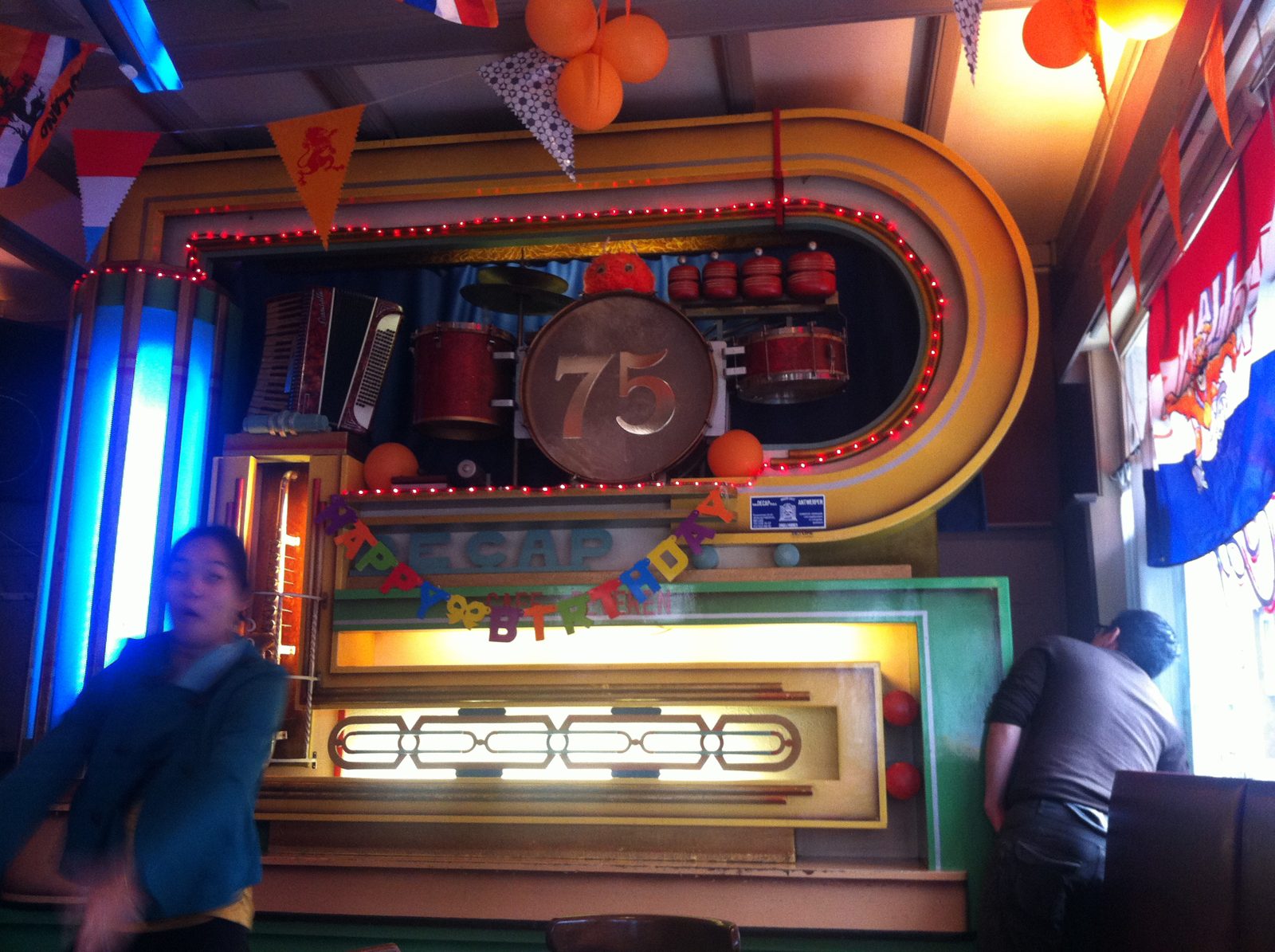
6.1.2 The façade: Art Nouveau to Art Deco
If the fairground front was carved-and-gilded Baroque and Rococo (Vol 4), the dance organ’s façade tells a twentieth-century story. Because the dance organ came into its own later than the fairground organ — its peak spanning roughly the 1910s through the 1930s — its façades track the design movements of exactly those decades. The earlier dance organs wear Art Nouveau fronts: flowing organic lines, sinuous carving, stained glass and the whiplash curve of the fin de siècle. As the tradition reached its height in the 1920s and 1930s, the fronts turned to Art Deco (Wikipedia: Dance organ): bold geometry, stepped and mirrored surfaces, chrome and coloured glass, sunburst motifs, and the streamlined machine-age glamour that suited a jazz-age dance hall. A high Mortier or Decap Art Deco front is one of the most spectacular objects the entire mechanical-organ tradition produced — a wall of mirrored, back-lit geometry several metres wide, as much a piece of ballroom architecture as a musical instrument.
The evolution of the façade is not merely decorative history; it is a reliable dating tool. An organ wearing a sinuous Art Nouveau front, all curves and stained glass, is likely earlier; one wearing the stepped, mirrored, sunburst geometry of Art Deco is likely from the tradition’s 1920s–30s peak. The proscenium, automata and swell-shutter survey of Vol 4 covers the general grammar of the grand front; the dance-organ front is its Belgian, indoor, twentieth-century dialect. Cross-ref Vol 4 for the shared vocabulary of the grand façade, and “The Case, Façade & Figures” (Dive 11) for general case construction.
6.1.3 The Belgian makers
Three Antwerp-area names dominate the dance-organ story.
Mortier (Antwerp). The house of Mortier, based in Antwerp, was the predominant dance-organ builder, and it was already the leading name by the early 1920s (Wikipedia: Dance organ). Mortier became almost synonymous with the grand Belgian dance organ: large, warm-voiced instruments behind broad, spectacular façades, built for the best dancing halls. When a collector or restorer speaks of a “Mortier,” they mean a grand Belgian ballroom organ of the interwar peak, and the name carries the same weight in the dance-organ world that Gavioli carries in the fairground world.
Gebroeders Decap (Antwerpen). The brothers Decap — Gebroeders Decap, of Antwerpen — rose to match Mortier in the 1930s, and it was Decap especially that carried the Art Deco façade to its height (Wikipedia: Dance organ). Where Mortier had led the earlier phase, Decap defined the later, more machine-age look, and the firm’s name is attached to some of the most extravagant mirrored Deco fronts ever built. The Decap tradition proved unusually durable: the firm continued into the era of later dance organs that incorporated accordions, saxophones and other dance-band voices, and Decap instruments are among the most sought-after grand dance organs surviving.
Arthur Bursens (Hoboken / Antwerp). The third name, Arthur Bursens, of Hoboken near Antwerp, worked at a smaller scale. Bursens built café orchestrions — smaller instruments for smaller rooms — under the brand names “Ideal” and “Arburo” (Wikipedia: Dance organ). (“Arburo” combines the names of Arthur Bursens and his partner Gustav Roels — Wikipedia: Dance organ.) Where a Mortier or a grand Decap filled a large dancing hall, a Bursens Ideal or Arburo suited the intimate café, and the firm’s output is the small-room end of the Belgian tradition. It is worth noting the term “orchestrion” here: a café orchestrion is a self-contained mechanical band — pipework plus percussion and often piano or accordion voices in one cabinet — and Bursens’s instruments sit at the boundary between the grand dance organ and the smaller mechanical-band cabinet.
Guardrail — dance is not fairground. The Belgian dance organ is an indoor instrument, deliberately quieter than the outdoor fairground organ, book and roll operated, with Art Nouveau → Art Deco façades and the Antwerp makers Mortier, Decap and Bursens. It is a distinct tradition from the French/German fairground organ of Vols 2 and 4, from the Dutch street organ of Vol 5, and from the American band organ below. Cousins, not synonyms (Wikipedia: Dance organ).
6.2 The American band organ
6.2.1 Why it is called a “band organ”
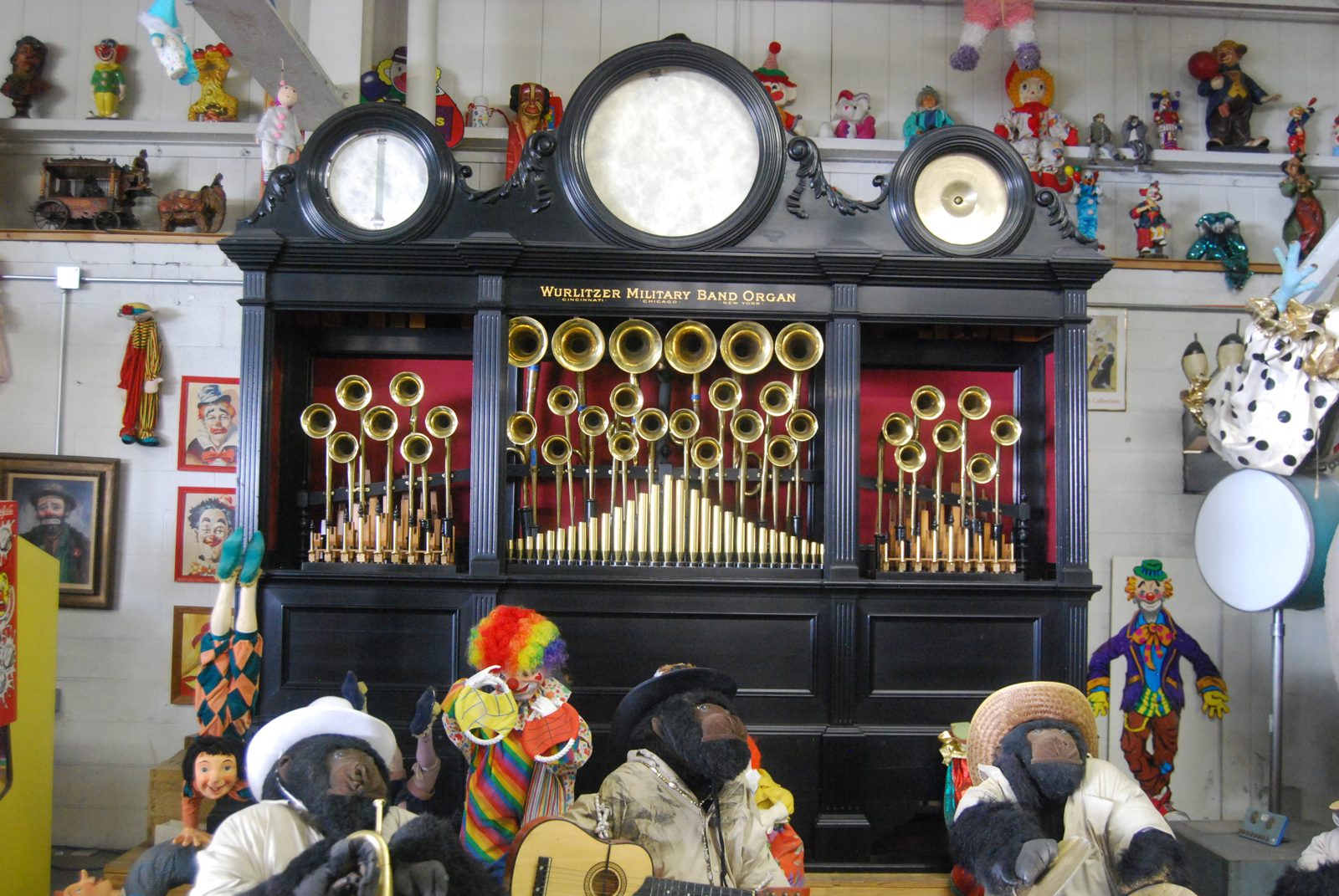
The band organ is the American term for the tradition, and the name is descriptive. The instrument was built and voiced to mimic the sound of a human band — most characteristically a marching or military band (Wikipedia: Band organ). Where the British and Continental trade spoke of “fair organs” or “fairground organs,” the American trade spoke of “band organs,” precisely because the point of the instrument was to sound like the brass-and-reed band that would otherwise have played the same midway. The voicing leans on the brass and reed ranks — trumpets, trombones, clarinets, piccolos — over a march-band accompaniment of bass, snare and cymbal, which is why a band organ playing a Sousa march sounds so convincingly like a real band a street away.
The band organ was used chiefly in two American settings: on carousels / merry-go-rounds, where it was the standard musical accompaniment, and in the circus (Wikipedia: Band organ). The carousel band organ is the archetype — the instrument in the centre or at the entrance of the merry-go-round, its façade facing the riders, its music turning with the horses. That carousel association is so strong that in American usage “carousel organ” and “band organ” are very nearly synonymous, and the preservation body for the tradition is the Carousel Organ Association of America (COAA).
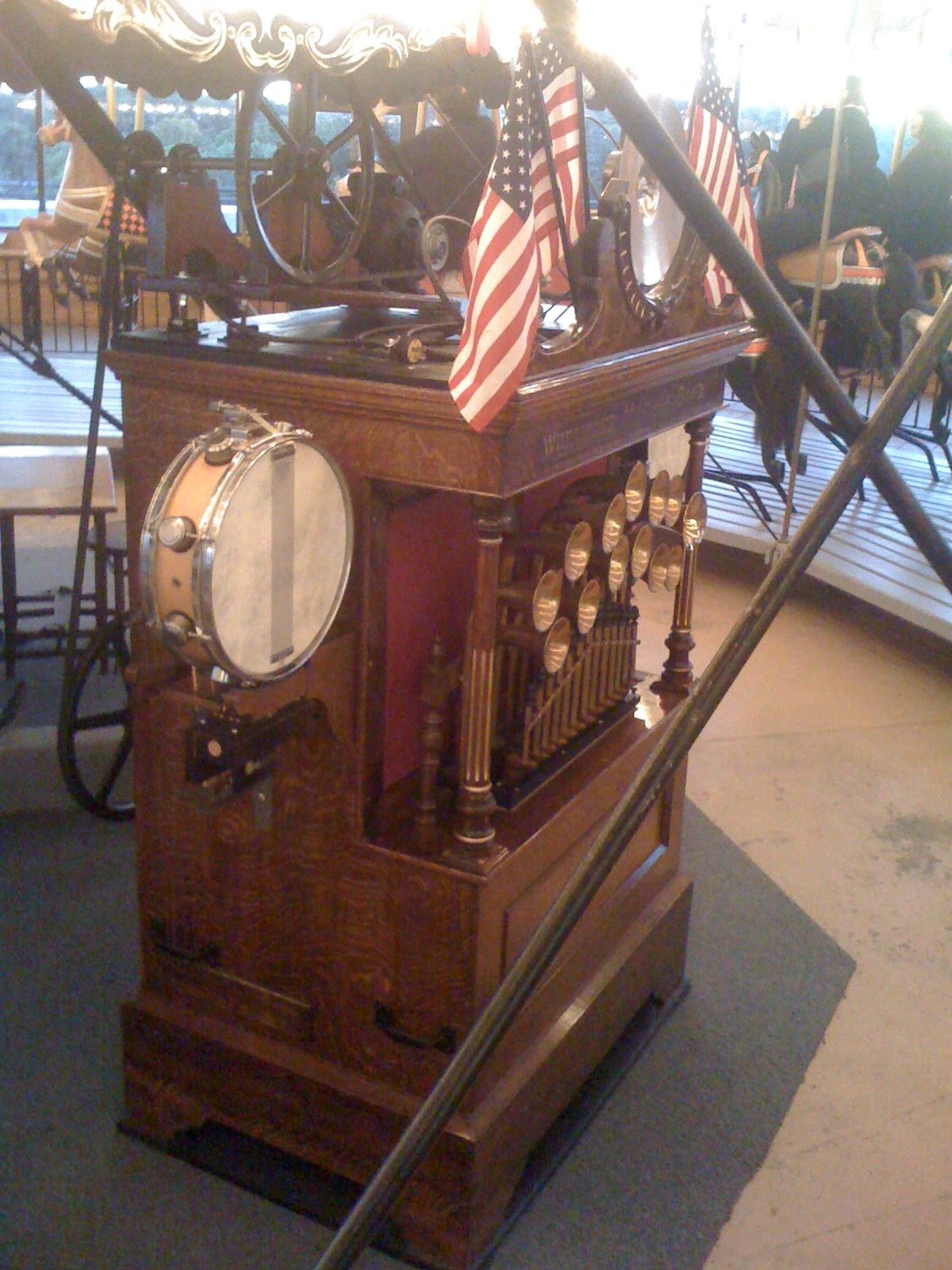
Like the fairground and dance organs, the band organ was roll-operated — after an early barrel period, it settled on the perforated paper roll (Wikipedia: Band organ; Wikipedia: North Tonawanda Barrel Organ Factory). And, to keep the dive’s central guardrail in front of the reader: the band organ is a wind instrument. It works its pipes on a few inches of water of wind, exactly like every other organ in this dive. Its steam cousin is the calliope of Dive 13, a different machine that blows whistles on 100–180 psi of steam. On an American midway the two could be heard within a few hundred feet of each other, which is the root of the perennial confusion; but a band organ is no more a steam organ than a Gavioli is. Wind, not steam.
6.2.2 The lineage: de Kleist to Wurlitzer
The American band-organ story runs through one town — North Tonawanda, New York — and one lineage of firms that begins with a former Limonaire man and ends with the Rudolph Wurlitzer Company.
Eugene de Kleist (1893). The founder of the American tradition was Eugene de Kleist, who had worked for the Paris house of Limonaire (see Vol 2 for the Limonaire firm, and Dive 1 for the general maker narrative) before emigrating. De Kleist set up band-organ production in 1893, moving from Martinsville to North Tonawanda, New York (Wikipedia: North Tonawanda Barrel Organ Factory). That he came out of Limonaire is the crucial link back to the European tradition: the American band organ is not an independent invention but a transplant, carried across the Atlantic by a man trained in the French fairground-organ trade and re-rooted in upstate New York.
DeKleist Musical Instrument Manufacturing Company (1903). De Kleist incorporated his business as the DeKleist Musical Instrument Mfg Co in 1903 (Wikipedia: North Tonawanda Barrel Organ Factory). Through this period the instruments moved, as the European organs had, from pinned barrels to perforated paper rolls as the music medium — the same evolution away from the fixed-length barrel that Gavioli’s book had driven in Europe, arrived at in America by way of the paper roll rather than the cardboard book.
Rudolph Wurlitzer (1908). In 1908, Rudolph Wurlitzer bought de Kleist out, and the North Tonawanda works became the Rudolph Wurlitzer Company of North Tonawanda (Wikipedia: North Tonawanda Barrel Organ Factory). Wurlitzer — already a major American musical-instrument concern — turned the band organ into a mass-produced product with a catalogue of standard styles and a large library of paper rolls, and “Wurlitzer” became the definitive American band-organ name, the way Gavioli was the definitive fairground name and Mortier the definitive dance-organ name.
Ceased 1942. Wurlitzer organ production ceased in 1942, and the very last band organ the firm built was a style 165 in a 157 case (Wikipedia: North Tonawanda Barrel Organ Factory). The end came as the Depression and then the Second World War foreclosed the carousel-and-circus market, and it fits the broader pattern of the whole dive: the grand mechanical organ, on both continents, was overtaken in the second quarter of the twentieth century — in Europe by “effective electrical sound amplification in the mid-1920s” (Wikipedia: Fairground organ), and in America by the same forces plus the war.
The other North Tonawanda houses. Wurlitzer was not alone in the town. Artizan Factories, Inc. and the North Tonawanda Musical Instrument Works were also North Tonawanda, New York band-organ builders (Wikipedia: Band organ; Wikipedia: North Tonawanda Barrel Organ Factory). The town became, for the American band organ, what Waldkirch was for the German fairground organ (Vol 2): a single place where an entire national tradition of the trade concentrated.
<circle cx="90" cy="130" r="4"/>
<text x="105" y="126" font-weight="bold">1903</text>
<text x="150" y="126">DeKleist Musical Instrument Mfg Co incorporated</text>
<text x="150" y="142" font-size="10">barrels → perforated paper rolls</text>

<circle cx="90" cy="180" r="4"/>
<text x="105" y="176" font-weight="bold">1908</text>
<text x="150" y="176">Rudolph Wurlitzer buys de Kleist out</text>
<text x="150" y="192" font-size="10">→ Rudolph Wurlitzer Co of North Tonawanda · roll styles 125 / 150 / 165 / 160</text>

<circle cx="90" cy="240" r="4"/>
<text x="105" y="236" font-weight="bold">1942</text>
<text x="150" y="236">Wurlitzer organ production ceases</text>
<text x="150" y="252" font-size="10">last organ: a style 165 in a 157 case</text>6.2.3 The Wurlitzer roll styles
Wurlitzer standardised its band organs into numbered styles, each keyed to a particular roll format. Because the roll defines how many musical lines and control functions the organ can read, the style number is in effect a scale specification — and, exactly as with the European “key” scales of Vol 3, the tracker-hole count is not the pipe count. A band organ voices its handful of playing lines across several ranks, so a 75-track style 165 still commands far more than 75 pipes.
The three principal Wurlitzer roll styles, with the big military band organ, are set out below. The exact hole and track counts are marked as estimates pending confirmation against the surviving roll catalogues, per the dive’s accuracy convention; the pattern — more tracks for the larger, more capable instruments — is firm.
Table 1 — 2.3 The Wurlitzer roll styles
| Wurlitzer style | Tracker holes (est.) | Tracks (est.) | Character / use |
|---|---|---|---|
| 125 | 43 tracker holes | 45 tracks | The small carousel band organ — the common merry-go-round size |
| 150 | 46 tracker holes | 54 tracks | A mid-size carousel band organ, more musical lines than the 125 |
| 165 | 69 tracker holes | 75 tracks | The large band organ — the top of the standard carousel range; the last organ built (1942) was a 165 |
| 160 “The Mammoth” | — | — | The big military band organ, voiced to imitate a full military brass band |
(Table: Wurlitzer band-organ roll styles. Hole/track counts marked (est.) pending verification against the Wurlitzer roll catalogues. The 160 “Mammoth” is the large military band organ. Sources: Wikipedia: Band organ; Wikipedia: North Tonawanda Barrel Organ Factory; roll-catalogue counts to be confirmed in the accuracy gate.)
Three details in that table repay comment. First, the 160 “The Mammoth” is the giant of the Wurlitzer line, the military band organ built to imitate a full brass band at the largest scale — the American answer to the grand Continental concert organs of Vol 3. Second, the 165 was the top of the ordinary carousel range, and it is a fitting coincidence that the very last organ Wurlitzer built, in 1942, was a style 165 (in a 157 case) — the tradition ended on its largest standard model. Third, and to keep the guardrail visible: a 43-hole style 125 does not have 43 pipes. The tracker holes count the roll’s playing and control channels; the pipes number in the scores or hundreds across the organ’s several ranks. Note/hole count is not pipe count — the same lesson as the European key scales.
<rect x="150" y="90" width="108" height="18" opacity="0.4"/>
<text x="20" y="104" font-size="11">150 · 54 tr.</text>
<text x="268" y="104" font-size="10">mid-size carousel organ</text>

<rect x="150" y="124" width="150" height="18" opacity="0.5"/>
<text x="20" y="138" font-size="11">165 · 75 tr.</text>
<text x="310" y="138" font-size="10">large carousel organ — last built 1942</text>

<rect x="150" y="158" width="185" height="18" opacity="0.6"/>
<text x="20" y="172" font-size="11">160 "Mammoth"</text>
<text x="345" y="172" font-size="10">military band organ (largest)</text>6.2.4 The rolls: ten tunes to six
A word on the rolls themselves, because they carry an unexpected piece of economic history. A Wurlitzer band-organ roll originally held about ten tunes (est.). During the Depression, that was cut to about six longer tunes per roll (est.). The reason was not musical but commercial: arranging music for a band organ — laying out every note and control across dozens of tracks — was skilled, expensive work, and fewer, longer tunes per roll meant less arranging labour to fill the same length of paper. It is a small, telling detail: even the length of a merry-go-round’s playlist was shaped by the arranger’s wage bill in a hard decade. The economics of the arrangement, not the capacity of the paper, set the number of tunes.
The roll is the American cousin of the European cardboard book (Vol 3; “Encoding the Music”, Dive 4). Both are punched media read as the medium travels past a reading head; both encode playing notes and register/effect controls; both freed the tune’s length from the fixed circumference of the old pinned barrel. The European fairground and Dutch street traditions settled on the sturdy, humidity-stable cardboard book; the American band organ, and much of the Belgian dance-organ tradition, settled on the perforated paper roll. On the “medium” axis of the dive, that is the through-line: book in France, Germany and the Netherlands; roll (and book) in Belgium; roll in America.
6.3 Dance versus band — two traditions side by side
The two traditions of this volume are easy to confuse because both are “the grand organ, but not French” — and both are frequently mis-labelled “steam” by the public. It is worth setting them side by side, and against the fairground and Dutch traditions of the earlier volumes, to keep the four cousins distinct.
Table 2 — 3. Dance versus band — two traditions side by side
| Dance organ | Band organ | (cf. Fairground) | (cf. Dutch street) | |
|---|---|---|---|---|
| Country | Belgium (Antwerp) | United States (North Tonawanda, NY) | France / Germany | Netherlands |
| Setting | Indoor — café, dancing hall | Outdoor — carousel, circus | Outdoor — the fair | Street corner |
| Medium | Book and roll | Roll (barrel first) | Book | Book |
| Loudness | Quietest — voiced for a room | Loud — voiced for the open midway | Loudest — over the fair | Loud — over a street |
| Imitates | A dance band | A marching / military band | A wind-and-percussion orchestra | A band, on the street |
| Façade | Art Nouveau → Art Deco | Painted carousel façade | Carved-gilded Baroque / Rococo | Bright mirror-and-scroll Dutch front |
| Makers | Mortier, Decap, Bursens | Wurlitzer (via de Kleist), Artizan, NT Musical Instrument Works | Gavioli, Marenghi, Limonaire, Bruder, Ruth | Carl Frei, Warnies, Perlee |
| Power | Low-pressure wind (~0.1–0.2 psi) | Low-pressure wind (~0.1–0.2 psi) | Wind | Wind |
(Table: the four grand-organ traditions compared. All four are wind organs, not steam; the steam cousin is the calliope of Dive 13. Sources: Wikipedia: Dance organ; Wikipedia: Band organ; Wikipedia: North Tonawanda Barrel Organ Factory; Wikipedia: Fairground organ; Wikipedia: Dutch street organ.)
Read across the “loudness” row and the whole logic of the family falls into place. The dance organ is quietest because it plays indoors; the band organ and the Dutch street organ are loud because they play outdoors, over a carousel or a street; the fairground organ is loudest of all because it must carry over an entire open fair. Loudness is set by the setting, and the setting is set by the country’s fairground culture. Read across the “medium” row and the other through-line appears: the book-music of France, Germany and the Netherlands versus the paper-roll of America, with Belgium using both. And read the bottom row and the dive’s central guardrail holds: all four are wind, none is steam. The steam machine is the calliope, and it is a different dive.
The one axis that unites all four against the public misconception is that last row. Whatever the country, setting, medium or loudness, a fairground, dance, street or band organ is a low-pressure wind instrument — ranks of tuned pipes on a few inches of water of wind. The calliope of Dive 13 is the machine that runs on steam, at a hundred-odd psi, and it is voiced as a set of brutal whistles rather than a blended orchestra of ranks. The band organ, in particular, is the one most often mis-called a “steam organ” because it worked the same American midways as the calliope — but it is wind, and the difference is three orders of magnitude of pressure.
6.4 How the two traditions sit in the family
The Belgian dance organ and the American band organ complete the grand-wind-organ survey. Placed against the earlier volumes, they fill in the last two branches of the family tree of Vol 1:
- The fairground organ (Vols 2, 4) is the French-and-German outdoor instrument, the book-music grand organ behind a carved-gilded proscenium, the loudest of the family.
- The Dutch street organ (Vol 5) is the Netherlands’ book-played street instrument, the draaiorgel or pierement, carried by the German-to-Dutch link of Carl Frei.
- The Belgian dance organ (this volume) is the indoor ballroom instrument, quieter, book and roll, its Antwerp makers Mortier, Decap and Bursens carrying the façade from Art Nouveau to Art Deco.
- The American band organ (this volume) is the carousel-and-circus instrument that imitates a marching band, roll-driven, the North Tonawanda lineage from de Kleist through Wurlitzer, ended in 1942.
All four are branches of the wind side of the family. The steam side is a single branch — the calliope of Dive 13 — and it is the band organ’s loud cousin, not its ancestor. That is the map the whole dive has been drawing: one family of grand mechanical organs, split by country and setting and medium and loudness, all of them speaking pipes on gentle wind, with the steam calliope standing apart as the machine that traded the blended orchestra of ranks for the raw carry of the steam whistle.
Vol 7 gathers the reference apparatus — the maker-and-tradition timeline, the full key-scale table, the four-traditions comparison, the wind-versus-steam contrast bar, and the glossary and bibliography — into a single cheatsheet for the whole dive.
Sources
- Wikipedia: “Dance organ” — the Belgian tradition; indoor, quieter than the fairground organ; roll and book operated; Art Nouveau → Art Deco façades; Mortier (predominant by the early 1920s), Gebroeders Decap Antwerpen (matching it in the 1930s), Arthur Bursens of Hoboken (“Ideal”, “Arburo” café orchestrions).
- Wikipedia: “Band organ” — the American term; imitates a human (marching/military) band; barrel → book → perforated paper roll; Wurlitzer, Artizan Factories Inc., Bruder; computer control from the early 1970s.
- Wikipedia: “North Tonawanda Barrel Organ Factory” — Eugene de Kleist (ex-Limonaire) sets up band-organ production 1893 (Martinsville → North Tonawanda, NY); DeKleist Musical Instrument Mfg Co incorporated 1903; Rudolph Wurlitzer buys him out 1908 → Rudolph Wurlitzer Co of North Tonawanda; barrels → paper rolls; organ production ceased 1942 (last a style 165 in a 157 case); factory closed 1973.
- Wikipedia: “Fairground organ” — decline “until the advent of effective electrical sound amplification in the mid-1920s” (cited for the parallel European decline).
- Wikipedia: “Dutch street organ” — cited for the four-traditions comparison.
- COAA (Carousel Organ Association of America) — preservation body for the American carousel/band-organ tradition (context).
Cross-references: “Steam Organs & Calliopes” (Dive 13, the steam cousin of the band organ); “Encoding the Music” (Dive 4, the roll/book/barrel encoding mechanism); “A History of Mechanical Organs” (Dive 1, the general maker narrative — de Kleist’s Limonaire background); Vol 2 (the Paris and Waldkirch makers, including Limonaire); Vol 3 (book music, the key frame, the key-scale ladder, key ≠ pipe count); Vol 4 (the grand façade and automata); Vol 5 (the Dutch street organ); Vol 7 (reference and cheatsheet). Hole/track counts for the Wurlitzer styles 125/150/165 are marked (est.) pending verification against the surviving roll catalogues.
Comments (0)