Fairground And Dutch Street Organs · Volume 5
Fairground & Dutch Street Organs — Vol 05: The Dutch Street Organ
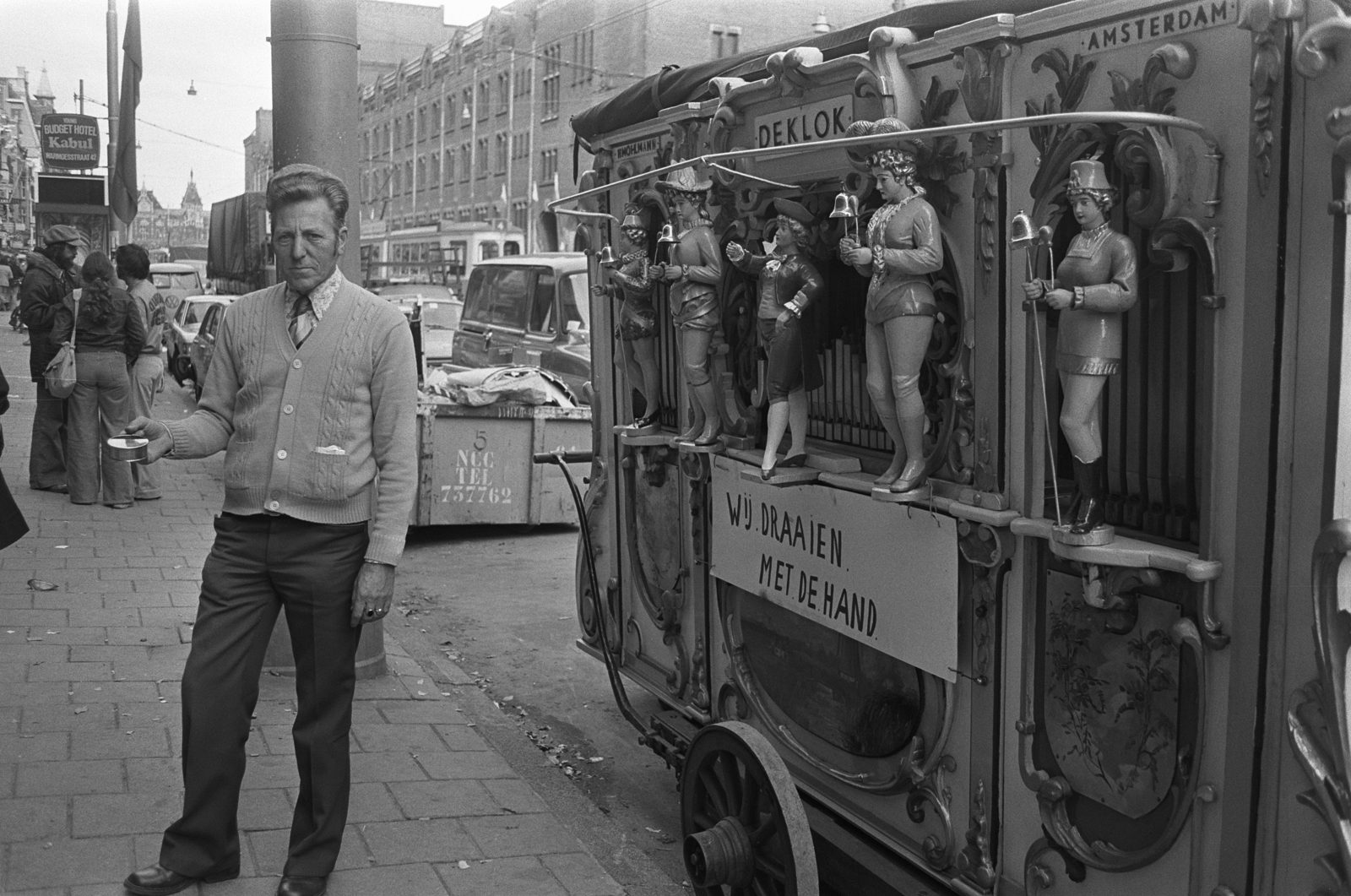
Of the four grand-organ traditions kept distinct across this dive — FAIRGROUND (French/German, outdoors), DANCE (Belgian, indoors), STREET (Dutch), and BAND (American) — the Dutch street organ is the one most tied to a single city’s streets and a single rental trade. It is a large, book-played wind organ, ornately fronted, historically wheeled to a busy corner and worked by one operator turning a crank. In Dutch it is the draaiorgel — literally “turning organ,” for the crank the operator turns — and colloquially the pierement; the operator is the orgelman, the organ grinder. This volume covers the instrument, the Amsterdam rental tradition that made it a civic fixture, and the German-trained builder Carl Frei, whose name closes a circle that runs the entire length of the program’s scale range.
This volume complements rather than repeats its siblings. The drive — how one crank works both the wind and the music — is developed mechanically in “Turning the Crank”; the bellows and reservoir it feeds are the subject of “Wind Systems”; the cardboard book the crank advances and the reading key frame are Vol 3 (Book Music & the Key Frame) of this dive and, for the encoding theory, “Encoding the Music” (Dive 4); the ornate front belongs to Vol 4 (The Grand Façade); and the individual makers are surveyed in Vol 2 (History & the Makers). This volume is the Dutch case study that ties them together, and the place where the program’s “Carl Frei” naming finally resolves.
5.1 What a draaiorgel is
5.1.1 The instrument, in one sentence
A Dutch street organ is a large mechanical wind organ that plays book music through multiple ranks of pipes plus percussion, and it was originally hand-cranked, the operator turning one large handle to work both the bellows/reservoir and the card (book) feed at once (Wikipedia: Dutch street organ). Every clause of that sentence matters, and each is developed below.
The scale of the thing sits deliberately between the busker organ and the fairground organ. Wikipedia (Dutch street organ) places it as “slightly smaller than the semi-trailer-sized fairground organ,” yet with “enough volume to be heard easily on a busy street corner.” That is the design brief in a phrase: not the semi-trailer of a grand Gavioli or Marenghi (Vol 2), but far larger and louder than the one-person 20-note crank organ of the busker dives — loud enough to carry over cobbles, trams, market traders, and crowds.
5.1.2 Not the busker organ, not steam
Two guardrails, stated once and plainly. First, the draaiorgel is not the small 20-note busker organ profiled in “The Hobby Crank Organ” and “The John Smith Universal Organ”; it is that instrument’s grand relative — many ranks, percussion, a proscenium front, and a music book several scale-widths wider. (Confusingly, one man’s name — Carl Frei — is attached to both ends of that range; §4 resolves exactly why, and it is not a mix-up.)
Second, the draaiorgel is a low-pressure WIND instrument, not steam. Its reservoir holds wind at a few inches of water column (≈0.1–0.2 psi), exactly as the fairground and band organs do, and as detailed in “Wind Systems.” It is never a steam machine: the steam instrument is the calliope (Dive 13), which runs at roughly 100–180 psi of steam — three orders of magnitude more pressure and an entirely different family. A street organ heard on an Amsterdam canal-side is wind; the calliope on a Mississippi showboat is steam. The two are cousins only in the loosest sense, and the pressure figures alone keep them apart.
5.1.3 Book music, ranks, and percussion
Like every grand organ in this dive, the draaiorgel plays book music: folded cardboard sheets punched with holes, read by a key frame (the mechanism is Vol 3; the encoding theory is Dive 4). It voices those keys across multiple ranks of pipes — typically a bourdon or gedeckt foundation, string-toned violin and cello ranks, flutes and piccolos, and reed voices such as trumpet, trombone, clarinet, or the vox celeste/celeste families for which the Dutch sound is prized (§4.3). Behind the front it also carries percussion — bass drum, snare, cymbal, and frequently a glockenspiel or bells — fired from registration keys in the book (Vol 3 §3.2).
As with all the grand organs, the key count is not the pipe count. A Dutch street organ quoted at, say, a 52- or 72-key scale (Dean Organ Builders; Vol 3 §6) does not have 52 or 72 pipes: it voices those keys across several ranks, so the pipe count runs into the low hundreds, plus the percussion. The exact ranks and their voicing belong to “Building Organ Pipes” and “Wind Systems”; this volume only insists on the distinction.
5.2 One crank, both jobs
5.2.1 Why “turning organ” is a literal name
The Dutch name draaiorgel — “turning organ” — is not decorative. It records the defining fact of the traditional instrument: the operator turns one handle, and that single rotary input drives two mechanisms at once (Wikipedia: Dutch street organ):
- the bellows and reservoir, which raise and store the low-pressure wind that speaks the pipes; and
- the book (card) feed, which draws the cardboard book steadily over the key frame at the tempo the crank sets.
The operator — the orgelman — therefore is at once the power source and the tempo. Crank faster and the music quickens and the wind supply strengthens; crank slower and both ease off together. The mechanical linkage that splits one crankshaft into these two loads — the geartrain, the eccentric/crank throw that rocks the feeder bellows, and the sprocket or spool train that advances the book — is the subject of “Turning the Crank”; the bellows, feeders, and reservoir the crank charges are the subject of “Wind Systems.” This volume notes only the consequence: the draaiorgel is a machine whose music and whose breath share one prime mover.
5.2.2 What the operator manages
Because one handle does two jobs, the orgelman’s craft is keeping the crank rate in a band where the reservoir stays full enough to speak every rank cleanly while the book runs at a musical tempo. Turn too slowly and a heavy chord — many ranks and percussion opening together — can momentarily outrun the wind, sagging the pitch (the same wind-starvation failure discussed for the busker organ in “The Hobby Crank Organ” and quantified in “Wind Systems”). Turn too fast and the tempo runs away. The traditional street organs are geared and their reservoirs sized so that a comfortable, sustainable cranking pace lands the operator in that band; on a well-regulated organ the work is rhythmic and unhurried rather than a fight.
Later and larger street organs, and most surviving working instruments, replaced the human crank with a motor drive turning the same shaft — an electric motor or a small petrol engine on the cart — precisely so the operator is freed to collect from the crowd, change books, and tend the organ rather than turn the handle all day. The hand-crank remains the historically defining and name-giving feature, and many organs retain a crank for demonstration or as a fallback, but “hand-cranked” describes the tradition’s origin; motorized drive of the same one-shaft, two-load arrangement is the common modern practice (consistent with the drive options in “Turning the Crank”).
5.2.3 Figure — the one-crank draaiorgel
5.3 The Amsterdam rental tradition
5.3.1 Warnies and the 1903 book-organ order
The Dutch street organ as a civic institution — rather than merely a type of instrument — grew out of a rental trade centred on Amsterdam, and it turned on one decision. In 1903, Leon Warnies ordered the first book-playing organs for his Amsterdam renters, and the cardboard book system rapidly displaced the older CYLINDER (barrel) organs that had worked the streets until then (COAA: Dutch Street Organs; corroborated by Dutch-culture sources). The reasons are the structural advantages of book music laid out in Vol 3 §5: a book is not bound to a drum’s circumference, so a tune can run its full length; the cardboard is sturdy and humidity-stable — no small thing in the Dutch damp — and it needs no rewind. A renter with book organs could offer longer, more varied, more current programmes, cheaply re-stocked from a shelf of books rather than a rack of pinned barrels. The old cylinder organs could not compete, and within a few years the Amsterdam street had become a book-organ street.
This is the same Gavioli-lineage substitution that reshaped the fairground (Vol 3 §1), arriving on the Dutch street through the rental trade: a drum of fixed size replaced by a ribbon of punched card of unbounded length. The timing is worth noting: Warnies’ 1903 order comes barely a decade after Anselme Gavioli’s 1892 book-music patent (Vol 2; Vol 3 §2), so the Amsterdam street took up the new medium while it was still the fresh industry standard, not a legacy technology — one reason the changeover from cylinder to book happened so quickly on Dutch streets.
5.3.2 3.1a A word on the terms
The three Dutch terms used throughout deserve to be fixed precisely, because they are not interchangeable. Draaiorgel (“turning organ”) names the instrument, after the crank the operator turns. Pierement is the colloquial Dutch name for the same instrument — the affectionate street word, roughly “the barrel organ” in everyday speech, though the pierement plays book rather than a barrel. And the orgelman (organ grinder) is the person who works it. A sentence such as “the orgelman wheeled his pierement to the market and turned the crank of the draaiorgel” is redundant on purpose: instrument, colloquial name, and operator, all in one. Keeping the three apart avoids the common error of treating “pierement” as a separate kind of organ; it is simply what an Amsterdammer calls the draaiorgel.
5.3.3 The rental model and roughly forty organs
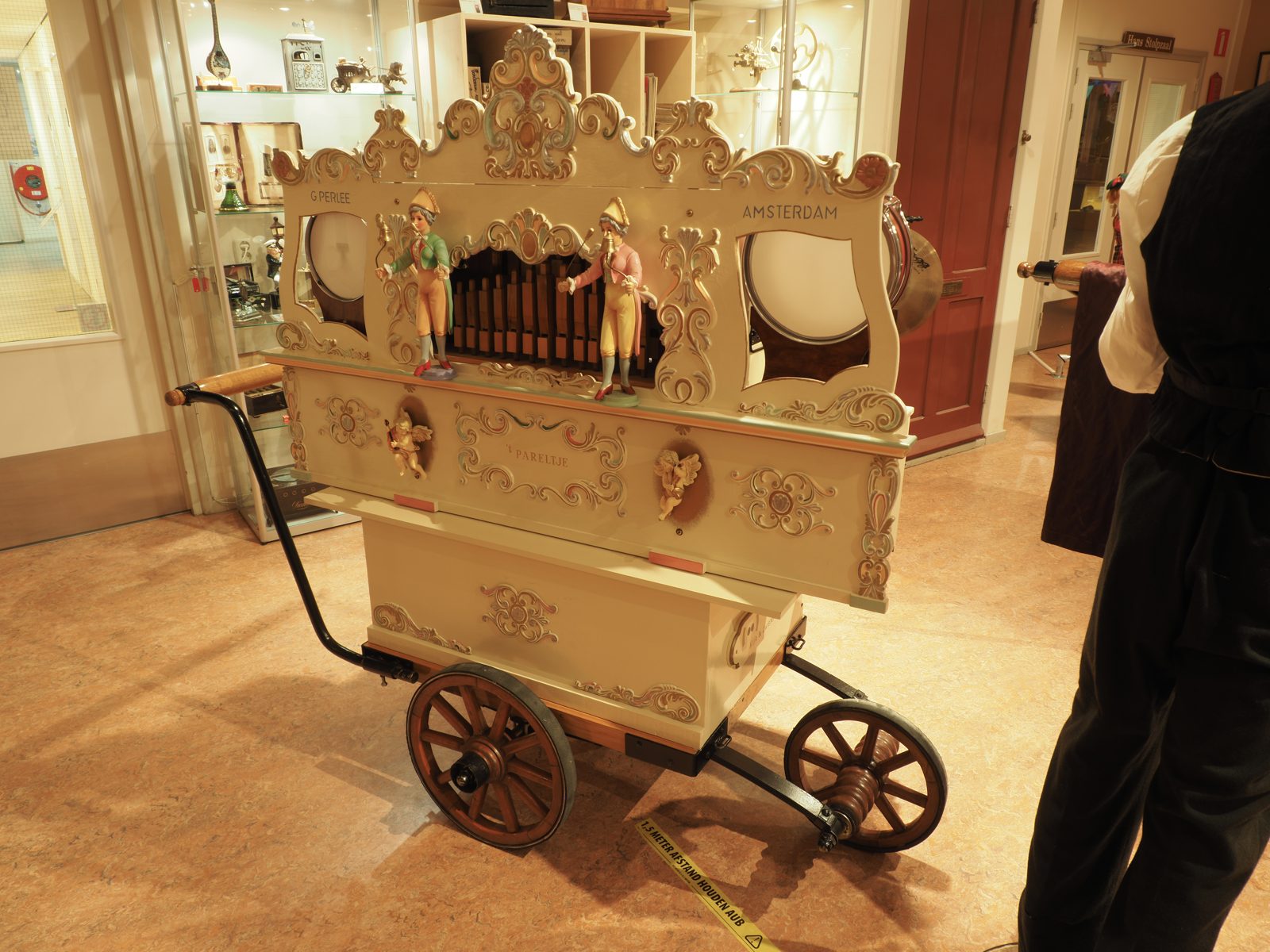
The Amsterdam trade worked on a rental basis. A workshop owned a fleet of street organs, maintained and re-booked them, and rented each out by the day to an orgelman who wheeled it to a pitch, worked it, and collected from the public — returning a share to the owner. This is why the tradition is inseparable from a few workshop names rather than a scatter of individual owners: the organs were fleet assets, kept running and re-voiced by the renting workshop.
At the trade’s height in the 1920s–30s, roughly 40 rented street organs (est.) worked Amsterdam’s streets on a busy day (COAA: Dutch Street Organs). The “~40” figure is a historical estimate, not a licensing count — it conveys the scale of a street culture in which the draaiorgel was an everyday sound, not a rarity, spread across the city’s markets, squares, and shopping streets. It should be read as order-of-magnitude, and it is flagged (est.) accordingly.
5.3.4 The Perlee workshop
The workshop most bound up with the Amsterdam trade is Perlee, long associated with building, renting, and maintaining the city’s street organs (COAA: Dutch Street Organs). The names attached to the Amsterdam rental tradition recur together — Warnies, who placed the pivotal 1903 book-organ order, and Gijs Perlee and the Perlee firm, which for generations kept, rented, and serviced street organs in Amsterdam. Precise firm chronology (foundation dates, the exact handing-on of organs and premises between Warnies and Perlee) varies between sources and is left to a Perlee/museum authority; those firm-detail specifics are flagged (est.) here. What is firm is the shape of the trade: a small number of workshops owned and maintained the fleet, and rented it out to the orgelmannen who gave the streets their sound.
5.3.5 Draaiorgel against the fairground organ
It is worth setting the Dutch street organ beside its larger French/German cousin directly, since the two are constantly confused. The differences are of setting, size, drive, and front-style, not of fundamental mechanism — both are book-played, low-pressure wind organs voicing many ranks.
Table 1 — 3.4 Draaiorgel against the fairground organ
| Attribute | Dutch street organ (draaiorgel) | Fairground organ (French/German) |
|---|---|---|
| Country / tradition | Netherlands (Amsterdam rental trade) | France (Gavioli, Marenghi, Limonaire) & Germany (Waldkirch: Bruder, Ruth) |
| Setting | The public street — markets, squares, canal-sides | The fairground — over rides, shows, crowds |
| Size | ”Slightly smaller than the semi-trailer-sized fairground organ” (Wikipedia) | Up to semi-trailer-sized; the grand 87/89/98 scales (Vol 3) |
| Music medium | Book music (cardboard) | Book (mostly); some later paper roll |
| Drive | One hand-crank driving both wind and book feed (later motorized) | Motor/engine drive; historically also crank on smaller organs |
| Front style | Bright mirror-and-scroll front, often moving figures | Ornate carved-and-gilded proscenium; national styles (Vol 4) |
| Ownership model | Rented from a workshop (Perlee, Warnies) to the orgelman | Owned by the showman / fairground operator |
| Wind | Low-pressure wind, few in. H₂O (not steam) | Low-pressure wind, few in. H₂O (not steam) |
Both fronts, and the national style contrasts, are the subject of Vol 4 (The Grand Façade); this table only fixes that the draaiorgel is a distinct tradition — the STREET organ — and not a synonym for the FAIRGROUND organ.
5.4 Carl Frei — the German→Dutch link
5.4.1 Why this name closes the program’s circle
The Dutch street organ is where the program’s single most connective figure belongs: Carl Frei. His career runs from the German organ-building town of Waldkirch to the Dutch city of Breda, and his name is attached to instruments at both extremes of the entire program’s scale range — the tiny 20-note busker organ of “The Hobby Crank Organ” and “The John Smith Universal Organ” and the grand Dutch street organs and his own 112-key concert organ. That one surname spanning the whole range is not an accident of naming; it is a genuine biographical link, and it is the reason the busker dives and this grand dive share the “Carl Frei” name. This section states the biography exactly, then draws the link.
5.4.2 The biography, exactly
Carl Frei was born 4 April 1884 in Schiltach and died 10 May 1967 in Waldkirch (Wikipedia: Carl Frei). His formation was pure Waldkirch — the Baden town in the southern Black Forest known as “the town of mechanical organs,” where organ building was founded by Matthias Martin in 1799 and the Bruder family business by Ignaz Bruder in 1829 (facts held identical to “The Hobby Crank Organ” / Jäger & Brommer dive). Frei trained at the Waldkirch music academy, and from the age of 14 he worked for the great firms of the trade — Bruder, Gavioli, Mortier, and DeVreese — across the Waldkirch and Paris worlds, absorbing the fairground, dance, and street traditions at their sources (Wikipedia: Carl Frei).
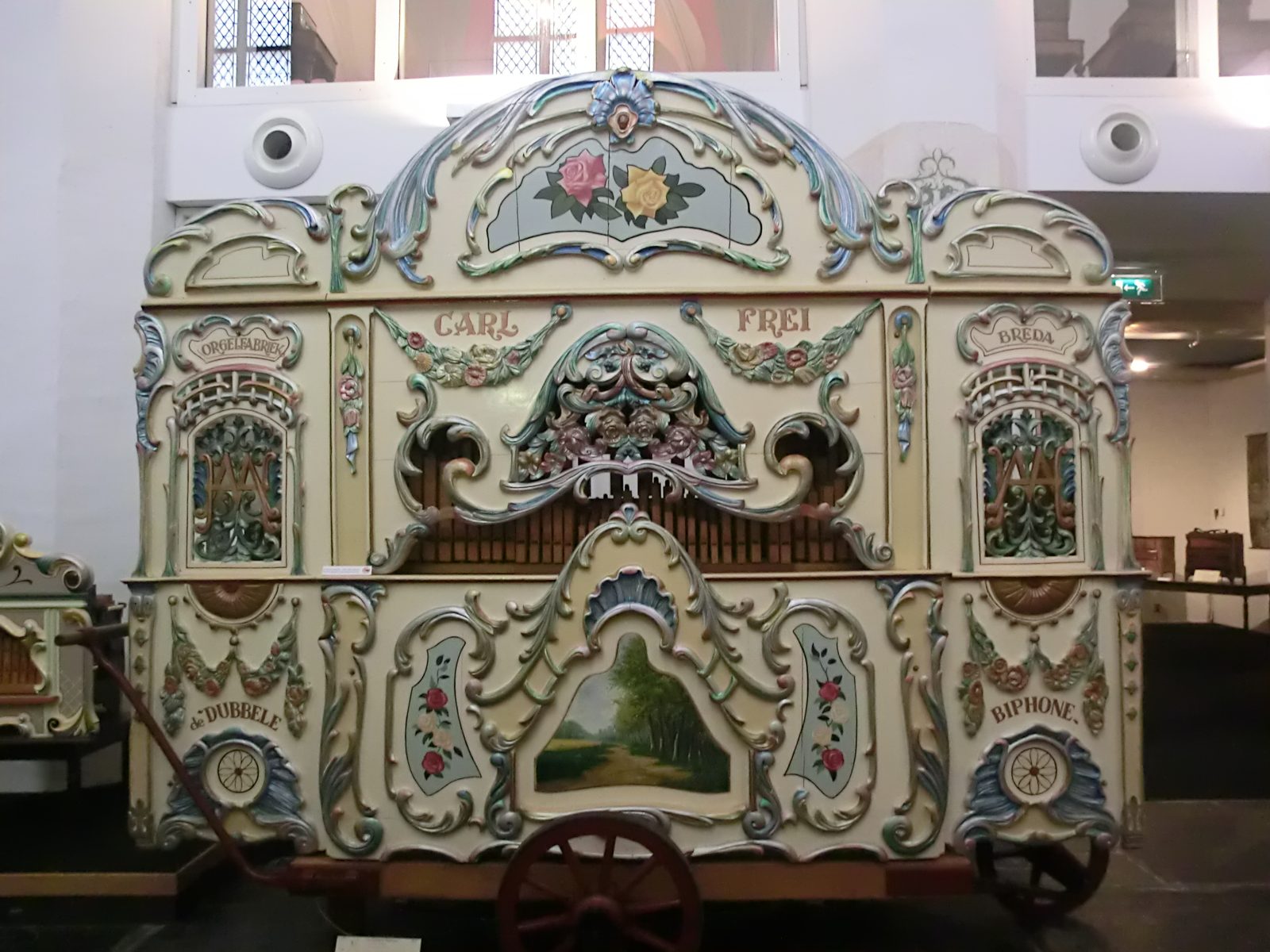
After the First World War, Frei moved to Breda, in the Netherlands, where he first repaired street organs and then, in 1920, began building his own (Wikipedia: Carl Frei). It was in Breda that he defined the classic Dutch street-organ voicing — the sound that, to a Dutch ear, is the pierement. Two of his registrations became signatures of that sound: the bourdon céleste register and the undamaris stop, both undulating, gently detuned celeste voices that give the Dutch street organ its shimmering, singing warmth (Wikipedia: Carl Frei; §4.3). His largest single instrument was the “Carl Frei Traveling Concert Organ,” of 112 keys (Wikipedia: Carl Frei) — a semi-trailer-scale concert organ at the very top of the key-scale ladder (Vol 3 §6). After the Second World War he was forced to leave the Netherlands and returned to Waldkirch, where he died in 1967, closing his life in the same town that had formed him.
Table 2 — 4.2 The biography, exactly
| Year / age | Event |
|---|---|
| 4 Apr 1884 | Born in Schiltach (Wikipedia: Carl Frei) |
| From age 9 | Trained at the Waldkirch music academy (the town of mechanical organs; organ-building from 1799, Matthias Martin) |
| From age 14 | Employed by Bruder, Gavioli, Mortier, DeVreese (Waldkirch & Paris) |
| After WWI | Moved to Breda, Netherlands; repaired street organs |
| 1920 | Began building his own organs at Breda; defined the classic Dutch street-organ voicing |
| (career) | Created the bourdon céleste register and the undamaris stop |
| (career) | Built his largest, the “Carl Frei Traveling Concert Organ,” 112 keys |
| After WWII | Forced out of the Netherlands; returned to Waldkirch |
| 10 May 1967 | Died in Waldkirch |
Sources: Wikipedia: Carl Frei for the biography, the Breda move (~1920), the bourdon céleste and undamaris, and the 112-key concert organ; Wikipedia: Waldkirch for the town (organ-building from 1799, Matthias Martin; Bruder from 1829), kept identical to the Jäger & Brommer / “Hobby Crank Organ” dive.
5.4.3 The Dutch sound he defined
Frei’s contribution was not just to build Dutch street organs but to voice them into a recognisable national style. The bourdon céleste and undamaris are the heart of it: paired ranks tuned very slightly apart so that, sounding together, they beat against each other at a slow, regular rate. That controlled beating produces the undulating, shimmering celeste that a Dutch listener identifies instantly as the pierement — warm, singing, and a little melancholy, distinct from the brighter, more brass-forward voicing of a French fairground Gavioli or the reed-heavy Belgian dance organ. The physics of celeste tuning (two ranks detuned by a few cents to produce audible beats) belongs to “Building Organ Pipes” and the tuning discussion in the pipe dives; what belongs here is the attribution: the classic Dutch street-organ sound is Carl Frei’s, worked out in Breda from 1920.
5.4.4 Both ends of the name — and the trade-name caveat
Here is the link stated exactly. Carl Frei’s name sits on both ends of the program’s scale range:
- At the grand end: the classic Dutch street organs he built and voiced from Breda, and his 112-key “Traveling Concert Organ,” his largest — the top of the key-scale ladder (Vol 3 §6; Wikipedia: Carl Frei). This is the tradition this dive surveys.
- At the small end: the little 20-note “Carl Frei” busker book/roll scale — the standard of the modern one-person hand-cranked organ — profiled in “The Hobby Crank Organ” and “The John Smith Universal Organ” and named identically in the Track-1 dives. This is the small cousin, the same 20-note “Carl Frei / Raffin” scale carried through the busker builds.
That is why the busker dives and this grand dive share the “Carl Frei” name: one Waldkirch-trained, Breda-based builder stands behind organs at both extremes of the range, from a strap-on street busker’s box to a semi-trailer concert organ.
One caveat must be stated precisely, as a matter of sourcing discipline. The attribution of the 20-note scale to the “Carl Frei” name rests on Dean Organ Builders and trade convention — that is the trade name the small keyless busker scale carries in the modern hobby and builder world (Dean Organ Builders). Wikipedia (Carl Frei) does not itself label the 20-note scale “Carl Frei”; its article covers the man, the Breda work, the voicing, and the 112-key concert organ, but does not name the busker scale. So the 20-note-scale link is credited to Dean / trade convention, and flagged as the trade name — not asserted as a Wikipedia statement it does not make. The biographical link (one builder, Waldkirch to Breda, behind both worlds of organ) is solid on Wikipedia; the specific scale-name attribution is Dean/trade convention. Both are true; they rest on different sources, and this volume keeps them separate.
5.4.5 Figure — the Carl Frei link
5.5 Reading it all together
The Dutch street organ — the draaiorgel, colloquially the pierement, worked by the orgelman — is the STREET member of the grand-organ family: a large, book-played, low-pressure wind organ, voicing many ranks and percussion through a bright mirror-and-scroll front, sized to fill a busy street corner rather than a whole fairground. Its defining trait is in its name: one crank, turned historically by the operator and today usually by a motor, driving both the bellows/reservoir and the book feed — the drive split developed in “Turning the Crank,” the wind side in “Wind Systems,” the book and key frame in Vol 3 and “Encoding the Music” (Dive 4). It became a civic institution through the Amsterdam rental trade: Leon Warnies’ 1903 book-organ order displaced the old cylinder organs, and by the 1920s–30s roughly 40 rented street organs (est.) worked the city, kept and re-booked by workshops such as Perlee.
And it is the natural home of the program’s most connective figure. Carl Frei — Waldkirch-trained, in Breda from 1920, the man who defined the Dutch street-organ sound with the bourdon céleste and the undamaris, builder of the 112-key concert organ — carries a name that sits on both ends of the whole program’s scale range: the grand Dutch organs of this dive and the small 20-note busker scale of the crank-organ dives (the latter by Dean / trade convention, not by any Wikipedia statement). That single surname, from a one-person street box to a semi-trailer concert organ, is the thread that ties the busker dives to this grand survey — and it runs, fittingly, straight through an Amsterdam street.
Sources
- Wikipedia: Dutch street organ — the draaiorgel as a large organ playing book music with multiple ranks of pipes and percussion; originally hand-cranked, the organ grinder turning a large handle to operate both the bellows/reservoir and the card feed; “slightly smaller than the semi-trailer-sized fairground organ” yet with “enough volume to be heard easily on a busy street corner.”
- Wikipedia: Carl Frei — b. 4 Apr 1884 Schiltach, d. 10 May 1967 Waldkirch; Waldkirch music-academy training; from age 14 employed by Bruder, Gavioli, Mortier, DeVreese; after WWI to Breda to repair street organs; began building his own in 1920; created the bourdon céleste register and the undamaris stop; largest instrument the “Carl Frei Traveling Concert Organ,” 112 keys; forced from the Netherlands after WWII, returned to Waldkirch. (Does not itself label the 20-note scale “Carl Frei.”)
- Dean Organ Builders (maker/scale table) — the small 20-note “Carl Frei / Raffin” busker scale; the scale-name attribution is trade convention, cited here as the trade name rather than to Wikipedia.
- COAA: Dutch Street Organs (Carousel Organ Association of America; Hans van Oost) — the Amsterdam rental tradition: Warnies’ 1903 book-organ order displacing the cylinder organs; roughly 40 rented street organs in the 1920s–30s (est.); the Perlee workshop building, renting and maintaining the city’s street organs.
- Wikipedia: Waldkirch — “town of mechanical organs”; organ-building founded by Matthias Martin in 1799; Bruder family business from 1829 (Ignaz Bruder) — kept identical to “The Hobby Crank Organ” / Jäger & Brommer dive.
The “~40 rented Amsterdam organs” figure and the fine Warnies/Perlee firm chronology are historical estimates marked (est.). The draaiorgel’s low-pressure wind (a few inches of water column, ≈0.1–0.2 psi) is kept identical to “Wind Systems”; it is wind, not steam — the steam instrument is the calliope (Dive 13, ~100–180 psi). Cross-references: “Turning the Crank” (the one-handle drive), “Wind Systems” (bellows/reservoir), Vol 3 (Book Music & the Key Frame) and “Encoding the Music” (Dive 4) for the book and its reader, Vol 4 (The Grand Façade) for the front, Vol 2 (History & the Makers), and the busker dives “The Hobby Crank Organ” and “The John Smith Universal Organ” for the small 20-note Carl Frei/Raffin cousin.
Comments (0)