Fairground And Dutch Street Organs · Volume 2
Fairground & Dutch Street Organs — Vol 02: History & the Makers
The grand fairground, street, dance and band organs were not the work of a single inventor or a single nation. They were the product of a handful of workshops — a few in Paris, a cluster in one small Black-Forest town, a scattering in Antwerp and Amsterdam, and one that crossed the Atlantic to upstate New York — that between them built, in roughly seventy years, almost every large mechanical wind organ that ever turned a fairground into a wall of sound. This volume is the deep maker survey. It complements, and does not repeat, the general lineage told in “A History of Mechanical Organs” (Dive 1): where that dive traces the whole family from the church organ and the pinned barrel forward, this one goes deep on the fairground, Dutch and band specifics — who the firms were, when they rose, what they invented, and how the tradition ended.
The single organising fact worth stating up front is that these instruments are low-pressure wind machines — ranks of tuned pipes fed at a few inches of water gauge (~0.1–0.2 psi), the wind raised by bellows the crank or motor works. They are not steam. The steam calliope, which runs at roughly 100–180 psi, is the loud cousin covered in “Steam Organs & Calliopes” (Dive 13). The distinction matters here because the makers below built wind organs almost exclusively; none of them was a calliope house.
2.1 The Paris houses
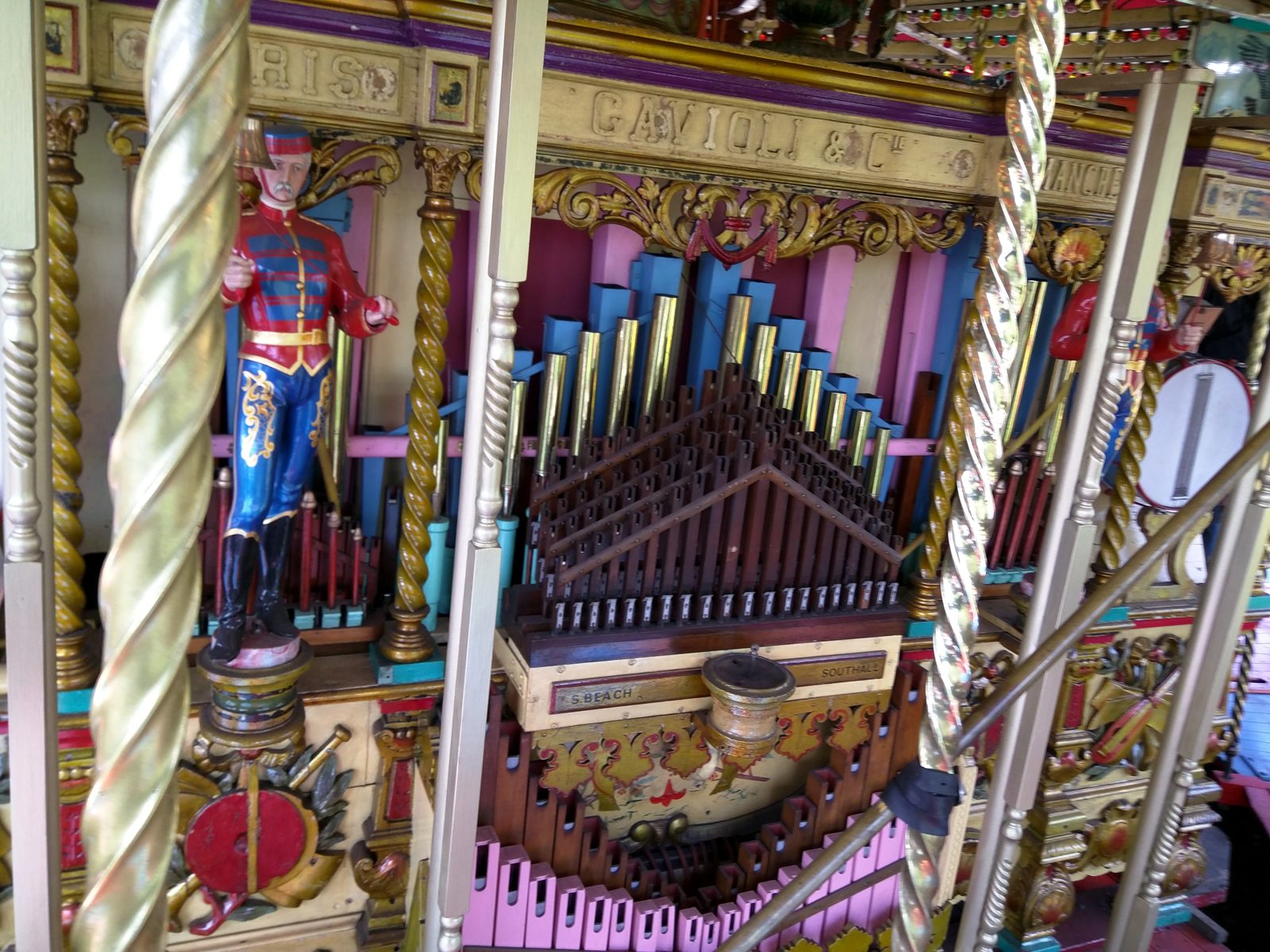
2.1.1 Gavioli — the pre-eminent builder
The firm that defined the grand fairground organ was Italian by birth and French by adoption. Gavioli & Cie was founded in 1806 at Cavezzo, in the province of Modena, Italy, by Giacomo Gavioli (1786–1875) (Wikipedia: Gavioli). Giacomo was an organ builder in the older barrel-organ tradition; the leap that would make the name famous came with his descendants and their move to France.
It was Lodovico (Ludovico) Gavioli (1807–1875) who moved the business to Paris in 1845 (Wikipedia: Gavioli). Paris was, at that moment, the natural home for a maker of mechanical instruments — it had the market, the fairground and street culture, and the mechanical trades — and it is why the fairground organ is so often described as French in origin even though the founding family was Italian. From the Paris works the firm grew into what the sources call, without hedging, “the most famous and prolific of fair organ builders” (Wikipedia: Gavioli). At its height the Paris establishment is reported to have had on the order of 300 organs in build or in the works (est. — the exact figure varies between accounts), and the firm ran branches in London, Manchester, New York City and Waldkirch.
That spread of branches is itself worth reading as evidence of scale: Gavioli was not a local workshop that occasionally exported, but an international concern with sales and service points in the two largest English fairground markets (London and Manchester), a foothold in the American market (New York City), and — decisively for the later story — a manufacturing branch in the German organ-building town of Waldkirch. Few instrument makers of any kind operated at that reach in the nineteenth century, and none in the mechanical-organ trade matched it. The firm’s pre-eminence was therefore not merely artistic; it was industrial, built on a division of labour between the Paris design-and-assembly works and the branches that fed and sold its output.
The two inventions that made Gavioli pre-eminent are the heart of this survey, and because they are frequently muddled together they must be kept strictly distinct.
The frein (1878). Anselme Gavioli (1828–1902) — son of Lodovico, and the technical genius of the family — invented the frein in 1878 (Wikipedia: Gavioli). The frein (French, literally “brake”) is a small metal reed-and-brake device fitted to a pipe to check and shape its speech, giving the pipe a sustained, string-like tone in imitation of the cello and violin. It is a voicing device — a matter of how a pipe sounds — and it is what let a fairground organ carry a convincing string section. The frein is treated in the pipework and voicing dives; here it matters only as the first of Anselme’s two landmark contributions, and as a thing that is not the book-music patent.
Book music (1892). Fourteen years later, in 1892, Anselme Gavioli patented cardboard book music (Wikipedia: Gavioli; Wikipedia: Book music) — the folded, punched cardboard “book” that replaced the pinned barrel and, in the sources’ words, “allowed music to be almost infinitely long.” This is the pivot of the entire grand- organ tradition: it freed a tune’s length from the physical circumference of a drum, and it gave the makers a music medium that was sturdy, humidity-stable and re-usable. The mechanism — the key frame, the keyless refinement, why book beats both barrel and paper roll — is the subject of “Encoding the Music” (Dive 4) for the encoding theory, and of Vol 3 of this dive for the fairground book-music tradition and the key- scale ladder. It is enough here to fix the fact and the date, and to keep it separate from the frein: frein 1878 (a voicing device); book music 1892 (the music medium). Two different inventions, fourteen years apart, by the same man.
The relationship between the two inventions repays a moment’s attention, because it explains why Gavioli specifically — rather than any of the equally capable Waldkirch or Paris rivals — became the pre-eminent name. The frein of 1878 gave Gavioli organs a distinctive, orchestral string voice a full decade and a half before the book. When the book-music patent then arrived in 1892 and removed the last real constraint on repertoire — the fixed circumference of the pinned barrel — Gavioli held both the best voicing device and the best music medium at the same moment. A rival could copy one; matching both, while Gavioli’s patents were in force, was another matter. The firm’s dominance in the 1890s and 1900s rested on that double lead.
Gavioli’s dominance did not survive the founder-generation and the financial shocks of the early twentieth century. Anselme died in 1902; the firm was caught in the commercial crisis of 1907 — the shock that also forced it to give up its Waldkirch works to Limonaire in 1908 (see §1.2) — and its organ-building business passed to Limonaire Frères at the end of the decade. Here the sources diverge on the precise year, and this volume states both rather than silently choosing. The Wikipedia “Fairground organ” article gives 1910 (“ceased trading in 1910, with patents … sold to Limonaire”); the Wikipedia “Gavioli” article gives 1912 (organ-making ceased 1912, the remainder transferred to Limonaire). The safe statement is therefore that Gavioli’s organ business passed to Limonaire Frères c.1910–12 (Wikipedia: Fairground organ, 1910; Wikipedia: Gavioli, 1912). The two figures likely mark different steps — the cessation of trading versus the final transfer — but the sources do not reconcile them, so the range is carried through the dive.
2.1.2 Limonaire Frères — the Orchestrophone house
Gavioli’s principal rival, and eventual successor, was Limonaire Frères, founded in Paris in 1839 by the brothers Joseph and Antoine Limonaire (Wikipedia: Limonaire Frères). Limonaire was, through the fairground-organ era, consistently the second-largest builder behind Gavioli, and its instruments were marketed under the brand name “Orchestrophone.” The name became so closely attached to the firm’s products that in some markets a Limonaire fair organ was simply called an orchestrophone.
The next generation industrialised the firm. The founders’ sons Eugène and Camille Limonaire built the Avenue Daumesnil factory in Paris in 1886 (Wikipedia: Limonaire Frères), a large purpose-built works that let Limonaire compete with Gavioli at scale. When Gavioli faltered, Limonaire absorbed its German capacity: the firm took over Gavioli’s Waldkirch premises in 1908, in the wake of the 1907 crisis (Wikipedia: Limonaire Frères), and later built a new Waldkirch factory in 1912 — the same window in which it inherited the Gavioli organ business in Paris.
Limonaire’s story runs on to a specific and well-documented end. The German factory was confiscated in 1917 (in the First World War) and eventually sold to Alfred Bruder in 1926 — a detail that ties the Paris houses back to the Waldkirch families covered below. The firm itself went into liquidation in 1929, and the Paris works were demolished in 1936 (Wikipedia: Limonaire Frères). Limonaire thus outlived Gavioli by roughly two decades, carrying the Paris grand-organ tradition — and Gavioli’s patents — through to the end of the fairground organ’s commercial life.
2.1.3 Charles Marenghi & Cie — and the succession to Gaudin
The third of the great Paris houses was Charles Marenghi & Cie. Marenghi is the name most associated with the large 89- and 98-key scales that sit near the top of the fairground-organ ladder — scales built out by expanding Gavioli’s celebrated 87-key pattern, and important enough that music arranged for them transferred between instruments (Wikipedia: Fairground organ; MBSI, “87, 89, and 98 Gavioli”). The scale theory belongs to Vol 3; what matters in the maker survey is that Marenghi was a first-rank builder whose instruments defined the upper end of the grand-organ range, alongside Gavioli and Limonaire.
Marenghi’s business was succeeded by Gaudin Frères (Wikipedia: Fairground organ), so that the Marenghi 89/98 scales — and their music — carried on under the Gaudin name. The Marenghi → Gaudin succession is the French counterpart of the Gavioli → Limonaire hand-over: in both cases a founding house’s scales and patterns outlived the founding name.
The wider point of the Paris section is that the French grand-organ trade was, by the 1890s, a small oligopoly of three names — Gavioli, Limonaire and Marenghi — whose scales interlocked. The 87-key Gavioli pattern was described as “one of the most popular and versatile fairground scales,” and it was expanded into the later 89- and 98-key scales used by Marenghi, Gaudin, Chiappa and Carl Frei (MBSI, “87, 89, and 98 Gavioli”). Because those scales shared their playing notes, an arrangement cut for one could be transferred to another with comparatively little rework, and a book library built for a Gavioli could largely serve a Marenghi. That interoperability — the direct consequence of the makers building to a common family of scales — is part of why the Paris tradition held together commercially even as individual firms failed and were absorbed. The detail of the scale ladder belongs to Vol 3; here it is enough to note that the three Paris houses were technically as well as commercially entangled.
2.2 Waldkirch — the town of mechanical organs
If Paris was the home of the grand French fair organ, the German centre of the whole mechanical-organ trade was a single small town in the southern Black Forest: Waldkirch, in Baden. These facts are shared verbatim in substance with the Waldkirch tradition as set out in “The Hobby Crank Organ” dive (the Jäger & Brommer profile) and the Track-1 history, and they are stated identically here.
Organ building in Waldkirch was founded by Matthias Martin in 1799 (Wikipedia: Waldkirch). From that single founding the town grew into what it still calls itself — the “town of mechanical organs” — and a cluster of family firms established there supplied fairground, street and dance organs across Europe. The town’s importance to this dive is that it, not Paris, produced most of the German and much of the Dutch- market instrument stock, and that the Paris and Waldkirch stories are physically linked: Gavioli, and then Limonaire, ran their German works there.
The concentration of the trade in one small town is not an accident of biography but a classic industrial cluster. A first workshop (Martin’s) trained the men who founded the next; those firms in turn trained apprentices — Carl Frei among them — who founded or joined further firms; and the specialist suppliers, pipe-makers, carvers and arrangers a grand organ needs all found enough work in one place to stay in business. Once such a cluster forms it is self-sustaining: a would-be builder went to Waldkirch for the same reason a would-be watchmaker went to the Jura. The result is that the German half of this survey is, in effect, the history of a handful of Waldkirch families — Bruder above all — plus the one out-of-town firm (Wellershaus, at Mülheim) that worked in the same tradition.
2.2.1 The Bruder family
The dominant Waldkirch dynasty was the Bruder family, whose organ business was founded by Ignaz Bruder in 1829 (Wikipedia: Waldkirch; Wikipedia: Fairground organ). Over the following century the Bruder name branched into several firms — the best-documented being Gebrüder Bruder (“Bruder Brothers”), Wilhelm Bruder Söhne (“Wilhelm Bruder’s Sons”), Ignaz Bruder Söhne, and Alfred Bruder — each a distinct workshop descended from the 1829 founding. Between them the Bruder firms built fairground and street organs across the whole scale range, from modest 46-key instruments (the Wilhelm Bruder models 76/77) up to large concert organs.
The Bruder name also closes one of the loops in this survey. When Limonaire’s confiscated German factory was sold in 1926, the buyer was Alfred Bruder (Wikipedia: Limonaire Frères) — so the Waldkirch premises that had been Gavioli’s, then Limonaire’s, returned to a Waldkirch family. And a Bruder — Richard Bruder — had been a director of the Gavioli branch plant opened at Waldkirch in 1898 (Wikipedia: Waldkirch), the plant that Limonaire later took over. The Bruder family is therefore woven through both the German and the French sides of the story.
2.2.2 Andreas Ruth & Sohn, and the wider Waldkirch trade
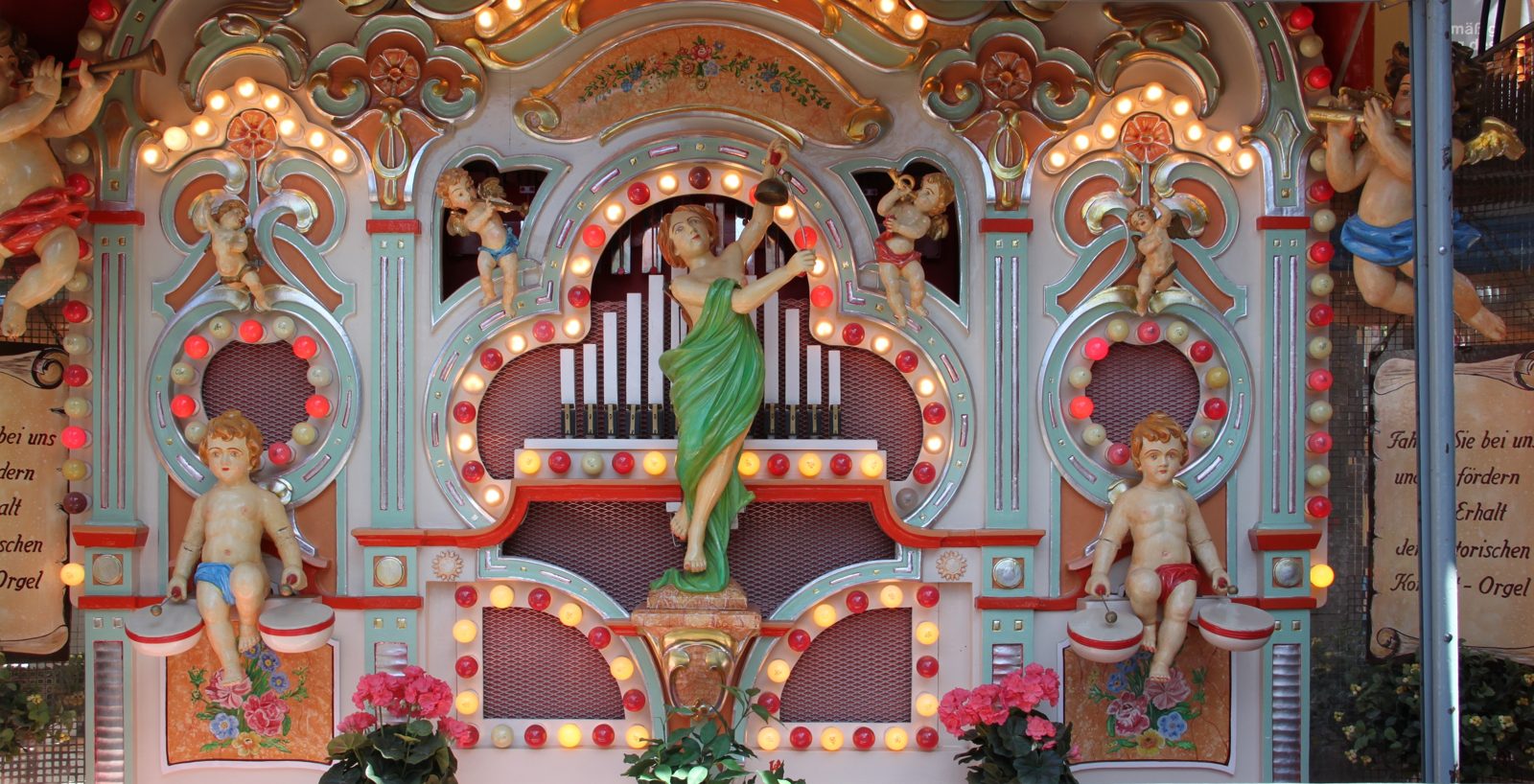
The second major Waldkirch house was Andreas Ruth & Sohn (“Andreas Ruth & Son”), a fairground-organ builder of the front rank (Wikipedia: Fairground organ; Wikipedia: Waldkirch). Ruth is particularly associated with the 52-key and the larger 57–72-key fairground scales, and Ruth instruments — with their carved German- figure fronts — are among the most prized surviving concert organs.
A point worth making explicit is the difference in front style between the Paris and the Waldkirch houses, since it is one of the clearest ways to tell a maker at a glance. The French firms — Gavioli and Marenghi above all — favoured the ornate Baroque and Rococo proscenium, gilded and columned, with the display pipes and fretwork arranged for maximum glitter. The Waldkirch houses (Bruder, Ruth) leaned instead toward the carved-figure front, with elaborate wooden statuary and relief work in the German tradition. Both are “grand fronts designed to attract attention” (Wikipedia: Fairground organ), but the national handwriting differs; the survey of the façade as a tradition — the columns, the name-board and crest, the animated figures, and these national styles — is delivered in Vol 4, which the case-and-façade dive (Dive 11) deferred here.
Waldkirch was also the training ground for the builder who would define the Dutch sound: Carl Frei learned and worked there — for Bruder and others — before moving to Breda in the Netherlands after the First World War. Frei’s biography and his role as the German-to-Dutch link belong to Vol 5; it is noted here only so that the Waldkirch roster is complete. The town thus supplied not only its own firms but a key figure of the Dutch street-organ tradition — one more instance of the cluster exporting trained men as well as instruments.
2.2.3 Gebrüder Wellershaus (Mülheim)
Slightly apart from the Waldkirch cluster, but part of the same German fairground- organ trade, was Gebrüder Wellershaus (“Wellershaus Brothers”) of Mülheim (Wikipedia: Fairground organ). Wellershaus built fairground organs in the same 57–72-key range as Ruth and the larger Bruders, and is named alongside the Waldkirch houses as one of the principal German makers. It is included here to keep the German roster complete: the German grand-organ trade was Waldkirch-centred but not Waldkirch- exclusive.
2.3 The wider family — Dutch, Belgian and American branches
The Paris and Waldkirch houses above are the core of this volume; the other national traditions are surveyed in their own volumes, and are noted here only to place the makers in the family. Each is a distinct tradition, not a synonym for the fairground organ.
- Dutch street organs (the draaiorgel / pierement) — large, book-played organs voiced for the street rather than the fair, and tied to the Amsterdam rental trade. The defining builder, Carl Frei (Waldkirch-trained, working from Breda from 1920), and the Amsterdam workshops (Warnies, Perlee) are the subject of Vol 5.
- Belgian dance organs — the indoor ballroom instruments of Mortier and Gebroeders Decap (Antwerp) and Arthur Bursens (Hoboken), quieter than a fairground organ and built for the dance hall. These belong to the dance-organ material later in the dive.
- American band organs — the carousel and circus organs of Rudolph Wurlitzer (North Tonawanda, New York), Artizan Factories and the North Tonawanda Musical Instrument Works. The American line begins with Eugene de Kleist — a builder who had worked for Limonaire in Paris — who set up band-organ production at North Tonawanda in 1893, incorporated as the DeKleist Musical Instrument Mfg Co in 1903, and was bought out by Wurlitzer in 1908 (Wikipedia: North Tonawanda Barrel Organ Factory). The de Kleist link is the thread that carries the Paris tradition across the Atlantic; the band-organ story is covered in the band-organ volume.
These four traditions — fairground, street, dance and band — are cousins that share the book (or roll) and the low-pressure wind chest, but they are distinct in country, setting and voicing, and the dive keeps them separate throughout.
2.4 Maker summary table
The table below collects the makers surveyed above (and the wider-family builders carried in later volumes) into a single reference: nation, founding, what each was known for, and its fate. Founding dates and fates are cited to the sources named in each row; where a value is not firmly attested it is marked (est.).
Table 1 — 4. Maker summary table
| Maker | Country | Founded | Known for | Fate |
|---|---|---|---|---|
| Gavioli & Cie | Italy → France (Paris from 1845) | 1806, Cavezzo | Pre-eminent fair-organ builder; the frein (1878) and book music (1892) | Organ business passed to Limonaire c.1910–12 |
| Limonaire Frères | France (Paris) | 1839 | ”Orchestrophone” fair organs; 2nd-largest builder; Avenue Daumesnil works (1886) | Liquidation 1929; Paris works demolished 1936 |
| Charles Marenghi & Cie | France (Paris) | c.1900 (est.) | The large 89- and 98-key fairground scales | Succeeded by Gaudin Frères |
| Gaudin Frères | France (Paris) | (est.) | Continued the Marenghi 89/98 scales | Successor firm to Marenghi |
| Bruder family (Gebrüder Bruder, Wilhelm Bruder Söhne, Alfred Bruder) | Germany (Waldkirch) | 1829 (Ignaz Bruder) | Full-range fairground and street organs; bought Limonaire’s German works 1926 | Multiple firms; long-running German dynasty |
| Andreas Ruth & Sohn | Germany (Waldkirch) | 19th c. (est.) | 52- and 57–72-key fairground organs; carved German fronts | Waldkirch grand-organ house |
| Gebrüder Wellershaus | Germany (Mülheim) | 19th c. (est.) | Fairground organs, 57–72-key range | German fairground-organ maker |
| Carl Frei | Germany-trained, Netherlands (Breda) | Own organs from 1920 | The classic Dutch street-organ voicing (bourdon céleste); 112-key concert organ | See Vol 5 |
| Mortier / Decap / Bursens | Belgium (Antwerp / Hoboken) | early 20th c. | Belgian dance (ballroom) organs; Art-Deco façades | See dance-organ volume |
| Wurlitzer (via de Kleist) | USA (North Tonawanda, NY) | de Kleist 1893 → Wurlitzer from 1908 | American band organs for carousels/circuses | Organ production ceased 1942 |
2.5 Family tree of the makers
The maker family falls naturally into three national trunks — the Paris houses, the Waldkirch/German cluster, and the wider Dutch/Belgian/American branches — with the two Paris successions (Gavioli → Limonaire, Marenghi → Gaudin) and the physical Waldkirch plant that both nations shared. The diagram traces those relationships.
Figure 5.1 — The grand-organ maker family. Solid lines are direct successions (Gavioli → Limonaire; Marenghi → Gaudin; Matthias Martin → Bruder → Ruth/Wellershaus). Dashed lines are cross-links: the shared Waldkirch plant that ran from Gavioli to Limonaire; de Kleist carrying the Paris tradition to Wurlitzer; and pointers out to the small 20-note busker scale (the Hobby Crank Organ dive) and to the steam calliope of Dive 13, which is a separate steam branch, not part of this wind family.
2.6 A maker timeline
Laid out on a single time axis, the tradition has a clear shape: a founding phase (Waldkirch 1799, Gavioli 1806, Limonaire 1839), a middle phase of invention and industrial peak (the frein 1878, book music 1892, the Waldkirch branch plant 1898, the Avenue Daumesnil works 1886), a hand-over phase (Gavioli to Limonaire c.1910–12), and a decline that begins in the mid-1920s and closes the commercial story (Limonaire liquidation 1929, the Paris works demolished 1936).
Figure 6.1 — The maker timeline. The founding cluster (1799 Waldkirch, 1806 Gavioli, 1839 Limonaire) is at left; the invention-and-peak run (frein 1878, Daumesnil works 1886, book music 1892, Waldkirch branch 1898) in the middle; the hand-over (c.1910–12) and the shaded mid-1920s decline at right, closing with Limonaire’s 1929 liquidation and the 1936 demolition of the Paris works. Note the two Gavioli inventions kept apart: the frein of 1878 (a voicing device) and book music of 1892 (the music medium).
2.7 The decline
The fairground organ’s commercial life had a definite end, and it is worth dating precisely because it is often blurred. Fairground organs — and their street, dance and band relatives — supplied, in the Wikipedia “Fairground organ” article’s phrasing, “virtually all ambient fairground music … until the advent of effective electrical sound amplification in the mid-1920s.” That is the pivot. Once electrically amplified recorded music became loud enough and cheap enough to fill a fairground, the economic case for a hand-built, semi-trailer-sized wind organ — with its arranger, its book-punching, its tuning and its team of handlers — collapsed. Recorded and amplified sound simply did the same job for a fraction of the cost.
It is worth being careful about what “mid-1920s” does and does not mean. It does not mean that the last fairground organ was built in the mid-1920s, or that they fell silent then; instruments already in service kept working for decades, and a handful of builders continued to make and rebuild organs for the preservation and showman markets long afterward. What the mid-1920s marks is the end of the fairground organ as the default provider of ambient fairground music — the moment after which a showman fitting out a new ride would reach for a loudspeaker rather than commission an organ. The technology did not vanish; its economic monopoly did.
The maker histories track that decline exactly. Gavioli’s organ business had already passed to Limonaire c.1910–12; Limonaire itself, the last of the great Paris houses, went into liquidation in 1929, and its Paris works were demolished in 1936 (Wikipedia: Limonaire Frères). The Waldkirch families weathered the change better than the Paris houses — the town’s diversified base of firms, and the later showman and collector market, kept the tradition alive there — but even so the great age of new grand-organ building was over by the 1930s. The American line closed later but for the same reason: Wurlitzer’s organ production ceased in 1942 (Wikipedia: North Tonawanda Barrel Organ Factory). What survived after that was not an industry but a preservation movement — the collectors, the societies (FOPS, COAA, MBSI) and the restorers who keep the surviving instruments playing — which is the subject of the reference volume.
2.8 Cross-references
- “A History of Mechanical Organs” (Dive 1) — the general lineage of the whole mechanical-organ family from the church organ and pinned barrel forward. This volume complements it; it does not repeat it.
- “Encoding the Music” (Dive 4) — the encoding theory of book music (how punched holes become notes: the key frame and the keyless refinement). This volume fixes only the date and inventor of the 1892 book-music patent.
- Vol 3 (Book Music & the Key Frame) — the fairground book-music tradition, the key frame, and the key-scale ladder (20 → 112 keys) whose Gavioli 87 / Marenghi 89/98 scales are named here.
- Vol 5 (The Dutch Street Organ) — Carl Frei’s biography, the German-to-Dutch link, and the Amsterdam rental trade (Warnies, Perlee).
- “The Hobby Crank Organ” (Jäger & Brommer / Waldkirch) — the same Waldkirch facts (organ-building from 1799, Matthias Martin; Bruder from 1829) as used here, and the small 20-note Carl Frei / Raffin busker scale that is the grand fairground organ’s little cousin.
- “Steam Organs & Calliopes” (Dive 13) — the steam cousin (~100–180 psi). None of the makers surveyed here built calliopes; the fairground organ is a wind instrument.
Comments (0)