Building Organ Pipes · Volume 7
Building Organ Pipes — Vol 07: Voicing, Tuning & Reference
The six volumes before this one built pipes: the workshop and its wood (Vol 02), the stopped flute that is the tonal backbone (Vol 03), the open flue pipe and the scaling of a rank (Vol 04), the narrow string pipe with its frein (Vol 05), and the free-reed “trumpet” that stands in for a beating reed (Vol 06). Every one of those volumes ended by naming the voicing moves its pipe needs. This final volume gathers those moves into one method, because voicing is the same discipline whatever the pipe: bring a box that makes a noise to a pipe that speaks its note promptly, at pitch, at a matched loudness, at the organ’s working wind. It then sets down the reference apparatus for the whole dive — the fault table, the wood, family, piccolo and scale-name tables, a consolidated glossary, a cross-index to Volumes 01–06 and the sibling dives, and the bibliography.
Where the physics lives. Why raising the cut-up rounds the tone, why a narrow pipe wants to overblow, why a stopped pipe tunes an octave low for its length, why a free reed’s pitch sits in the tongue and not the tube — all of it belongs to the sibling dive “How Organ Pipes Make Sound.” This volume uses those relationships to adjust a pipe; it does not re-derive them. Temperament theory — why equal temperament divides the octave as it does, and what the historical alternatives buy — is deferred to the forthcoming “Tuning & Voicing” dive (Dive 10) and the acoustics dive; §4 gives only the one working paragraph a pipe builder needs at the bench.
Units and sourcing. Dimensions are in millimetres and centimetres (the hobby pages are metric), with inches kept where a source is imperial, pressures in inches of water column (in H₂O) with the metric equivalent, and pitch deviations in cents. Craft facts are cited inline: (jsart42) Bruce Thompson on the block-and-face pipe, (jsart26) Tony Goldsworthy’s pipe-making tips, (jsart09) John Smith on piccolo pipes, (jsart51) Gisli Olsen on free-reed pipes, and (jsart19) John Pettifer’s 26-note build, all on
melright.com/busker; (en_vioolpijp) and (en_pijp) onhobbycrankorgan.com; and (OHS works18 / works03) for the Organ Historical Society’s anatomy and timbre families. Traditional norms the hobby sources do not state are flagged (est.).
7.1 What voicing is, and why it happens at the bench
7.1.1 The three targets
Vol 01 defined voicing as bringing a pipe to three conditions at once, and the definition is worth restating because everything in this volume serves it:
- Correct pitch — the pipe sounds the right note, in the right octave, at the organ’s wind pressure. This is the tuning half (§3), and it includes making sure the pipe speaks in its intended octave rather than overblowing to the one above — a live failure mode for narrow string pipes (en_vioolpijp; Vol 05).
- Prompt speech — the pipe starts cleanly and quickly, without a delayed onset, a false low grunt, a spit of wind noise, or an uncontrolled chiff on the attack. Speech is governed almost entirely at the mouth, and this is where most bench time goes (§2).
- Blend — the pipe sits with its rank and the other ranks at a matched loudness and tone, so the organ sounds like one instrument. A pipe can be in tune and speak promptly and still be wrong because it is twice as loud as its neighbours.
Tuning and speech are what a single pipe is brought to; blend is judged across the rank, by ear, with the neighbouring pipes sounding. In practice a builder voices each pipe for prompt speech first, tunes it, then walks the finished rank and evens the loudness and attack across it.
7.1.2 Voice at a known, steady pressure — not by mouth
The single most important rule of bench voicing is that it happens at a known, regulated wind pressure, delivered by a pump, never by mouth. There are two reasons, and both come straight from the sources. First, a pipe voiced at one pressure speaks differently at another — the jet speed at the flue depends on the pressure — so a pipe voiced by lung, at whatever pressure the builder happens to blow, will not behave the same on the chest. It must be voiced at the pressure it will actually see. Second, and more damaging, blowing a thin wooden pipe by mouth floods it with exhaled moisture, and moisture in thin walls is the recurring failure mode of the whole craft (swelling, warping, unsealed joints letting go — Vol 02 §1.4). Voicing by pump keeps the wood dry (jsart26).
The bench rig is simple and is built in Vol 02 §6: an inflator (a foot pump, an aquarium pump, or a small blower) feeding the pipe through a windchest or a single-pipe adaptor, with a U-tube manometer teed into the wind so the builder can read the exact gauge pressure. The pipe is voiced at the pressure the organ runs — the small-organ standard is ≈ 5 in H₂O (127 mm ≈ 1.245 kPa) for the John Smith 20-note busker, with the 26-note bass chest running a little higher at about 6½ in (jsart19). Set the manometer to that figure, hold it there, and make every adjustment while reading it. Anything about the wind system beyond that one number is the Wind Systems dive.
7.1.3 Small steps, because the cuts do not come back
Voicing is iterative and, at the mouth, largely irreversible: wood cut from a lip or a nick filed into a block does not grow back. The craft is therefore to approach every adjustment from the safe side and in small increments — cut the cut-up a hair low and raise it, open the flue a little and test, add one nick and listen — rather than to make a large change and hope. A pipe is cheap to build and expensive to un-cut. Vol 03 §9 makes the same point for the first stopped flute; it is the governing attitude for this whole volume.
7.2 Voicing a flue pipe to speech
Speech is set at the mouth, and the mouth has only a handful of adjustments. Taken in order, they are: the flue (windway) width and its alignment to the lower lip; the cut-up; the nicking of the block or languid edge; and the ears. Each has a predictable effect, and the art is in combining them so the pipe starts promptly and holds its octave.
7.2.1 The flue (windway) and its alignment to the lower lip
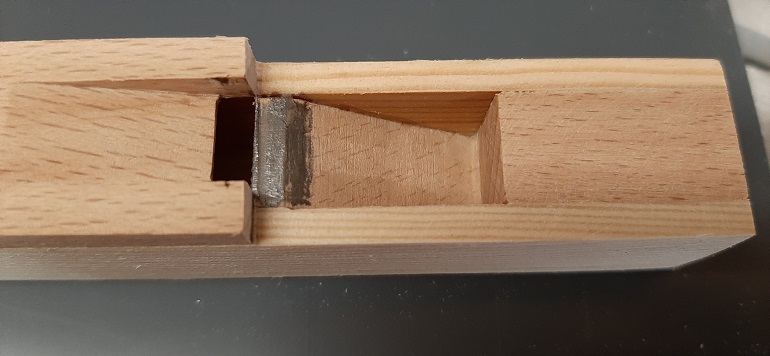
The flue — the windway, the narrow slit between the block (in a wooden pipe) or the languid (in a metal one) and the lower lip — forms the flat air-sheet that crosses the mouth and strikes the upper lip. Two things about it are adjustable and both are decisive.
The first is width. A wider flue passes more wind and drives the pipe harder and louder, but too wide and the sheet becomes turbulent and the pipe hisses and spits; a narrower flue is quieter and cleaner but, taken too far, starves the pipe and makes it slow or reluctant to start. In a wooden pipe the flue width is set at glue-up by how the cap or front sits relative to the block, so it is adjusted by paring or shimming that joint — en_pijp sets the cap flush to +0.5 mm above the core for exactly this reason (Vol 03 §6.1). The lower lip can also be very slightly lowered to open the flue: en_pijp darkens the lower lip with a pencil to increase airflow, the graphite easing the surface (en_pijp).
The second, and the one beginners get wrong, is alignment: the air-sheet must leave the flue aimed at the edge of the upper lip — neither driven into the body behind the lip (the pipe will be dull, breathy, or silent) nor thrown outside it (the pipe will overblow or refuse to speak). In practice this means the block’s top edge, the flue exit, and the lower and upper lips must line up so the sheet crosses the mouth cleanly to the upper-lip edge. A pipe that will not speak at all, having been built and glued square, is most often a flue misaligned with the lower lip rather than any subtler fault (§5). Sighting down the mouth against a light, and testing at the manometer, tells the builder which way to correct.
7.2.2 Cut-up: the master tone control
The cut-up is the height of the mouth, from the lower lip up to the upper lip. It is the single most powerful tone control on a flue pipe, and its effect is simple to remember:
- Raising the cut-up (a taller mouth) gives a rounder, fuller, flutier tone with later, gentler speech — the pipe starts more slowly and with less chiff.
- Lowering the cut-up (a shorter mouth) gives a brighter, keener, stringier tone with quicker, chiffier speech — the pipe starts fast, with more attack transient.
This is why the stopped flute (round, foundational) is cut relatively high, and the string pipe (keen, overtone-rich) is cut relatively low. The hard limit comes from Bruce Thompson: the cut-up should not exceed 1/3 the width of the mouth (jsart42). That ceiling is the one firm hobby number; the broader working band of roughly 1:3 to 1:4 (mouth height to mouth width) for wooden busker flue pipes is a traditional rule of thumb, flagged (est.), and why a taller mouth rounds the tone belongs to the acoustics dive, not to a re-derivation here.
Because cut-up is set by where the upper lip is cut, and cutting only removes wood, the discipline of §1.3 is absolute: cut the mouth a little low and raise it in steps. A cut-up that is too low is fixed by paring the upper lip up a hair; a cut-up that is too high is a scrapped face. Thompson’s own trick makes the cut clean: score a knife cut on the inside of the face equal to the intended cut-up before chiselling the mouth slope, so the chisel breaks out to a crisp upper-lip edge at exactly the right height rather than tearing past it (jsart42; Vol 03 §6.3). A slight rounding of that upper-lip edge softens the tone a touch further.
7.2.3 Nicking the block or languid edge
Nicking is the filing of small notches into the edge the air-sheet leaves — the front edge of the block (wooden pipe) or the languid (metal pipe), and sometimes the lower lip — to break the single flat sheet into a comb of finer jets. The effect is to steady the jet and soften the attack: a nicked pipe starts more smoothly, with less of the transient chiff and less tendency to a false start or an unstable onset. Heavier nicking gives a rounder, gentler, “tamer” speech; lighter or no nicking leaves the chiff and the transient bite intact, which a string or a bright flute may actually want.
Nicking is done with a fine triangular file or a knife point, a few evenly-spaced notches to begin with, tested at pressure and added to a little at a time. Like cut-up it only takes away material, so it is approached from the light side: start with few, shallow nicks and add more until the attack is as clean as wanted. A busker organ playing outdoors generally wants promptly-speaking, well-behaved pipes over a maximally-chiffy attack, so light-to-moderate nicking is the norm on the flue ranks, with the string pipe left brighter.
7.2.4 The ears
Ears are the vertical plates left or fitted on the two sides of the mouth. They partly shield the air-sheet from side draughts and slightly slow and focus the wind across the mouth, which aids speech — it helps a reluctant pipe start and steadies it — at some cost in brightness. They matter most on narrow pipes: the string pipe of Vol 05 leans on its ears (and its frein) to speak at all (Vol 05 §2), and the open piccolo uses them to firm up its speech (Vol 04 §2.3). On a wide, easily-speaking stopped flute they may be unnecessary. Adjusting ears is a matter of their spacing from the mouth and their projection: bringing them in closer, or making them deeper, increases their speech-aiding effect. They are a speech aid, not a tone control, and are reached for when cut-up and flue alone will not get a narrow pipe to start cleanly.
7.2.5 The order of operations
The adjustments interact, so they are made in an order that avoids chasing one’s tail:
- Set the wind to the working pressure on the manometer (§1.2) and leave it there for the whole session.
- Check flue alignment first (§2.1) — a misaligned flue makes every later adjustment meaningless. Get the sheet crossing cleanly to the upper-lip edge.
- Set the flue width for a full but clean sound — open enough to drive the pipe, not so open that it hisses.
- Bring the cut-up to pitch of speech (§2.2): with the mouth cut low, raise the upper lip in steps until the tone and octave are right, staying under the 1/3-width ceiling (jsart42).
- Nick to taste (§2.3): add nicks until the attack is as clean as wanted.
- Fit or adjust ears (§2.4) only if a narrow pipe still will not speak promptly.
- Then tune (§3), because tuning changes are small and must sit on top of a pipe that already speaks well.
Figure 1 — The voicing adjustments at the mouth and what each does to tone and speech. Cut-up is the master tone control (raise for round/late, lower for bright/chiffy), bounded by the ≤ 1/3-mouth-width ceiling (jsart42); flue width sets drive and cleanliness; nicking steadies the jet and softens the attack; ears aid a narrow pipe’s speech. Every one of them only removes material, so each is approached from the safe side, in small steps, at the working pressure.
7.3 Tuning, by pipe family
Where speech is set at the mouth and is common to all flue pipes, tuning — the final setting of pitch — is done by a different means in each family. The five methods below are each covered in build detail in the earlier volumes; gathered here they make the point that the organ is tuned by five distinct mechanical adjustments, and a builder must know which pipe answers to which.
7.3.1 Stopped pipes — the stopper
A stopped (gedeckt) pipe is tuned by sliding its stopper in or out. Pushing the stopper in shortens the air column and raises the pitch; drawing it out lengthens the column and lowers the pitch. Because a stopped pipe sounds an octave low for its length (Vol 03 §1.1), a small stopper movement is a usable tuning range, and the leather-padded (or foam) stopper holds its position by friction against the walls (en_pijp; jsart26 uses camping-foam stoppers). The stopper must seal well: a leaky stopper or a loose cap is a common cause of an unstable or flat pitch (§5). Stopped pipes are the most forgiving to tune for exactly this reason — the adjustment is continuous, reversible, and needs no cutting.
7.3.2 Open pipes — length, tuning slide, or cone
An open pipe’s pitch is set by its open length (open f₁ ≈ c/2L), so it is tuned by changing that length. Three methods, in ascending order of finesse:
- Cut to length — the pipe is built a little over-length (the end correction and a margin, Vol 04 §1.3) and its top is trimmed down to pitch. Once cut, it is cut; this is the least forgiving method and is why pipes are always cut long.
- Tuning slide — a close-fitting sleeve or collar over the open top that slides up (flatter) or down (sharper), giving a continuous, reversible adjustment. The string pipe is deliberately built over-length with a tuning slide for this reason (en_vioolpijp; Vol 05 §4.1).
- Tuning cone / knocking — on soft metal pipes, a cone flares the top slightly wider (sharper) or curls it in (flatter). This is a metal-pipe method; the wooden busker builder uses length and slides.
An open pipe is never tuned by a stopper — it has no closed end to move (Vol 04 §1.3).
7.3.3 String pipes — the frein and the plate-gap
A string pipe is a narrow-scaled open pipe, so it tunes for pitch exactly like an open pipe — over-length, with a tuning slide (§3.2). But it carries a second adjustment that is unique to it and is really an octave control: the frein, Gavioli’s thin 0.5–1 mm brass (or aluminium) plate fixed across the mouth (en_vioolpijp). The distinctive method (Vol 05 §4) is to voice the pipe without the frein first, at which point the narrow pipe sounds an octave too high, then fit the frein, which “sucks the air out of the pipe” and pulls it down into its proper octave (en_vioolpijp). Fine adjustment is then by the plate-to-mouth gap: the frein’s two holes let it be fastened and then bowed toward or away from the mouth, closing or opening the gap, to trim the speech and hold the fundamental (en_vioolpijp). So a string pipe has two tuning-related settings — the slide for pitch and the frein gap for octave/speech — and they are set in that order. (The harmonic or roller bridge is the classical alternative to the frein, but the hobby source uses a frein, not a bridge — Vol 05 §5, and the distinction is kept (est.) where the bridge dimensions are concerned.)
7.3.4 Beating reeds — the tuning wire
A beating (striking) reed is tuned not by its resonator but by the free vibrating length of its brass tongue, set by the tuning wire (tuning spring) that presses against the tongue partway down. Sliding the wire down shortens the free length and sharpens the pitch; sliding it up lengthens the free length and flattens it (Vol 06 §2). The resonator above is then adjusted to agree with the tongue, not to set the pitch. This is worth stating because it is the opposite of a flue pipe: on a reed the vibrating element sets the pitch and the tube reinforces it. The busker builder generally does not make beating reeds — both source families judge them too hard for the amateur (Vol 06 §3) — but the tuning-wire principle is needed to understand the free-reed substitute.
7.3.5 Free reeds — scratching and loading the tongue
The free-reed “trumpet” of Vol 06 inherits the reed principle — the tongue sets the pitch, the tube only reinforces — so it is tuned by working the tongue, not the cardboard resonator (whose length jsart51 explicitly calls “not critical”). Two moves, both on the tongue:
- To lower the pitch, remove metal from the middle of the tongue, reducing its stiffness: lay the plate flat on a hard surface and scratch the middle of the tongue over 3–4 mm with a needle or fine file, a little at a time, until it reads about 4–5 cents above zero (jsart51). Melodica reeds arrive factory-tuned to A = 420 Hz and so read about 20 cents sharp at A = 440, so nearly every reed is lowered into the rank (jsart51; Vol 06 §4.2–4.3).
- To raise the pitch, remove mass near the tip of the tongue (filing the free end) or, conversely, load the tip with a touch of mass to lower it — the general free-reed rule of “remove metal at the tip to sharpen, at the middle to flatten.” The hobby recipe leans on the middle-scratch to flatten because the reeds start sharp; loading the tip is the (est.) counterpart move for the occasional reed that comes in flat.
Once the tongue reads ~4–5 cents sharp, the resonator tube is brought into tune by sliding its stopper for best resonance — low C ≈ 10 cm, high C ≈ 6 cm from reed-middle to the closed top (jsart51; Vol 06 §4.6). The stopper here tunes the tube’s reinforcement, not the reed’s pitch, which is the reverse of the stopped-flue case in §3.1.
Figure 2 — Tuning method by pipe family. On the three flue pipes the air column sets the pitch, so tuning moves the column: the stopper (stopped), the length or slide (open), the slide plus the octave-setting frein (string). On the two reeds the tongue sets the pitch: the tuning wire on a beating reed, and scratching the tongue’s middle on a free reed — with the tube then tuned to reinforce it. Knowing which pipe answers to which adjustment is half of tuning an organ.
7.4 Temperament — one working paragraph
For a busker organ, tune the rank to equal temperament with an electronic tuner at a stable temperature. Set A = 440 Hz on the tuner (the pitch the free reeds were retuned to, Vol 06 §4.2), warm the room and the instrument to a steady working temperature first, tune each pipe to its note by the appropriate method of §3, and then walk the rank a second time, because tuning one pipe can slightly disturb its neighbours through shared wind. Pipes drift with temperature — a wooden flue pipe sounds sharper as it warms (the speed of sound in the air column rises), so a rank tuned cold plays sharp in a warm market square and vice versa; this is a real, routine effect a busker manages by tuning at the temperature the organ will be played at, and by touching up on site. That is the whole of what a pipe builder needs at the bench. Why equal temperament divides the octave into twelve equal steps, what the historical temperaments (meantone, well-tempered) trade for their sweeter thirds, and how any of it interacts with the pipe’s own inharmonicity is temperament theory, and it is deferred, in full, to the forthcoming “Tuning & Voicing” dive (Dive 10) and the “How Organ Pipes Make Sound” acoustics dive.
7.5 Common faults and their fixes
The table below is the bench troubleshooting chart for a homemade flue or reed pipe: a symptom, its usual cause, and the fix, with the volume that treats it in full. Work top to bottom — check the simple, common causes (alignment, flue, cut-up) before the rarer ones — and always at the working pressure on the manometer (§1.2).
Table 1 — 5. Common faults and their fixes
| Symptom | Usual cause | Fix | See |
|---|---|---|---|
| Overblows to the octave above | Too much wind for the pipe; cut-up too low; narrow (string) scale wanting its octave | Lower the wind toward ≈ 5 in H₂O; raise the cut-up slightly; on a string pipe add the frein / beard to force the fundamental | §2.2, §3.3; Vol 05 |
| Slow or late speech | Flue too narrow / starved; cut-up too high; over-nicked | Open the flue a little; lower the cut-up; check the nicking is not excessive; add or deepen ears | §2.1–2.4 |
| Wind noise / hiss / spit | Flue too wide or its edges rough/burred | Narrow the flue slightly; deburr and smooth the flue and lip edges | §2.1; Vol 02 |
| No speech at all | Flue misaligned — air-sheet not aimed at the upper-lip edge | Re-align the block/flue so the sheet crosses cleanly to the upper lip; sight against a light | §2.1 |
| Uncontrolled chiff / rough attack | Too little nicking; jet unsteady | Add nicks to the block/languid edge a few at a time until the attack cleans up | §2.3 |
| Swollen or warped walls | Water from glue or from mouth-blowing swelling thin wood | Reseal wind-contact surfaces (thinned PVA / sanding sealer); voice by pump, not mouth; in future seal before glue-up | §1.2; Vol 02 §1.4, §2 |
| Unstable or drifting pitch (stopped pipe) | Leaky stopper or loose cap letting wind past | Re-pad the stopper (leather/foam) for a firm seal; re-seat or re-glue the cap | §3.1; Vol 03 §7 |
| Pitch sharp when warm / flat when cold | Normal temperature drift of the air column | Tune at the playing temperature; touch up on site — not a fault to “fix” | §4 |
| Free reed will not come to pitch | Reed still ~20 cents sharp from A = 420 factory tuning | Scratch the tongue middle 3–4 mm to lower it to ~4–5 cents sharp, then stopper-tune the tube | §3.5; Vol 06 §4.3 |
| Free reed silent or choking | Wrong reed of the pair in use, or slot fouled | Confirm the air-out reed is the one sounding (air-in taped off); clear the slot | Vol 06 §4.1 |
7.6 Reference tables
7.6.1 Wood shortlist
Each wood is given with its use and the source that documents it in a busker context. There is no single “correct” wood — Höffle’s plan specifies fir, and every other entry is a builder’s attested substitution (Vol 02 §1). Norms not stated in the hobby sources are (est.).
Table 2 — 6.1 Wood shortlist
| Wood | Use | Notes | Source token |
|---|---|---|---|
| Fir | Body / board wood | The Höffle plan’s specified body wood | en_bouwhoeffle (Höffle plan) |
| Beech | Body, and block / face / lips / core | The hobby default; chosen for tone over the plan’s fir; used for the ~10 cm core and front slat | en_pijp, en_31toets, en_bouwhoeffle |
| Pine / Canadian white wood | Body / board wood | Pettifer’s 26-note pipes, cut from old library shelving | jsart19 |
| Cedar | Body / board wood | Preferred over balsa for small pipes | jsart26 |
| Spruce / pine | Bodies | Traditional pipe-body softwoods | (est.) |
| Pear / maple | Block, lips | Traditional close-grained block and lip woods | (est.) |
Across all of them the governing requirements are straight, quartersawn grain for stability (est.) and thorough sealing of every wind-contact surface against moisture (Vol 02 §1.4, §2). Small-pipe walls run 2–3 mm (jsart26).
7.6.2 Pipe family and timbre summary
The consolidated version of the family table introduced in Vol 01, with tone, harmonic content, and relative build difficulty for the builder planning a rank.
Table 3 — 6.2 Pipe family and timbre summary
| Family | Voice | Tone | Harmonics | Difficulty | Vol |
|---|---|---|---|---|---|
| Flue | Stopped (gedeckt) flute | Round, hollow, quiet; foundation | Odd only (octave-low for its length) | Easiest — the first build | 03 |
| Flue | Open flute / piccolo | Fuller, brighter; adds body | Full series | Moderate; piccolo small and fiddly | 04 |
| Flue | String (violin) | Thin, keen, overtone-rich | Full, strong upper partials | Hardest flue pipe (overblows; needs frein) | 05 |
| Reed | Beating (striking) reed | Bright, buzzy, brassy | Full, reedy | Too hard for the amateur | 06 |
| Reed | Free-reed “melodica trumpet” | Bright, singing over the flutes | Reedy, free-reed character | Moderate — harvested reed, home tube | 06 |
7.6.3 Piccolo dimensions (jsart09)
John Smith’s octave-above piccolo, kept in the source’s inches with millimetres for reference; the intermediate pipes graduate between the two ends of the compass (Vol 04 §3.5). This is the one fully-specified worked rank in the dive.
Table 4 — 6.3 Piccolo dimensions (jsart09)
| Pipe | Internal diameter | Dimension A | Dimension B |
|---|---|---|---|
| Top D (highest) | 3/8″ (9.5 mm) | 1⅜″ (34.9 mm) | 2½″ (63.5 mm) |
| Bottom D (lowest) | 9/16″ (14.3 mm) | 2½″ (63.5 mm) | 4″ (101.6 mm) |
| Intermediate pipes | graduate between | graduate between | graduate between |
Base block 2″ × 1⅞″ × 15/16″ thick, bored with a 5/8″ Forstner bit; 1/32″ ply forms the top of the air slit and the upper lip, set by a cardboard shim; the resonators are rolled-paper tubes (≈ 5 turns, watered PVA) and the pipe sounds an octave above the melody (jsart09; Vol 04 §3).
7.6.4 Scale-name reference — note count is not pipe count
Table 5 — 6.4 Scale-name reference — note count is not pipe count
| Scale | Name / attribution | Range / note | Also built by |
|---|---|---|---|
| 20-note | Carl Frei / Raffin (a.k.a. Stüber) | Carl Frei spans bass F (MIDI 53) to D (MIDI 86) | Stüber, Deleika, Jäger & Brommer, Peter Trueman, Alderman & Davis |
| 26-note | Alderman (Ian Alderman, Poole, Dorset; Beckman: “Aldeman”) | Adds range and chromatic notes over the 20-note | John Smith “Universal” plays both 20- and 26-note rolls (jsart19) |
Note count is not pipe count. A scale’s note count is the number of distinct notes the music is punched for, not the number of pipes. A 20-note scale drives far more than 20 pipes, for two reasons: multiple ranks (a stopped foundation plus open, octave, string, or reed ranks — each rank needs a pipe per note; the 26-note build layers double Bourdons, stopped flutes, octave open, and open flutes, jsart19), and doubled bass (the 31-note Stille build uses two pipes per tone in the bass, en_31toets; the 26-note fronts double Bourdons, jsart19). The 26-note John Smith “Universal” carries about 69 pipes to play its 26 notes (see the The John Smith Universal Organ dive) — nearly three pipes per note. Plan wood for notes × ranks, plus the doubled-bass extras, never for the note count (Vol 01; Vol 04 §4.5).
Glossary
Consolidated from the verified terms used across Volumes 01–06 (definitions after OHS works18/works03, en_pijp, en_vioolpijp, jsart42, jsart51 as cited in the earlier volumes). Spelling watch: gedeckt/gedackt (stopped), frein (not “frain”), languid (not “langued”), shallot (not “shalot”), Bourdon.
Table 6 — 7. Glossary
| Term | Definition |
|---|---|
| Foot | The lower, tapered part of a pipe that admits wind; a pipe = foot + body. |
| Body | The resonating tube above the mouth. |
| Block | In a wooden pipe, the wood plate (as wide as the interior) that almost closes the foot from the body and forms the flue — the wooden equivalent of the metal languid. |
| Face | In a wooden pipe, the small front plate on the block that carries the upper lip. |
| Languid | In a metal pipe, the internal horizontal plate almost closing the foot from the body; forms the flue. |
| Flue / windway | The narrow slit between the block (or languid) and the lower lip that shapes the wind into the flat air-sheet. |
| Mouth | The cut-out opening where tone is generated, between the lower and upper lips. |
| Lower lip | The lower edge of the mouth; with the upper lip it focuses the wind. |
| Upper lip | The sharp edge the air-sheet strikes to produce sound; in wooden pipes chiselled into the face (jsart42). |
| Cut-up | The height of the mouth (lower lip to upper lip). ≤ 1/3 the mouth width here (jsart42). Higher = rounder/later; lower = brighter/chiffier. |
| Nicking | Small notches filed into the block/languid edge (and/or lower lip) to steady the jet and soften the attack/chiff. |
| Ears | Vertical side plates at the mouth that focus the wind and aid speech, chiefly on narrow pipes. |
| Beard / frein | A bar or plate below/across the mouth stabilising a string pipe’s speech. French frein, Dutch/German Bart. |
| Frein | Gavioli’s thin 0.5–1 mm brass plate across a string-pipe mouth that pulls the pitch down an octave (en_vioolpijp). |
| Harmonic / roller bridge | A rotatable dowel across a string-pipe mouth; the classical, tunable alternative to the frein (est.). |
| Cap | On a stopped/metal pipe, the piece over the pipe end that forms the mouth from below. |
| Stopper | The leather- (or foam-) padded plug closing a stopped pipe’s top; sliding it tunes the pipe (en_pijp; jsart26). |
| Shallot | The part-closed tube in a reed pipe against which a beating tongue strikes. |
| Tongue | The vibrating brass reed — wider than the opening (beating) or passing through its frame (free). |
| Boot | A reed pipe’s foot and socket, holding the shallot, tongue, wedge and tuning wire. |
| Tuning wire / spring | The wire that sets the free vibrating length of a beating-reed tongue, and so its pitch. |
| Free reed | A tongue that passes through its frame (melodica/harmonica/accordion) — the basis of the hobby “trumpet” (jsart51). |
7.7 Cross-index — topics to volumes and sibling dives
Where each major topic of this dive is treated in full, and where the theory behind it lives in the sibling dives.
Table 7 — 8. Cross-index — topics to volumes and sibling dives
| Topic | This dive | Sibling dive |
|---|---|---|
| Why build pipes; note ≠ pipe count | Vol 01; §6.4 | The John Smith Universal Organ (~69 pipes) |
| Wood, glue, sealing, tolerances | Vol 02; §6.1 | — |
| The bench voicing rig (manometer + inflator) | Vol 02 §6; §1.2 | Wind Systems (the ≈ 5 in H₂O wind) |
| Stopped (gedeckt) flute — first build | Vol 03; §3.1 | How Organ Pipes Make Sound (octave-low, odd harmonics) |
| Open flue pipe, ears, tuning by length | Vol 04; §3.2 | How Organ Pipes Make Sound (open f₁ ≈ c/2L) |
| Piccolo dimensions | Vol 04 §3; §6.3 | — |
| Scaling a rank (Töpfer, h = 17) | Vol 04 §4 | How Organ Pipes Make Sound (halving number, end correction) |
| String pipe, frein, plate-gap | Vol 05; §3.3 | How Organ Pipes Make Sound (why narrow pipes overblow) |
| Beating reed anatomy; tuning wire | Vol 06 §2; §3.4 | How Organ Pipes Make Sound (reed excitation) |
| Free-reed “trumpet” trick; tongue tuning | Vol 06 §4; §3.5 | How Organ Pipes Make Sound (pitch in the tongue) |
| Cut-up, flue, nicking, ears (voicing) | §2 | How Organ Pipes Make Sound (why cut-up sets tone) |
| Tuning by family | §3 | Tuning & Voicing (Dive 10) — method depth |
| Temperament, pitch drift | §4 | Tuning & Voicing (Dive 10) + How Organ Pipes Make Sound |
| Faults and fixes | §5 | — |
| The whole worked instrument | — | The John Smith Universal Organ; The Hobby Crank Organ |
| How the notes reach the pipes | — | Encoding the Music |
7.8 Bibliography
Primary hobby-build corpus
- hobbycrankorgan.com — the amateur crank-organ build corpus.
en_pijp.htm— “How to make an organ pipe”: beech core ~10 cm, moulded upper lip, cap flush to +0.5 mm, pencil-darkened lower lip, leather stopper.en_vioolpijp.htm— violin/string-pipe intonation: the frein (Gavioli, 0.5–1 mm brass, two holes), labium and core both 9°, the over-length-and-slide, voice-without-frein-first method.en_31toets.htm— the 31-note Ulrich Stille build with Klaus Ospelt’s pipe chapter: beech pipes, two pipes/tone in the bass, and the melodica free-reed “trumpet” trick.en_bouwhoeffle.htm/en_hoeffle*— the Walter Höffle 20-note (Carl Frei/Raffin) plan and build report (fir plan, beech substitution).
- melright.com/busker — John Smith busker index and contributor articles.
(Serves a self-signed certificate; fetch over plain HTTP.)
jsart09.htm(John Smith) — piccolo pipes and their dimensions.jsart19.htm(John Pettifer) — the 26-note “Universal” build; double Bourdons, ranks, ≈ 6½ in bass pressure.jsart26.htm(Tony Goldsworthy) — pipe-making tips: 2–3 mm walls, seal-first, shooting jig, camping-foam stoppers, the manometer + inflator voicing rig.jsart42.htm(Bruce Thompson) — the traditional block-and-face pipe; the cut-up ≤ 1/3 mouth-width rule and the knife-cut-equal-to-cut-up trick.jsart51.htm(Gisli Olsen) — free-reed organ pipes: the full melodica-reed recipe (A = 420 → ~20 cents sharp, scratch the middle 3–4 mm to ~4–5 cents, cardboard resonator, beeswax mount, stopper tuning low C ≈ 10 cm / high C ≈ 6 cm).jsmith.htm/raffin.htm/tuning.htm— the John Smith index, Raffin-scale and tuning notes.
- johnsmithbusker.co.uk / rollcutter.com — the primary plans vendor for the Universal/busker organs (cited as the plan source).
Authoritative organ-building references
- Organ Historical Society,
works18.htm(“Flue Pipe Construction”) andworks03.htm(“Pipes and Timbres”) — pipe anatomy (foot, body, languid vs block+face, flue, lips, ears, beard, cap vs stopper) and the flue/reed timbre families. - Töpfer / Normalmensur (via Organ flue pipe scaling, Wikipedia) — reference internal diameter 155.5 mm at 8′ C, mouth width ¼ of the circumference, diameter halving on the 17th note (h = 17), area 1:√8 per octave. A round-metal-pipe yardstick, used in Vol 04 as a scaling principle, not as literal cut-lengths for square wooden pipes.
- G. A. Audsley, The Art of Organ Building (1905, public domain) — the classic treatise on wooden-pipe construction, mouth ratios and voicing; cited for traditional practice where the hobby sources are silent.
7.9 Cross-references
- “How Organ Pipes Make Sound” (Track 1, acoustics) — owns every “why” this volume uses: why cut-up sets tone, why a narrow pipe overblows, why a stopped pipe is octave-low, open f₁ ≈ c/2L, the reed’s pitch in the tongue, the Töpfer halving number h = 17, and end correction ~0.61·radius.
- “Wind Systems” (Track 1) — the ≈ 5 in H₂O (127 mm ≈ 1.245 kPa) wind this volume voices to, and the ≈ 6½ in bass chest.
- “Tuning & Voicing” (Track 3, Dive 10, forthcoming) — the depth treatment of tuning method and the whole of temperament theory, deferred from §4.
- “Encoding the Music” (Track 1) — how the notes reach the pipes this dive builds.
- Vols 01–06 of this dive — the build arc this volume voices, tunes and indexes; see the cross-index in §8 for the topic map.
- “The John Smith Universal Organ” and “The Hobby Crank Organ” — the worked busker builds a reader may be building toward (Raffin 20-note + Alderman 26-note, ~69 pipes, ~5 in H₂O; the Höffle path and a Jäger & Brommer benchmark).
7.9.1 Source tokens used
jsart42 (Bruce Thompson, block-and-face pipe — cut-up ≤ 1/3), jsart26 (Tony
Goldsworthy, pipe-making tips — the voicing rig, seal-first), jsart09 (John Smith,
piccolo dimensions), jsart51 (Gisli Olsen, free-reed tuning), jsart19 (John
Pettifer, 26-note build) on melright.com/busker; en_vioolpijp and en_pijp
(hobbycrankorgan.com); OHS works18 and OHS works03 (Organ Historical Society
anatomy and timbre); Töpfer/Normalmensur and Audsley for scaling and traditional
practice. Items marked (est.) — the 1:3–1:4 cut-up band, the roller-bridge as the
frein’s alternative, tip-loading a flat free reed, and traditional wood/grain norms
— are not stated in the hobby sources and are flagged accordingly.
Comments (0)