Building Organ Pipes · Volume 4
Building Organ Pipes — Vol 04: Open Flue Pipes & Scaling
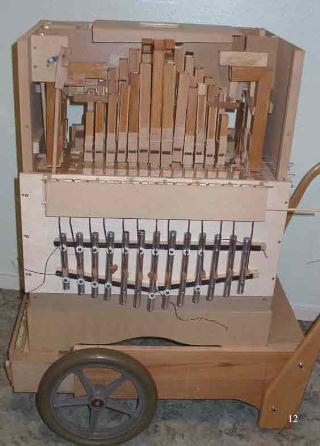
Vol 03 spent every tool and jig from Vol 02 on the first pipe a builder should ever cut — the stopped (gedeckt) flute, closed at the top by a sliding stopper, speaking the round, quiet, odd-harmonic tone that is the tonal backbone of a busker organ. This volume takes the lid off. Opening the top of the box turns the stopped flute into an open flue pipe, and that single change moves almost everything: the pipe of a given pitch is now roughly twice as long, it speaks the full harmonic series and so is brighter and louder, and it can no longer be tuned by a stopper — it is tuned by its physical length, by a tuning slide, or by cutting. This volume also introduces the discipline that turns a handful of pipes into a coherent rank: scaling, the graduation of pipe size up the compass so the timbre stays even from bass to treble. The worked build here is John Smith’s piccolo — a compact high pipe voiced an octave above the melody, whose graduated rolled-paper tubes are scaling made visible in miniature.
Where the physics lives. Why an open tube sounds an octave above a stopped tube of the same length (open f₁ ≈ c/2L versus stopped f₁ ≈ c/4L), why an open pipe reinforces the full harmonic series while a stopped pipe reinforces only odd harmonics, why cut-up trades brightness for roundness, and where Töpfer’s h = 17 halving number comes from, all belong to the sibling dive “How Organ Pipes Make Sound” (see its Vol 03, Open vs Stopped, and Vol 04, Scaling and Voicing). This volume states those relationships exactly and uses them; it does not re-derive them. The finished-pipe adjustments — the flue, nicking, chiff and speech control — are Vol 07 (Voicing, Tuning & Reference). Wind pressure is context only: these pipes are voiced at the small-organ standard of ~5 in H₂O (127 mm ≈ 1.245 kPa) — see the Wind Systems dive.
Units and sourcing. Ratios and general dimensions are given in millimetres, with inches where a source is imperial. The piccolo dimensions from John Smith’s article are kept in inches exactly as published (with millimetres in parentheses for reference only — the inch value governs). Craft facts drawn from a specific page are cited inline: (jsart09) for John Smith’s piccolo article and (jsart42) for Bruce Thompson’s traditional-pipe article on
melright.com/busker; (jsart19) for John Pettifer’s 26-note build; (en_31toets) for the 31-note hobby build onhobbycrankorgan.com; (OHS works18) for the Organ Historical Society’s flue-pipe anatomy; and (Töpfer/Normalmensur) for the scaling reference values. Anything the sources do not pin down is marked (est.) and never invented.
4.1 The open flue pipe: what changes when the top is opened
An open flue pipe is, in construction, the stopped flute of Vol 03 with the stopper removed and the top left open — the same foot, block, face, flue and mouth (see the anatomy in Vol 03 §2 and OHS works18), but a body that is a tube open at both ends rather than closed at the top. Everything the reader built for the gedeckt transfers directly; only the acoustic behaviour of the body changes, and with it the length, the tone, and the way the pipe is tuned.
4.1.1 Same pitch, twice the length
Stated in the exact terms the sibling dives use: for the same speaking length, a stopped pipe sounds about one octave lower than an open pipe; turned around, to reach the same pitch, an open pipe must be cut to about twice the length of the stopped pipe that would sound it. The idealized relations are open f₁ ≈ c/2L and stopped f₁ ≈ c/4L — quoted here only to fix the vocabulary; the derivation is in How Organ Pipes Make Sound, Vol 03.
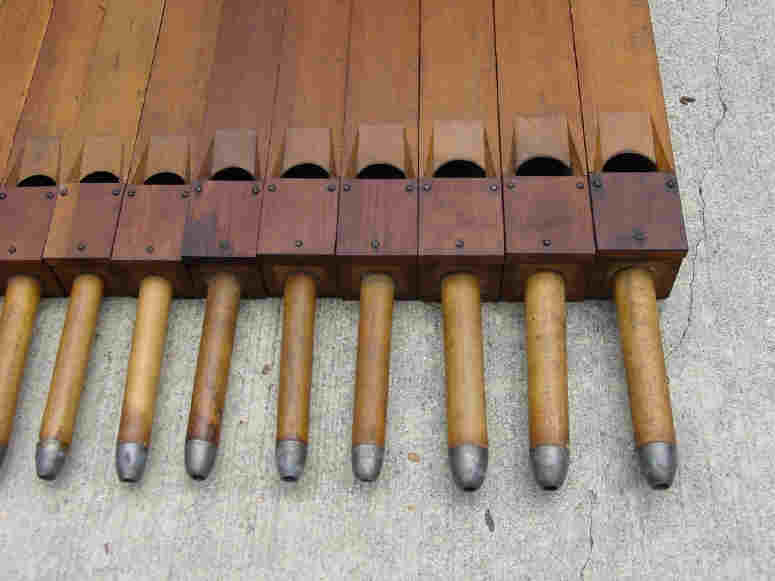
This is the exact inverse of the gift Vol 03 celebrated. Where the stopped flute reached a middle-of-the-scale pitch from a body on the order of 150–170 mm (the worked example in Vol 03 §4), the open pipe at that same pitch wants a body on the order of 300–340 mm (est. for the same worked example) — twice the board, twice the glue line to keep airtight, a longer box to plane true and keep from warping. That extra length is the price of the brighter, louder voice described next, and it is why the stopped flute, not the open pipe, is the beginner’s first build.
Note — the ~2× is an idealization, and the pipe is cut long. Real pipes fall a little short of the ideal L because of the end correction at each open end (roughly 0.6·radius per open end, plus a mouth correction — the ~0.61a figure is derived in How Organ Pipes Make Sound). At hobby scale the correction is simply absorbed by tuning: the builder cuts the body over-length and tunes down by shortening it (§1.3). The ”≈ twice the stopped length” relationship is the design rule; the last few millimetres are found on the bench, not calculated.
4.1.2 The full harmonic series: brighter and louder
Because both ends are open, the open pipe resonates on a half-wavelength at its fundamental and reinforces the complete harmonic series — fundamental, 2nd, 3rd, 4th, 5th, … — not just the odd harmonics of the stopped pipe. The even harmonics that the closed gedeckt suppressed are now present and strong. The audible result is the family the reader hears as open flute, principal, and diapason: a brighter, fuller, and distinctly louder tone than the stopped flute of the same pitch. In a busker rank the stopped flutes lay down the soft, fundamental-heavy bed; the octave open and open flute ranks sit on top of them, adding brightness and carrying power — exactly the layout John Pettifer used on his 26-note build, with front double Bourdons, then stopped flutes, then an octave open, then open flutes (jsart19). Why the even harmonics change the timbre this way is the acoustics dive’s subject, not a matter to re-derive here.
4.1.3 Tuning: by length, slide, or cut — never by a stopper
The stopped flute’s defining convenience was that it tuned by sliding its stopper, over a wide range, with no cutting (Vol 03 §10). The open pipe gives that up. With no stopper, the resonating length is the physical length of the open body, and the pipe is tuned by changing that length in one of three ways:
- By physical length at the top — the crudest method: the body is cut to length. A pipe cut slightly long is shortened by trimming the top until it is at pitch; because wood cannot be put back, the body is always cut over-length and taken down to the note (est. — the “leave it long” rule follows the end-correction reasoning above). This is a one-way adjustment and is reserved for a pipe that will never need re-tuning.
- By a tuning slide — the practical method for a rank that must hold a
temperament. A close-fitting sleeve or a slotted, movable strip at the top of
the body lengthens or shortens the effective tube: sliding it up flattens
the pipe, sliding it down sharpens it. The string/violin pipes of Vol 05 are
built over-length with a tuning slide for exactly this reason (see Vol 05 and
en_vioolpijp), and any open flute meant to be re-tuned should have one. - By tuning ears or a tuning flap/scroll on metal or large pipes — bending the ears in or a rolled scroll of metal at the top — is the traditional metal-pipe equivalent; for the small wooden busker pipes of this dive, a slide is the hobby-scale answer.
The rule to carry forward is simple and absolute: a stopped pipe tunes at the stopper; an open pipe tunes at its open top. A builder who reaches for a stopper to tune an open flute has, by definition, made a stopped pipe.
Figure 1 — Same pitch, different length. To sound a given note, an open pipe is cut to about twice the length of the stopped pipe, because a stopped (closed) tube sounds an octave lower than an open tube of equal length. The open pipe speaks the full harmonic series (brighter, louder) and is tuned at its open top by cutting or a tuning slide; the stopped pipe speaks odd harmonics only and tunes at its stopper. The physics is in “How Organ Pipes Make Sound, Vol 03.”
4.2 Mouth ratios for the open pipe
The mouth of an open pipe is cut exactly as the stopped flute’s mouth was (Vol 03 §6) — a rectangular opening between a lower lip and an upper lip, fed by the windway between the block and the lower lip. What differs is that the open pipe’s brighter voice makes the two governing ratios — the cut-up (mouth height) and the mouth width — matter even more, because there is no stopper to mask a mis-cut mouth by re-tuning. Two ratios and one aid to speech carry this section.
4.2.1 Cut-up: mouth height at most one-third the mouth width
The cut-up is the vertical distance from the lower lip to the upper lip — the height of the mouth. The one hard hobby rule, stated for a solid-block wooden pipe and applying equally to the open pipe, is Bruce Thompson’s: “the cut-up should not exceed 1/3 the width of the mouth” (jsart42). For a mouth 15 mm wide, that caps the cut-up at ~5 mm; for a mouth 20 mm wide, at ~6.7 mm. Within that limit the cut-up is the primary tone control:
- a lower cut-up gives a brighter, stringier tone with more upper partials — the direction pushed to the limit for string pipes (Vol 05);
- a higher cut-up gives a rounder, flutier tone with a stronger fundamental.
The general 1:3-to-1:4 band (mouth height : mouth width) is the traditional rule-of-thumb range and is marked (est.) — the only hard hobby number is ≤ 1/3 (jsart42). Why a lower cut-up buys brightness at the cost of a slower, harder start belongs to How Organ Pipes Make Sound, Vol 04, not to a re-derivation here. For a first open flute, cut up toward the round end of the allowed range — start low within the limit and open it slightly if the pipe is dull, since wood cannot be put back. Thompson’s knife-cut-equal-to-the-cut-up trick for leaving a clean upper-lip edge (Vol 03 §6.3; jsart42) applies without change.
4.2.2 Mouth width as a fraction of the pipe front
The mouth width on a wooden pipe is customarily some fraction of the pipe’s front width (the internal width of the face). Two reference points bracket the practical range:
- Round and metal pipes: the mouth width is one-quarter of the circumference (Töpfer/Normalmensur; see §4). This is the yardstick the scaling reference assumes.
- Square wooden pipes: the mouth width is customarily about one-fifth of the pipe’s front width for a normal flute, opening up toward one-quarter for a bold Open Diapason voice (est. — a traditional norm from Audsley and the OHS survey material; the hobby pages do not state a wooden mouth-width fraction explicitly, so both figures are flagged**)**.
The practical reading: a wider mouth (nearer ¼ of the front) gives a bolder, louder, more diapason-like pipe that needs more wind; a narrower mouth (nearer ⅕) gives a gentler flute. For a first open flute on a busker rank, the ⅕-of-front mouth width is the safe default; the piccolo of §3 uses a mouth cut into a 1/32″ ply lip on a small paper tube, sized by the same reasoning at miniature scale.
4.2.3 Ears to aid speech
An open flue pipe — especially a narrow one, and every string pipe — speaks more promptly and more stably with ears: short vertical side plates glued to the left and right edges of the mouth, standing proud of the face (OHS works18). They partly enclose the air-sheet at the sides, focus the wind on the upper lip, and steady the jet against side-wobble, which makes the pipe start faster and hold its speech at a wider range of wind pressures. On the small wooden busker pipes, ears are simple rectangular slips of the body wood, their height roughly the cut-up to a little more (est.), glued flush with the mouth. They are the mild, always-safe speech aid; the stronger interventions — a beard or a harmonic/roller bridge across the mouth — belong to the harder-starting string pipe and are covered in Vol 05.
Figure 2 — Open-pipe mouth geometry. The mouth width W is a fraction of the pipe front — about 1/5 for a flute, up to 1/4 for a bold open diapason (est.). The cut-up must not exceed W/3 (jsart42); lower cut-up brighter, higher rounder. Ears — vertical slips glued to each side of the mouth — focus the wind and steady the pipe’s speech (OHS works18).
4.3 A worked small pipe: the piccolo
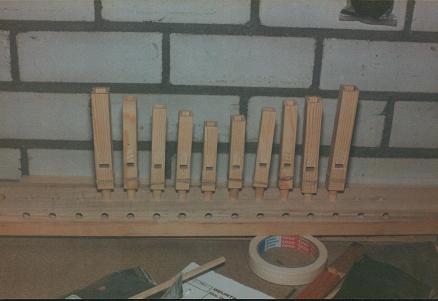
John Smith’s piccolo article is the concrete worked example for this volume: a compact high pipe that, in a small street organ, sounds an octave above the melody pipes (jsart09). It brings together everything above at miniature scale — a mouth cut to the ratios of §2, a resonating tube whose diameter is graduated up the rank exactly as §4 will formalize, and a tuning method borne by a plug at the top. All dimensions here are kept in the inches John Smith published, with millimetres in parentheses for reference only.
An honest note on “open” versus “stopped.” A classical orchestral-flute “Piccolo” rank is usually an open flute. John Smith’s busker piccolo, however, is built with a chamois-covered plug stopper on a bamboo skewer at the top of each tube (jsart09) — so in construction it is a stopped small pipe, tuned by that stopper, that fills the octave-above role. It is included in this volume because its graduated rolled-paper tubes are the clearest hands-on illustration of scaling (§4) a hobbyist will meet, and because its two-piece base and 1/32″-ply mouth are a masterclass in cutting a tiny mouth to the §2 ratios. Where the text says the piccolo “tunes by its stopper,” that is the Vol 03 stopped-pipe mechanism, not the open-pipe tuning of §1.3 — the two are kept distinct on purpose.
4.3.1 The simplified two-piece base
The traditional piccolo base is three pieces of wood, all with critical angles and grain directions, the chisel-shaped centrepiece being the hardest — Bob Minney warned John Smith that making them to the traditional drawings is “anything but easy for the amateur builder,” and one base took a whole morning (jsart09). John Smith’s fix is a two-piece base that eliminates the awkward centrepiece:
- Start with a block of good wood, 2″ × 1⅞″ × 15/16″ thick (50.8 × 47.6 × 23.8 mm) (jsart09).
- Drill the bore with a 5/8″ (15.9 mm) Forstner bit — a flat-bottomed hole (jsart09).
- Mark out the two parts and make just four cuts (starting with the small off-cuts); the block splits into two pieces with their grains running in the correct directions (jsart09). The first pair is used as a pattern to mark out the blocks for the remaining pipes.
- Cut away the wood remaining at the bottom of the hole, then, holding the base upright in a simple jig, drill the air-inlet holes (jsart09).
- Form the windway with a sharp chisel — but leave the last 2 mm flat at the end rather than chiselling all the way; that flat is then sanded to the end with a small sanding stick, which is far easier and cleaner than trying to chisel the whole slope (jsart09).
4.3.2 The air slit, the upper lip, and the cardboard shim
The mouth is formed from thin ply and set by a paper shim:
- A piece of 1/32″ (0.79 mm) ply forms the top of the air slit; the same material forms the mouth upper lip (jsart09).
- A cardboard shim sets the width and breadth of the air slit (jsart09) — the shim is the piccolo’s equivalent of the card-set windway gap used on the stopped flute (Vol 03 §4).
The base and windway parts are held together (not yet glued) and adjusted while the pipe is blown; when the sound is good, the base and windway are glued, and the upper lip is glued on last — with the final adjustment to it made on the organ’s own wind supply (jsart09). This is the same “voice at a known gauge, adjust the lip last” discipline the stopped flute used, applied to a pipe small enough to hold between two fingers.
4.3.3 Rolled-paper tubes, graduated in diameter
Piccolo resonators are normally brass, but John Smith found that rolled paper (or plastic) tubes give an identical sound to his ear — with a decisive advantage for scaling (jsart09):
- Paper tubes can be made with a gradual increase in diameter up the rank, not just the three sizes normally found in brass — this is scaling by hand (§4).
- Roll from shiny, brochure-type paper, gluing with watered-down PVA brushed on, working quickly, about 5 turns around a suitable mandrel (jsart09).
- All the different tube sizes fit the same base hole, simply by wrapping an extra strip of paper around the tube base to build it up to the 5/8″ bore (jsart09) — one base pattern serves the whole graduated set.
4.3.4 The stopper: a simplified chamois plug on a skewer
Traditional piccolo stoppers have threaded rods that let an acorn adjust the tuning — a complication John Smith judged unnecessary (jsart09). His simplified stopper:
- a simple wooden plug with a strip of chamois leather wrapped around it, sealing and sliding in the tube (the same seal-and-slide leather stopper as the gedeckt, Vol 03 §7) (jsart09);
- mounted on a bamboo skewer shaft, the end left to protrude about half an inch (≈12.7 mm) above the top of the tube (jsart09);
- topped with a “decorative” acorn instead of a tuning nut (jsart09).
With the tube-and-stopper assembly glued in place and the base parts adjusted by ear on wind, the finished pipes “seemed to be waiting to burst into life” and work on any pressure, just getting louder with more air — John Smith’s first set of 13 gave “a very nicely balanced sound without any problem” (jsart09).
4.3.5 Piccolo dimensions (jsart09)
John Smith gives the two ends of the compass — top D and bottom D — and instructs the builder to graduate the intermediate sizes between them (jsart09). Dimensions A and B are the two build measures called out on his drawing; both grow from the top of the compass to the bottom, alongside the internal diameter — the graduation that makes the rank scale evenly (§4). The inch values are the specification; millimetres are given only for reference.
Table 1 — 3.5 Piccolo dimensions (jsart09)
| Pipe | Internal diameter | Dimension A | Dimension B |
|---|---|---|---|
| Top D (highest) | 3/8″ (9.5 mm) | 1⅜″ (34.9 mm) | 2½″ (63.5 mm) |
| Bottom D (lowest) | 9/16″ (14.3 mm) | 2½″ (63.5 mm) | 4″ (101.6 mm) |
| Intermediate pipes | graduate between | graduate between | graduate between |
Reading the table: from bottom D up to top D the internal diameter falls from 9/16″ to 3/8″ (a ratio of ~0.67) while both build dimensions shrink in step. That is scaling in a nutshell — the diameter falls more slowly than the pitch rises (an octave-plus of pitch for a two-thirds diameter change), so the timbre stays even across the little rank. The general principle behind that graduation is §4.
Figure 3 — John Smith’s simplified two-piece piccolo (jsart09). A block bored with a flat-bottomed 5/8″ Forstner bit is split by four cuts into two pieces with correct grain; the windway is chiselled but left 2 mm flat at the end and sanded to finish; a 1/32″ ply strip forms the top of the air slit and the upper lip, set by a cardboard shim; the resonator is a rolled-paper tube; a chamois-covered plug on a bamboo skewer with an acorn top closes and tunes it. Dimensions kept in inches per the source.
4.4 Scaling a rank: Töpfer’s Normalmensur as a principle
A single pipe can be cut and voiced by trial. A rank — a full row of pipes, one per note across the organ’s compass — cannot, because the ear demands that the timbre stay even from bass to treble. If every pipe in a rank simply had its length set to its pitch and its width left constant, the treble pipes would sound thin and screaming and the bass pipes tubby and dull, because a pipe’s tone depends not only on its length but on its diameter relative to its length — its scale. Scaling is the systematic graduation of pipe diameter up the compass that keeps the tone consistent. The reference framework is Töpfer’s Normalmensur.
4.4.1 The reference: 155.5 mm at 8′ C, mouth a quarter of the circumference
Töpfer’s Normalmensur (“normal scale”) fixes a reference diameter and a mouth proportion from which a whole rank is derived (Töpfer/Normalmensur):
- the reference internal diameter is 155.5 mm (6.12 in) at 8′ C — the low C of an 8-foot open rank;
- the mouth width is one-quarter of the pipe’s circumference.
These two numbers anchor a round metal principal rank. They are quoted here as the reference yardstick, not as cut lengths — the busker pipes of this dive are square, wooden, and far smaller, and Normalmensur is used for its proportional principle, not its literal metal diameters (§4.4).
4.4.2 Diameter halves on the 17th note — the halving number h = 17
The heart of Normalmensur is a single rule about how fast diameter falls as pitch rises (Töpfer/Normalmensur):
-
the diameter halves every 16 semitones — that is, it is halved on the 17th note up the chromatic compass. The halving number is h = 17;
-
equivalently, the cross-sectional area varies as 1 : √8 per octave (√8 ≈ 2.828) — over one octave, twelve semitones, the diameter falls by a factor 2^(12/16) = 2^0.75 ≈ 1.682, and the area by its square, ≈ 2.83 = √8;
-
the diameter of the n-th note above the reference is:
dₙ = d₁ / 2^((n − 1)/(h − 1)), with h = 17.
So d₁ is the reference (n = 1); on the 17th note (n = 17), the exponent is 16/16 = 1 and d₁₇ = d₁/2, the diameter is halved; two octaves up (n = 25) it is 2^(24/16) = 2^1.5 ≈ 2.83 times smaller. The h = 17 convention is kept identical to the acoustics dive, which derives why this particular taper gives an even timbre; this volume uses the number, it does not prove it. The table below shows the taper as ratios of the reference diameter:
Table 2 — the taper as ratios of the reference diameter
| Semitones above reference | dₙ / d₁ = 2^(−n_st/16) | Note |
|---|---|---|
| 0 | 1.000 | reference (d₁) |
| 4 | 0.841 | |
| 8 | 0.707 | |
| 12 (one octave) | 0.595 | area ↓ to 1/√8 (÷2.83) |
| 16 (17th note) | 0.500 | diameter halved |
| 24 (two octaves) | 0.354 | |
| 32 | 0.250 | diameter quartered |
4.4.3 Why scaling matters: diameter falls more slowly than pitch
The single insight a builder must take from Normalmensur is this: diameter is made to fall more slowly than the pitch rises. Pitch doubles every octave (12 semitones), but the diameter only halves every 16 semitones — so as the rank climbs, each pipe is made proportionally wider for its length than a strict “shrink everything together” rule would give. That deliberate mismatch is what keeps the timbre even: a treble pipe scaled by h = 17 is fat enough not to turn thin and stringy, and a bass pipe is not so fat it turns tubby. A rank whose diameter fell as fast as pitch (halving every octave, h = 13) would grow brighter and stringier toward the treble; a rank whose diameter fell more slowly (h larger than 17) would grow rounder and flutier toward the treble. The halving number is therefore also a tone-family choice — narrow-scaling for strings, wide-scaling for flutes — a lever picked up again for the string pipe in Vol 05 and for voicing in Vol 07.
Figure 4 — Töpfer’s Normalmensur as a graduated rank. Pipe diameter falls with the formula dₙ = d₁/2^((n−1)/16), so the 17th pipe has exactly half the diameter of the first (h = 17), and the cross-sectional area varies 1 : √8 per octave. Because the diameter falls more slowly than the pitch rises, the timbre stays even from bass to treble. This is a proportional principle, not a table of cut-lengths for square wooden busker pipes (§4.4).
4.4.4 Approximating scale on a small busker rank
Normalmensur is a round-metal-pipe yardstick; a busker builder applies its principle, not its metal diameters, to small square wooden (or rolled-paper) pipes. In practice:
- Read “diameter” as “internal width.” For a square wooden pipe, the governing dimension is the internal side (front) width; graduate that side up the rank following the same slow taper — roughly halving the width every 16 semitones (est. as applied to square section) — rather than computing a metal circumference.
- Interpolate between two known-good pipes. The most reliable hobby method is the one John Smith used for the piccolo: fix the width at the bass end and at the treble end of the rank, then graduate the intermediate pipes smoothly between them (jsart09) — his rolled-paper tubes ran from 9/16″ at bottom D to 3/8″ at top D, graduating between, precisely so the little rank scaled evenly. A builder who has one good bass pipe and one good treble pipe can lay out a whole rank by smooth interpolation and check it by ear.
- Keep the mouth width tracking the pipe. As the front width falls up the rank, hold the mouth width to its chosen fraction of the front (§2.2, ~1/5 to 1/4), so the mouth scales with the pipe and the tone stays of a piece.
- Cut over-length and tune down (§1.3): scale sets the width; length is finished on the bench with a tuning slide or a trim.
4.4.5 Note count is not pipe count
A final caution that governs how many pipes a rank actually contains. A scale’s note count is not its pipe count. A 20-note organ is built to the Carl Frei / Raffin scale (also called the Stüber format), spanning bass F up to D; a 26-note organ adds range on the Alderman scale, and the John Smith “Universal” plays both rolls (see The John Smith Universal Organ). But the number of notes the scale carries says nothing about the number of pipes:
- Bass tones are commonly doubled. The 31-note hobby build fits two pipes per tone in the bass for more body (en_31toets); the 26-note build fronts the organ with double Bourdons (jsart19).
- Multiple ranks multiply the count. A single note may sound a stopped flute, an octave open, an open flute, and a string pipe together — John Pettifer’s 26-note layout stacks front double Bourdons, stopped flutes, an octave open, and open flutes (jsart19) — so the pipe count is several times the note count. The 26-note John Smith Universal carries on the order of ~69 pipes for its 26 notes (see the John Smith Universal dive).
When scaling a rank, then, the builder scales each rank across the compass and counts the pipes per rank, times the number of ranks, plus the doubled bass — never one pipe per note of the scale.
4.5 What the open pipe adds, and where next
The open flue pipe takes the stopped-flute craft of Vol 03 and trades the closed top for a longer, brighter, louder voice: about twice the length for the same pitch, the full harmonic series, and tuning at the open top by cut or slide rather than at a stopper. Its mouth is cut to the same ratios — cut-up ≤ 1/3 the mouth width (jsart42), mouth width ~1/5 to 1/4 of the front (est.) — with ears to steady its speech. The piccolo showed those ratios and, in its graduated rolled-paper tubes (jsart09), showed scaling made visible; Töpfer’s Normalmensur (h = 17) made scaling a principle — diameter falling more slowly than pitch so the timbre stays even — that a hobbyist applies to a small busker rank by interpolating widths between two good pipes and remembering that note count is not pipe count.
The next volume, The String (Violin) Pipe (Vol 05), pushes the open pipe to its narrow, bright extreme: a narrow-scaled body with a low cut-up that yields rich, violin-like overtones but is prone to overblow an octave and hard to start — tamed by ears, a box beard, and above all the frein, Gavioli’s thin brass plate across the mouth, built over-length on a tuning slide and voiced without the frein first. For the acoustics behind every “why” in this volume — the full harmonic series, the h = 17 taper, the end correction — see How Organ Pipes Make Sound; for the finished-pipe voicing and tuning, see Vol 07; for the wind that drives these pipes, see Wind Systems; and for the instrument this rank is being built toward, see The John Smith Universal Organ.
Comments (0)