Building Organ Pipes · Volume 1
Building Organ Pipes — Vol 01: Making Your Own Pipes
This is the opening volume of Building Organ Pipes, the construction-craft dive in the Mechanical Organs program. Where the Track-1 theory dives explain why a pipe sounds — see the How Organ Pipes Make Sound dive for edge-tone and standing-wave physics, and the Wind Systems dive for how the wind reaches the pipe — this dive is about the shavings on the bench: choosing the wood, cutting the mouth, gluing the box, and coaxing the finished pipe into speech. It is written for the engineer-minded hobbyist who intends to actually build a rank of pipes for a small hand-cranked busker or street organ, on a scale of roughly 20 to 31 notes.
The scope is deliberately narrow. This is not a treatise on the great church organ, whose 32′ pipes are taller than the room this reader is working in. It is the small, portable, air-hungry-but-low-pressure world of the crank organ, where the whole instrument fits on a cart, the wind sits at around 5 in H₂O (127 mm ≈ 1.245 kPa), and the pipes are little rectangular boxes of softwood a hobbyist can hold in one hand. Everything below is oriented to that instrument.
1.1 Why an amateur builds pipes instead of buying them
A reasonable first question is why anyone would build pipes at all when a firm like Raffin, Deleika, Stüber, or Jäger & Brommer will happily sell a finished, voiced rank. There are three honest answers.
1.1.1 Cost
A hand-cranked organ is mostly pipes, and finished, voiced pipes are the single most expensive line item in a professional build. A busker organ carries dozens of them — the 26-note John Smith “Universal” has on the order of 69 pipes (see the The John Smith Universal Organ dive), and even a modest 20-note machine needs far more pipes than its note count suggests (see Note count is not pipe count, below). Buying a full complement of voiced pipes can cost more than every other part of the instrument combined. Building them from softwood board, glue, and a few grams of brass turns that line item into shop time. For the amateur with more evenings than money, that trade is the whole point.
1.1.2 Matching a specific scale
An organ plays only the notes its scale provides, and the small-organ world has settled on a handful of fixed scales that the music rolls or book-music are punched to. The two that matter for this dive are:
- The 20-note Carl Frei / Raffin scale — the de-facto small busker/street standard, also built by Stüber, Deleika, Jäger & Brommer, Peter Trueman, and Alderman & Davis. Carl Frei’s layout spans bass F (MIDI 53) up to D (MIDI 86).
- The 26-note Alderman scale (Ian Alderman, of Poole, Dorset; Beckman spells it “Aldeman”), a larger arrangement that adds range and chromatic notes.
The John Smith “Universal” is so named because it plays both the 20-note (Raffin) and 26-note (Alderman) rolls (jsart19; see the The John Smith Universal Organ dive). A builder who has committed to a particular scale — because that is what the available music is cut for — needs pipes tuned and laid out to exactly that note set. Building the pipes puts that choice entirely in the builder’s hands: the rank is made to fit the chest and the scale, rather than the chest being made to fit whatever rank was for sale.
1.1.3 Gaining the skill to voice
The third reason is the one that turns a hobbyist into an organ builder. A bought pipe arrives voiced; when it goes off — and a wooden pipe in a cart wheeled between a cold van and a warm market square will go off — the owner who did not make it is at the mercy of whoever did. The builder who cut the mouth, set the flue, and brought the pipe to speech understands what every adjustment does and can put it right. Voicing is a craft learned only at the bench, on pipes cheap enough to ruin a few. Making one’s own is the least expensive way to acquire it. Volume 7 of this dive is devoted entirely to voicing and tuning; the whole build arc exists to get the reader to the point where that volume makes sense in the hands.
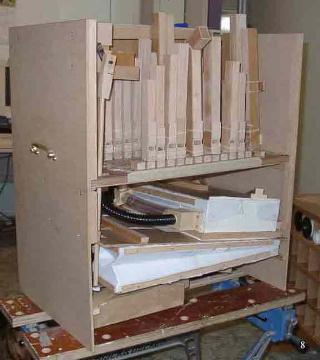
1.2 The pipe families used in a crank organ
Every pipe on a crank organ belongs to one of two great families, divided by how the air is made to vibrate — the physics of which lives in the How Organ Pipes Make Sound dive and is not re-derived here.
- Flue pipes work like a whistle or a recorder: a thin sheet of wind from a narrow slit (the flue or windway) is thrown against a sharp edge (the upper lip), and the resulting oscillation drives the air column in the body. No moving part. The great majority of a busker organ’s pipes are flue pipes.
- Reed pipes work like a clarinet or an accordion: a thin tongue of brass vibrates and chops the airstream into puffs, and a resonator above reinforces the result. There is a moving part — the tongue — and it is the source of most of a hobbyist’s tuning grief, which is why the amateur crank-organ world has a clever way of dodging the hardest version of it.
Within those two families, a small organ typically draws on the voices below. The mechanics of each are covered in its own later volume; here is what each contributes to the ensemble.
Table 1 — The pipe families used in a crank organ
| Family | Voice | Build note | Tone / role in the ensemble |
|---|---|---|---|
| Flue | Stopped (gedeckt) flute | Closed top, ~half the length of an open pipe at the same pitch | Round, hollow, quiet; odd harmonics only; the backbone/foundation rank of most busker organs. First pipe to build (Vol 3). |
| Flue | Open flute / open flue | Open top, tuned by length or a tuning slide | Fuller, brighter, all harmonics present; adds body and presence over the stopped foundation. Includes the octave-above piccolo (jsart09). Vol 4. |
| Flue | String / violin pipe | Narrow scale, fitted with a frein | Thin, keen, overtone-rich, “violin-like”; adds edge and shimmer — but is quiet and prone to overblowing. Vol 5. |
| Reed | Beating (striking) reed | Brass tongue beats on a shallot in a boot | Bright, buzzy, brassy “trumpet”; the classical reed. Judged too hard for the amateur by the hobby sources (en_31toets, jsart51). |
| Reed | Free-reed “melodica trumpet” | Melodica/harmonica reed on a cardboard resonator | The hobbyist’s practical reed substitute: a “special sound … almost singing” over the stopped rank (jsart51). Vol 6. |
1.2.1 The stopped (gedeckt) flute
The stopped, or gedeckt, flute is the foundation. Its top is closed by a movable stopper, and a closed pipe sounds about one octave lower than an open pipe of the same speaking length — equivalently, a stopped pipe is about half the length of an open pipe at the same pitch, and it produces odd harmonics only (the acoustics behind that is in the How Organ Pipes Make Sound dive). Two consequences follow that make it the ideal first build: it uses roughly half the wood for a given note, and its rounder, more forgiving tone makes it easy to voice. That is exactly why Vol 3 starts here. In the ensemble it supplies the warm, quiet, fundamental-heavy body that everything else sits on top of.
1.2.2 The open flute (and the piccolo)
Open flue pipes have an open top and sound their full harmonic series, giving a brighter, fuller tone that lifts the stopped foundation. They tune by physical length — cut a little long and trimmed, or fitted with a tuning slide — because an open pipe’s pitch depends on its open length (open f₁ ≈ c/2L). The small octave-above piccolo is the compact member of this family; John Smith’s piccolo build uses a simplified two-piece base and rolled-paper tubes and “sounds an octave above the melody” (jsart09) — though that particular busker piccolo is in fact built stopped, with a chamois-plug stopper filling the octave-above role, as Vol 4 sets out honestly. Open ranks are covered in Vol 4, along with the scaling of a whole rank.
1.2.3 The string (violin) pipe
A string pipe is simply a flue pipe built to a narrow scale — a small cross-section relative to its length. That narrow scale enriches the upper partials into a keen, “violin-like” tone, but it comes at a price: the pipe is quieter than a stopped pipe and prone to speaking an octave too high (en_vioolpijp). The classic remedy on a busker organ is the frein — a thin brass plate across the mouth, an invention attributed to Gavioli, which stabilises the jet and pulls the pitch down into its proper octave. (An alternative classical device, the harmonic or roller bridge, exists, but the hobby source uses a frein, not a roller bridge — the distinction is drawn carefully in Vol 5.) The string pipe adds edge and shimmer to the ensemble and is the connoisseur’s rank; it is also the fussiest flue pipe to voice, which is why it comes after the open pipe in the build arc.
1.2.4 Reed pipes — and the free-reed substitute
The classical reed pipe makes its sound with a brass tongue that beats against the facing of a shallot (a part-closed tube) seated in a boot, with a tuning wire setting the tongue’s free length and a resonator above reinforcing the tone. It is bright and brassy and utterly characteristic — and it is genuinely difficult to make and keep in tune at the bench. Both the hobbycrankorgan and John Smith communities judge the metal-wire beating-reed trumpet “too difficult for a hobby organ builder” (en_31toets) and reach instead for a substitute:
The free-reed “melodica trumpet” trick is the headline hobby move. Rather than cut and voice a beating reed, the builder harvests a free reed from a melodica or harmonica — a tongue that passes through its frame rather than beating against a facing — and mounts it on a small cardboard resonator. Melodica reeds are chosen specifically because a melodica “uses about the same air pressure as the organ” (en_31toets), so they speak happily at the organ’s ~5 in H₂O. The result “gives a special sound … together with the stopped rank the sound is much better, almost singing” (jsart51). The full recipe — which reed of the air-out/air-in pair to use, how to retune from A = 420 Hz to A = 440 Hz, the cardboard resonator, and the beeswax mount — is Vol 6.
Figure 1 — The pipe families of a small crank organ. Every voice descends from one of two ways of exciting the air: a flue (air thrown on an edge) or a reed (a vibrating tongue). The hobbyist builds the three flue voices and substitutes a free reed for the difficult beating reed.
1.3 What “voicing” a homemade pipe means
Voicing is the word that separates a box that makes a noise from a pipe that belongs in an organ, and it is worth defining precisely at the outset because the whole build arc converges on it. To voice a homemade pipe is to bring it to three conditions at once:
- Correct pitch. The pipe sounds the right note, at the right octave, at the organ’s working wind pressure. This means both tuning to the intended frequency (by stopper position on a stopped pipe, by length or tuning slide on an open pipe, by the frein on a string pipe, by the tuning wire or a resonator stopper on a reed) and ensuring the pipe speaks in its intended octave rather than overblowing to the octave above — a real failure mode for narrow string pipes (en_vioolpijp).
- Prompt speech. The pipe starts cleanly and quickly when the wind arrives, without a delayed onset, a false low “grunt,” a spit of wind noise, or an uncontrolled chiff on the attack. Speech is governed at the mouth — the width and height of the flue, the cut-up (mouth height), any nicking of the block or lip — and this is where most bench time is spent.
- Blend. The pipe sits with its rank and with the other ranks at a matched loudness and tone, so the ensemble sounds like one instrument rather than a collection of individuals. A pipe can be perfectly in tune and speak promptly and still be wrong because it is twice as loud as its neighbours.
Two disciplines follow from this definition and recur throughout the dive. First, voice at a known, steady pressure, not by mouth. Blowing a pipe by mouth is inconsistent and, worse, floods the thin wood with exhaled moisture — the classic warping failure. The bench method is a pump or inflator feeding a U-tube manometer so the builder can set and read the exact gauge (~5 in H₂O) the pipe will actually see (jsart26). Second, voicing is iterative and largely irreversible at the extremes: wood removed at the mouth does not come back, so the craft is to approach each adjustment in small steps. Volume 7 is the full voicing manual; the earlier volumes each end with the specific voicing moves their pipe needs.
1.4 Note count is not pipe count
The single most important thing for a first-time builder to internalise before ordering wood is that the number of notes in a scale is not the number of pipes in the organ. It is tempting to hear “20-note organ” and picture 20 pipes. The real figure is a large multiple of that, for two independent reasons.
Multiple ranks. A busker organ rarely plays a single rank. It layers voices — a stopped foundation, an open or octave rank over it, perhaps a string rank and a reed rank for colour — and each rank needs its own pipe for every note. John Pettifer’s 26-note build, for example, layers double Bourdons at the front, then a rank of stopped flutes, then an octave open rank, then open flutes (jsart19). Four ranks over a 26-note scale is already on the order of a hundred pipes before any doubling.
Doubled bass. The bass notes of a small organ are frequently doubled — two pipes sound the same low note — to give the bottom end more weight and presence. The 31-note Ulrich Stille build uses two pipes per tone in the bass for “more body in the tone” (en_31toets), and the 26-note build fronts its layout with double Bourdons for the same reason (jsart19). A low note that is doubled costs two pipes, not one, per rank it appears in.
Put concretely: the 26-note John Smith “Universal” carries about 69 pipes to play its 26 notes (see the The John Smith Universal Organ dive) — very nearly three pipes for every note in the scale. A builder who orders wood for “20 pipes” because the roll says 20-note will fall dramatically short. The correct planning quantity is notes × ranks, plus the extra pipes for every doubled bass note, and that number should be settled — from the specific plan being built — before the first board is cut. The Encoding the Music dive explains how those notes get onto the roll or book in the first place; this dive is concerned with the pipes they trigger.
Figure 2 — Why “20-note” never means 20 pipes. Each rank carries a pipe for every note (pipes shorten toward the treble), and the bass notes are commonly doubled — two pipes to one note — for weight. The organ’s pipe count is notes × ranks plus the doubled-bass extras.
1.5 How this dive sits atop the theory dives
Building Organ Pipes is a Track-3 construction dive, and it stands deliberately on the shoulders of the Track-1 theory dives. It does not repeat them; it assumes them and points back to them at every “why.” The division of labour is:
- How Organ Pipes Make Sound owns the acoustics: the jet and edge tone at the mouth, standing waves in the body, why open pipes sound f ≈ c/2L and stopped pipes f ≈ c/4L (an octave lower for the same length), odd-versus-full harmonic series, the end correction (~0.61·radius) that makes a pipe cut a touch long, the Töpfer halving number h = 17 used in scaling, and how a reed tongue excites its resonator. Whenever this dive states a ratio or a “cut it long and tune down,” that dive is where the why lives.
- Wind Systems owns the wind: the bellows, reservoir, pressure regulation, and the wind path to the chest. This dive uses exactly one number from it — the working pressure of ~5 in H₂O — as the pressure at which pipes are voiced, and points there for anything more.
- Encoding the Music owns how the notes reach the pipes: the roll or book, the keyframe, the pallet valves. This dive builds the things those valves feed.
- The John Smith Universal Organ and The Hobby Crank Organ are the sibling build dives — the whole instruments. The John Smith Universal (Raffin 20-note + Alderman 26-note, ~69 pipes, ~5 in H₂O) is the concrete worked example a reader of this dive may be building toward; The Hobby Crank Organ covers the Walter Höffle 20-note path and a Jäger & Brommer professional benchmark at the whole-instrument level. This dive zooms into just the pipes those instruments need, and does not duplicate their subsystem overviews.
The practical upshot for the reader: keep the acoustics dive open in a second tab. This volume and its siblings will say “cut-up controls tone” and “stopped is an octave lower”; the theory dive says why, and the two are written to agree exactly.
1.6 The build arc — Volumes 2 through 7
The remaining six volumes follow the natural order in which a builder actually makes pipes: get the shop ready, build the easiest pipe first to learn the moves, then work up through the harder flue voices and the reed substitute, and finish with the voicing and tuning that ties it all together.
1.6.1 Volume 2 — Wood, Tools & the Workshop
Timber selection and why it matters more than any other single choice: Höffle’s plan specifies fir, but hobbyists routinely substitute beech for tone (en_bouwhoeffle, en_31toets, en_pijp), and other documented busker choices include pine / Canadian white wood (jsart19) and cedar (jsart26) — each attributed to its builder, because there is no single “correct” wood. The volume covers body wood versus the harder close-grained wood for block, cap, and lips; grain and seasoning; sealing every wind-contact surface against exhaled and glued-in moisture (the recurring failure mode is water-based glue and breath swelling thin walls); the glue choices (thinned PVA as the workhorse, hide glue, epoxy — with tradeoffs); the tool kit; the essential jigs (a shooting jig for square edges, the glue-up-with-a-spacer-front weighted with lead-filled cans, jsart26); wall thicknesses at hobby scale (2–3 mm for small pipes, jsart26); and building the manometer-and-inflator voicing rig.
1.6.2 Volume 3 — The Stopped (Gedeckt) Flute: the First Pipe
The first pipe to build, because it is the most forgiving. Full anatomy — foot, block, face, flue/windway, lower and upper lip, mouth, body, stopper — and the precise statement that a stopped pipe is an octave lower / half the length / odd harmonics only relative to an open pipe (with the why in the acoustics dive). The concrete hobby numbers: a beech core ~10 cm long, the cap set flush to +0.5 mm above the core, the stopper made from the core remnant plus leather (en_pijp), and 2–3 mm walls glued up with the spacer-and-cans method (jsart26). Cutting the mouth, making the leather stopper, first assembly, and tuning by stopper position.
1.6.3 Volume 4 — Open Flue Pipes & Scaling
The open pipe (open top, tuned by length or tuning slide) and the ratios that
govern its mouth: the cut-up ≤ 1/3 of the mouth width (Bruce Thompson,
jsart42) — the one hard hobby number — with the traditional wooden mouth-width
fraction (~1/5 of the front width) flagged (est.). The octave-above piccolo
with its imperial dimensions and rolled-paper tubes (jsart09). And scaling a whole
rank: Töpfer’s Normalmensur presented as the principle — reference internal
diameter 155.5 mm at 8′ C, mouth width ¼ of the circumference, diameter
halving on the 17th note (h = 17), area varying 1:√8 per octave — applied to a
small busker rank as a guide to even timbre, not as literal cut-lengths for
square wooden pipes.
1.6.4 Volume 5 — The String (Violin) Pipe
The narrow-scale pipe: rich overtones, but quiet and prone to overblowing an
octave. The frein (Gavioli’s invention; 0.5–1 mm brass or aluminium, two
holes — one to fasten, one to bow the plate toward or away from the mouth) and the
distinctive method — build over-length with a tuning slide, voice without the
frein first (it will sound an octave high), then add the frein, which “sucks the
air out of the pipe” to drop it into its proper octave (en_vioolpijp). Labium and
core angles both 9°. Ears and box beard, and the harmonic/roller bridge as the
classical alternative to the frein (est.) — carefully distinguished, since the
hobby source uses a frein, not a bridge.
1.6.5 Volume 6 — Reed Pipes & Special Voices
The beating-reed anatomy (tongue, shallot, boot, tuning wire) and why the metal-wire trumpet is judged too hard for the amateur — then the free-reed “melodica trumpet” trick in full: use only the air-out reed of the plate’s air-out/air-in pair; melodica reeds factory-tuned to A = 420 Hz read about 20 cents sharp at A = 440, corrected by scratching the middle of the tongue over 3–4 mm until ~4–5 cents above zero; a resonator rolled from 0.5 mm cardboard ~12 cm long on a 20 × 20 mm wood mount; the reed plate mounted with beeswax (soldering iron, and the plate must not be heated); and tuning by sliding a stopper — low C ≈ 10 cm, high C ≈ 6 cm — to find resonance (jsart51; en_31toets). When and why a hobbyist adds a reed rank at all.
1.6.6 Volume 7 — Voicing, Tuning & Reference
The payoff volume: bringing a finished pipe to speech at the bench. Flue and windway adjustment, cut-up tweaks, nicking, and chiff/speech control; the manometer-voiced method at ~5 in H₂O; tuning by the appropriate means for each family (stopper, slide, frein, tuning wire); and the common faults and their fixes — overblowing, slow or late speech, wind noise, swollen walls. It closes with the reference apparatus for the whole dive: a wood shortlist, the pipe-family/timbre table, the piccolo dimensions, the scale-name table, a consolidated glossary, a cross-index to Volumes 1–6, and the bibliography.
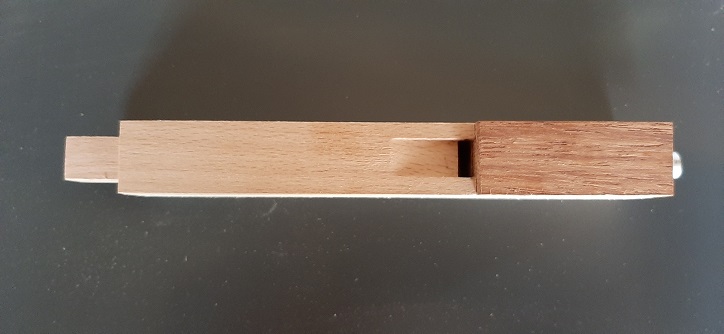
1.7 Where to begin
For the reader who intends to build: read Volume 2 next, get the wood and the two essential jigs sorted, and build the manometer rig before cutting a single pipe — voicing at a known pressure is not optional, and the rig is an afternoon’s work. Then build one stopped flute from Volume 3, ruin it if necessary, and build a second. The stopped flute teaches every move — squaring the box, cutting the mouth, setting the flue, tuning the stopper — that the harder pipes in Volumes 4 through 6 build upon. By the time the reader reaches the voicing manual in Volume 7, the pipes to practise on will be sitting on the bench, and the “why” will be one tab away in the How Organ Pipes Make Sound dive. That is the whole plan: not to buy a rank, but to become the person who can make one — and fix it in a cold market square when it inevitably drifts.
Comments (0)