Building Organ Pipes · Volume 5
Building Organ Pipes — Vol 05: The String (Violin) Pipe
Vol 03 built the stopped flute — the quiet, round, forgiving backbone of the organ — and Vol 04 opened the top of the box to make the brighter open flue pipe and set out how a rank is scaled. This volume builds the pipe that gives a busker organ its singing, violin-like voice, and it is deliberately placed last of the flue builds because it is the hardest flue pipe to make speak. A string pipe is an open flue pipe cut to a narrow scale — a small cross-section relative to its speaking length — and that one choice buys a rich, keen, string-like tone at the cost of a pipe that is reluctant to start, quick to overblow an octave high, and quieter than the stopped rank it sits over (en_vioolpijp). Taming it is a craft of its own, and the hobby literature documents a specific, quotable method for doing so with a frein: a thin brass plate laid across the mouth, an invention attributed to Gavioli (en_vioolpijp).
The frein is the centre of this volume. The build sequence around it is unusual — the pipe is made over-length with a tuning slide, voiced without the frein first (where it sounds an octave too high), and only then fitted with the frein, which pulls it down the octave to its intended note (en_vioolpijp). The volume also names the classical string aids — ears, the box beard, and the harmonic (roller) bridge — and presents the roller bridge as the alternative way to tame the jet, kept strictly separate from the frein the hobby source actually uses.
Where the physics lives. Why a narrow-scale pipe is rich in upper partials, why it prefers to overblow to its second mode (the octave) rather than settle on its fundamental, and why a bar or plate across the mouth stabilises the air-sheet and forces the fundamental, all belong to the sibling dive “How Organ Pipes Make Sound” (see its treatment of the edge tone, the mode-locking of the jet, and cut-up versus tone). This volume states those relationships and uses them to build a pipe; it does not re-derive them. String pipes are open pipes, so the open relation f₁ ≈ c/2L and tuning by physical length (Vol 04) still hold. Wind is context only: the rank is voiced at the small-organ standard of ~5 in H₂O (127 mm ≈ 1.245 kPa) — see the Wind Systems dive.
Units and sourcing. Dimensions are in millimetres and degrees (the hobby pages are metric). Craft facts drawn from a specific page are cited inline: (en_vioolpijp) for
hobbycrankorgan.com/subdir/en_vioolpijp.htm(the community violin-pipe intonation page — the primary source for this volume), (en_pijp) for the same site’s “how to make an organ pipe,” (jsart26) for Tony Goldsworthy’s pipe-making tips and (jsart19) for John Pettifer’s 26-note build onmelright.com/busker, and (OHS works18) / (OHS works03) for the Organ Historical Society’s flue-pipe anatomy and timbre vocabulary. Traditional norms the hobby sources do not pin down — the string-scale ratio, the roller-bridge dimensions — are marked (est.) and never invented.
5.1 What makes a string pipe: narrow scale
5.1.1 Scale is the ratio of width to length
“Scale” (German Mensur) is the relationship between a flue pipe’s cross-section and its speaking length. Two open pipes cut to the same length sound essentially the same pitch, but if one is wide and the other narrow, they sound like different instruments. Vol 04 introduced Töpfer’s principle that pipe diameter falls more slowly than pitch up a rank (the halving number h = 17); scale is the same idea turned into a family choice. The organ flue families sort by scale from wide to narrow (OHS works03):
- Flutes / stopped ranks — the widest scale. Wide pipes damp their upper partials and emphasise the fundamental, giving the round, hollow, quiet gedeckt tone of Vol 03.
- Principals / diapasons — a medium scale, the organ’s “own” voice.
- Strings — the narrowest scale of the flue voices. A string pipe is markedly slimmer in cross-section than a flute or principal of the same speaking length (en_vioolpijp; OHS works03).
There is no single hobby number for how narrow a busker string pipe should be; the traditional string-scale ratio is a workshop norm rather than a published figure, so any specific proportion here is marked (est.). As a working target for a small wooden busker string pipe, cutting the body to roughly two-thirds to three-quarters of the cross-section of the open flute at the same pitch (est.) puts it firmly in string territory without making a pipe so thin it cannot be built or will not speak at all. The principle, not the exact ratio, is what matters: the narrower the body relative to its length, the more string-like and the harder to start.
5.1.2 Narrow buys upper harmonics — and trouble
A narrow body reinforces the upper partials of the tone far more than a wide one does, which is precisely why the string rank sounds keen, bright, and “violin-like” — a bowed-string tone is itself rich in harmonics, and the narrow pipe imitates it (en_vioolpijp; OHS works03). That richness is the whole point of building the rank: it is the register that makes a busker organ sing over the soft bed of stopped flutes.
The same narrowness that buys the harmonics also buys three difficulties, all documented on the source page (en_vioolpijp):
- It is prone to overblow an octave high. A narrow open pipe would rather sound its second mode — the octave above the intended note — than settle on its fundamental. Left unaided, a freshly-voiced string pipe frequently speaks a full octave too high. Why a narrow pipe favours the octave mode is the acoustics dive’s subject; that it does is the central build problem here.
- It is quieter than the stopped rank. A string pipe puts its energy into the upper partials rather than a strong fundamental, so it is less loud than a stopped flute of the same pitch (en_vioolpijp). The string rank colours and brightens; it does not carry the organ’s weight.
- It is slow and fussy to start. The narrow air column takes longer to lock onto its fundamental, so the pipe is reluctant to speak promptly and cleanly — the reason string pipes need the speech aids of §2 and §3.
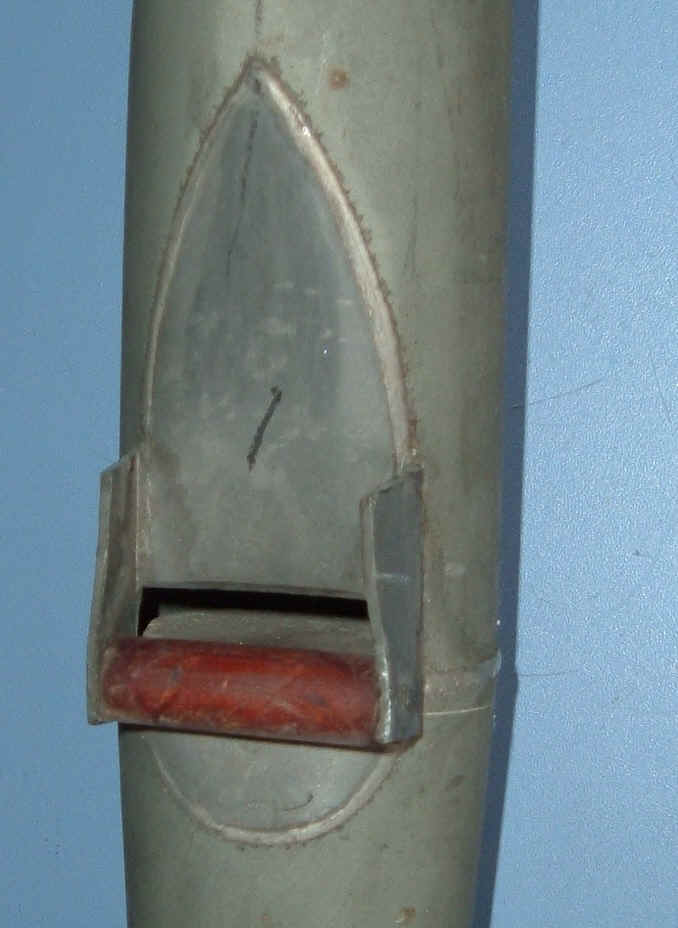
5.2 Why string pipes are hard to start: ears, beard, and the bridge
Because a string pipe fights the builder for its fundamental, organ-builders have long added hardware at the mouth to stabilise the air-sheet and coax the pipe onto the correct octave. The physics of each — how a fixed obstacle near the air-sheet damps the octave mode and encourages the fundamental — is the acoustics dive’s business; here they are named as tools, defined by the Organ Historical Society’s anatomy (OHS works18), so the builder knows what each looks like and what it is for.
- Ears — vertical side plates left and right of the mouth, standing proud of the pipe face. They focus the wind at the mouth and shield the air-sheet from side draughts, steadying speech (OHS works18). Ears are cheap, common, and used on almost every string pipe, including the frein-tamed hobby build — they are not an alternative to the frein but a companion to it.
- Box beard — a three-sided box built out from the ears and across the bottom of the mouth, enclosing a small pocket of air in front of the air-sheet. It is a heavier version of the plain beard (a bar or dowel below the lower lip) and gives strong, prompt speech on keenly-scaled string pipes (OHS works18). Beard is the English term; the same part is Bart in Dutch/German and frein in French (OHS works18; en_vioolpijp).
- Harmonic (roller) bridge — a rotatable dowel or bar mounted across the mouth, between the ears, at the level of the air-sheet. Turning the roller adjusts how the sheet meets the obstacle, so it is a tunable speech aid — the classical alternative this volume treats in §5 (OHS works18).
These are the traditional kit. The hobby source at the centre of this volume does not use a beard or a roller bridge; it uses the frein (§3), with ears at the mouth. The distinction matters and is kept firm throughout: the frein and the roller bridge are two different ways to tame the same jet, and the hobby page uses the first (en_vioolpijp).
5.3 The frein: Gavioli’s plate across the mouth
5.3.1 What it is
The frein (French; = beard, Dutch/German Bart) is a thin flat plate laid across the mouth of a string pipe that stabilises the air-jet and forces the pipe onto its fundamental, curing the octave overblow of §1.2. The hobby page attributes the device to Gavioli — the fairground-organ builders — and gives concrete dimensions (en_vioolpijp):
- Material: brass (or aluminium), 0.5–1 mm thick (en_vioolpijp). A thin, stiff, flat metal plate — brass is the traditional choice, aluminium a lighter, cheaper, easily-worked substitute.
- Two holes: the plate is drilled with two holes (en_vioolpijp). One hole fastens the plate to the pipe (a single screw into the pipe face below or beside the mouth); the second is the adjustment point, used to bow the plate toward or away from the mouth so that the gap between the plate and the mouth can be set and re-set (en_vioolpijp). That plate-to-mouth gap is the fine tuning of the pipe’s speech (§4.4).
- Position: the plate lies across the mouth, in front of the air-sheet, spanning between the ears — the same location a beard or a roller bridge would occupy, which is exactly why the three are alternatives to one another.
5.3.2 The 9-degree angles
The hobby page fixes two build angles for the string pipe, and both are the same value: the labium and the core are both cut at 9° (en_vioolpijp).
- The labium is the upper lip — the sharp edge the air-sheet strikes. Cutting it at 9° gives the keen, narrow lip a string pipe wants.
- The core is the wooden block (the languid-equivalent of Vol 03) whose top bevel aims the air-sheet at the labium. Cutting it at 9° sets the aim of the sheet to match.
Matching the two angles at 9° aligns the departing air-sheet with the lip it must strike — a tighter, more deliberate geometry than the rounder flute mouth of Vol 03, and part of why the string pipe is fussier to voice. The value is quoted exactly from the source; why a shallow, matched angle favours the string tone is the acoustics dive’s ground.
Figure 1 — The string-pipe mouth with ears and frein. Left, front view: the narrow body carries ears at each side of the mouth, and the thin brass frein (0.5–1 mm) lies across the mouth with two holes — one to fasten, one to bow the plate toward or away from the mouth. Right, section: the core and labium are both cut at 9°, aiming the air-sheet at the upper lip, and the frein stands in front of the mouth at an adjustable plate-to-mouth gap. After en_vioolpijp.
5.4 Build and intonation: the frein method
The order of operations for a string pipe is different from every other pipe in this dive, and following it in the wrong order will waste a pipe. The hobby page gives the sequence explicitly (en_vioolpijp): build the body over-length with a tuning slide, voice it without the frein first, then fit the frein to pull the pitch down the octave, and finally fine-tune by the plate-to-mouth gap.
5.4.1 Build over-length with a tuning slide
A string pipe is an open pipe, so — like the open flue of Vol 04 — it is tuned by its physical length, not by a sliding stopper. Cut the body over-length and fit a tuning slide at the top: a short sleeve or a rolled collar that slides over (or into) the top of the body and can be moved to shorten or lengthen the speaking length (en_vioolpijp). Cutting long and tuning down is the forgiving direction, exactly as with the stopped flute’s over-length box (Vol 03) — a pipe left long can always be shortened by the slide, whereas a pipe cut short has run out of wood. Body construction, wall thickness, sealing, and the mouth-cutting technique are the same thin-box discipline as Vols 02–04, with the two string specifics of §3.2 (labium and core both 9°) and the narrow scale of §1.1.
5.4.2 Voice it without the frein — it sounds an octave high
Voice the pipe first with no frein fitted (en_vioolpijp). At this stage the narrow scale does exactly what §1.2 warns: with nothing to stabilise the jet, the pipe overblows and speaks an octave too high. This is expected and correct — the source method relies on it. Bring the pipe to clean, prompt speech on that high octave, at the working gauge pressure of ~5 in H₂O using the bench manometer and inflator (Vol 02), adjusting the windway and the mouth until the (high) note is steady. Voicing to the octave first is easier because the pipe wants to sound there; the frein’s job is to move that settled speech down, not to rescue a pipe that will not speak at all.
5.4.3 Fit the frein — it pulls the pitch down an octave
Now fit the frein across the mouth. The hobby page describes its effect vividly: the plate “sucks the air out of the pipe,” and in doing so pulls the pitch down an octave to the correct note (en_vioolpijp). In acoustic terms the frein damps the octave (second-mode) speech the narrow pipe preferred and forces the fundamental; the audible result is that the pipe drops the full octave from the note it was voiced to in §4.2, landing on its intended pitch. Fasten the plate through its fastening hole with a single screw so it lies across the mouth between the ears, close to the air-sheet. The pipe should now speak on its fundamental — the keen, string-like voice the rank is built for.
5.4.4 Fine-tune by the plate-to-mouth gap
The second hole in the frein is the fine adjustment. Because the plate is thin brass or aluminium, it can be bowed slightly toward or away from the mouth, changing the gap between the plate and the air-sheet (en_vioolpijp). Closing the gap (plate nearer the mouth) presses harder on the jet; opening it (plate farther out) relaxes that control. The builder works this gap to trade prompt, secure speech against tone — enough control to hold the fundamental firmly, not so much that the pipe goes dull or slow. This is the string pipe’s equivalent of the stopped flute’s stopper adjustment: a single, re-settable degree of freedom that finishes the voicing. Final pitch is then trimmed on the tuning slide (§4.1), the frein gap and the slide together giving both speech and pitch.
Table 1 — 4.4 Fine-tune by the plate-to-mouth gap
| Step | Action | State of the pipe | Source |
|---|---|---|---|
| 1 | Cut body over-length, fit a tuning slide at the top | Long, untuned | en_vioolpijp |
| 2 | Voice without the frein at ~5 in H₂O | Speaks, but an octave too high | en_vioolpijp |
| 3 | Fit the frein across the mouth (fasten hole) | Pitch drops an octave to the correct note; speaks on the fundamental | en_vioolpijp |
| 4 | Bow the plate toward/away — set the plate-to-mouth gap | Speech and tone fine-tuned | en_vioolpijp |
| 5 | Trim final pitch on the tuning slide | In tune with the rank | en_vioolpijp |
Table 1 — The frein intonation sequence. The unusual middle step — voicing to the octave first, then letting the frein pull the pitch down — is what distinguishes the string-pipe build from every other pipe in this dive.
5.5 Frein versus the harmonic (roller) bridge
The frein is not the only way to tame a string pipe’s jet. The classical alternative is the harmonic (roller) bridge — a rotatable dowel or bar across the mouth, between the ears, at the level of the air-sheet (OHS works18). Both devices sit in the same place and do the same job — obstruct and steady the jet so the pipe holds its fundamental — but they differ in how they are made and adjusted. The hobby source uses the frein, not a roller bridge; the roller bridge is presented here so a builder recognises it in traditional pipework and can choose it, not because the hobby page uses one.
- Frein — a thin flat plate (0.5–1 mm brass or aluminium) fastened across the mouth, adjusted by bowing the plate toward or away from the mouth via its second hole (en_vioolpijp). Flat, light, quick to make from sheet stock; the adjustment is by flexing the plate.
- Harmonic (roller) bridge — a round dowel or bar mounted on pins between the ears so it can rotate; adjustment is by turning the roller to present a different face to the air-sheet (OHS works18). Dimensions are a traditional norm the hobby sources do not give — a roller on the order of 3–6 mm diameter set a millimetre or two in front of the air-sheet (est.) is a reasonable starting point, to be dialled in by rotation. Both figures are (est.) and should be proven on the bench, not treated as sourced.
Figure 2 — Two ways to tame the same jet. Left: the frein, a flat 0.5–1 mm brass plate fastened across the mouth and adjusted by bowing it toward or away from the air-sheet (en_vioolpijp) — the device the hobby source uses. Right: the harmonic (roller) bridge, a round rotatable dowel across the mouth adjusted by turning it (OHS works18) — the classical alternative, with dimensions marked (est.). The two are not combined; a builder chooses one.
The two are best compared side by side.
Table 2 — 5. Frein versus the harmonic (roller) bridge
| Aspect | Frein | Harmonic (roller) bridge |
|---|---|---|
| Form | Flat thin plate, 0.5–1 mm brass/alu (en_vioolpijp) | Round rotatable dowel/bar across the mouth (OHS works18) |
| Adjustment | Bow the plate toward/away from the mouth (2nd hole) (en_vioolpijp) | Rotate the roller to change the face it presents (OHS works18) |
| Fastening | Screw through the fastening hole to the pipe face (en_vioolpijp) | Pinned between the ears so it can turn (OHS works18) |
| Dimensions | 0.5–1 mm thick, two holes (en_vioolpijp) | ~3–6 mm dia., set 1–2 mm off the sheet (est.) |
| Used by | The hobby crank-organ source (en_vioolpijp) | Classical/traditional pipework (OHS works18) — the alternative |
| Attribution | Gavioli (en_vioolpijp) | Traditional organ-building practice |
Table 2 — Frein versus harmonic (roller) bridge. Both stabilise the air-sheet to force the fundamental of a narrow string pipe; they are alternatives, not companions. This dive follows the frein because that is what the hobby source documents (en_vioolpijp); the roller-bridge dimensions are estimates.
5.6 Practical guidance: scale, wall thickness, and wood
5.6.1 How narrow to cut the body
The single defining decision is the scale (§1.1). There is no published busker string-scale figure, so treat the following as a working starting point marked (est.), to be refined by ear against the frein and the tuning slide: cut the string body narrower than the open flute of the same pitch — on the order of two-thirds to three-quarters of that flute’s cross-section (est.) — keeping the section roughly square or slightly narrower front-to-back. Narrower gives more string character and more overblow to fight; wider is easier to start but blander. A first string rank is best cut toward the safer, wider end of that band, since a pipe that will not speak even with the frein is useless, whereas a pipe that is merely a little tame can be re-voiced narrower on the next attempt.
5.6.2 Wall thickness and wood
Wall thickness follows the same hobby standard as the rest of the dive: small busker pipes use 2–3 mm walls (jsart26). The narrow string body makes thin, straight, well-sealed walls even more important — there is less cross-section to spare, so a swollen or bowed wall detunes or silences a string pipe faster than it would a wide flute. Seal the interior with thinned PVA before assembly and voice with a pump, not by mouth, to keep moisture out of the walls (jsart26; Vol 02 §2). Wood is the same shortlist as Vol 02 — the plan wood is fir, with beech, pine / Canadian white wood, and cedar as attested builder substitutions (en_pijp; jsart19; jsart26). For the string pipe the harder, close-grained choice (beech) has a mild advantage: the narrow mouth and its 9° labium hold their crisp geometry better in a firm wood, and the frein screws seat more securely in beech than in a soft pine face. The frein itself is metal — brass or aluminium sheet, 0.5–1 mm (en_vioolpijp) — not wood.
5.6.3 A build checklist for one string pipe
- Cut a narrow body (est. two-thirds to three-quarters of the flute cross-section), over-length, with a tuning slide at the top (§4.1; en_vioolpijp).
- Cut the mouth with the labium and core both at 9° (§3.2; en_vioolpijp), walls 2–3 mm, interior sealed (jsart26).
- Fit ears at each side of the mouth (§2; OHS works18).
- Voice without the frein at ~5 in H₂O until it speaks cleanly — an octave too high (§4.2; en_vioolpijp).
- Cut the frein from 0.5–1 mm brass/alu, drill two holes, fasten it across the mouth; the pitch drops an octave to the correct note (§4.3; en_vioolpijp).
- Bow the plate to set the plate-to-mouth gap; trim final pitch on the slide (§4.4; en_vioolpijp).
5.7 Where string pipes sit in a busker rank
A string rank is a colour rank, not a foundation. Its quietness (§1.2) and brightness make it the top dressing of the organ’s sound — the register that lets the instrument imitate a violin or a keen orchestral string over the soft bed of stopped flutes. A documented busker rank order (John Pettifer’s 26-note “Universal,” jsart19) runs, front to back, double Bourdons → stopped flutes → octave (open) → open flutes; a string rank, where fitted, joins this family of ranks as an additional bright voice, typically drawn for its violin effect and left off for a rounder registration. In the small hand-cranked organ the string register is the “singing” voice — quieter, keener, and reserved for melody colour rather than accompaniment weight.
Two program-wide points keep the accounting honest:
- Note count is not pipe count. Adding a string rank does not add notes to the scale — it adds a whole extra rank of pipes playing the notes already there. A 20-note (Carl Frei / Raffin) or 26-note (Alderman) scale drives far more than 20 or 26 pipes once multiple ranks and doubled bass pipes are counted (the John Smith 26-note has ~69 pipes; bass tones are frequently doubled — 31-note = 2 pipes/tone, 26-note = double Bourdons). A string rank multiplies the pipe count by roughly one note-set again.
- The string rank is optional and demanding. Because string pipes are the hardest flue pipes to voice, a first-time builder is best served finishing a reliable stopped + open organ before adding strings. The string rank is a refinement — the last flue voice to attempt, which is why it is the last flue volume in this dive.
5.8 Troubleshooting the string pipe
Full voicing method is Vol 07; this is the short list of string-specific faults and their first-order fixes. Change one thing at a time and re-blow at the same gauge pressure (~5 in H₂O), with the manometer, not by mouth (jsart26).
Table 3 — 8. Troubleshooting the string pipe
| Symptom | Likely cause | First fix |
|---|---|---|
| Speaks an octave too high, no frein fitted | Normal at this stage — narrow scale overblows (§1.2) | Fit the frein; the pitch drops the octave (en_vioolpijp) |
| Still an octave high with the frein | Frein too far from the mouth / not controlling the jet | Bow the plate toward the mouth to close the gap (en_vioolpijp) |
| Dull, slow, or choked after fitting the frein | Frein too close — over-controlling the jet | Bow the plate away to open the gap (en_vioolpijp) |
| Will not speak at all, either octave | Body cut too narrow, or windway/mouth wrong | Widen the scale on the next pipe (est.); re-check the 9° core/labium aim (en_vioolpijp) |
| Weak, buried under the stopped rank | Expected — strings are quieter (§1.2) | Voice for tone, not loudness; balance by registration, not by forcing wind |
| Pitch drifts / won’t hold tune | Tuning slide loose, or a wall has swollen | Firm the slide fit; seal the walls, keep exhaled moisture out (jsart26) |
| Ragged, hissy attack | Mouth/labium edge not clean, or side draughts | Re-true the 9° labium; confirm the ears are fitted (OHS works18) |
| Frein buzzes or rattles | Loose fastening screw, or the thin plate resonating | Tighten the fastening hole; ensure the plate lies flat and firm (en_vioolpijp) |
Table 3 — String-pipe troubleshooting. The first three rows are the frein’s own adjustment logic: fit it to drop the octave, bow it toward the mouth for more control, bow it away for more tone.
5.9 What the string pipe adds, and where next
A working string rank proves the last and hardest flue skill in this dive: building a narrow-scaled open pipe that fights for its fundamental, and taming it with a frein through the unusual voice-high-then-pull-down-an-octave method the hobby source documents (en_vioolpijp). With the stopped flute (Vol 03), the open flue and its scaling (Vol 04), and now the string pipe, the flue side of the organ is complete: a round backbone, a bright foundation, and a singing colour voice.
The next volume, Reed Pipes & Special Voices (Vol 06), leaves the flue family entirely for pipes whose tone is set by a vibrating tongue rather than an air-sheet across a lip — the beating reed (tongue, shallot, boot, tuning wire) and, because the metal-wire trumpet reed is judged too hard for the amateur, the hobby world’s melodica/harmonica free-reed “trumpet” trick. For the acoustics behind every “why” in this volume — the edge tone, the octave mode a narrow pipe prefers, and why a plate or bar across the mouth forces the fundamental — see How Organ Pipes Make Sound. For the wind that drives these pipes, see Wind Systems; for the instrument the rank is built toward, see The John Smith Universal Organ.
5.10 Cross-references
- “How Organ Pipes Make Sound” (Track 1, acoustics) — owns the physics this volume defers to: the edge/jet tone, why a narrow pipe favours its octave mode, how an obstacle at the mouth (frein/beard/roller bridge) forces the fundamental, open f₁ ≈ c/2L, and cut-up versus tone.
- “Wind Systems” (Track 1) — the ≈ 5 in H₂O wind this volume only voices to.
- Vol 03, “The Stopped (Gedeckt) Flute” — pipe anatomy and the forgiving first build; the over-length-and-tune-down discipline reused here.
- Vol 04, “Open Flue Pipes & Scaling” — the open pipe, tuning by length, mouth ratios, ears, and Töpfer scaling (h = 17); the string pipe is a narrow-scaled open pipe.
- Vol 07, “Voicing, Tuning & Reference” — full voicing and tuning method, the fault tables in depth, and the reference tables and glossary.
- “The John Smith Universal Organ” and “The Hobby Crank Organ” — the worked busker builds a reader may be building toward; sources overlap with this volume.
5.10.1 Source tokens used
en_vioolpijp (hobbycrankorgan.com, violin-pipe intonation — primary), en_pijp
(hobbycrankorgan.com, how to make a pipe); jsart19 (John Pettifer, 26-note build)
and jsart26 (Tony Goldsworthy, pipe-making tips) on melright.com/busker;
OHS works18 (Organ Historical Society, flue-pipe anatomy — ears, beard/frein,
harmonic bridge) and OHS works03 (Pipes and Timbres — the string family). Items
marked (est.) — the string-scale ratio and the roller-bridge dimensions — are
traditional norms not stated in the hobby sources and are flagged accordingly.
Comments (0)