Building Organ Pipes · Volume 6
Building Organ Pipes — Vol 06: Reed Pipes & Special Voices
Vols 03 through 05 built the three flue voices a busker organ leans on: the stopped (gedeckt) flute that is the tonal backbone, the open flue pipe and its scaling, and the narrow string pipe with its frein. Every one of those pipes makes sound the same way — wind is squeezed through a windway into a flat air-sheet that beats against a lip. This volume turns to the other whole family of organ tone: the reed, where the wind sets a thin tongue of metal vibrating and a resonator above it reinforces the note. A reed rank is what gives an organ its brass — the trumpet, the trombone, the clarinet — the bright, cutting, singing voices that a rank of flutes cannot make.
The catch for the amateur is that a proper organ reed is one of the hardest things in the whole craft to make well, and the hobby literature says so plainly. So this volume does two things. First it lays out the beating (striking) reed by name — tongue, shallot, boot, tuning wire, resonator — so a builder knows what the professional part is and why it is judged too difficult for a hobby organ builder to cut and voice. Then it gives, in full, the move the hobby world actually uses instead: the melodica / harmonica free-reed “trumpet” trick, a documented, repeatable recipe for building a reed rank out of factory free-reeds, cardboard tube, wood, and beeswax. That trick is the headline of this volume, and the numbers in it are quoted exactly as the sources give them.
Where the physics lives. How a vibrating tongue and a resonator lock into a note, why a beating reed’s pitch is set by the free length of the tongue, and how a free reed’s frequency depends on its own mass and stiffness rather than on the tube above it, all belong to the sibling dive “How Organ Pipes Make Sound” (see its reed section). This volume names those relationships and uses them to build; it does not re-derive the excitation theory. Wind is context only: these reeds are voiced at the small-organ standard of ~5 in H₂O (127 mm ≈ 1.245 kPa) — the melodica reed was chosen because it runs at about that pressure — and anything beyond that one number is the Wind Systems dive.
Units and sourcing. Dimensions are given in millimetres and centimetres (the hobby pages are metric), with the odd inch where a source is imperial, and pitch deviations in cents. Craft facts drawn from a specific page are cited inline: (jsart51) for Gisli Olsen’s free-reed article on
melright.com/busker, (en_31toets) for the 31-note Ulrich Stille build with Klaus Ospelt’s pipe chapter onhobbycrankorgan.com, and (OHS works18) and (OHS works03) for the Organ Historical Society’s flue- and reed-pipe anatomy and timbre families. The free-reed tuning numbers are quoted exactly as jsart51 gives them and are never rounded away. Anything the sources do not pin down is marked (est.).
6.1 Two kinds of reed, and why the difference matters
An organ pipe that uses a reed does not squeeze wind into an air-sheet the way a flue pipe does. Instead the wind blows across a thin, springy tongue — a small strip of brass — and sets it vibrating; the vibrating tongue chops the wind into puffs, and those puffs feed a resonator above it that reinforces one frequency into a musical note. That is the whole family the reference books call the reed stops — the trumpets, trombones, oboes, clarinets, and regals of a large organ (OHS works03).
There are two mechanically distinct ways a tongue can be arranged against the opening it beats over, and the entire strategy of this volume hangs on keeping them apart:
- A beating (striking) reed has a tongue that is larger than the opening it covers, so the tongue strikes against the flat face of that opening and slaps shut against it once per cycle. This is the traditional organ reed. It is the hard one.
- A free reed has a tongue that is slightly smaller than the slot it sits in, so the tongue passes cleanly through its own frame and never touches anything — it swings back and forth through the slot like a gate through a gateway. This is the reed inside a harmonica, an accordion, or a melodica. It is the one an amateur can actually use.
The distinction is not pedantry: a beating reed must be filed, curved, and voiced by hand against a precisely-cut shallot, which is professional bench work, while a free reed arrives already made, already curved, already voiced inside a cheap mass-produced instrument. The hobby route is to harvest free reeds rather than make beating reeds — and the two sound different, which §7 addresses.
Guardrail — do not blur the two. A free reed passes through its frame and touches nothing; a beating reed strikes the flat face of a shallot. Every “reed” in the melodica trick from §4 onward is a free reed. Every “reed” in the professional-anatomy discussion of §2 is a beating reed. They are not interchangeable parts.
6.2 Anatomy of a beating (striking) reed — for contrast
Even though the amateur will not build one, a builder needs the beating reed by name, because it is the voice the free-reed trick is substituting for, and because the parts recur in every organ-reed reference. A beating reed pipe has, bottom to top:
- Boot — the reed pipe’s foot and socket, a closed cup that admits wind from the chest and holds all the reed hardware inside it. Everything below the resonator lives in the boot (OHS works18; est. exact form).
- Shallot — a small part-closed tube (think of a tube with one side planed flat and open) seated in a block inside the boot. The flat, open face of the shallot is the surface the tongue beats against; wind entering the boot is channelled down the inside of the shallot.
- Tongue — the vibrating strip of brass, curved along its length, laid over the flat face of the shallot and held at its top end by a wedge. Because the tongue is wider than the shallot’s opening, it cannot pass through — it beats (strikes) against the face of the shallot, closing and reopening the opening once per vibration. This striking action is exactly what distinguishes it from the free reed of §3.
- Wedge (block) — a small tapered block that clamps the top of the tongue and the shallot together in the boot so the tongue is anchored at one end and free at the other.
- Tuning wire (tuning spring / crook) — a stiff wire that presses against the face of the tongue partway down its length. Sliding the wire up or down changes the free vibrating length of the tongue — a longer free length vibrates slower (flatter), a shorter free length faster (sharper). The tuning wire sets the pitch. This is the single most important thing to remember about a beating reed: pitch is set by the tongue’s free length, adjusted with the wire, not by the length of the tube above.
- Resonator (the “trumpet”) — the tube above the boot, often conical and flared like a small brass horn, that reinforces the tone the tongue generates and gives the stop its characteristic colour and volume. It is tuned to agree with the tongue; the physics of that agreement is in How Organ Pipes Make Sound.
Figure 1 — Cutaway of a beating (striking) reed pipe, for contrast with the free-reed substitute. Wind enters the boot and passes down the shallot; the curved brass tongue, being wider than the shallot opening, beats against its flat face once per cycle. The tuning wire presses on the tongue and sets its free vibrating length — and therefore the pitch — while the flared resonator above reinforces the tone. The excitation physics is in “How Organ Pipes Make Sound.” Anatomy after OHS works18.
6.3 Why the metal-wire beating reed is too hard for the amateur
Both principal hobby sources reach the same verdict independently, and it is worth stating flatly: the metal-wire beating-reed trumpet is judged too difficult for a hobby organ builder to make, and both substitute a free-reed voice instead (en_31toets; jsart51). The reasons are entirely practical, and they follow from the anatomy in §2:
- The tongue must be cut, curved, and voiced by hand. A beating reed only speaks well if the brass tongue has exactly the right thickness, taper, and curvature along its length so that it peels off the shallot face smoothly rather than slapping. Getting that curve right is a hand skill built over many reeds, with tools and brass stock the amateur does not have.
- The shallot face must be flat and true. The tongue beats against the shallot’s flat face; any irregularity there and the reed rattles, buzzes, or goes silent. Cutting and truing a shallot is precision metalwork.
- The whole assembly must be voiced at pressure. Even a correctly-made beating reed will not speak without voicing — adjusting the curve and the wire together at the working wind pressure until it starts promptly and holds pitch. That is the professional reed-voicer’s craft, not a first-project skill.
- The parts are not sold to hobbyists in a busker scale. A builder cannot simply buy 13 or 20 matched shallots, tongues, and boots in the small sizes a crank organ wants.
The hobby sources do not treat this as a failure but as a fork in the road: since the hard part of a reed is making the vibrating element, and since a free reed that is already made and already voiced can be bought for pennies inside a harmonica or melodica, the amateur simply harvests the vibrating element and builds only the easy part — a tube — around it. That fork is the rest of this volume.
6.4 The headline move — the melodica / harmonica free-reed “trumpet” trick
The documented hobby solution is to build a reed rank from free reeds taken
out of a cheap free-reed instrument, mounted on a home-made cardboard-tube
resonator. The recipe below is Gisli Olsen’s, given step by step on
melright.com/busker (jsart51), with the melodica-specific sourcing notes
from the 31-note Stille build (en_31toets). Every dimension is quoted exactly
as the sources give it.
6.4.1 Free reeds come in air-out / air-in pairs — use only the air-out reed
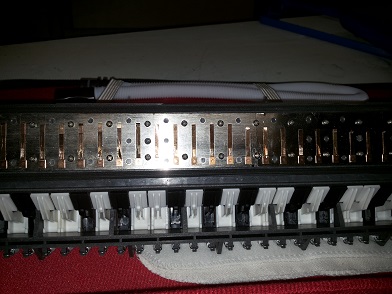
A free-reed instrument’s reeds are mounted on an aluminium plate, and they come in pairs: on each plate position there is one reed that speaks when air is blown out through the slot and, alongside it, a second reed that speaks when air is drawn in — the “draw” and “blow” reeds of a harmonica are exactly this pairing. For an organ pipe, wind only ever flows one way (out of the chest, through the pipe), so only the air-out reed is used; the air-in reed of the pair is simply taped off, closing its slot so no wind is wasted through it, and left in place as a spare (jsart51).
This is the first place the guardrail bites: these are free reeds — each tongue passes cleanly through its slot in the aluminium plate and touches nothing. Nothing here is filed to beat against a face.
6.4.2 Factory pitch: A = 420 Hz, so about 20 cents sharp at A = 440
Free reeds harvested from a typical cheap instrument are factory-tuned to A = 420 Hz (jsart51). An organ built to modern concert pitch wants A = 440 Hz. Measured against an A = 440 tuner, the reeds as bought read about 20 cents sharp — each reed’s pitch comes in roughly 20 cents high relative to the note it must play in the 440 Hz rank, so every reed has to be lowered in pitch before it can be tuned into the rank (jsart51). (This is the builder’s own reported figure; the number is taken as given, not derived from the 420-versus-440 reference gap.)
A free reed’s pitch is set by the mass and stiffness of the tongue itself, not by the resonator length. To flatten it, remove stiffness or add mass at the right place; to sharpen it, remove mass near the tip. Why that is so is in How Organ Pipes Make Sound — here it is used, not derived.
6.4.3 Lowering the pitch: scratch the middle of the tongue, 3–4 mm
To lower a free reed, metal is removed from the middle of the tongue — thinning the tongue near its centre reduces its stiffness and drops the pitch. The method, exactly as given: lay the reed-plate flat on a hard surface and, with a needle or a fine file, scratch the middle of the tongue over a length of 3–4 mm, working a little at a time (jsart51). Re-check the pitch after each pass. Keep lowering until the reed reads about 4–5 cents above zero — i.e. stop just 4–5 cents sharp, not dead on and not flat, so that final fine-tuning and any settling leaves headroom to trim down to pitch rather than having to add metal back (jsart51).
Two numbers here are quoted exactly and must not be rounded away: the scratch is over 3–4 mm of the tongue’s middle, and the target is ~4–5 cents above zero, having started at ~20 cents sharp. Working flat on a hard surface keeps the delicate tongue supported so the file does not bend or crack it.
6.4.4 The resonator: rolled 0.5 mm cardboard, about 12 cm long
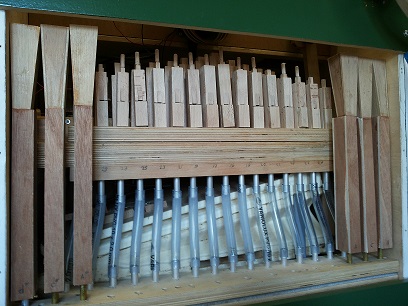
The resonator that turns the naked reed into a pipe is a rolled cardboard tube. The stock is 0.5 mm cardboard — the source names a cornflakes box as exactly the right weight — rolled into a tube about 12 cm long. A full rank in this build is 13 tubes (jsart51). The 12 cm blank is deliberately generous: it is longer than the resonating length any of the tubes will actually need, so each tube is tuned by shortening the working air column with a stopper (§4.6) rather than by being cut to a calculated length.
6.4.5 The wood mount and the beeswax-glued reed-plate
Each reed-plate is carried on a small wood mount: a piece of 20 × 20 mm square stock cut to 65 mm long, with a rectangular hole cut through it that is 2 mm smaller than the reed-plate all round, so the plate seats over the hole with a lip of wood to bear on (jsart51). The cardboard resonator tube fits onto this mount above the plate.
The reed-plate is fixed to the wood mount with beeswax, and how it is applied matters: the wax is melted and run around the joint with a soldering iron, but the reed-plate itself must not be heated (jsart51). Heating the aluminium plate would ruin the delicate, carefully-lowered tongue tuning of §4.3 — so the wax is worked at the wood-and-wax joint while the plate stays cool. Beeswax is chosen deliberately over glue: it seals airtight, it holds firmly at the low working pressure, and it is reversible — a reed can be lifted and re-tuned or replaced by re-warming the wax, which a PVA or epoxy joint would not allow. (Beeswax as the free-reed-plate mounting medium is noted again in Vol 02’s glue table.)
6.4.6 Tuning by sliding a stopper: low C ≈ 10 cm, high C ≈ 6 cm
With the reed lowered to ~4–5 cents sharp and mounted, the tube is brought into tune by finding its resonance — sliding a stopper inside the tube to change the length of the closed air column until the tube reinforces the reed most strongly. The working length is measured from the middle of the reed to the inside of the closed top (the stopper face), and the sources give the two anchor lengths for the ends of the rank:
- low C ≈ 10 cm (reed-middle to the inside of the closed top),
- high C ≈ 6 cm,
with the notes in between graduating across that range (jsart51). Critically, the source adds that the length is “not critical” — the reed’s own pitch is set by the tongue (§4.3), and the tube is there to reinforce and colour it, so the stopper is slid to the position of best, loudest, most singing resonance rather than to a length calculated to the millimetre (jsart51). This is the opposite of a flue pipe, where the tube length sets the pitch; here the tongue sets the pitch and the tube is tuned to agree.
6.4.7 Finishing: reinforce and paint
The rolled cardboard tube is fragile, so it is reinforced with one layer of newspaper laid on with thinned PVA, left to dry, and then painted (jsart51). The newspaper-and-PVA skin stiffens the tube against handling and against moisture (the same thin-wall/moisture caution that governs the wooden pipes in Vols 03–05 applies to a paper tube), and the paint seals and finishes it to match the rest of the pipework.
Figure 2 — The melodica free-reed “trumpet” build (jsart51). The aluminium reed-plate carries an air-out reed (used) and its air-in partner (taped off); the plate is beeswax-glued to a 20 × 20 × 65 mm wood mount with a rectangular hole 2 mm smaller than the plate — with the plate itself kept cool. A rolled 0.5 mm cardboard tube ~12 cm long sits above, and a sliding stopper sets the resonating length, measured reed-middle to the inside of the closed top: low C ≈ 10 cm, high C ≈ 6 cm, length “not critical.” Reinforce with one layer of newspaper and thinned PVA, then paint.
6.5 Why the melodica specifically — it matches the organ’s wind
The 31-note Stille build is specific about which free-reed instrument to raid, and the reason is a wind match. Ulrich Stille and Walter Höffle advise using melodica reeds because a melodica “uses about the same air pressure as the organ” (en_31toets) — that is, roughly the small-organ standard of ~5 in H₂O (127 mm ≈ 1.245 kPa) that Vols 03–05 voice the flue pipes at, and that the Wind Systems dive covers in full.
This matters because a free reed is voiced by its maker to speak at a particular pressure. A harmonica reed is designed for the low, breath-driven pressure of a player’s lungs; an accordion reed for its bellows; a melodica reed for the modest pressure of a player blowing through the mouthpiece into the reed chamber. A reed harvested from an instrument built for about the organ’s own pressure will speak promptly and at a sensible volume when it is put on the organ chest, without having to be re-voiced to a pressure it was never made for. Choosing the melodica is therefore not arbitrary — it is choosing the free-reed source whose factory voicing already matches the busker organ’s ~5 in H₂O wind.
Harvesting the reeds is itself a small job the source flags: a melodica takes about 50 screws to dismount to get the reeds out, and the reeds are then set into custom “goblets” (the wood-mount-and-tube assemblies of §4) to become the amateur’s “trumpet” rank (en_31toets). There are enough matched reeds in a single melodica to furnish a busker rank.
6.6 Beating reed versus free-reed substitute — at a glance
The table draws the two together so the substitution is explicit. The left column is what a professional reed stop is; the right column is what the hobby build actually makes and why it is the achievable route.
Table 1 — 6. Beating reed versus free-reed substitute — at a glance
| Aspect | Beating (striking) reed — professional | Free-reed “trumpet” — hobby substitute |
|---|---|---|
| Tongue vs opening | Tongue wider than the opening; strikes the shallot face | Tongue narrower than the slot; passes through the frame, touches nothing |
| Vibrating element | Brass tongue cut, curved and voiced by hand | Factory reed harvested from a melodica/harmonica, already made and voiced |
| Where pitch is set | Free tongue length, set by the tuning wire | Tongue mass/stiffness; lowered by scratching its middle 3–4 mm (jsart51) |
| Factory / starting pitch | n/a — made to pitch | A = 420 Hz → reads ~20 cents sharp at A = 440 (jsart51) |
| Tuning target | Voiced to pitch on the wire | Filed down to ~4–5 cents sharp, then stopper-tuned (jsart51) |
| Resonator | Machined/soldered brass, often conical | Rolled 0.5 mm cardboard, ~12 cm, papered + painted (jsart51) |
| Mounting | Wedge and shallot in a metal boot | Reed-plate beeswax-glued to a 20 × 20 × 65 mm wood mount, plate kept cool (jsart51) |
| Tuning the tube | Resonator agrees with the tongue | Slide a stopper for best resonance: low C ≈ 10 cm, high C ≈ 6 cm; “length not critical” (jsart51) |
| Wind pressure | Voiced at the organ’s pressure by hand | Melodica reed already runs at ~organ pressure (~5 in H₂O) (en_31toets) |
| Verdict for the amateur | Too difficult for a hobby builder (en_31toets; jsart51) | The documented, repeatable hobby route |
The through-line of the table is the same fork from §3: the hard, hand-voiced part of a reed — the vibrating tongue — is bought ready-made in the free reed, and the amateur builds only the tube around it.
6.7 When and why a hobbyist adds a reed rank, and how it blends
A busker organ can be built entirely on flue pipes, and the stopped flute of Vol 03 remains its backbone. A reed rank is an addition, and it earns its place for two reasons.
The first is colour. Flue voices — stopped, open, string — are all variations on wind-against-a-lip, and however well voiced they share a family resemblance. A reed voice is generated a completely different way, and it adds a bright, cutting, brass-like timbre that a flue rank simply cannot produce. On a small organ playing outdoors, that cutting quality helps a melody carry over street noise and gives the arrangement a lead voice distinct from its accompaniment. This is the reed’s traditional role — the trumpet or cornet on top of the diapasons and flutes (OHS works03).
The second, and the reason the hobby sources are enthusiastic about the free-reed trick despite its humble materials, is how it blends. Gisli Olsen’s verdict on the finished free-reed rank is quoted directly: it “gives a special sound … together with the stopped rank the sound is much better, almost singing” (jsart51). That is the key practical point. The home-made free-reed “trumpet” is not intended to be played alone as a raw solo reed — a naked free reed on a cardboard tube can sound thin or reedy by itself. It is intended to be combined with the stopped flute rank of Vol 03: the stopped rank supplies the round, fundamental-heavy, odd-harmonic body, and the free reed adds a bright, singing edge on top, and the combination is markedly better than either alone. The reed does not replace the flutes; it rides on them and lifts them into song.
This is why the reed rank comes late in a build and late in this dive. It is a voice added to a working organ that already has its flue ranks, to give the instrument a lead colour and to make the ensemble “almost singing.” A builder adds it when the flue pipework is done and speaking well, harvests a melodica for its matched, pressure-appropriate reeds, and builds the cardboard-and-beeswax tubes of §4 — and then voices and tunes the rank against the stopped flutes it will play with, not in isolation.
6.8 What this volume set down, and where next
This volume drew the hard line between the two reed mechanisms and committed the build to the achievable one. The beating (striking) reed — brass tongue striking the flat face of a shallot in a boot, pitch set by the tuning wire, tone reinforced by a resonator (§2) — is the professional voice, and it is too hard for a hobby builder to cut and voice, on the plain testimony of both source families (§3). The free-reed “trumpet” trick (§4) is the documented amateur route: harvest the air-out reed of each pair from a melodica (chosen because it runs at about the organ’s ~5 in H₂O pressure — §5), lower each reed from its ~20-cents-sharp factory pitch by scratching the middle 3–4 mm of the tongue until it reads ~4–5 cents sharp, mount the plate on a 20 × 20 × 65 mm wood block with beeswax (plate kept cool), roll a 0.5 mm cardboard tube ~12 cm long, and tune it by sliding a stopper to the resonance — low C ≈ 10 cm, high C ≈ 6 cm, length “not critical” — then reinforce with newspaper and PVA and paint. Added to the stopped flute rank of Vol 03, it makes the organ “almost singing” (§7).
For the excitation physics behind every “why” in this volume — how a tongue and a resonator lock into a note, why a free reed’s pitch lives in the tongue and not the tube — see How Organ Pipes Make Sound. For the wind that both the melodica reed and the flue pipes are matched to (~5 in H₂O ≈ 1.245 kPa), see Wind Systems. The stopped rank the reed blends with is Vol 03; the string pipe and its frein that share the “adds colour on top of the flutes” role is Vol 05. The next and final volume, Voicing, Tuning & Reference (Vol 07), brings every rank in this dive — flue and reed alike — to prompt, in-tune speech at the bench, and gathers the reference tables, glossary, and cross-index for the whole build.
Comments (0)